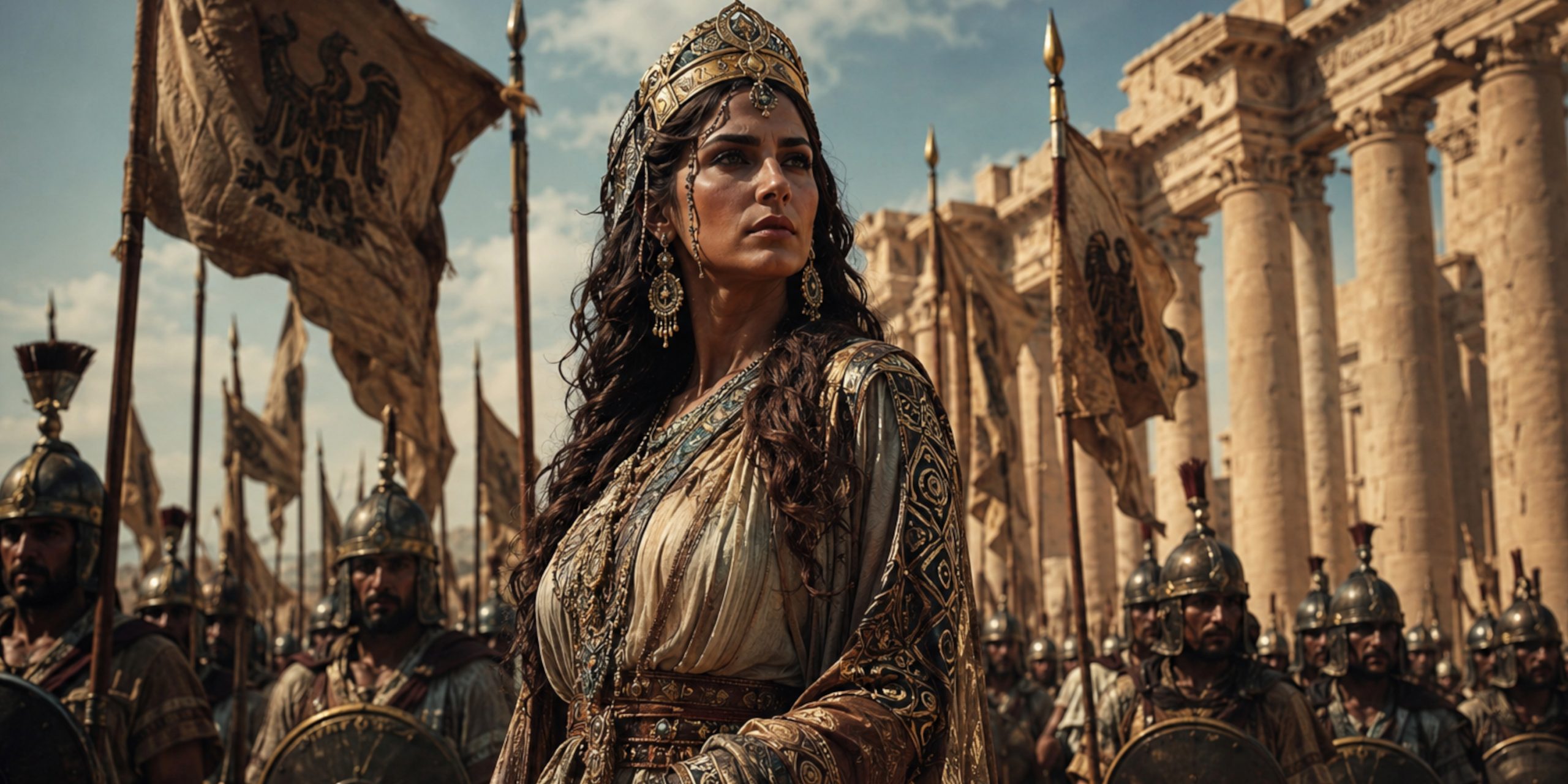
Few figures from the ancient world stride through history with quite the same force as Zenobia. Queen, conqueror, scholar, political operator and, depending on which Roman writer you trust least, either a dangerous rebel or a brilliant monarch who embarrassed an empire at its weakest moment.
In the third century AD, when the Roman Empire seemed permanently on the edge of collapse, Zenobia transformed the desert city of Palmyra into the centre of a short lived but astonishing eastern empire. She challenged Roman authority, marched armies across Egypt and the Levant, and forced Emperor Aurelian into one of the defining campaigns of his reign.
Roman historians often wrote about her with a mixture of admiration and irritation. That is usually a good sign. Empires rarely enjoy being outmanoeuvred by someone they initially underestimated.
Who Was Zenobia?
Zenobia, known in inscriptions as Septimia Zenobia and in some eastern sources as Bat-Zabbai, ruled the Palmyrene Empire during the late third century AD. She was likely born around AD 240 and rose to power after the assassination of her husband, Odaenathus, ruler of Palmyra.
Palmyra itself occupied a crucial position in the Syrian desert, linking Rome’s eastern provinces with Persian and Arabian trade routes. It was wealthy, cosmopolitan and fiercely ambitious. Its monumental colonnades, temples and funerary towers reflected both Roman influence and eastern traditions.
After Odaenathus was murdered in around AD 267, Zenobia acted as regent for her young son Vaballathus. What followed was no timid regency. Within a few years she effectively controlled Syria, Egypt and large parts of Anatolia.
At Rome’s moment of greatest weakness, Zenobia saw opportunity.
The Crisis of the Third Century
To understand Zenobia properly, one must understand how chaotic the Roman Empire had become.
The third century was a disaster zone of civil wars, invasions, economic collapse and emperors dying at an almost comedic rate. Some ruled for months before being murdered by their own troops. Stability had become an exotic luxury.
Palmyra initially acted as Rome’s eastern shield against the Sasanian Persians. Odaenathus had won fame by driving back Persian forces after Emperor Valerian suffered the humiliation of being captured alive.
Zenobia inherited both military prestige and political leverage. Rome needed Palmyra more than Rome perhaps wished to admit.
Zenobia’s Appearance and Character
Descriptions of Zenobia come largely from hostile or semi-hostile Roman sources, though even they struggled not to sound impressed.
The Historia Augusta describes her as dark-eyed, intelligent, disciplined and exceptionally well educated. She reportedly spoke several languages, including Greek, Egyptian and Aramaic, and claimed descent from Cleopatra VII.
Whether every detail is true is another matter. Ancient historians often embroidered biographies with the enthusiasm of tavern storytellers after too much wine.
Still, Zenobia’s reputation for intelligence and command appears genuine. She rode with armies, participated in long marches and cultivated the image of a ruler who embodied both eastern royalty and Roman authority.
The Rise of the Palmyrene Empire
Zenobia’s expansion began cautiously before becoming increasingly bold.
Key Territories Controlled by Zenobia
| Region | Approximate Date Secured | Importance |
|---|---|---|
| Syria | AD 267–268 | Core of Palmyrene power |
| Egypt | AD 269 | Grain supply and immense prestige |
| Arabia | AD 270 | Trade routes and military depth |
| Anatolia | AD 270–271 | Expansion into Roman Asia Minor |
The conquest of Egypt was especially significant. Rome depended heavily on Egyptian grain, and controlling Alexandria gave Zenobia enormous leverage.
Palmyrene forces entered Egypt under the command of the general Zabdas. Roman resistance collapsed surprisingly quickly. That alone tells you how fragile imperial control had become.
Coins soon appeared bearing the images of both Vaballathus and the Roman emperor, though eventually the pretence of subordination weakened. Zenobia was no longer behaving like a loyal client queen.
She was building an empire.
Battles and Military Acumen
Zenobia’s military achievements were substantial, even if overshadowed by her eventual defeat.
She demonstrated sharp strategic instincts, particularly in exploiting Roman instability. Her campaigns were fast, opportunistic and economically focused. She targeted wealthy provinces and strategic trade arteries rather than engaging in reckless territorial expansion.
Major Campaigns and Battles
| Battle or Campaign | Date | Result |
|---|---|---|
| Conquest of Egypt | AD 269 | Palmyrene victory |
| Campaigns in Anatolia | AD 270–271 | Expansion of Palmyrene control |
| Battle of Immae | AD 272 | Roman victory under Aurelian |
| Battle of Emesa | AD 272 | Decisive Roman victory |
| Siege of Palmyra | AD 272 | Collapse of Zenobia’s resistance |
Battle of Immae
Near Antioch, Emperor Aurelian finally confronted Zenobia’s forces directly.
The Palmyrene army relied heavily on cataphract cavalry, heavily armoured horsemen capable of terrifying frontal assaults. Aurelian baited them into pursuit during the Battle of Immae. Roman cavalry feigned retreat, exhausted the cataphracts in the heat, then counterattacked.
It was classic Roman battlefield discipline defeating raw striking power.
Battle of Emesa
Zenobia regrouped at Emesa, modern Homs, where another major engagement took place. Again the Palmyrene cavalry fought fiercely, but Roman cohesion and tactical flexibility prevailed.
After defeat at Emesa, Zenobia retreated to Palmyra itself.
She attempted to flee east toward Persian territory but was captured near the Euphrates.
Arms and Armour of Zenobia’s Forces
The armies of Palmyra reflected the crossroads nature of the city itself. Roman, Persian, Arabian and local Syrian influences all blended together.
Weapons Used by Palmyrene Troops
- Spatha cavalry swords
- Long lances used by cataphracts
- Composite bows
- Spears and javelins
- Roman style infantry equipment
- Curved eastern daggers and sidearms
Cataphract Cavalry
The elite of Zenobia’s military were cataphracts.
These riders and their horses were often covered in scale armour or lamellar armour. Contemporary depictions and archaeological finds show extensive use of metal scales sewn onto leather or fabric backing.
A charging cataphract unit must have looked horrifying to opposing infantry. One suspects Roman recruits occasionally reconsidered their career choices upon seeing them approach.
Armour and Equipment
| Unit Type | Typical Equipment |
|---|---|
| Cataphracts | Scale armour, lance, sword |
| Archers | Composite bow, light armour |
| Infantry | Spear, shield, Roman style helmets |
| Noble Retainers | Decorated armour, cavalry weapons |
Palmyrene military equipment often combined practical battlefield utility with rich ornamentation. Decorative eastern motifs appeared alongside Roman military forms.
Zenobia and Rome
Zenobia’s relationship with Rome remains fascinating because it evolved gradually from cooperation into outright rebellion.
For several years she maintained nominal loyalty to the empire. Coins still acknowledged Roman emperors, and Palmyra technically acted in Rome’s interest against Persia.
Yet the balance shifted once Aurelian stabilised the empire.
Aurelian was many things, but tolerant of separatist kingdoms was not one of them.
His eastern campaign in AD 272 was swift and brutally effective. After capturing Zenobia, he marched into Palmyra. Though the city initially survived, a later revolt provoked harsh retaliation.
Much of Palmyra’s grandeur never fully recovered.
Contemporary and Ancient Quotes
Ancient writers could not quite decide whether Zenobia was admirable or alarming.
Zosimus
“Zenobia was accustomed to toil with her soldiers.”
Historia Augusta
“She preserved an imperial dignity.”
Aurelian, according to later accounts
“The Roman people speak in contempt of the war which I am waging against a woman.”
That last quote carries a certain defensive tone. One can almost hear the irritation through the centuries.
Archaeology and Latest Discoveries
Palmyra remains one of the most important archaeological sites of the ancient Near East.
Modern archaeology has revealed extraordinary details about the city’s wealth, military culture and artistic traditions.
Major Archaeological Features
- The Great Colonnade
- Temple of Bel
- Funerary tower tombs
- Palmyrene military reliefs
- Caravan trading inscriptions
Reliefs discovered in Palmyra depict heavily armed cavalrymen remarkably similar to descriptions of Zenobia’s forces. These carvings provide valuable evidence for armour styles, horse barding and weaponry.
Recent archaeological analysis has also focused on trade networks, showing how Palmyra became wealthy through commerce between Rome, Persia and Arabia.
Sadly, the site suffered catastrophic destruction during recent conflicts in Syria. Temples, arches and funerary monuments were deliberately damaged or destroyed. Restoration and preservation efforts continue, though some losses are irreversible.
Even now, excavations continue to uncover inscriptions and artefacts that deepen our understanding of Palmyrene identity and culture.
Artefacts and Where to See Them
Artefacts connected to Palmyra and Zenobia’s era are scattered across museums worldwide.
Important Collections
| Museum | Notable Artefacts |
|---|---|
| Louvre Museum, Paris | Palmyrene funerary busts |
| British Museum, London | Syrian and Palmyrene inscriptions |
| Ny Carlsberg Glyptotek, Copenhagen | Palmyrene sculptures |
| Damascus National Museum | Artefacts from Palmyra |
| Vatican Museums | Roman eastern provincial collections |
Palmyrene funerary busts are particularly striking. Their large eyes, jewellery and detailed robes feel strangely modern. They stare back at visitors with unnerving confidence, as though mildly disappointed by the twenty first century.
Zenobia’s Legacy
Zenobia became something larger than history quite quickly.
Romans remembered her as a formidable enemy. Later Arab traditions admired her independence and intellect. European writers transformed her into a romantic eastern queen. Modern historians increasingly see her as a sophisticated political ruler operating within the fractured realities of the third century.
She has appeared in novels, paintings, operas and television dramas. Her story continues to resonate because it combines ambition, military resistance, cultural sophistication and tragedy.
There is also something undeniably compelling about a ruler who briefly made Rome blink.
What Happened to Zenobia?
Her final fate remains uncertain.
Some traditions claim Aurelian paraded her through Rome in golden chains during his triumph before sparing her life. Later accounts suggest she lived comfortably in Italy afterward and even married into Roman aristocratic society.
Others imply darker endings.
Frankly, ancient historians loved dramatic conclusions almost as much as modern streaming services do.
The truth may never be fully known.
Takeaway
Zenobia’s career lasted only a few years, yet it left a permanent mark on Roman history.
She emerged during one of the empire’s weakest periods and nearly carved out a durable eastern rival state. Her military campaigns were intelligent, her political instincts sharp and her ability to command loyalty extraordinary.
Most rulers of the third century vanished into obscurity. Zenobia became legend.
That alone says rather a lot.