Akira Kurosawa’s Seven Samurai is regularly introduced as one of the greatest films ever made. That sort of praise can make a three-and-a-half-hour Japanese drama from 1954 sound suspiciously like homework.
Thankfully, it is nothing of the sort.
This is a muscular, funny and surprisingly emotional action film about desperate farmers hiring seven impoverished samurai to defend their village from bandits. Its scale is epic, but its attention remains fixed on individual people: who is frightened, who is hungry, who wants to be admired and who understands that victory rarely belongs to those who do the dying.
More than 70 years after its release, Seven Samurai still feels alive. The action is readable, the characters are distinct and its famous rain-soaked climax makes plenty of modern battles look like expensive confusion.
Spoiler warning: This article discusses the full plot and ending.
Seven Samurai Film Details
| Detail | Information |
|---|---|
| Original title | Shichinin no Samurai |
| Director | Akira Kurosawa |
| Release date | 26 April 1954 in Japan |
| Setting | Japan, 1586 |
| Period | Sengoku period |
| Runtime | Approximately 207 minutes, including an intermission |
| Studio | Toho |
| Screenwriters | Akira Kurosawa, Shinobu Hashimoto and Hideo Oguni |
| Cinematography | Asakazu Nakai |
| Music | Fumio Hayasaka |
| Language | Japanese |
| Genre | Historical drama and action |
| Seven Swords rating | 10/10 |
What Is Seven Samurai About?
A farming village learns that a band of mounted raiders intends to return after the barley harvest. The farmers have no professional soldiers, little food and almost nothing with which to pay for protection. Their only realistic option is to find hungry samurai willing to work for meals.
That search brings them to Kambei Shimada, an experienced rōnin who recognises both the danger and the villagers’ desperation. He calculates that seven warriors will be needed to defend the settlement properly.
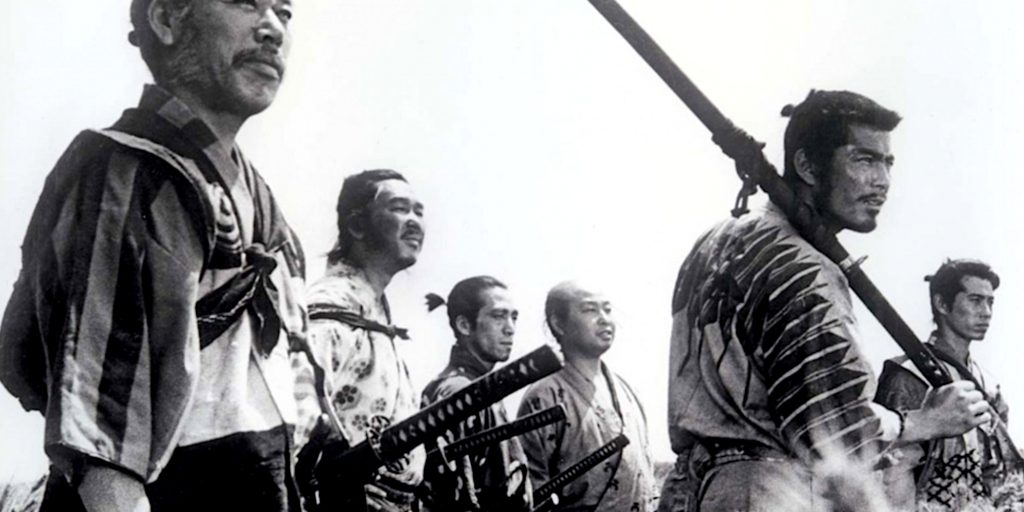
Kambei gradually assembles a mismatched group:
- Gorobei, an intelligent and dependable tactician
- Shichirōji, Kambei’s loyal former companion
- Kyūzō, a highly disciplined swordsman
- Heihachi, a cheerful fighter who helps hold the group together
- Katsushirō, a young samurai eager to prove himself
- Kikuchiyo, a loud, chaotic outsider carrying an absurdly long sword
- Kambei himself, whose greatest weapon is his judgement
The samurai travel to the village, study its geography, train the farmers and prepare defensive positions. When the bandits arrive, the battle becomes a carefully controlled war of attrition.
The premise is simple. The execution is anything but.
Who Are the Seven Samurai?
| Samurai | Actor | Role within the group |
|---|---|---|
| Kambei Shimada | Takashi Shimura | Veteran leader and strategist |
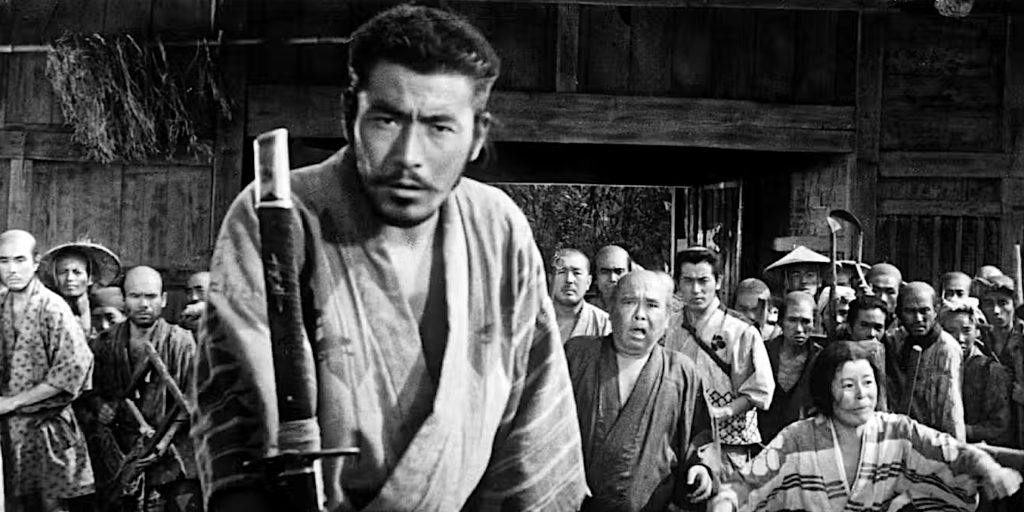
| Kikuchiyo | Toshirō Mifune | Impulsive outsider with peasant origins |
| Gorobei Katayama | Yoshio Inaba | Calm tactician and second-in-command |
| Kyūzō | Seiji Miyaguchi | Reserved master swordsman |
| Shichirōji | Daisuke Katō | Kambei’s experienced former comrade |
| Heihachi Hayashida | Minoru Chiaki | Good-humoured fighter and team builder |
| Katsushirō Okamoto | Isao Kimura | Idealistic young samurai |
Kurosawa gives each man an immediately recognisable personality, silhouette and way of moving. This matters because the film contains a large ensemble of samurai, villagers and bandits. Even in heavy rain and frantic combat, we usually understand who is involved and what they are trying to accomplish.
That clarity is one reason the film remains so easy to follow despite its length.
Kambei: Leadership Without Vanity
Kambei is introduced while cutting off his topknot so that he can disguise himself as a monk and rescue a kidnapped child. It is an efficient character introduction. He sacrifices a visible mark of samurai status without hesitation because someone needs help.
He is neither a swaggering champion nor an invincible swordsman. His real strength is experience. Kambei reads people, terrain and risk exceptionally well. He knows that courage without planning is merely a dramatic route to an early grave.
Takashi Shimura gives him warmth as well as authority. Kambei listens before speaking and rarely treats leadership as a performance. In a genre filled with men trying very hard to look formidable, his restraint feels almost radical.
Kikuchiyo: The Film’s Chaotic Heart
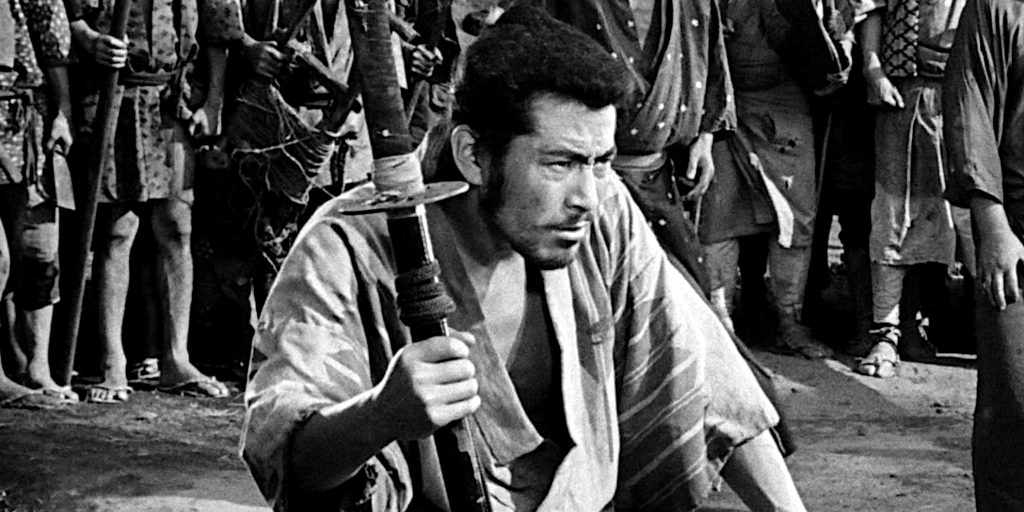
Toshirō Mifune’s Kikuchiyo enters the story like somebody has accidentally released a wild animal onto the set. He is noisy, boastful, emotional and often very funny. His oversized sword suits him perfectly because subtlety has clearly declined his invitation.
Yet Kikuchiyo is also the character through whom the film examines the divide between farmers and samurai.
He claims samurai status, but his stolen family record exposes the lie. He was born into the peasant class and has constructed an exaggerated warrior identity to escape the shame and powerlessness of his childhood.
When the samurai discover armour and weapons hidden by the villagers, Kikuchiyo delivers the film’s angriest and most revealing speech. Farmers can be deceitful, selfish and murderous, he admits, but generations of samurai violence made them that way.
Mifune plays the moment without turning Kikuchiyo into a tidy moral spokesperson. He remains contradictory, ridiculous and deeply wounded. That messiness is precisely why he works.
The Farmers Are Not Helpless Innocents
A weaker version of this story would present the farmers as pure victims and the samurai as spotless rescuers. Kurosawa has far less interest in comfortable morality.
The villagers hide food, conceal weapons and initially distrust the men they have recruited. Some possess armour stripped from dead or murdered samurai. Manzō cuts his daughter Shino’s hair and disguises her as a boy because he fears what armed strangers might do to her.
Their suspicion is not irrational. Samurai armies had repeatedly marched through rural communities, taking food and inflicting violence. The farmers need warriors, but they also have good historical reasons to fear them.
This mutual distrust gives the alliance weight. The two groups do not become friends because the screenplay says teamwork is nice. They are forced to cooperate while carrying the damage of an unequal social system into every conversation.
It is considerably more interesting than seven cool men arriving to solve everything with swords.
How Historically Accurate Is Seven Samurai?
The film takes place in 1586 during Japan’s Sengoku period, an era of political fragmentation, shifting alliances and frequent warfare. Masterless samurai, fortified settlements, roaming armed groups and vulnerable agricultural communities all fit that environment.
The exact story is fictional, but its social tensions are historically credible.
Peasant communities were not necessarily passive or completely unarmed. Villages could organise watches, construct barriers and use spears, bows or captured weapons. Nor were all rōnin wandering champions governed by spotless codes of honour. Many were unemployed fighting men attempting to survive in an unstable society.
The film simplifies certain military realities for dramatic purposes. The bandits operate more like a compact raiding army than a loosely organised criminal group, while the seven defenders possess a conveniently broad range of useful talents. Still, Kurosawa avoids the polished ceremonial version of samurai warfare.
These men become tired, frightened and filthy. Combat is fast, ugly and often decided by position rather than swordsmanship.
The Weapons Used in Seven Samurai
Swords are important to the film’s imagery, but the defence of the village depends on combined weapons, obstacles and disciplined teamwork.
| Weapon | Users | Battlefield purpose |
|---|---|---|
| Katana | Samurai and some bandits | Close combat and personal defence |
| Wakizashi | Samurai | Secondary sidearm |
| Nodachi or oversized field sword | Kikuchiyo | Powerful cutting weapon and visual expression of his personality |
| Yari | Farmers, samurai and bandits | Keeping mounted attackers at distance |
| Yumi | Samurai and bandits | Ranged attacks and control of approaches |
| Tanegashima matchlock | Bandits, later captured by defenders | Penetrating ranged fire |
| Bamboo spears | Farmers | Inexpensive defensive weapons |
| Clubs and improvised tools | Villagers | Emergency close combat |
The film understands something that screen combat often forgets: a spear held by a frightened farmer inside a prepared defensive position can matter more than an elegant sword.
Katana duels supply some of its most memorable individual moments, particularly those involving Kyūzō. The actual battle, however, is won through barriers, routes, numbers and coordination.
Kyūzō and the Myth of the Perfect Swordsman
Kyūzō is the closest Seven Samurai comes to presenting the classical image of an elite swordsman. He speaks little, moves economically and appears almost impossible to unsettle.
His early duel establishes both his ability and his temperament. After recognising that a practice encounter would have ended in death, he tries to walk away. His opponent insists on repeating it with real swords, apparently because being publicly wrong was once considered worth dying over. Kyūzō kills him with a single decisive cut.
Later, he slips into the bandit camp alone and returns with one of their matchlock firearms. Katsushirō is awestruck. Kikuchiyo, jealous of the admiration Kyūzō receives, tries to perform a similar feat.
That contrast is important. Kyūzō acts because a job must be done. Kikuchiyo initially acts because he wants someone to see him doing it. By the end, Kikuchiyo has learned the difference.
How the Village Defence Works
Kambei does not attempt to protect every building. He looks at the settlement as a battlefield and accepts that some areas must be abandoned.
The defensive plan relies on:
- Flooding exposed ground
- Removing a bridge
- Fortifying vulnerable entrances
- Using narrow approaches to restrict mounted attackers
- Training villagers to fight in groups
- Allowing small numbers of bandits inside
- Isolating and killing those attackers before admitting more
- Tracking enemy losses on a banner
- Capturing the bandits’ matchlock firearms
The plan creates a series of controlled engagements rather than one uncontrolled clash. Kambei turns the village into a system of traps.
Kurosawa makes the geography understandable before the fighting begins. We see maps, reconnaissance and construction. Once the attack starts, every broken defence and changing route has meaning.
Modern action films sometimes spend enormous sums making audiences wonder where everyone is. Seven Samurai settles the matter with a hand-drawn map and several intelligent conversations.
Why the Action Still Feels Modern
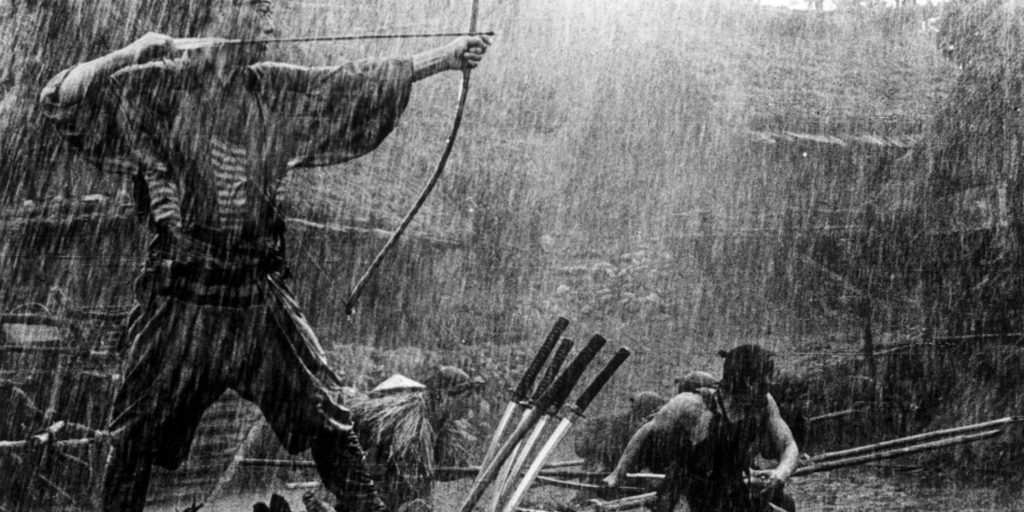
Kurosawa used multiple cameras to capture parts of the action, particularly during the final battle. This allowed performances, horses and environmental chaos to unfold with greater continuity than heavily reconstructed coverage might have achieved.
Telephoto lenses compress space, making mounted attackers feel dangerously close. Longer lenses also let the camera observe action through rain, mud and movement without losing the human figures at its centre.
The editing alternates between several levels of information:
- The overall tactical position
- Small groups defending individual routes
- Personal confrontations
- Reactions from villagers
- Kambei monitoring the battle
- The changing number of surviving bandits
Rain transforms the climax visually. Armour, clothing, bodies and horses become coated in mud. The battlefield looks exhausting rather than glamorous. Deaths happen suddenly and are rarely awarded the luxury of a heroic pause.
The action has texture, but it also has grammar. We understand cause and effect.
Why the Film Is More Than Three Hours Long
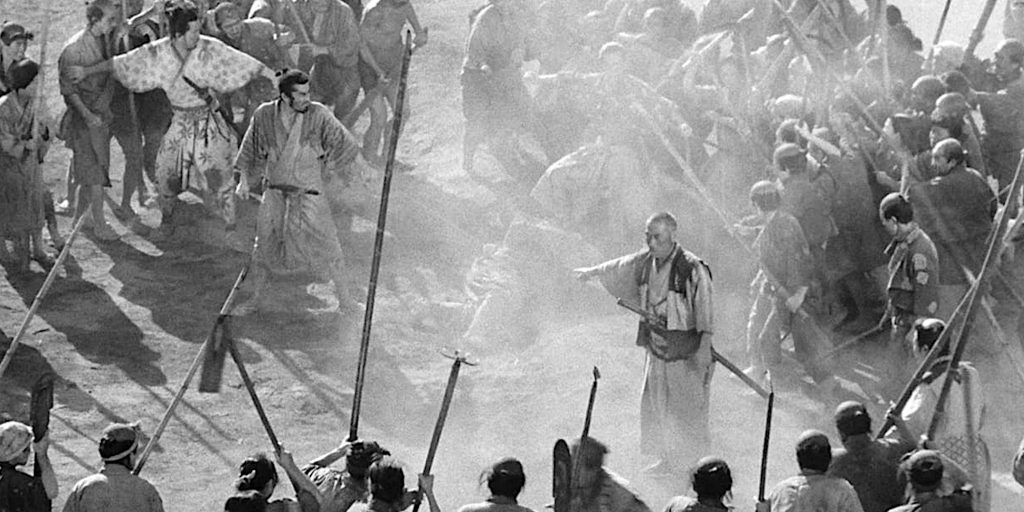
At approximately 207 minutes, Seven Samurai asks for a serious chunk of your day. You could watch a shorter film, cook dinner and reconsider several life choices in the same period.
The length serves a purpose, though.
The film is broadly divided into recruitment, preparation and battle. Each stage changes how we understand the next. We spend enough time with the villagers to recognise their homes and relationships. We see the samurai become a functioning group. We watch the village’s defences take shape.
Because of that preparation, every death removes someone we know rather than reducing a statistic. Every collapsed barrier changes a location we understand. The final battle works because the film has patiently taught us how to read it.
There are slower passages, particularly for viewers accustomed to modern pacing. The romance between Katsushirō and Shino can also feel less sharply developed than the central military and social drama. Even so, very little of the full version feels disposable.
The intermission is there for a reason. Use it. Honour can wait while you make tea.
Class Is the Real Battlefield
The bandits provide the immediate threat, but the deeper conflict lies between the samurai and farmers.
Both groups depend on one another, yet neither can fully escape its social position. The farmers admire, fear and occasionally deceive their protectors. The samurai defend people they have historically dominated, knowing that they will leave with little more than food and graves.
Kikuchiyo bridges this divide. His peasant origins allow him to understand the villagers’ behaviour, while his longing to become a samurai exposes the appeal of the class that harmed them.
The film refuses to settle the argument by declaring either group morally superior. Poverty can produce cruelty. Status can produce violence. Heroism exists, but it does not erase the structure surrounding it.
That gives the story a tension that its many imitators rarely reproduce.
The Meaning of the Ending
Four samurai die defending the village: Heihachi, Gorobei, Kyūzō and Kikuchiyo. Kambei, Shichirōji and Katsushirō survive.
The bandits are defeated, the harvest is secured and the villagers return to planting rice. The surviving samurai stand apart, looking towards the graves of their companions.
Kambei observes that they have lost again. The farmers are the victors, not the samurai.
It is a devastating conclusion because it overturns the surface logic of the story. The surviving warriors achieved their military objective, but they do not belong to the community they saved. The villagers still have homes, work, families and a future tied to the land. The samurai have only the road and the knowledge of who did not return.
Katsushirō’s brief relationship with Shino cannot bridge that division. The village absorbs the battle and continues. The samurai remain outsiders.
Victory arrives, but glory quietly leaves through the back door.
Seven Samurai and the Samurai Code
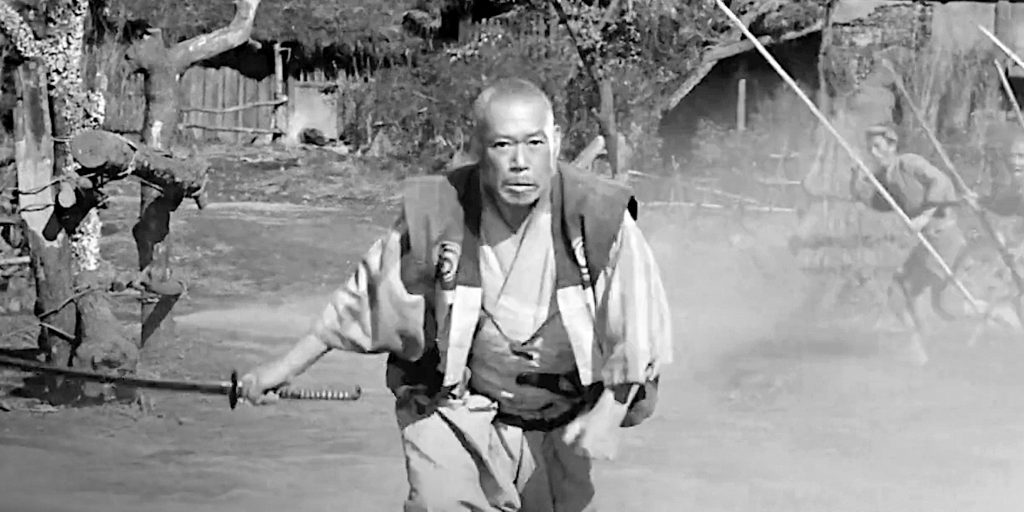
The film does not present bushidō as a single, fixed rulebook followed identically by every warrior. Its samurai display different relationships with duty, status and violence.
Kambei embodies responsibility and self-command. Kyūzō pursues technical discipline. Katsushirō begins with a romantic idea of the warrior class. Kikuchiyo wants the status attached to being a samurai without initially understanding its demands.
Their shared decision to defend the village is honourable, but it also has practical foundations. They are rōnin without wealthy masters. Some are hungry, bored or seeking a meaningful purpose. Kurosawa allows noble behaviour to grow from imperfect motives.
That feels more human than treating honour as a magical personality setting.
How Seven Samurai Changed Action Cinema
The film did not invent every device associated with it, but it combined them with extraordinary effectiveness. Its influence can be seen in stories built around recruiting a specialised team for a dangerous mission.
The most direct remake is John Sturges’ The Magnificent Seven from 1960, which moves the premise to Mexico and replaces samurai with gunfighters. The underlying structure has since appeared across westerns, war films, science fiction, animation and superhero cinema.
Its influence includes:
- The gradual recruitment of a team
- Distinct characters selected for complementary skills
- Planning sequences that establish battlefield geography
- Training scenes that build relationships
- Defensive battles fought in stages
- Tracking the diminishing enemy force
- Heroic sacrifice without a completely triumphant ending
Kurosawa’s approach also helped shape later action direction. George Lucas, Steven Spielberg, George Miller and many other filmmakers have drawn from his visual storytelling, although claims about influence should be kept specific. Star Wars, for example, owes a clearer narrative debt to Kurosawa’s The Hidden Fortress than to Seven Samurai.
In the 2022 Sight and Sound critics’ poll, Seven Samurai placed within the top 20 rather than first, as the previous version of this article claimed. Its reputation does not need an invented gold medal. BFI
The Performances
Takashi Shimura provides the film’s calm centre, but Toshirō Mifune produces its most explosive performance. Kikuchiyo runs, shouts, sulks, boasts and grieves with his entire body. He could easily have become exhausting. Instead, his energy exposes emotions that the more restrained samurai will not express.
Seiji Miyaguchi is almost his opposite as Kyūzō. His stillness makes every movement significant. Isao Kimura gives Katsushirō an appealing mixture of sincerity and naivety, while Minoru Chiaki brings badly needed warmth to Heihachi.
The villagers are equally important. Yoshio Tsuchiya’s Rikichi carries a personal trauma that gradually reveals the human cost of the bandits’ raids. Bokuzen Hidari turns the timid Yohei into a source of comedy without making his fear feel meaningless.
This is an ensemble film in the proper sense. No one is merely waiting behind the lead actor for a close-up.
What Has Aged Less Well?
Calling Seven Samurai a masterpiece does not require pretending every element is beyond criticism.
The women have far less narrative freedom than the men. Shino’s relationship with Katsushirō is shaped by her father’s fear and by a sexual double standard that the film depicts powerfully, but does not fully escape. Other women largely appear through grief, family relationships or collective labour.
Some comic performances are broad by modern standards. Kikuchiyo’s physical behaviour is intentionally theatrical, while several villagers express panic with an intensity that may initially feel excessive.
The film also demands patience during its early stages. Viewers expecting immediate sword fights may be surprised by how much time is spent recruiting warriors and arguing about rice.
None of these issues destroys the film. They do make it more useful to discuss Seven Samurai as a work from a particular culture and period rather than as a sacred object that must only be admired from a respectful distance.
Is Seven Samurai Worth Watching Today?
Yes, particularly in its complete version.
The runtime looks intimidating, but the film is far more accessible than its reputation suggests. It contains strategy, humour, romance, social conflict and some of the finest battle direction ever committed to film.
Watch it if you enjoy:
- Samurai history and Japanese cinema
- Tactical battles with clearly established geography
- Ensemble stories about assembling a team
- Character-led action
- Films that examine class and power
- Toshirō Mifune operating at maximum volume
Viewers seeking constant combat may find the preparation lengthy. Anyone willing to let the film build its village, characters and defences will understand why the final hour has carried so much influence.
Final Verdict
Seven Samurai survives its enormous reputation because it remains a genuinely exciting film rather than a museum exhibit.
Kurosawa gives the audience heroic warriors, memorable swordplay and a brilliantly constructed siege. He also questions who benefits from heroism, why farmers fear their protectors and what victory means to people who have no home waiting for them.
The film’s imitators often borrow the team, the mission and the sacrifices. Far fewer retain its suspicion of glory.
It is long, occasionally broad and deeply rooted in the social attitudes of its time. It is also funny, intelligent and visually ferocious. The final battle still feels dangerous, while Kambei’s closing judgement gives the adventure an emotional weight that no amount of sword-clashing could achieve alone.
Seven Swords rating: 10/10
Frequently Asked Questions
Is Seven Samurai based on a true story?
No. Its village, characters and battle are fictional. Kurosawa and his co-writers conducted historical research, however, and placed the story within the credible social and military conditions of Sengoku-period Japan.
Why did the villagers hire seven samurai?
Kambei studies the size and layout of the village before calculating that seven defenders are needed. The villagers cannot pay wages, so they recruit hungry rōnin prepared to work for food.
Is Kikuchiyo really a samurai?
No. His stolen family record exposes that he is impersonating one. Kikuchiyo was born into the peasant class and attempts to create a samurai identity for himself.
Who survives Seven Samurai?
Kambei, Shichirōji and Katsushirō survive. Heihachi, Gorobei, Kyūzō and Kikuchiyo are killed.
Was Seven Samurai remade as The Magnificent Seven?
Yes. The Magnificent Seven from 1960 adapts Kurosawa’s central premise as a western, replacing the seven samurai with seven gunfighters.
How long is Seven Samurai?
The complete version runs for approximately 207 minutes and includes an intermission. Shorter international cuts have circulated, but the full version provides the strongest character and tactical development.
Sources: British Film Institute, Criterion Collection, BFI Sight and Sound poll