Zhang Yimou’s Hero is a martial arts film in which every colour argues a point, every sword fight reveals a character, and Jet Li spends much of the running time sitting extremely still in front of a king who may have him killed. It should feel static. Somehow, it feels electric.
Released in China in 2002, Hero arrived internationally after Crouching Tiger, Hidden Dragon had opened a much wider audience to wuxia cinema. Yet it is no imitation. Zhang uses the genre to build a compact political tragedy about assassination, unity and the danger of surrendering individual lives to a grand national idea.
It is also absurdly beautiful. Christopher Doyle’s cinematography turns falling leaves, green silk and a perfectly calm lake into things that seem more expensive than entire modern franchises. Beauty, though, is never merely decoration here. It distracts, persuades and occasionally lies.
This article contains major spoilers.
Hero at a glance
| Detail | Information |
|---|---|
| Original title | Yīngxióng (英雄) |
| Director | Zhang Yimou |
| Writers | Li Feng, Wang Bin and Zhang Yimou |
| Release year | 2002 |
| Running time | Approximately 99 minutes |
| Genre | Wuxia, martial arts, historical drama |
| Setting | The Warring States period, before the Qin unification of 221 BCE |
| Main cast | Jet Li, Tony Leung Chiu-wai, Maggie Cheung, Zhang Ziyi, Donnie Yen and Chen Daoming |
| Cinematography | Christopher Doyle |
| Music | Tan Dun |
| Action choreography | Ching Siu-tung |
What is Hero about?
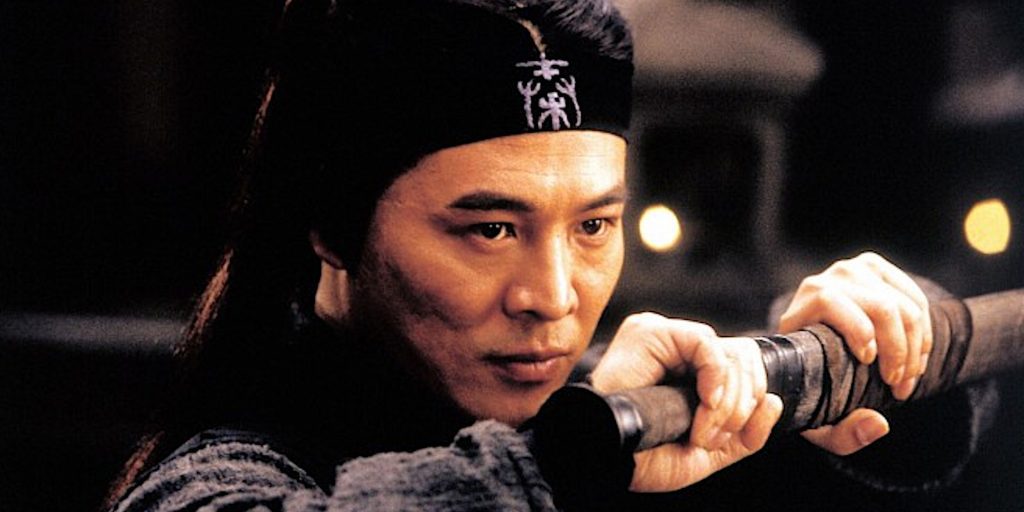
Nameless, played by Jet Li, is a minor Qin official who is granted an audience with the King of Qin. He claims to have defeated three assassins who threatened the ruler: Long Sky, Flying Snow and Broken Sword. As proof, he brings their weapons to the palace.
The king rewards each supposed victory by allowing Nameless to sit closer to the throne. That detail gives the conversation its tension. Nameless has not come for applause. He has developed a technique that can kill from ten paces, and every story brings him nearer to his target.
He first describes a tale of jealousy and betrayal. The king spots its weaknesses and proposes a different version. Nameless then admits that both accounts are partly constructed. What really happened is more painful, and much more politically awkward.
The structure invites comparisons with Akira Kurosawa’s Rashomon, but Hero is doing something slightly different. Its competing stories are not simply memories distorted by unreliable witnesses. They are strategic arguments. Nameless and the king use narrative as a duel fought before the final blade is drawn.
Who are the main characters?
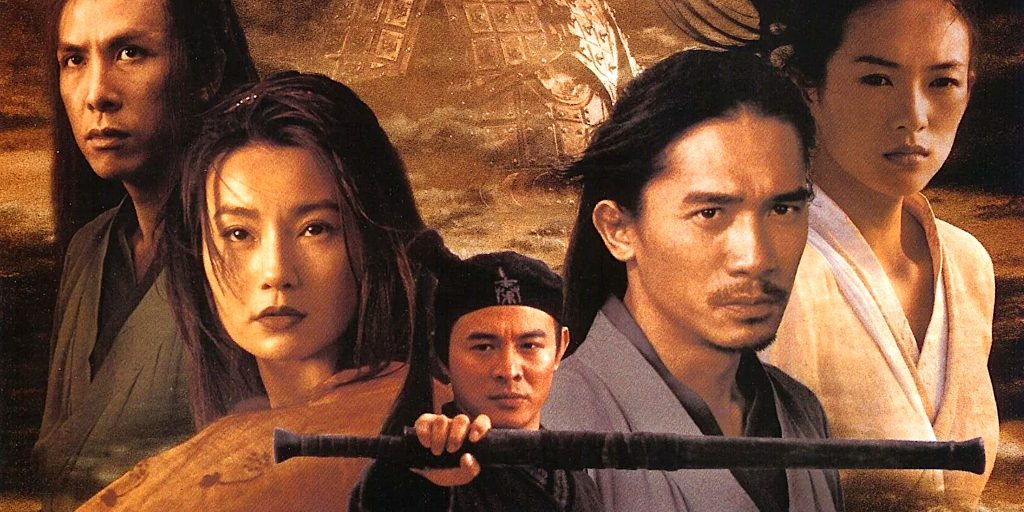
| Character | Actor | Role in the story |
|---|---|---|
| Nameless | Jet Li | A Qin official and master swordsman with a hidden purpose |
| Broken Sword | Tony Leung Chiu-wai | A gifted assassin, calligrapher and idealist |
| Flying Snow | Maggie Cheung | A formidable swordswoman driven by grief and revenge |
| Long Sky | Donnie Yen | A spear fighter who helps make Nameless’s plan possible |
| Moon | Zhang Ziyi | Broken Sword’s devoted student |
| King of Qin | Chen Daoming | The ruler seeking to conquer the remaining rival states |
Jet Li gives one of his most controlled performances. Nameless is so contained that the smallest pause matters. Chen Daoming meets him with equal precision, making the king intelligent, frightened, ruthless and capable of recognising an idea larger than his own survival.
Tony Leung and Maggie Cheung supply the film’s emotional centre. Broken Sword and Flying Snow love one another, but they no longer agree about what justice requires. Their tragedy is not caused by a silly misunderstanding that could be fixed over tea. It comes from a genuine moral division, which is far less convenient.
The colour stories and what they mean
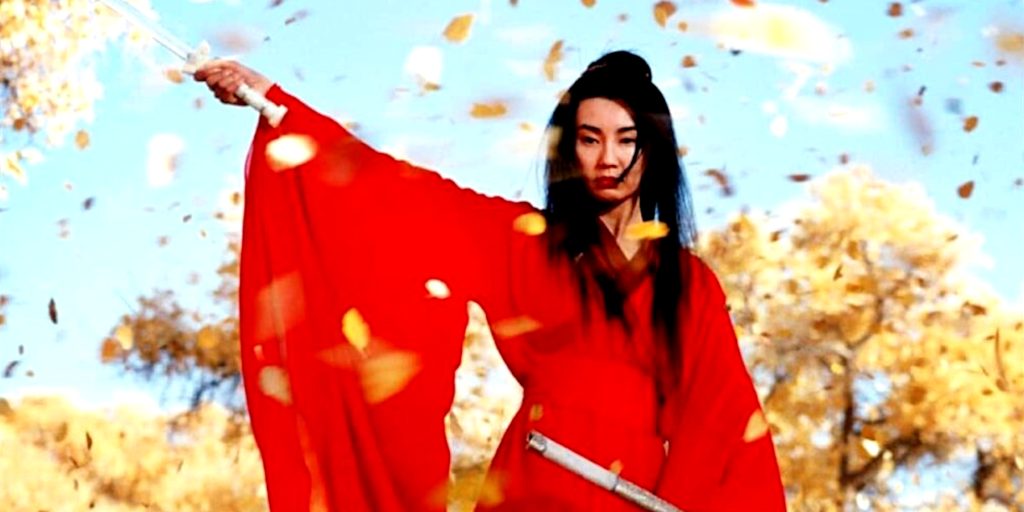
Hero divides its versions of events through dominant colours. The design makes the narrative easy to follow, but it also changes how each account feels.
Red: passion, jealousy and fabrication
Nameless’s first story unfolds in intense reds. Desire and anger overwhelm judgement as Flying Snow and Broken Sword appear to turn against one another. The scene in which Moon fights Flying Snow among yellow leaves is almost offensively photogenic.
This is the most melodramatic version of events, and deliberately so. It is a story calculated to make powerful warriors look vulnerable to ordinary jealousy.
Blue: reason, trust and the king’s interpretation
The king imagines a cooler version dominated by blue. Here, Broken Sword and Flying Snow are united in purpose. Their choices arise from discipline and sacrifice rather than romantic chaos.
Blue does not automatically mean truth. It represents the king’s reading of the assassins, shaped by his growing respect for opponents he has never truly understood.
White: the revealed account
The final account is largely white. It strips away the lush emotional exaggeration of the earlier tales and shows the plan agreed by Nameless, Long Sky and Flying Snow. Broken Sword remains the dissenter because he has reached a startling conclusion: the king must live.
Zhang said that the colours were used to distinguish ideas within the different stories. Christopher Doyle also resisted rigid, universal interpretations of the palette. So the colours guide our response, but they are not a secret code with one tidy answer. Cinema would be much easier if every red curtain came with footnotes.
The darker black of the palace scenes is equally important. Qin power appears severe, ordered and almost airless. Green, used for Broken Sword and Flying Snow’s earlier attack on the palace, belongs to memory and to the possibility that history might once have turned another way.
The best sword fights in Hero
Nameless against Long Sky
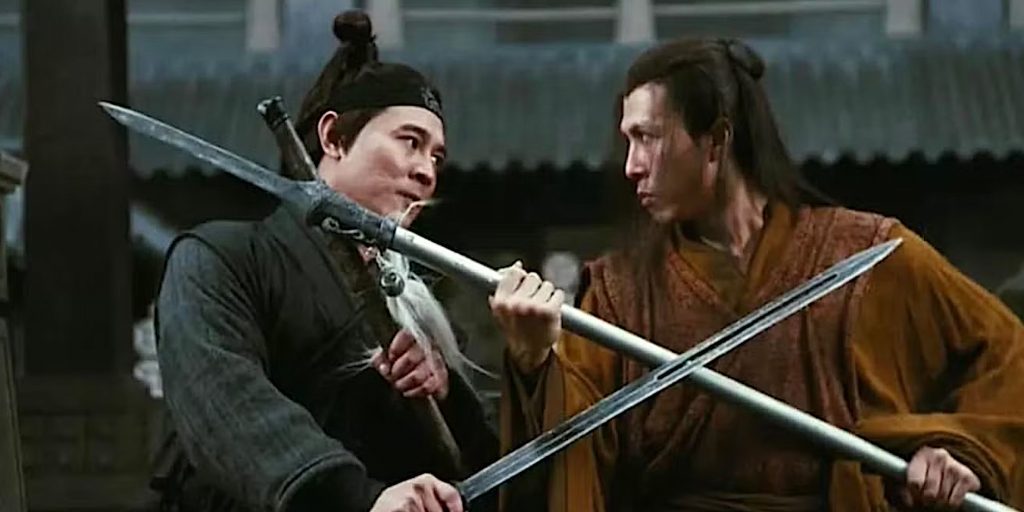
The first major duel takes place in a rain-soaked chess courtyard. Long Sky fights with a spear while Nameless uses a straight sword. Much of their contest occurs in the imagination before the decisive physical exchange.
This is wuxia at its most philosophical. Skill is presented as perception, timing and mental composure rather than a frantic quantity of slashes. Donnie Yen and Jet Li share relatively little screen time, but they make it count.
Moon against Flying Snow
Moon pursues Flying Snow through a forest of yellow leaves while the surrounding landscape shifts towards red. The duel is driven by grief and loyalty, and it is one of the film’s clearest examples of action functioning as emotion.
The wire work abandons realism, of course. That is the point. Wuxia movement expresses inner power and feeling through bodies that transcend ordinary limits. Asking whether someone could genuinely balance on a leaf is a little like asking why nobody in an opera simply speaks up.
Nameless against Flying Snow
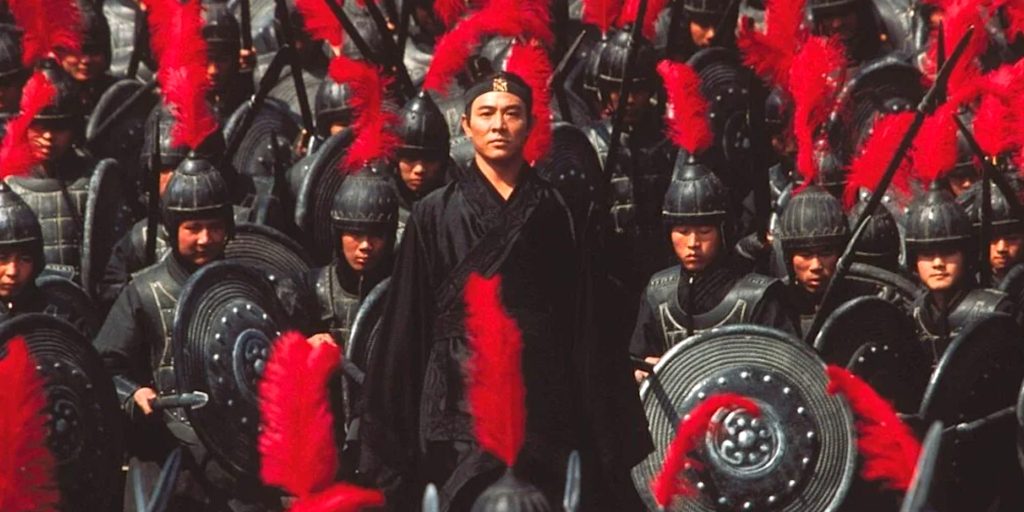
Their encounter before the Qin army is spare and ceremonial. Thousands of soldiers watch what appears to be a fatal confrontation, unaware that the performance serves a deeper plot.
The sequence gains power retrospectively. Once the deception is revealed, each movement becomes an act of trust rather than straightforward combat.
Broken Sword against Nameless on the lake
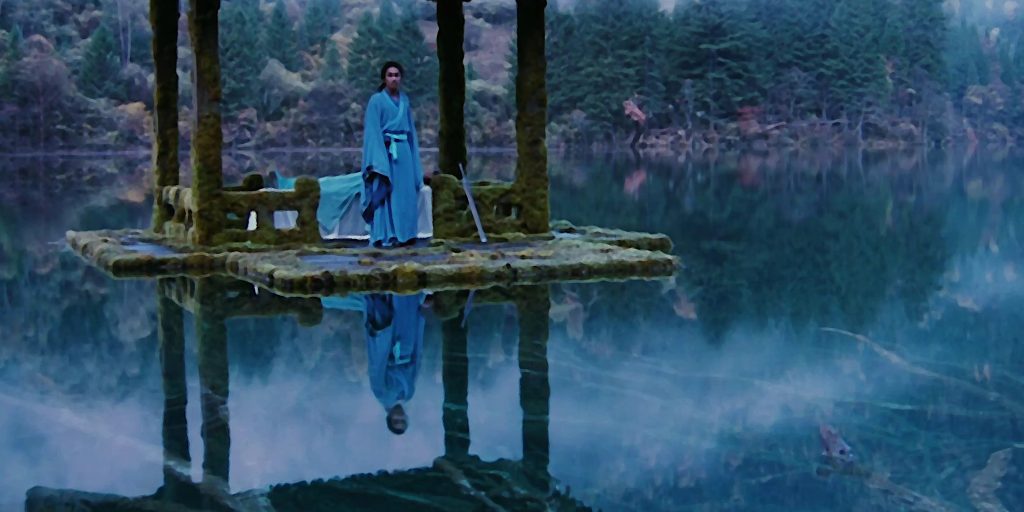
The lake duel is the film’s visual peak. The men skim across an almost motionless surface, their swords interrupting reflections rather than bodies. It is staged as an imagined tribute to Flying Snow, with violence transformed into mourning.
The sequence was filmed at Jiuzhaigou in Sichuan. Its calm matters. This is not a contest motivated by hatred, and the landscape seems to understand that before either fighter does.
What swords are used in Hero?
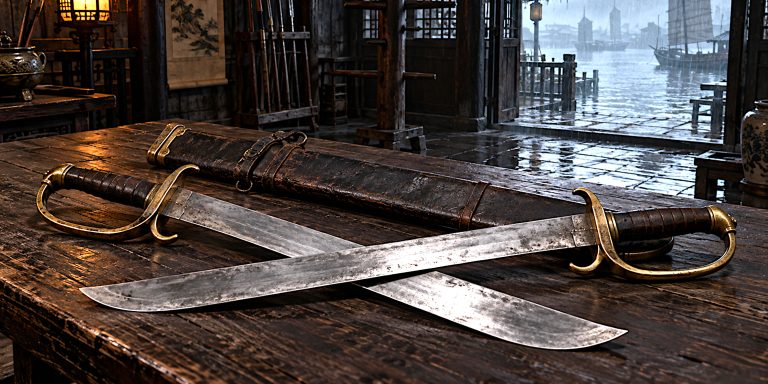
The film does not establish the elaborate named weapons sometimes attached to its characters online. Nameless, Broken Sword and Flying Snow mainly use stylised versions of the Chinese straight, double-edged sword usually called the jian. Moon also fights with a straight sword, while Long Sky’s principal weapon is a spear.
Their props are designed for visual identity and screen movement rather than strict archaeological reconstruction. Nameless carries a dark, restrained weapon suited to his severe presence. Broken Sword’s blade and scabbard have a more artistic character, fitting a man who sees a connection between swordsmanship and calligraphy. Flying Snow’s weapon complements her speed and directness.
Historically, swords were certainly present during the Warring States period. Surviving examples include finely cast bronze jian, some decorated with inlay. Iron and steel weapons also became increasingly important during the later centuries of the period. The film’s long, light blades and aerial exchanges belong to wuxia tradition, however, not a documentary demonstration of third-century BCE combat.
That distinction does not diminish the choreography. Hero is trying to visualise ideals of mastery, not give us a safety briefing for a Qin infantry recruit.
How historically accurate is Hero?
The broad setting is historical. Ying Zheng, the King of Qin, conquered the six remaining major states and declared himself Qin Shi Huang, the First Emperor, in 221 BCE. Qin government helped establish forms of centralised administration that shaped later imperial China.
The assassins in Hero are fictional, although the historical king survived real assassination attempts. The best known was made by Jing Ke in 227 BCE, an episode recorded in ancient Chinese historical tradition. Nameless’s audience with the king loosely echoes that wider history without dramatising it directly.
The massed crossbows, palace architecture, costumes and weaponry create a persuasive imagined past rather than a literal reconstruction. Scale and uniformity are exaggerated to express Qin authority. The army seems less like a collection of individual soldiers and more like a single machine.
This approach suits the film’s theme, but it also reveals its political problem. Qin unification ended the Warring States period, yet it came through conquest, coercion and enormous human suffering. The First Emperor’s reign was brief, authoritarian and followed by rapid collapse. Peace did not arrive with a neat bow tied around it.
Hero’s ending explained
Broken Sword persuades Nameless that killing the king would prolong division and war. His message, written in the sand as tianxia, is commonly translated in the film as “Our Land”, although “All Under Heaven” more closely conveys its political scope.
When Nameless finally reaches striking distance, he chooses not to kill the king. He demonstrates that he could have done so, then walks away. The king understands his sacrifice, but his ministers insist that Qin law must be upheld. Nameless is executed by a volley of arrows and buried with honour as a hero.
Broken Sword and Flying Snow also die. Flying Snow, furious that he stopped the assassination, attacks him. Broken Sword lowers his defence and allows her blade to pass through him. Realising what she has done, she dies with him.
The ending completes the film’s idea of the highest swordsmanship. Mastery progresses from technical control, to using no sword, to abandoning the desire to kill. Nameless wins the intimate moral contest and loses his life to the state.
Whether he makes the right choice is the question Hero refuses to settle as comfortably as its final captions might suggest.
Is Hero political propaganda?
This is where admiration for the film tends to become complicated.
Broken Sword and Nameless accept violent unification as the price of future peace. The king’s phrase “All Under Heaven” turns imperial conquest into a collective good. Read plainly, the film appears to justify authoritarian power when it promises order. Critics have therefore interpreted Hero as nationalist and sympathetic to the logic of the modern Chinese state.
That reading has real weight. The king receives greater understanding as the narrative progresses, while resistance ends in voluntary sacrifice. Individual victims are asked to trust the historical mission of the ruler killing them. Governments have enjoyed worse endorsements.
Yet the film also leaves unease everywhere. Nameless must be murdered to preserve the law. The king stands alone beneath a vast palace roof. Unity is achieved through armies, arrows and the erasure of dissent. Zhang presents the argument for national consolidation with immense visual force, but the human cost is impossible to miss.
I do not think Hero becomes more interesting if we declare it either a simple celebration of empire or a hidden denunciation of it. Its politics are troubling because the central temptation is expressed so persuasively. The film asks viewers to feel the appeal of order, then makes them stare at the body required to secure it.
Why the action still works
Ching Siu-tung’s choreography treats combat as character writing. Long Sky is controlled and direct. Flying Snow attacks with emotional clarity. Broken Sword seems to move as though he has already considered the moral consequences. Nameless is economical, almost frighteningly so.
Wire-assisted movement is used without apology. Fighters run across water, hover above trees and redirect falling droplets. Physical realism gives way to emotional precision. The result has aged better than many effects-heavy films of the same period because the spectacle follows a consistent visual language.
Tan Dun’s score helps enormously. Percussion gives the palace and army their severity, while strings and voices bring an ache to the more intimate scenes. During the courtyard duel, the elderly musician’s performance connects swordplay with rhythm and concentration. Combat becomes something heard and imagined before it is seen.
Hero review: is it still worth watching?
Yes. Hero remains one of the most visually accomplished martial arts films ever made, but its staying power comes from the argument beneath the imagery.
The performances are restrained, the structure rewards a second viewing, and the action scenes carry ideas instead of pausing them. Maggie Cheung and Tony Leung make the tragic romance believable with very little exposition. Jet Li proves that stillness can be as commanding as speed. Chen Daoming somehow makes listening look dangerous.
The film’s political conclusion deserves scrutiny rather than reverence. Its version of history bends towards the ruler, and its faith in unity can feel chilling. Still, a difficult film is not necessarily a failed one. Hero makes power look beautiful, then shows what that beauty can persuade people to surrender.
Verdict: A magnificent and politically uneasy wuxia tragedy. Come for the sword fights, stay for the colour, then spend the next hour arguing with the ending.
Rating: 4.5 out of 5
Frequently asked questions
Is Hero based on a true story?
It uses the historical King of Qin and the real unification of China as its setting, but Nameless, Broken Sword, Flying Snow and Long Sky are fictional. The plot draws broadly on the tradition of assassination attempts against Ying Zheng.
What does “Our Land” mean in Hero?
The written phrase is tianxia, literally “All Under Heaven”. It describes a political and cultural world brought under one order. “Our Land” makes the idea more emotionally immediate in the film’s English subtitles, but loses some of its imperial meaning.
Why are there different colours in Hero?
Each colour distinguishes a different version, mood or period within the story. Red heightens passion and jealousy, blue cools the story into reflection, and white accompanies the account presented as closest to the truth. The filmmakers did not intend every colour to have one fixed symbolic definition.
Did Hero win an Oscar?
No. It was nominated for Best Foreign Language Film at the 75th Academy Awards but lost to Nowhere in Africa.
Was Hero successful at the box office?
Yes. It earned about $177.4 million worldwide. Its delayed US release opened at number one and eventually made roughly $53.7 million in the domestic market.
Is Hero suitable for younger viewers?
The film contains stylised violence, deaths and tragic themes, but relatively little graphic gore. Parents should check the current classification used by their local service or home-video release.
Sources and further reading
- The 75th Academy Awards, Academy of Motion Picture Arts and Sciences
- Hero box-office record, Box Office Mojo
- 10 great wuxia films, British Film Institute
- Zhang Yimou interview on Hero, Phase9
- Warring States period bronze sword, Metropolitan Museum of Art
- Qin dynasty overview, Metropolitan Museum of Art