The bilbo sword has a less straightforward history than its name suggests. Associated with Bilbao and the reputation of Spanish blades, it appears in early modern literature, museum catalogues and auction descriptions. Those sources do not always mean precisely the same weapon.
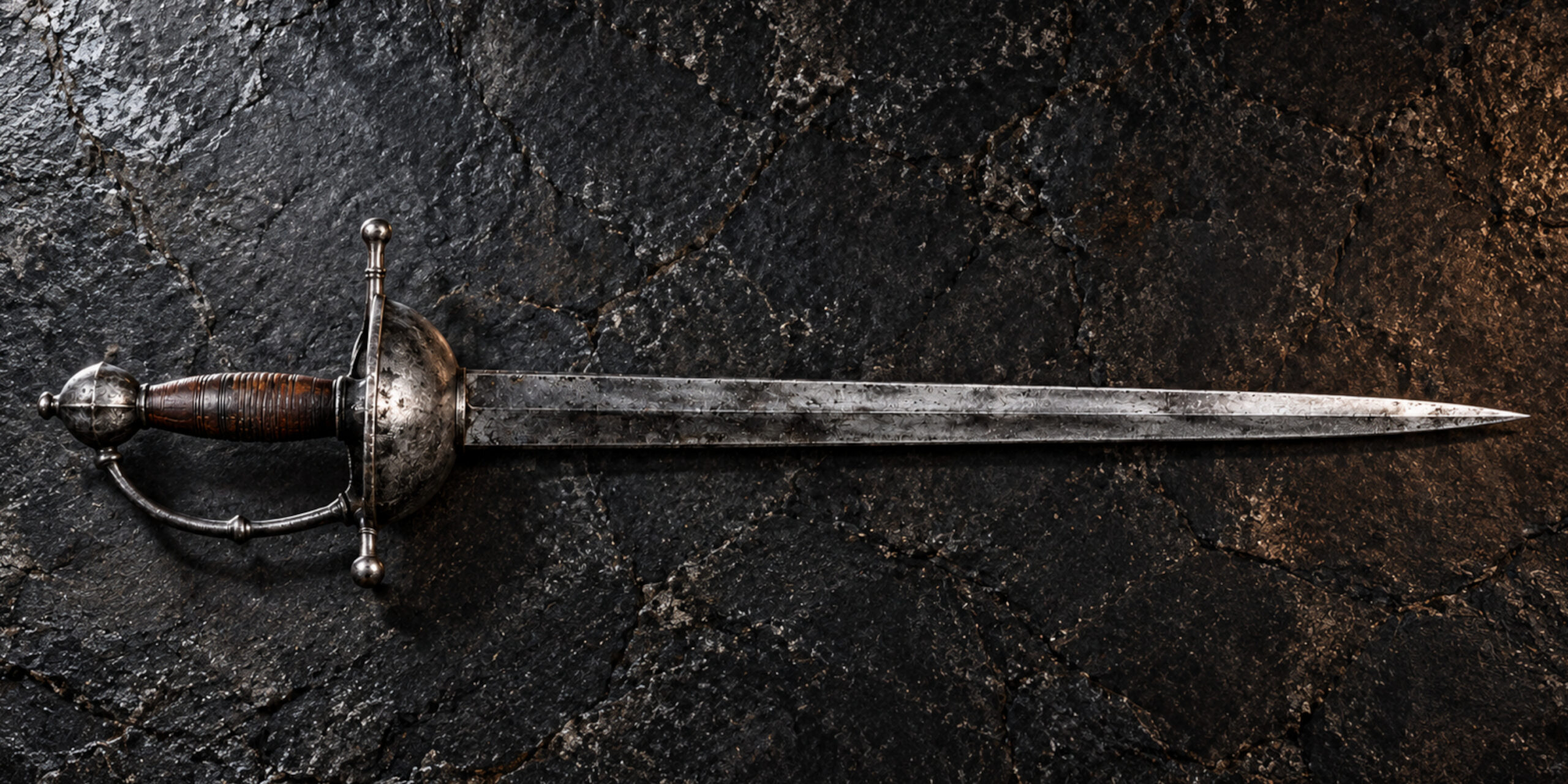
Broadly, the name connects two things: swords associated with Bilbao’s blade trade, and later swords identified by collectors through characteristic protective hilts. Many surviving examples have straight, double-edged blades suitable for cutting and thrusting. Their dimensions and construction vary considerably.
That variety makes the bilbo interesting. It also makes confident claims about a standard short, lightweight naval sword rather difficult to defend.
What Is a Bilbo Sword?
A bilbo is best understood as a historical sword name and a later collecting category, rather than one standardised design.
The name is associated with Bilbao, a Basque centre of sword production and trade. In later museum terminology, “bilbo type” frequently describes a hilt incorporating protective shells, quillons and a knuckle bow.
These meanings overlap, but they should not be treated as interchangeable. An Elizabethan reference to a bilbo does not automatically describe the double-shell hilt found on a later seventeenth-century sword.
Nor does a bilbo-type guard prove that its blade was made in Bilbao. The Royal Armouries records a related double-boatshell sword with a Spanish hilt and a German blade, a useful reminder that components travelled too.
Specification and Identifying Features

There is no single specification that covers every sword described as a bilbo. Identification should begin with the individual blade and hilt.
| Feature | Description |
|---|---|
| Weapon category | One-handed sword, with classifications overlapping rapier and military sword |
| Blade | Commonly straight and double-edged |
| Blade length | Variable; documented auction examples include 28½ inches and 36¼ inches, approximately 72 and 92 cm |
| Point | Usually tapered, providing a thrusting capability |
| Fullers | Present on some examples, with varying lengths and arrangements |
| Guard | Often paired shells, or a related cup-like construction, with quillons and knuckle protection |
| Grip | Wood, sometimes covered or bound with wire |
| Pommel | Rounded or flattened forms occur |
| Weight | Requires measurement of the individual sword |
| Balance | Depends on blade geometry, guard construction and pommel |
Cowan’s catalogued one example with a 28½-inch blade and asymmetrical shell protection. Christie’s recorded a mid-eighteenth-century Spanish bilbo-type sword with a 36¼-inch blade, an iron cup guard and a wire-bound wooden grip. Neither supports a universal specification.
The longer example is particularly useful when assessing claims that bilbos were invariably compact boarding weapons. A blade approaching a metre requires a little more room than the word “compact” usually promises.
History and Evolution
Bilbao’s swordmaking industry
Research by arms historian Germán Dueñas Beraiz documents a substantial sixteenth-century sword trade. A contract dated 1519 specified 208 broad swords made in the style customary for Ireland. A 1591 document concerned permission to export 100 Bilbao swords to New Spain.
These records suggest production adapted to different customers and destinations. They do not describe one design exported unchanged.
The name in England
Shakespeare’s The Merry Wives of Windsor associates the bilbo with flexibility. The reference belongs to the earlier history of the name and predates the later hilt form commonly recognised by collectors.
Later protective hilts
Dueñas Beraiz distinguishes these earlier swords from the later seventeenth-century shell-hilt category. His study also identifies museum objects described variously as bilbo swords, bilbo-type hilts and cavalry swords. The terminology was never especially obedient.
By the eighteenth century, surviving examples include both rapier-like weapons and broader swords with substantial guards. Christie’s mid-eighteenth-century example demonstrates that the category extends beyond the early eighteenth-century endpoint sometimes given in general descriptions. Christie’s
Advantages and Disadvantages
The following are assessments of the design features found on relevant examples. They should not be read as proof that every bilbo performed alike.
Advantages
- Cut-and-thrust capability: a moderately broad, double-edged blade can combine useful cutting edges with a serviceable point.
- Hand protection: shells and knuckle guards place steel between the hand and an opposing weapon.
- Versatile blade form: a straight blade permits both point-led actions and cuts, depending on its geometry.
- Protective coverage: substantial shells can shield parts of the hand without requiring a complete enclosing basket.
Disadvantages
- Variable handling: similar-looking hilts can carry blades with very different mass, stiffness and balance.
- Guard bulk: protective steel occupies space and contributes weight, although its effect depends on the whole weapon.
- Length in confined spaces: a long example offers none of the automatic convenience often attributed to a short naval sidearm.
- Maintenance: steel remains vulnerable to corrosion. A reputation for durability does not make salt water a friend.
It is sensible to judge a sword’s likely performance through its construction. “Spanish”, “military” or “bilbo” alone tells us remarkably little about how it moves in the hand.
Comparison with Similar Weapons
These categories overlap. The distinctions below describe broad tendencies rather than rigid boundaries.
| Weapon | General characteristics | Useful distinction |
|---|---|---|
| Bilbo-type sword | Straight blade with shell or related protective hilt | A variable label associated with Bilbao and later hilt forms |
| Rapier | Often a long blade with developed hand protection | Generally places greater emphasis on point control; some bilbo-type swords are catalogued as rapiers |
| Cup-hilt rapier | Protective cup, quillons and usually a knuckle bow | Compare the complete blade and guard rather than assuming a different social status |
| Basket-hilted broadsword | Broad, double-edged blade with an enclosing basket | Usually provides more enclosing hand protection |
| Cutlass | Generally a shorter, broad blade, often single-edged | A clearer comparison for compact naval fighting swords |
The Royal Armouries’ use of “rapier” for swords with bilbo-related hilts illustrates why the categories should remain flexible. A hilt name and a blade classification can describe different aspects of the same object.
Legacy
The bilbo survives through a mixture of literary reputation, surviving weapons and museum terminology.
Its earlier history belongs to the trade in Bilbao blades. Its later collecting identity often rests on the appearance of the hilt. Keeping those strands distinct produces a more useful account than treating every example as a standard naval weapon.
The Spanish-hilted, German-bladed sword recorded by the Royal Armouries also captures something important about European arms manufacture: the finished weapon could bring together work from several places.
For collectors, that complexity is part of the attraction. A sword can preserve evidence of manufacture, trade, repair and changing taste within a single object.
Where to See Bilbo Swords
The most useful starting points are identifiable collection records.
| Collection | Relevant material | Visiting advice |
|---|---|---|
| Royal Armouries, UK | Eighteenth-century rapiers with bilbo-type hilts, including double-shell forms | Confirm the object’s location and display status before travelling |
| San Telmo Museum, Donostia-San Sebastián | Two related hilts illustrated in Dueñas Beraiz’s study, inventory numbers H-000254 and H-000243 | Enquire about current display or research access |
The Royal Armouries’ online records provide useful comparisons for hilt construction. The San Telmo examples are documented in the published study, rather than confirmed here as currently displayed.
An online record confirms an object’s presence in a collection. It does not guarantee that the sword will be waiting in a public case on Tuesday afternoon.
Collectors’ Guide: Authenticity and Condition
Buy the construction and supporting evidence, rather than the most exciting description.
“Naval”, “colonial” and “conquistador” are claims requiring documentation. A protective guard cannot establish an owner’s profession.
Before bidding:
- Assess blade and hilt together. Consider whether their construction, wear and apparent age are compatible.
- Request clear photographs of markings. Inscriptions, stamps and fuller arrangements can assist identification.
- Inspect the guard. Look for cracks, brazing, replacement sections and repairs around vulnerable joints.
- Examine the grip. Renewed wood or wire should be disclosed and considered when assessing originality.
- Ask about cleaning. Heavy polishing may weaken inscriptions and remove useful surface evidence.
- Request provenance in writing. Earlier catalogues, photographs and ownership records provide firmer support than an undocumented association.
Cowan’s condition report for its 2017 example specifically noted that cleaning had left the blade markings weak and difficult to read. Condition affects what can be learned from a sword as well as how it looks.
A repaired or restored sword can remain worth collecting. Its description and price should acknowledge the work.
Auction Prices and Published Estimates
Public records provide some reference points, but they do not justify a precise universal price guide. An auction estimate is not a realised price.
| Auction record | Published figure | How to interpret it |
|---|---|---|
| Cowan’s, lot 442, May 2017: catalogued as a late seventeenth-century Continental bilbo sword | US$1,000 to US$1,500 estimate | The public listing withholds the realised price |
| Centurion Auctions, lot 84009: catalogued as an eighteenth-century Spanish P1728 bilbo sword | US$1,000 to US$2,000 estimate | The realised price requires login; the identification is the auction house’s attribution |
| Pook & Pook, lot 298, 17 November 2018: Spanish bilbo-type decorative sword | US$75 hammer price, excluding buyer’s premium | A decorative object, unsuitable as a direct comparison for an authenticated period weapon |
These figures come from the respective auction listings. The low decorative-sword result is included to show why catalogue wording matters, rather than to suggest a bargain price for an antique fighting sword. Bidsquare
For an individual purchase, compare swords with similar blades, hilts, originality and condition. Keep historical records in their original currency, and distinguish hammer prices from totals including buyer’s premium.
Precise bands for “museum-grade” or “colonial” examples would imply stronger evidence than this small sample supplies.
Further Reading
- Royal Armouries: eighteenth-century rapier with bilbo-type hilt
- Christie’s: Spanish sword of bilbo type
- Cowan’s: Continental bilbo sword, lot 442
- Germán Dueñas Beraiz: La producción de armas blancas en Bilbao durante el siglo XVI