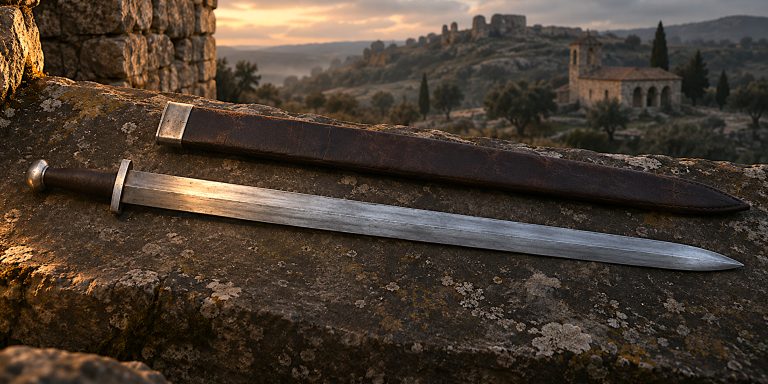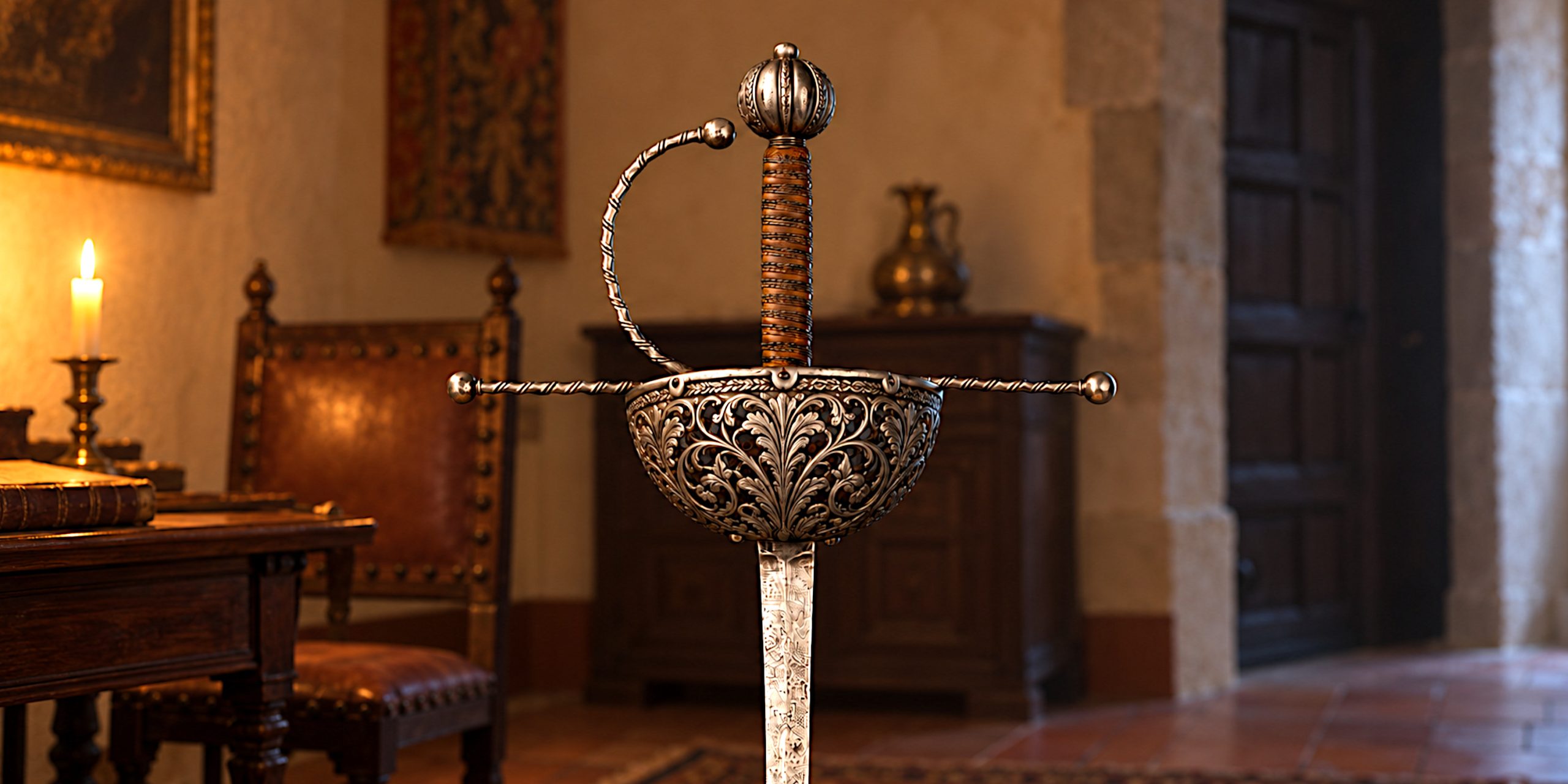
The cup-hilt rapier is a European sword distinguished by a deep, bowl-shaped guard protecting the sword hand. Closely associated with seventeenth-century Spain and Italy, it combined a long, pointed blade with a particularly effective answer to an awkward fencing problem: keeping an opponent’s steel away from the fingers.
Its appearance can be deceptive. Some examples are austere working weapons; others carry pierced steel, elaborate chiselling and decoration worthy of a silversmith’s workshop. Both belong to a world in which a sword could serve as personal protection, an expression of status and an expensive accessory.
“Cup-hilt” describes the guard rather than a standardised blade or fencing system. Surviving examples vary considerably in dimensions, weight and construction. Understanding those differences is essential, whether studying their use or considering one for a collection.
Cup-Hilt Rapier Specifications

There was no universal cup-hilt rapier specification. The following measurements summarise several surviving seventeenth-century examples rather than defining limits for the entire type.
| Feature | Description |
|---|---|
| Main historical period | Seventeenth century, with continued use in some regions during the eighteenth century |
| Principal associations | Spain and Italy, with examples made or assembled elsewhere |
| Overall length | Approximately 115–131 cm among the selected museum examples |
| Blade length | Approximately 97–112 cm among the selected examples |
| Weight | Approximately 0.94–1.30 kg among the selected examples |
| Blade form | Generally straight, double-edged and tapering to an acute point |
| Blade section | Variable, including flattened diamond and other sections |
| Guard | Deep metal cup, either solid or pierced and decorated |
| Additional protection | Usually quillons and a knuckle bow |
| Grip | Commonly a wooden core covered with wire |
| Pommel | Variable, including rounded, flattened and faceted forms |
The Metropolitan Museum of Art holds an example with a Spanish hilt and German blade measuring 114.9 cm overall and weighing approximately 964 g. Another, attributed to Italy, measures 131.4 cm and weighs approximately 1.16 kg. These are substantial swords, but they are not uniformly heavy.
A fixed balance point should not be assigned to the whole category. Blade taper, hilt construction, pommel mass and later alterations all influence handling.
The Main Parts
- Cup guard: Shields the fingers and the front and sides of the hand.
- Quillons: The projecting crossguard arms, which contribute to protection and blade engagement.
- Knuckle bow: Extends around the knuckles towards the pommel.
- Ricasso: The unsharpened blade section near the hilt, often associated with finger placement.
- Pommel: Secures the hilt assembly and contributes to the sword’s distribution of mass.
The cup is the most conspicuous feature, but its relationship with the grip and blade matters more than ornament alone.
History and Evolution
Origins in the Early Seventeenth Century
The cup hilt developed within the wider evolution of complex rapier guards. Earlier arrangements used combinations of bars, rings and shells to protect the hand. A deeper cup offered a more continuous barrier against an approaching point.
The Metropolitan Museum’s The Academy of the Sword places the development of the form in Italy or Spain around 1625. That is a more defensible starting point than assigning a precise invention date or a single undisputed national origin. resources.metmuseum.org
This was not a tidy replacement of one design by another. Swept hilts, shell guards and cup hilts overlapped. Sword fashions were rarely considerate enough to change on schedule.
Seventeenth-Century Development
By the middle of the century, cup-hilt rapiers included both relatively plain examples and highly decorated weapons.
Common decorative treatments included:
- Piercing and chiselling.
- Engraved foliage and geometric borders.
- Heraldic devices.
- Gilding and precious-metal embellishment.
Surviving swords also reveal an international trade in components. The Met holds a rapier with an Italian hilt, probably from Naples, and a Solingen blade attributed to Johann Bongen. A sword’s hilt and blade need not share a country of manufacture.
Continued Use in Spanish Territories
Cup-hilt rapiers remained important in Spain and Spanish territories after lighter smallswords became fashionable elsewhere. The Met’s survey identifies their continued predominance in those regions into the late eighteenth century.
Their later history should therefore not be reduced to ceremonial survival. Regional preferences and fencing traditions gave them a longer practical life than a simple European replacement timeline suggests.
Fencing Traditions and Practical Use
The cup-hilt rapier is strongly associated with Spanish La Verdadera Destreza, the fencing tradition linked to Jerónimo de Carranza and Luis Pacheco de Narváez. However, that tradition began before the mature cup hilt appeared. A fencing school and a guard design are different things, even when history repeatedly brings them together.
The rapier was principally a civilian sidearm. Its long blade and acute point suited fencing in which distance, timing and control of the opposing weapon were central concerns.
It should not be described as incapable of cutting. Historical rapiers included double-edged blades intended for cut-and-thrust fencing, although cutting performance depended on the individual blade. Equally, they should not be imagined as oversized modern sporting foils.
Cup-hilt rapiers could also be paired with a left-hand parrying dagger. Surviving examples and museum catalogues document this combination, although it was not obligatory for every encounter or method.
Advantages and Disadvantages
These are practical tendencies rather than guarantees. Two swords with similar cups may handle very differently.
Advantages
- Extensive hand protection: A solid cup closes many of the openings found between the bars of more open guards.
- Useful reach: A long blade can threaten an opponent while keeping the wielder farther away.
- Point control: A well-designed example supports precise thrusting and controlled blade engagement.
- Protection around the grip: The cup and knuckle bow work together to shield vulnerable fingers.
- Scope for skilled craftsmanship: Decoration could be integrated into a functional guard rather than added as a separate display feature.
Disadvantages
- Awkwardness in restricted spaces: Long blades and projecting quillons require room.
- Conspicuous carriage: A large rapier is difficult to wear unobtrusively.
- Variable cutting performance: Narrow, thrust-oriented blades offer different capabilities from broader cutting swords.
- No complete enclosure: The cup protects extensively, but the hand and wrist are not invulnerable.
- Potential fragility in elaborate decoration: Fine pierced work may be more vulnerable to damage than a plain, robust cup.
A rapier’s effectiveness depended on its construction and the person using it. Decorative ambition did not automatically improve either.
Comparison with Similar Weapons
Guard style alone cannot establish blade width, speed or cutting ability. The comparisons below describe broad differences.
| Weapon | Main distinction | Comparison with a cup-hilt rapier |
|---|---|---|
| Swept-hilt rapier | Protection formed largely from bars and rings | May leave more openings around the hand; blade characteristics can overlap considerably |
| Shell-hilt rapier | Uses protective shells or plates | Protection varies with the size, depth and arrangement of the shells |
| Smallsword | Usually a shorter, lighter civilian thrusting sword | Generally easier to carry, with different proportions and handling |
| Basket-hilted broadsword | Enclosing guard usually paired with a broader blade | Commonly places greater emphasis on cutting capability |
| Cup-hilt broadsword | Cup guard mounted with a broader blade | Demonstrates why a cup guard does not automatically make a sword a rapier |
The most useful comparison is between complete weapons. “Cup hilt versus swept hilt” tells us something about protection, but relatively little about the behaviour of the blade.
Legacy
The cup-hilt rapier remains one of the most recognisable forms of early modern European sword. Its appeal comes partly from that unusually clear relationship between appearance and purpose: the deep guard makes its protective function immediately understandable.
Surviving examples also complicate national labels. Spanish fashions, Italian metalwork and German blades could meet in a single weapon. The result belongs to a network of craftsmen and customers rather than an isolated national tradition.
For historical fencing, the form offers a physical connection to the study of early modern swordsmanship. For collectors, it presents an equally demanding exercise in judgement. Recognising an attractive cup is easy. Establishing when its blade, grip and pommel became acquainted takes rather more work.
Where to See Cup-Hilt Rapiers
The following collections have identifiable examples that can be researched before a visit. Display arrangements can change.
| Museum | Example | What to examine |
|---|---|---|
| Metropolitan Museum of Art, New York | 51.170.1, Italian, possibly Naples, c.1650–1675 | A substantial example weighing approximately 1.30 kg |
| Metropolitan Museum of Art, New York | 04.3.13, Italian hilt with German blade, c.1650–1675 | The combination of Neapolitan-style hilt and Solingen blade |
| Wallace Collection, London | A642, Italian, c.1630–1650 | Elaborately worked protective shells and an inscribed blade |
| Wallace Collection, London | A659, possibly third quarter of the seventeenth century | Pierced decoration and the catalogue’s discussion of an associated blade |
The Met currently lists the first two examples in Gallery 376. Wallace’s records place A642 in Arms and Armour IV and A659 in Arms and Armour III. Check the individual records before travelling for a particular sword.
A659 is especially instructive for collectors because its catalogue explicitly questions the relationship between the blade and hilt. Museum objects are not exempt from complicated assembly histories.
Collectors’ Guide: Authenticity and Condition
Assess the whole sword before paying for the reputation of its blade inscription or the beauty of its guard.
A rapier may contain original seventeenth-century components, later repairs and replacement parts. That does not automatically make it worthless or fraudulent. It does change how it should be described and valued.
What to Check Before Buying
- Component compatibility: Do the blade, cup, quillons, grip and pommel make sense together?
- Restoration: Ask specifically about replaced grips, repaired cups, welded quillons and altered blade tips.
- Surface condition: Look for heavy polishing, softened engraving and corrosion concealed in recesses.
- Blade inscriptions: Compare lettering and marks with documented examples rather than accepting a famous name at face value.
- Hilt construction: Request photographs inside the cup and around the blade’s entry into the guard.
- Provenance: Seek dated invoices, earlier catalogue entries and photographs.
- Catalogue language: Read terms such as “associated”, “composite”, “restored” and “in seventeenth-century style” carefully.
The Met itself records a Spanish cup-hilt rapier with a seventeenth-century attribution but a nineteenth-century grip and restorations. Replacement parts are part of the collecting landscape, including in major institutions.
An inscription naming Toledo is evidence to investigate, not a complete certificate of origin. The same applies to an impressive family story. Ancestors have acquired remarkably good swords in the retelling.
What Influences Value?
| Factor | Why it matters |
|---|---|
| Quality of workmanship | Fine chiselling, balanced design and well-executed construction attract interest |
| Originality | Coherent assemblies are assessed differently from later composites |
| Condition | Serious repairs, losses and aggressive cleaning can reduce appeal |
| Attribution | A securely identified maker or workshop strengthens an object’s significance |
| Provenance | Documented collection history supports research and confidence |
| Rarity | Unusual features matter most when their authenticity is established |
Piercing or gilding alone does not guarantee a higher value. A convincing plain sword may be more desirable than an ornate example with substantial alterations.
Cup-Hilt Rapier Auction Prices
Documented sales are more useful than broad price bands that treat every cup-hilt rapier as comparable.
| Auction and date | Catalogued example | Recorded result |
|---|---|---|
| Bonhams, 30 November 2011, lot 137 | Spanish cup-hilt rapier, late seventeenth century | £1,125, as reported by LotSearch |
| Bonhams, 30 November 2011, lot 138 | Spanish cup-hilt rapier, late seventeenth century | £437, as reported by LotSearch |
| Olympia Auctions, 28 June 2023, lot 234 | Spanish or Mexican cup-hilt rapier, eighteenth or early nineteenth century, with wavy blade | £1,300, published by the auction house |
The Bonhams figures above are secondary auction-archive reports. Olympia’s result is available directly in its lot record. Premium treatment is not established consistently across these records, so the figures should not be compared as identical final purchase costs. LotSearch
These historical results are individual comparisons, not a current valuation range. Their dates, condition and differing attributions matter. They do show why claims that ordinary cup-hilt rapiers invariably begin at several thousand pounds are too rigid.
Before bidding:
- Obtain a condition report and detailed photographs.
- Compare similar swords with similar restoration histories.
- Calculate the buyer’s premium, relevant taxes and delivery charges.
- Separate auction estimates from achieved prices.
- Seek an independent specialist opinion for an expensive or uncertain example.
The best purchase is a sword whose construction and history you understand. A dramatic attribution can wait until the evidence catches up.