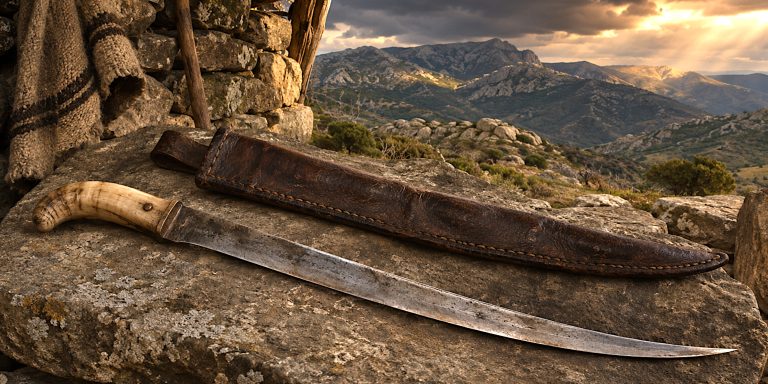
The wodao is a Japanese or Japanese-influenced single-edged sword found in Chinese military history, particularly during the Ming and Qing dynasties. In its long, two-handed form, it combines a slender, gently curved blade with a substantial grip that gives the swordsman leverage and control.
Its history is more complicated than the familiar description “China’s version of the katana” suggests. The name could refer to Japanese swords themselves, as well as Chinese weapons made under their influence. It was never a single, unchanging design with a universally agreed set of measurements. Historical sword terminology rarely makes life that convenient.
What makes the wodao interesting is the practical thinking behind it. Chinese soldiers encountered effective foreign weapons, studied them and adapted them to their own requirements. The resulting sabres belong to a history of military exchange in which usefulness could matter rather more than national pride.
What Does Wodao Mean?
Wōdāo, commonly written 倭刀, means “Japanese sword” or “Japanese-style sabre”. Another historical spelling is 窩刀.
For readers and collectors, two meanings need separating:
- A Japanese sword described in Chinese sources, which need not have been manufactured in China.
- A Chinese Japanese-style sabre, including long weapons intended for two-handed use.
This article concentrates on the second meaning, especially the long sabres associated with Ming military adaptation and later Qing regulations. The distinction matters when comparing surviving weapons: an imported Japanese blade in Chinese mounts and a Chinese-made long sabre can both appear in discussions of the wodao.
Wodao Specifications

There is no reliable specification that covers every weapon called a wodao. A better approach is to distinguish a documented surviving example from broader descriptions.
Mandarin Mansion records a long sabre, catalogued as an antique miaodao, which closely follows Qing wodao regulations. Its suggested date is the late nineteenth or early twentieth century.
| Feature | Recorded detail |
|---|---|
| Overall length | 117.5 cm |
| Blade length | 84 cm |
| Weight | 1,286 g |
| Blade thickness | 8 mm at the base, 7 mm at the middle, 5.5 mm near the tip |
| Point of balance | 24.5 cm forward of the guard |
| Blade form | Long, gently curved, with a pronounced ridge |
| Fittings | Plain iron |
| Grip | Long wooden grip; surviving wrap replaced by the dealer |
| Scabbard | Leather-covered scabbard, with losses to its fittings |
These measurements describe one surviving sword, not a universal production standard. Its relatively forward balance is equally specific to that example.
Construction and handling
Surviving related long sabres show Japanese influence in features such as ridged blade sections, guard shapes and grip construction. Chinese craftsmen nevertheless produced weapons with their own combinations of materials and fittings.
One documented changdao has an 84.3 cm blade but measures 146.3 cm overall, largely because of its much longer hilt. That is a useful reminder that blade length alone tells us surprisingly little about how a sword handles.
History and Evolution

Ming coastal warfare
The sixteenth-century campaigns against the wokou, conventionally called Japanese pirates, provided an important setting for Chinese adoption of Japanese-style long swords. These raiding groups included both Chinese and Japanese participants.
General Qi Jiguang, 1528–1588, adopted Japanese-influenced long sabres within his military reforms. Their history overlaps with weapons described as changdao, meaning long sabre, and dandao, a term used in contemporary swordsmanship literature. These names should not be treated as perfectly separate modern product categories.
Training and military use
The weapon’s importance extended beyond its shape. A long blade required suitable footwork, distance judgement and organised instruction.
Cheng Zongyou’s Dandao Faxuan, published in 1621, provides a significant source for Chinese long-sabre technique. Surviving weapons can resemble its illustrations, although resemblance alone cannot establish a Ming date. Japanese-influenced construction continued under the Qing.
Qing regulation
The wodao appears in the Huangchao Liqi Tushi, whose 1766 woodblock edition describes a weapon approximately 120 cm long, with an iron disc guard, wooden grip and iron pommel.
Its inclusion shows that the wodao became part of the regulated Qing arsenal. It was more than a short-lived experiment prompted by coastal raiders.
Advantages and Disadvantages
The following assessment concerns long, two-handed wodao forms. It describes the practical consequences of their construction rather than measurable superiority over other swords.
| Advantages | Practical significance |
|---|---|
| Two-handed leverage | Helps control the edge, redirect the blade and recover after a cut |
| Useful reach | Can threaten an opponent before a shorter sidearm reaches effective distance |
| Cutting and thrusting capability | A gently curved blade with a suitable point can perform both actions |
| Substantial blade construction | Can provide stiffness without requiring an excessively broad blade |
There are corresponding compromises:
- Both hands are normally occupied. Using a separate shield becomes impractical.
- Length complicates movement in restricted spaces. Doorways, boats and crowded interiors impose their own tactical opinions.
- Poor distance judgement is costly. An opponent who passes the point can reduce the advantage of reach.
- Handling varies considerably. Grip length, blade taper and balance matter more than the name on a catalogue label.
The wodao should not be described as inherently clumsy or incapable of accurate thrusting. Equally, a long cutting sword was no guarantee of success against armour, spears or coordinated troops.
Comparison with Similar Weapons
Chinese sword names can describe length, blade shape, carrying method or perceived origin. Some overlap is unavoidable.
| Weapon | Broad distinction | Relationship to the wodao |
|---|---|---|
| Katana | Japanese curved, single-edged sword, commonly used with two hands | Relevant to Japanese influence, but not an exact equivalent for every wodao |
| Ōdachi | Large Japanese sword | Particularly relevant to accounts of long swords encountered during Ming coastal warfare |
| Changdao | Literally “long sabre” | Can overlap with Japanese-influenced Chinese long-sabre forms |
| Miaodao | Now commonly understood as a slender Chinese two-handed sabre | Closely connected with the later terminology and practice of the long sabre |
| Liuyedao | Willow-leaf blade form, usually encountered on one-handed sabres | Generally a more compact sidearm than the long wodao discussed here |
| Yanmaodao | Mostly straight blade with curvature towards the point | A different blade profile within the broader Chinese sabre tradition |
Modern typologies are useful, but they can imply cleaner historical boundaries than the evidence supports. Period sources and surviving swords do not always fit neatly into today’s labels.
Legacy and the Connection with the Miaodao
The wodao’s legacy survives partly through Chinese long-sabre practice and the weapon now commonly called the miaodao.
The relationship is documented, although it should not be simplified into an identical weapon passing unchanged through the centuries. Jin Yiming’s 1932 Single Defence Sabre explicitly connects the wodao with a two-handed long miaodao. The same text also uses miaodao for a one-handed sword, suggesting that the term originally had a broader application to slender blade shapes.
Today, miaodao usually means the long, two-handed martial arts weapon. That modern usage is helpful, provided it is not automatically projected backwards onto every Ming or Qing sword.
For me, the wodao’s lasting interest lies in that combination of continuity and adaptation. Its story involves imported blades, local manufacture, military regulation and changing martial identities. A sword could cross a border rather more easily than the arguments about who deserved credit for it.
Where to See Wodao and Related Swords
Finding a securely identified wodao requires more care than simply looking for a curved Chinese sword in a museum case.
| Collection or resource | What it offers | Viewing qualification |
|---|---|---|
| Mandarin Mansion online archive | Detailed photographs and measurements of a long sabre catalogued as an antique miaodao and compared with Qing wodao regulations | Sold archive item; not a standing public display |
| Forde Military Antiques identification article | An illustrated Japanese-bladed Qing sword discussed as a wodao, identified with Met accession number 32.75.301a, b | Useful research reference; confirm location and display status independently |
| Metropolitan Museum of Art online collection | Related Chinese sabres, including the seventeenth-century Sword with Scabbard, accession 14.48.2a, b | A comparison piece, not a confirmed long wodao; currently listed as not on view |
These resources allow closer inspection of blade geometry and mounting details without promising a museum display that may not exist.
Before travelling to see a particular sword, ask the institution about the specific accession number.
Collector’s Guide: Identifying an Antique Wodao
The first question is what the seller means by “wodao”. Is the attribution based on an imported Japanese blade, Chinese Japanese-style construction or comparison with a regulated long-sabre form?
A convincing description should explain its reasoning.
What to check
- Blade geometry: Examine the ridge, taper, curvature and point, rather than relying on overall silhouette.
- Mounting history: Establish whether blade, guard, grip and scabbard belong together.
- Condition: Look for cracks, deep corrosion, excessive polishing and changes to the original profile.
- Restoration: Replacement wrapping or fittings should be disclosed.
- Dating evidence: Separate documented provenance from a date suggested purely by appearance.
- Comparable examples: Ask which published objects support the identification.
Artificial ageing and ambitious dating are recognised problems in the Chinese sword market. A dark surface is not a certificate of antiquity, and “Ming dynasty” deserves more support than an enthusiastic sales description. Forde Military Antiques
Avoid treating visible steel patterning as proof of age or quality. Construction, condition and provenance need to be assessed together.
Wodao Auction Prices
There is insufficient verified evidence here to give a dependable wodao-specific auction range. Broad claims that Ming examples routinely fetch £7,000–£20,000, or Qing examples £4,000–£12,000, should therefore be removed.
Documented Chinese sabre results provide context, with important limits:
| Auction or record | Recorded price | What it establishes |
|---|---|---|
| Bonhams, auction 22991, lot 22: nineteenth-century Qing peidao | £2,250 including premium | A related Chinese sabre result, not a confirmed wodao sale |
| Bonhams, auction 22991, lot 23: nineteenth-century Qing peidao | £4,000 including premium | Another related result, not a wodao valuation |
| Mandarin Mansion, antique miaodao closely matching wodao regulations | Sold; price not published on the accessible record | A useful identification reference, without a usable public sale figure |
The Bonhams prices are historical results rather than current valuations. They demonstrate variation in the wider Chinese sabre market, not a reliable price band for antique wodao. bonhams.com
When comparing prices, keep hammer prices, totals including buyer’s premium and dealer asking prices separate. For a potentially valuable example, obtain an independent specialist assessment before allowing rarity to do all the negotiating.