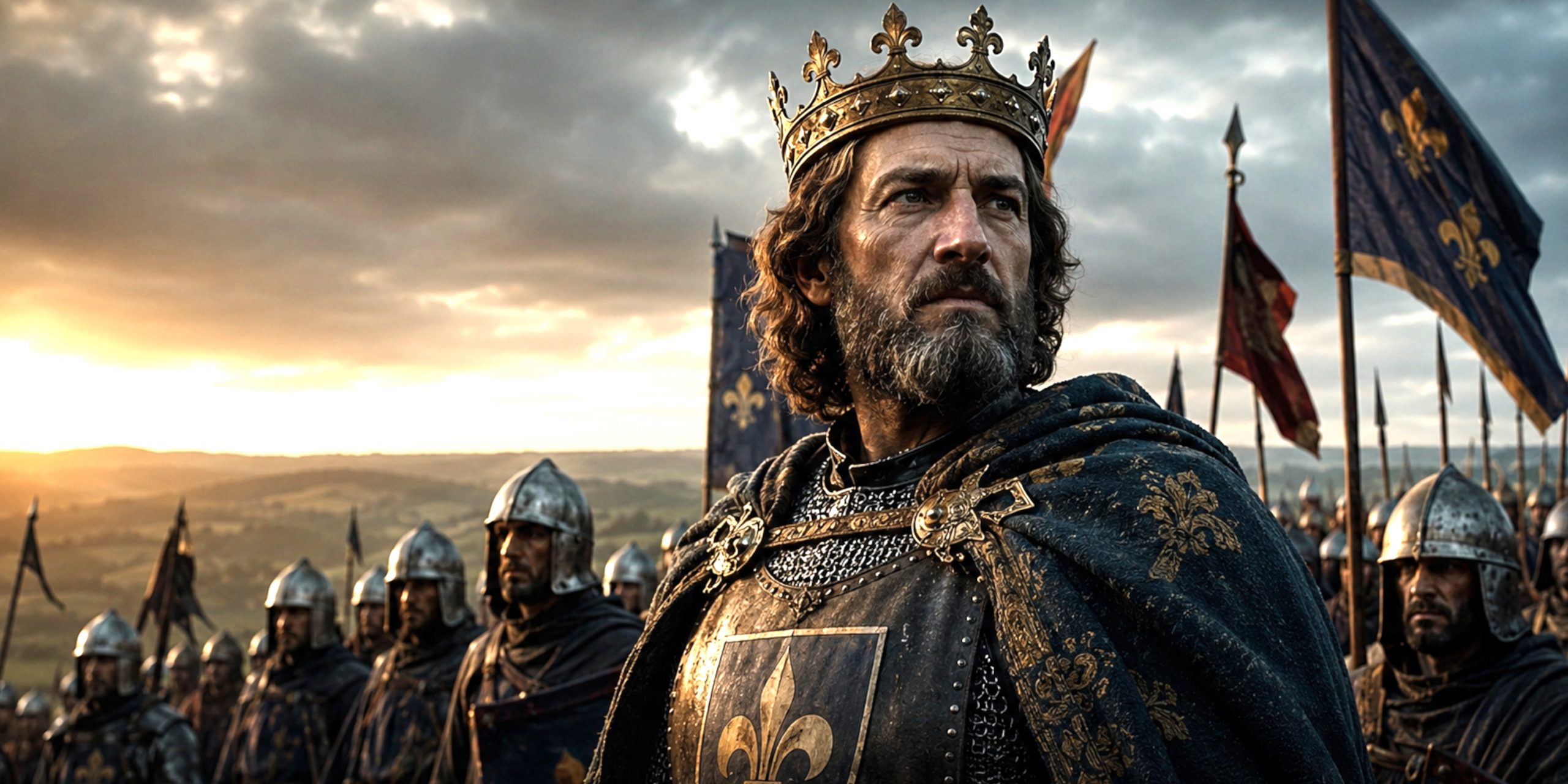
Hugh Capet is one of those rulers whose reputation becomes stranger the closer you look at it. He founded the dynasty that would dominate French monarchy for centuries, yet his own kingdom was fragmented, his military achievements were fairly modest, and several of the great lords who theoretically owed him allegiance possessed considerably more territory than he did.
There was no great Capetian conquest in 987. No dramatic battlefield victory created a new France overnight. Hugh’s achievement was subtler. He secured a disputed crown, survived a serious Carolingian challenge and, most importantly, arranged matters so that his son inherited what he had won.
For a king who reigned for only nine years, that was quite a piece of work.
| Hugh Capet | Details |
|---|---|
| Born | c. 939–941 |
| Father | Hugh the Great, Duke of the Franks |
| Mother | Hedwig of Saxony |
| Dynasty | Robertian, founder of the Capetian royal dynasty |
| Duke of the Franks | 956–987 |
| King | 987–996 |
| Wife | Adelaide of Aquitaine |
| Principal royal centres | Paris, Orléans and the surrounding royal domain |
| Main rival | Charles of Lower Lorraine |
| Son and successor | Robert II |
| Died | 24 October 996 |
| Burial | Basilica of Saint-Denis |
Who Was Hugh Capet?
Hugh was born around 939 to 941 into the immensely powerful Robertian family. His father, Hugh the Great, was Duke of the Franks and one of the dominant magnates of West Francia. His mother, Hedwig of Saxony, was a daughter of Henry the Fowler and sister of Otto I, the future Holy Roman Emperor.
Hugh therefore entered politics with an enviable family tree.
When Hugh the Great died in 956, his son inherited the title Duke of the Franks and substantial possessions centred on Paris and Orléans. Hugh was still young, however, and the politics surrounding his inheritance were complicated by Carolingian kings, competing aristocratic families and the influence of the Ottonian rulers to the east.
This matters because Hugh did not suddenly emerge in 987 as an ambitious noble who fancied becoming king. His family had been operating at the highest level of West Frankish politics for generations.
Two of his Robertian ancestors, Odo and Robert I, had already been kings.
Hugh simply made the arrangement permanent.
Why Was He Called Capet?
The origin of “Capet” is not completely straightforward, although the traditional explanation associates it with the Latin cappa, meaning a cloak or cape.
Hugh held important lay abbacies, including Saint-Martin of Tours, whose famous relic was associated with the cloak of Saint Martin. His nickname may therefore have developed from his ecclesiastical associations.
Contemporary and near-contemporary references do not always use “Capet” in the tidy dynastic sense familiar to us today. The label became much more significant because historians subsequently applied “Capetian” to Hugh’s descendants.
He would probably have been rather surprised to discover quite how much historical weight his nickname eventually had to carry.
West Francia Before Hugh Became King
To understand Hugh, it helps to forget the modern map of France.
The West Frankish kingdom of the late tenth century was a patchwork of powerful principalities. Normandy, Flanders, Aquitaine, Burgundy, Anjou and Blois all had rulers capable of acting with considerable independence.
Kingship remained prestigious and sacred, but royal orders did not automatically translate into obedience throughout the kingdom.
Hugh’s own effective territorial base lay principally between Paris and Orléans, with estates and rights scattered elsewhere. Some of the men who recognised him as king controlled territories far larger than the royal domain.
This is the apparent contradiction at the heart of early Capetian monarchy. The king could be territorially weak while remaining politically important.
The Death of Louis V and the Succession Crisis of 987
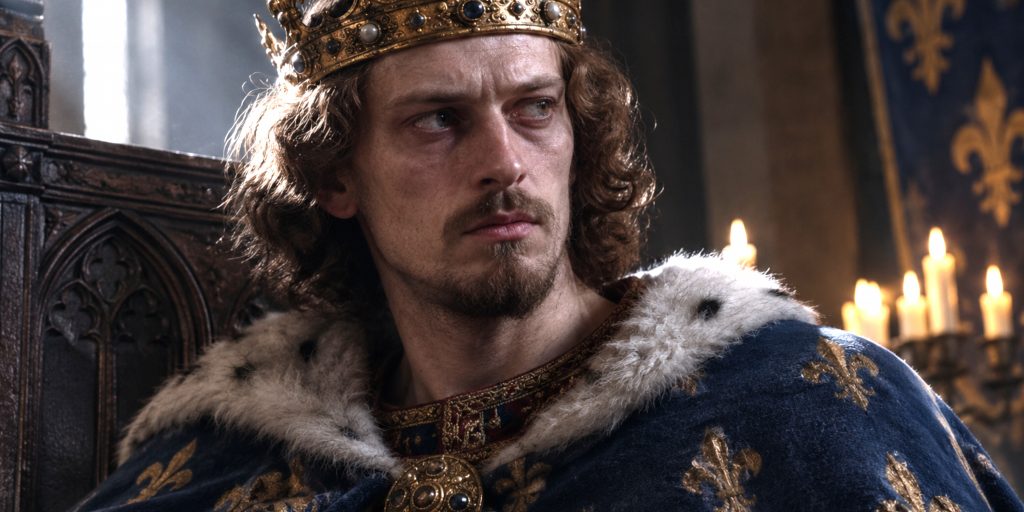
King Louis V died in May 987 without an heir.
The obvious Carolingian claimant was his uncle, Charles of Lower Lorraine. Yet Charles had spent much of his career closely associated with the Ottonian world and had enemies among the West Frankish political and ecclesiastical elite.
Hugh had a particularly influential supporter in Adalbero, Archbishop of Reims.
An assembly of magnates chose Hugh as king. According to the account preserved by Richer of Reims, Adalbero argued that the throne should go to a man distinguished by his qualities rather than simply passing according to hereditary right.
That argument was politically convenient, of course. Medieval constitutional principles have a remarkable habit of becoming flexible when the correct candidate is standing nearby.
Hugh was crowned in 987, traditionally associated with Noyon.
The Carolingians had lost the West Frankish crown.
The Capetian age had begun.
Making Robert King
Hugh’s cleverest move may have come almost immediately.
He arranged for his son Robert to be crowned during his own lifetime, in December 987.
Officially, the decision could be justified by the dangers facing the kingdom and the possibility that Hugh might die while campaigning. Politically, its usefulness is obvious. The election of Hugh could have established the principle that another magnate would simply be elected after his death.
By having Robert consecrated as co-king, Hugh presented succession as something approaching an accomplished fact.
Early Capetian kings repeatedly used this technique. Sons were crowned during their fathers’ lifetimes until hereditary succession became sufficiently secure that the practice was no longer necessary.
Hugh had been elected.
Robert would inherit.
That distinction helped change French history.
Hugh Capet’s Royal Domain
It is easy to exaggerate how little territory Hugh controlled, just as it is easy to exaggerate how much authority medieval kings possessed.
His strongest concentrations of power were around Paris and Orléans, supported by important estates, monasteries, offices and relationships spread across northern France.
The king’s authority also extended beyond land ownership.
Hugh possessed the prestige of consecrated kingship. He could summon assemblies, issue diplomas, intervene in episcopal appointments and draw legitimacy from the Church.
Royal power in 987 cannot therefore be measured simply by colouring Hugh’s personal estates on a map.
Still, nobody should mistake him for Louis XIV. Hugh had to negotiate constantly with aristocrats whose cooperation he required.
Charles of Lorraine Challenges the New King
The greatest military threat to Hugh’s reign came from Charles of Lower Lorraine.
Charles had an obvious advantage. He was a Carolingian.
To those who regarded hereditary descent as important, Hugh could be portrayed as an interloper who had taken a crown belonging to the old royal family.
In 988 Charles seized Laon, one of the most important Carolingian strongholds. The struggle continued for several years and demonstrated the limitations of Hugh’s military resources.
This was not a neat war ending in a heroic Capetian victory.
Hugh struggled to dislodge his rival.
The crisis was eventually resolved through politics and betrayal rather than battlefield brilliance.
The Capture of Charles of Lorraine
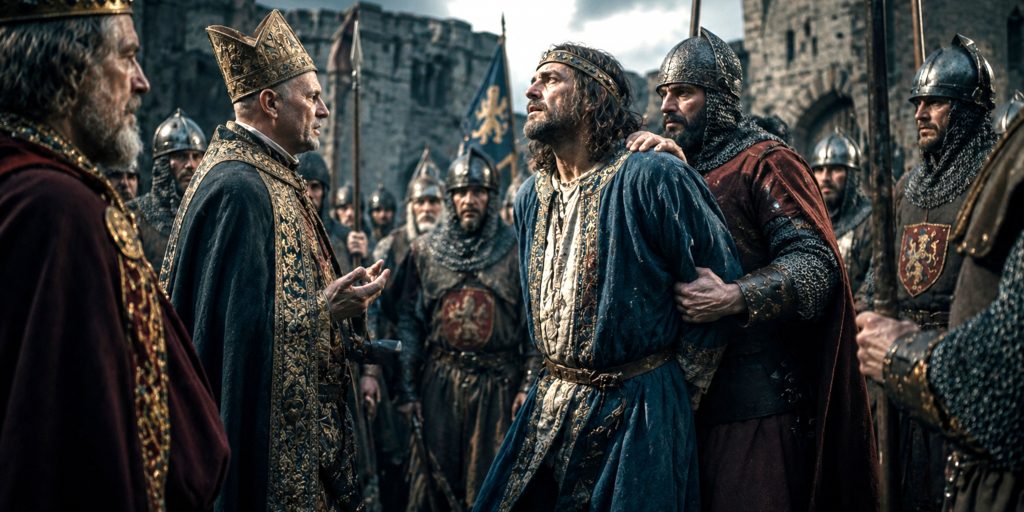
Adalbero, or Ascelin, Bishop of Laon, became the decisive figure.
Having gained Charles’s confidence, the bishop betrayed him in 991. Charles and Archbishop Arnulf of Reims were captured and delivered into Hugh’s hands.
Charles was imprisoned at Orléans and disappeared from active politics.
It was an enormously important moment.
The most dangerous Carolingian claimant had not been destroyed in a glorious battle. He had been removed through political manoeuvring.
That feels rather appropriate for Hugh’s reign.
The new dynasty survived because Hugh understood that medieval power was exercised through relationships, churchmen, fortresses, hostages and negotiated loyalties as much as through cavalry charges.
Battles and Military Campaigns
Hugh Capet’s reign contains relatively little conventional battlefield history.
| Conflict or campaign | Date | Hugh’s role | Result |
| Struggle against Charles of Lorraine | 988–991 | Defended his crown against the Carolingian claimant | Capetian victory |
| Fighting around Laon | 988–991 | Attempted to recover a major Carolingian stronghold | Initially unsuccessful |
| Laon campaign | c. 990 | Hugh and Robert operated against Charles | No decisive battlefield success |
| Capture of Charles | 991 | Political and ecclesiastical manoeuvring | Charles captured |
| Conflict involving Blois and royal allies | 990s | Supported allies against hostile magnates | Continued balance of power |
The absence of a famous “Battle of Hugh Capet” is revealing.
His reign was essentially a struggle for political survival rather than territorial conquest.
Hugh Capet’s Military Acumen
Calling Hugh a great general would be difficult to justify.
Calling him militarily incompetent would be equally misleading.
Hugh understood the strategic situation he inherited. His resources were limited, major aristocratic houses could field substantial forces, and an aggressive attempt to impose royal control across the entire kingdom could easily have united his enemies.
His approach was therefore cautious.
He relied on fortified centres, trusted nobles, bishops, family alliances and selective military pressure. When force did not work against Charles of Lorraine, Hugh remained politically engaged until circumstances produced another solution.
There is a lesson here about medieval warfare that popular history sometimes misses. Winning did not necessarily mean annihilating an enemy army.
Possessing the right fortress, bishop, hostage or marriage connection could accomplish rather more.
Hugh won the war that mattered. His dynasty remained on the throne.
What Did Hugh Capet’s Army Look Like?
There was no permanent French royal army in the modern sense.
When Hugh required military force, it would have been assembled from his household warriors, landed followers, allied nobles and contingents owing service through political and tenurial relationships.
Mounted aristocratic warriors were increasingly important. These men belonged to the developing military elite from which the later medieval knight would emerge.
Infantry remained essential, particularly during sieges and the defence of fortified places.
The warfare of Hugh’s lifetime was frequently local and seasonal. Raids, sieges, devastation of estates and struggles over castles could matter more than large set-piece battles.
Arms and Armour
No surviving sword, helmet or mail shirt can securely be identified as belonging to Hugh Capet.
Any reconstruction of his equipment must therefore be based on late Carolingian and tenth-century evidence rather than personal artefacts.
Sword
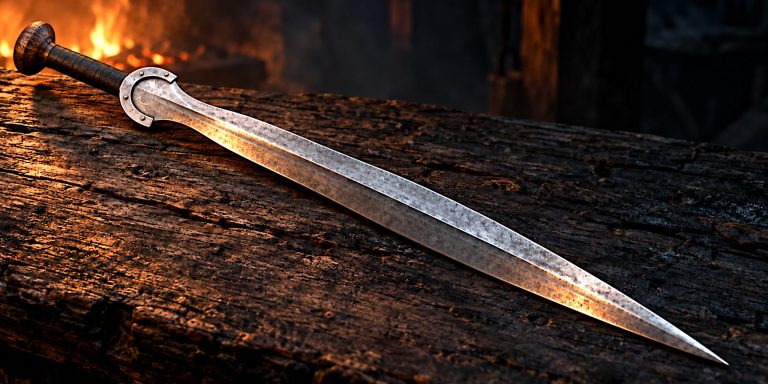
A high-ranking warrior such as Hugh could have carried a straight, double-edged sword descended from the Carolingian and Viking Age traditions.
These blades generally had broad cutting profiles and relatively simple guards. Elaborate hilts could advertise wealth and status.
A sword was both a weapon and an aristocratic object. For a man of Hugh’s position, symbolism mattered almost as much as edge geometry.
Lance
The lance was one of the most important weapons of mounted aristocratic warfare.
Cavalry tactics were evolving during the tenth and eleventh centuries. We should be cautious about projecting the fully developed image of the charging High Medieval knight backwards into Hugh’s lifetime, but mounted warriors armed with spears or lances were already central to elite warfare.
Mail represented the principal high-status body defence.
A wealthy warrior could wear a mail shirt over clothing or textile protection. Producing thousands of individually linked iron rings required considerable labour, making mail expensive equipment.
Helmet
Iron helmets offered vital head protection. Conical forms were known during the period, although the surviving archaeological record is limited.
The classic Norman nasal helmet belongs more securely to the eleventh-century visual world, so it is sensible not to dress Hugh automatically as a soldier from the Bayeux Tapestry several generations early.
Shield
Round and developing elongated shield forms existed around this broad period. The familiar long kite shield becomes particularly visible in eleventh-century sources.
For Hugh’s lifetime, reconstructions should therefore avoid presenting one shield type as universally standard.
The Reims Crisis
Once Charles had been captured, another political problem emerged.
Archbishop Arnulf of Reims was a Carolingian and had been associated with Charles. Hugh had him deposed and supported Gerbert of Aurillac as his replacement.
Gerbert was one of the outstanding intellectuals of medieval Europe and would later become Pope Sylvester II.
The deposition created a dispute with the papacy, which questioned whether the Frankish bishops possessed the authority to remove an archbishop without papal approval.
For Hugh, control of Reims was intensely political. Reims was one of the great ecclesiastical centres of the kingdom and closely connected with royal legitimacy.
The episode shows just how inseparable religion and politics were in Hugh’s world.
Hugh Capet and the Church
Hugh’s relationship with the Church was one of the foundations of his authority.
Kingship was sacred as well as political. Coronation and anointing transformed the king into more than the largest landowner in the room.
Hugh also possessed longstanding connections with important monasteries and ecclesiastical institutions.
This did not make him obedient to churchmen. The Reims dispute proves quite the opposite.
Hugh wanted ecclesiastical support, but he also wanted influential episcopal positions occupied by people whose political loyalties he could trust.
Medieval kings and bishops could argue magnificently about spiritual principles when an extremely valuable archbishopric happened to be involved.
Hugh Capet and the Great Nobles
Hugh’s relationships with the aristocracy required constant management.
The counts of Blois were particularly important competitors. The counts of Anjou, including the formidable Fulk Nerra, also participated in the shifting political struggles of the period.
Normandy remained effectively governed by its own dynasty.
Aquitaine was even further removed from regular royal interference.
The king therefore presided over a political community rather than a tightly administered territorial state.
Hugh’s achievement was keeping himself at the centre of that community.
Marriage and Family
Hugh married Adelaide of Aquitaine, daughter of William III of Aquitaine.
Their children included Robert II, who succeeded Hugh, and daughters including Hedwig and Gisela.
The marriage connected Hugh with another major aristocratic family and illustrates how dynastic relationships formed part of the political infrastructure of medieval Europe.
Robert’s succession became the family’s most important success.
Once Robert inherited peacefully in 996, the Capetian experiment had survived its first transfer of power.
That was arguably more important than anything Hugh achieved on campaign.
Was Hugh Really “King of France”?
Using the title “King of France” is convenient but slightly anachronistic if interpreted in its later sense.
Hugh’s kingship belonged to the political tradition of the Franks, and royal terminology developed gradually. The idea of a clearly bounded French territorial monarchy was still evolving.
This distinction matters because later maps can make Hugh look like the ruler of something resembling modern France.
He was not.
His kingdom contained extraordinarily powerful regional princes and deeply entrenched local structures of authority.
The later Capetian monarchy was built slowly from these beginnings.
Royal Government Under Hugh
Hugh’s administration remained relatively small and personal.
Royal diplomas, ecclesiastical patronage, assemblies and relationships with leading aristocrats formed important mechanisms of government.
There was nothing resembling the extensive bureaucratic monarchy created by later Capetians.
Even royal coinage demonstrates the limitations of Hugh’s power. The Library of Congress notes the absence of a substantial purely royal coinage under Hugh, contrasting sharply with the stronger monetary authority developed by later French kings.
The monarchy Hugh founded was therefore powerful in legitimacy but still comparatively weak in administrative reach.
That combination would define the challenge facing his descendants.
Hugh Capet’s Coins and Seals
Material evidence directly connected with Hugh is frustratingly scarce.
Coins attributed to his reign exist, although attribution and minting authority require care. A denier associated with Hugh and Hervé, bishop of Beauvais, survives in the collection of the Musée Carnavalet.
Evidence for Hugh’s royal seal is even more elusive. The original seal is no longer securely preserved and is principally known through later drawings. Research into early Capetian sigillography shows how royal seals became increasingly substantial under his successors.
For anyone interested in the material origins of Capetian monarchy, this scarcity is rather fitting. Hugh founded an enormously important dynasty while leaving surprisingly little royal hardware behind.
Where Did Hugh Capet Live?
Hugh’s political world revolved heavily around Paris and the royal lands of the Île-de-France, although medieval kings were itinerant and government travelled with them.
Paris was important to the Robertians long before it became the commanding capital of later France.
Royal residences of Hugh’s period have been transformed, rebuilt or destroyed repeatedly. Visitors looking for “Hugh Capet’s palace” will therefore be disappointed if expecting an intact tenth-century royal residence.
The physical city visible today belongs overwhelmingly to later centuries.
Its political importance, however, was already developing.
Hugh Capet’s Death
Hugh died on 24 October 996.
The precise circumstances of his final illness are not securely enough documented to justify some of the confident diagnoses repeated in popular accounts.
He was buried at Saint-Denis, the great royal abbey north of Paris.
His son Robert II succeeded him.
That peaceful succession was the real monument to Hugh’s reign.
There was no renewed election that displaced the family. No Carolingian restoration followed. The crown remained Capetian.
What Happened to Hugh Capet’s Tomb?
Saint-Denis became the great necropolis of French monarchy, but the tombs suffered badly during the French Revolution.
Royal graves were opened and remains disturbed or removed in 1793. Later restoration attempted to recover and reorganise the surviving royal monuments.
Consequently, visitors should distinguish between Hugh’s historical burial at Saint-Denis and the later monuments, restorations and rearrangements visible within the basilica.
The site remains essential for understanding the dynasty he founded, even though its archaeological history is considerably messier than a neat line of untouched royal tombs.
Where to See Artefacts and Evidence From Hugh Capet’s World
There is no surviving collection of personal possessions comparable with those associated with much later monarchs. The best approach is to explore objects, manuscripts and sites belonging to Hugh’s political and material world.
Musée Carnavalet, Paris
The museum’s numismatic collection includes a denier associated with Hugh Capet and Bishop Hervé of Beauvais. It is one of the most tangible objects connected with the monetary world of his reign.
Bibliothèque nationale de France, Paris
The BnF preserves manuscripts, later genealogical material, documentary collections and historical sources relating to Hugh and the earliest Capetians. Its collections are particularly valuable for anyone interested in how Hugh’s reign was recorded and subsequently remembered.
Basilica of Saint-Denis
Hugh was buried here, and the basilica became inseparable from the history of French monarchy. Most of what visitors see belongs to later phases, but few places better demonstrate what the Capetian dynasty eventually became.
Laon
Laon was at the centre of Hugh’s struggle against Charles of Lorraine. The medieval city visible today is largely later, but its geography helps explain why possession of this elevated fortified centre mattered so much.
Reims
Reims was politically crucial during Hugh’s reign because of Archbishop Adalbero, Arnulf and the struggle over the archbishopric. The present cathedral postdates Hugh, so it should be treated as a historical location rather than surviving architecture from his coronation age.
Archaeology and the World of Hugh Capet
There has been no recent archaeological discovery that can convincingly be advertised as “Hugh Capet’s sword”, palace treasure or personal armour.
That is worth stating because archaeology becomes less useful when every tenth-century object found near Paris is quietly promoted into royal property.
What archaeology is improving is our understanding of the society in which the first Capetians operated.
Excavation and reassessment of early medieval settlements, churches, fortified sites and elite residences are revealing a landscape in which political authority was becoming increasingly localised around defended centres and aristocratic estates.
This is particularly relevant to Hugh’s reign.
The late tenth century sits within a difficult archaeological transition between the Carolingian world and the castle-dominated landscape more familiar from the eleventh and twelfth centuries. Fortification was not suddenly invented around the year 1000. Instead, historians and archaeologists increasingly examine gradual changes in elite residences, settlement patterns, defensive works and territorial lordship.
Ongoing archaeological work at major French medieval sites continues to refine this wider picture. At Fontainebleau, for example, Inrap investigations associated with redevelopment have uncovered previously unknown medieval remains, demonstrating how much evidence can survive beneath later royal complexes. The excavations continue within a programme extending into 2026. They do not directly concern Hugh Capet, but they illustrate how archaeological work is revising the physical history of medieval centres traditionally understood mainly through later buildings.
For Hugh himself, documentary archaeology remains frustratingly stronger than personal archaeology. We have political landscapes, contemporary material culture and documentary traces, but remarkably few objects that can be placed in the king’s hands with confidence.
What Contemporary Sources Tell Us
One of the most important narrative sources for Hugh’s rise is Richer of Reims, whose Histories cover the political world surrounding the collapse of Carolingian rule.
Richer was close enough to events to be invaluable, but he was not a neutral modern reporter. His account reflects the intellectual, ecclesiastical and political environment of Reims.
That is precisely why it is so interesting.
The arguments surrounding Hugh’s election reveal how contemporaries could frame legitimate kingship around ability, public good, aristocratic choice and religious authority as well as bloodline.
Later Capetian success can make the outcome look inevitable.
Richer’s world reminds us that it was anything but.
Hugh Capet’s Historical Reputation
Hugh suffers from the success of his descendants.
Philip Augustus conquered territory. Louis IX became a saint. Philip IV challenged popes. Later Capetian and Valois kings presided over an increasingly powerful French monarchy.
Hugh looks rather small beside them.
That comparison misses the point.
He inherited a political system in which kingship could easily have passed between aristocratic families. The Carolingian claim had not magically vanished when Hugh was crowned. Regional princes possessed enormous autonomy.
Yet when Hugh died, his son was king.
Then Robert’s descendants continued to reign.
The Capetian crown gradually stopped looking like one possible outcome of aristocratic politics and began looking hereditary.
That transformation started with Hugh.
How Important Was Hugh Capet?
If historical importance were measured purely by conquered territory, Hugh would not rank especially highly among medieval rulers.
If it is measured by consequences, he becomes difficult to ignore.
His descendants formed the direct Capetian line and later the Valois and Bourbon branches. Capetian dynastic descendants ruled not only France but kingdoms and principalities across Europe.
The monarchy itself changed enormously along the way. Hugh would barely have recognised the centralised kingdom governed by Philip IV, much less the France of Louis XIV.
That is precisely what makes his reign fascinating.
The dynasty did not begin powerful.
It became powerful.
The Seven Swords Takeaway
I find Hugh Capet more interesting than many kings with much longer lists of battles beside their names.
There is something wonderfully misleading about beginning the history of one of Europe’s greatest dynasties with a king whose authority could sometimes look painfully fragile.
Hugh did not conquer France. He could not simply order the great princes around, and his attempt to defeat Charles of Lorraine demonstrated the limits of Capetian military strength. His monarchy depended on bishops, alliances, family connections and the cooperation of men who were powerful enough to cause him serious trouble.
Yet he understood the central problem better than most.
The crown had to survive him.
By securing Robert’s coronation and defeating the Carolingian challenge, Hugh transformed a successful election into the beginning of a dynasty. His descendants then had something priceless to work with: time.
The Capetians would spend centuries turning that inheritance into a powerful monarchy.
Hugh’s kingdom was modest.
His legacy was anything but.