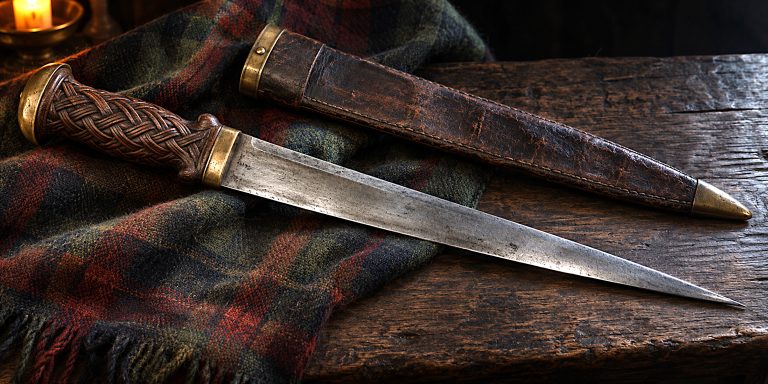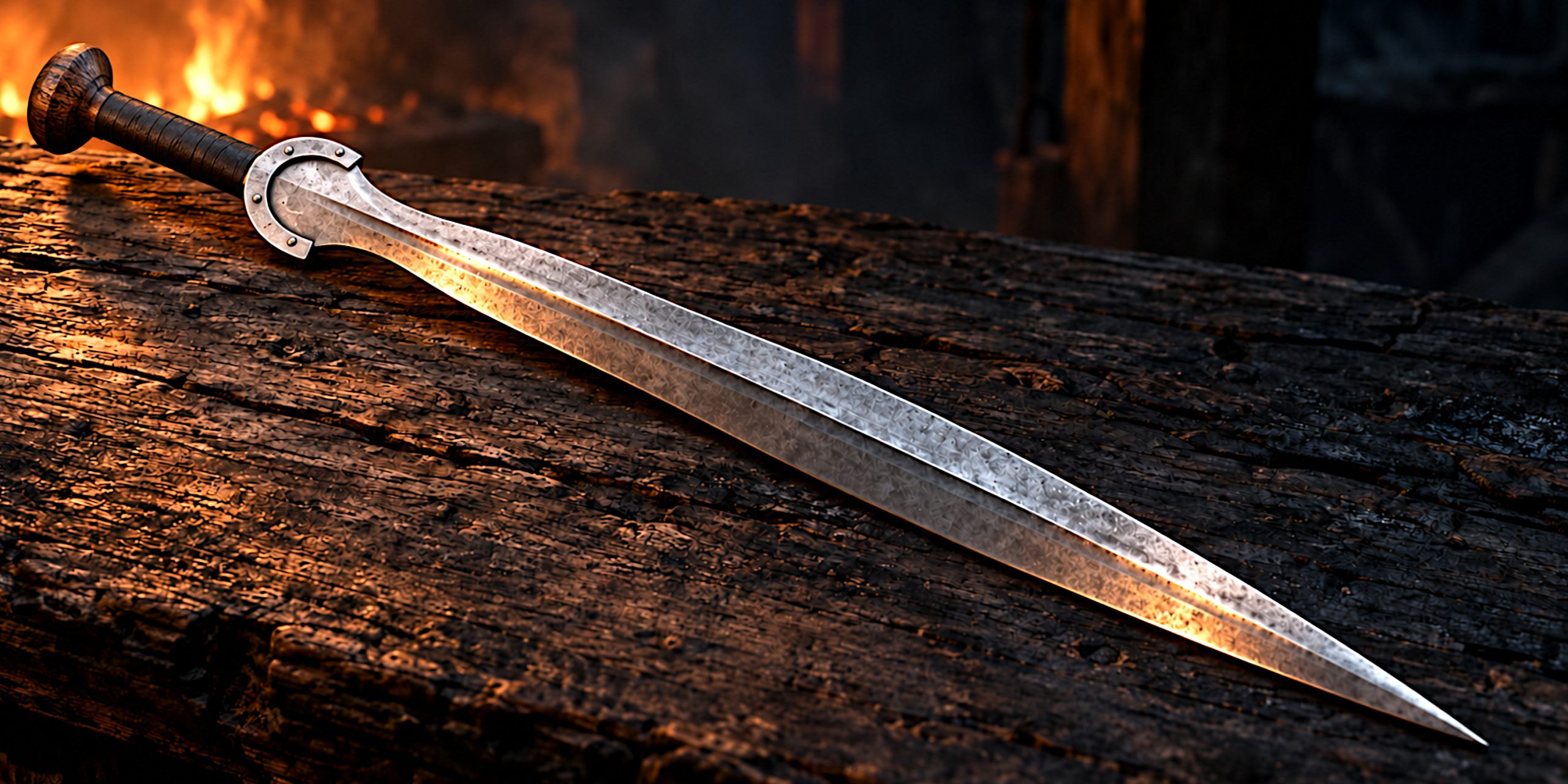
A Hallstatt sword could announce its owner’s position before it ever left its scabbard. A long blade, an imposing pommel and, in exceptional examples, imported ivory or amber made an expensive statement. Whether everyone nearby appreciated that statement is another matter.
The term Hallstatt sword covers related weapons rather than one standard design. These swords belong to the transition between Europe’s later Bronze Age traditions and the early Iron Age, when established bronze-working skills existed alongside developing iron technology.
Their importance lies in that overlap. Bronze did not suddenly become useless, and an iron blade did not automatically provide a better weapon. The surviving swords reveal a more interesting history of experimentation, regional preferences and the close relationship between weapons and social standing.
What Is a Hallstatt Sword?

Hallstatt swords take their name from the Austrian settlement and cemetery that gave the wider archaeological culture its name. However, related swords occur well beyond Hallstatt itself.
Two particularly important types are:
- Gündlingen swords, generally associated with bronze blades and continuing late Bronze Age traditions.
- Mindelheim swords, often longer weapons made in bronze or iron, with distinctive hilt arrangements and broad, hat-shaped pommels.
The terminology needs care. Archaeologists use Hallstatt A and B for late Bronze Age chronological phases, while Hallstatt C and D refer to the early Iron Age. Consequently, an auction catalogue describing a “Hallstatt bronze sword” may be discussing something substantially earlier than the classic iron long swords.
At the Hallstatt cemetery, the characteristic bronze and iron swords belong principally to Hallstatt C, approximately 800–600 BCE. Later burials increasingly feature elaborate daggers. British Museum
Hallstatt Sword Specifications
There was no universal Hallstatt specification. Measurements depend on the type, date and completeness of the surviving weapon.
| Feature | Description |
|---|---|
| Main period of classic long swords | Approximately eighth to seventh centuries BCE, with regional variation |
| Principal materials | Cast bronze or forged iron |
| Blade arrangement | Straight, double-edged |
| Blade profile | Commonly gently leaf-shaped, although proportions and points vary |
| Blade length | Substantial variation, from around 55 cm in some bronze examples to approximately 90 cm in large Mindelheim forms |
| Blade section | Often strengthened by a central ridge or raised midrib |
| Grip construction | Commonly a flat tang with attached organic grip components |
| Grip materials | Wood, bone or ivory, depending on the example |
| Pommel | Broad hat-shaped forms are characteristic of Mindelheim swords |
| Hand protection | No substantial projecting crossguard comparable with a medieval sword |
| Weight | No reliable universal figure; corrosion and missing fittings complicate comparisons |
For a specific reference point, the British Museum’s Gündlingen sword WG.1238 has a recorded blade length of 56.2 cm. This is a useful reminder that not every Hallstatt-associated sword was an exceptionally long weapon.
A table is convenient. Treating it as a prehistoric manufacturer’s catalogue would be less sensible.
History and Evolution
Late Bronze Age foundations

Hallstatt sword designs developed from existing European sword-making traditions. Bronze smiths already understood how blade shape, thickness and hilt construction affected a weapon’s performance.
The introduction of iron therefore involved adapting established ideas as well as developing new working methods. Casting a bronze blade and forging an iron one demanded different skills, even when their finished outlines looked similar.
Bronze and iron in parallel
The early Iron Age was a period of coexistence. Bronze remained useful, familiar and capable of producing effective weapons.
Iron’s performance depended on its composition and manufacture. Slag inclusions, carbon distribution and the smith’s working methods all mattered. Describing every early iron sword as harder, tougher or better at retaining an edge than bronze goes beyond the evidence.
Metallurgical study also remains uneven. The surviving objects are numerous enough to establish broad forms, but detailed analysis covers a much smaller sample.
Weapons and wealth
Some Hallstatt swords carried fittings that required access to distant materials. Vienna’s Natural History Museum identifies iron swords with ivory handles and amber inlays among the evidence for Hallstatt’s extensive exchange networks.
Such weapons combined practical potential with conspicuous expense. Their owners were participating in a world where access to materials, skilled labour and connections could be displayed on a sword hilt.
The later shift towards daggers
During the later Hallstatt period, richly furnished graves in parts of the cultural zone increasingly included daggers rather than long swords.
This change should not be read as proof that swords vanished from everyday warfare. Burial customs record choices about commemoration and status, as well as equipment. They are evidence, but they are not an army inventory.
How Were Hallstatt Swords Used?
Hallstatt swords were capable weapons, but their precise use must be reconstructed from their physical characteristics and archaeological context.
Long blades offered reach and cutting potential. More pointed examples could also deliver effective thrusts, while blade section and tip shape influenced how suitable an individual sword was for either action.
Important qualifications include:
- Not every type handled alike. A shorter bronze sword and a long iron Mindelheim blade should not be assigned identical fighting characteristics.
- Mounted use is plausible for some long forms. Length alone does not establish that a sword was exclusively a cavalry weapon.
- Prestige and practicality could coexist. Expensive fittings do not automatically make a sword ceremonial.
- No surviving Hallstatt fencing manual explains the techniques. Modern reconstructions remain interpretations.
The safest approach is to discuss a particular sword’s design rather than invent a single fighting system for an extensive archaeological culture.
Advantages and Disadvantages
These assessments concern design and manufacture. Individual weapons could differ considerably.
| Advantages | Practical significance |
|---|---|
| Long reach in larger examples | Allowed the wielder to threaten an opponent from farther away |
| Two cutting edges | Provided usable edges on both sides of the blade |
| Reinforcing midrib | Helped stiffen the blade without requiring uniform thickness |
| Established bronze-working traditions | Supported sophisticated blade manufacture before iron became dominant |
| Recognisable prestige fittings | Communicated wealth and standing as well as ownership |
| Disadvantages | Practical significance |
|---|---|
| Limited hand protection | Left the hand more exposed than on swords with substantial guards |
| Variable iron quality | Performance depended heavily on material preparation and workmanship |
| Length of larger forms | Required space and control, particularly in confined fighting |
| Organic hilt components | Could loosen, deteriorate or require replacement |
| Iron corrosion | Creates serious preservation problems for surviving originals |
The key distinction is between material and workmanship. “Iron” describes what a blade contains, not how well it was made.
Comparison with Similar Weapons
| Weapon | Broad context | Main characteristics | Relationship to Hallstatt swords |
|---|---|---|---|
| Late Bronze Age leaf-shaped sword | European Bronze Age | Double-edged bronze blade, frequently with a pronounced leaf profile | Provides important design and manufacturing precedents |
| Gündlingen sword | Late Bronze Age to early Iron Age transition | Usually bronze, with a flange-hilted construction | One of the principal Hallstatt-associated sword types |
| Mindelheim sword | Especially early Hallstatt Iron Age | Often long, made in bronze or iron, with characteristic broad pommel forms | Represents the imposing long-sword tradition commonly associated with Hallstatt C |
| Hallstatt antenna-hilted dagger | Particularly later Hallstatt contexts | Short blade with distinctive projecting pommel terminals | Illustrates changing choices in elite weapon burial |
| La Tène sword | Later European Iron Age | Diverse iron swords with evolving blades, hilts and scabbards | Belongs to subsequent traditions rather than one uniform replacement model |
Simple rankings are misleading here. Bronze Age swords were not all crude chopping tools, and La Tène swords were not all specialised thrusting weapons.
The British Museum even records swords combining Gündlingen and British Ewart Park features, demonstrating how untidy real objects can be beside our tidy categories.
Archaeology and Legacy
Hallstatt swords help archaeologists examine more than the development of blades. Their manufacture, distribution and deposition offer evidence for:
- The adoption of iron-working.
- Connections between different regions.
- Access to imported luxury materials.
- The presentation of martial identity in burial.
- Differences between functional equipment and funerary display.
Their legacy should not be reduced to a direct family tree leading neatly to Roman and medieval swords. European weapon development involved interruptions, borrowing and changing requirements.
What makes these swords compelling is the combination of technological change and personal display. A blade could be a practical possession, an expensive commission and part of how someone wished to be remembered.
Where to See Hallstatt Swords
Naturhistorisches Museum, Vienna, Austria
Vienna holds a major collection from the Hallstatt cemetery. Its early Iron Age holdings include an exceptional sword with an ivory pommel decorated with amber inlays. The museum also places the weapons within the wider story of mining, trade and burial. Early Iron Age
Welterbemuseum Hallstatt, Austria
The museum provides the local archaeological context for the cemetery and salt-mining community. The Natural History Museum in Vienna identifies it as another repository of Hallstatt finds. Burial Site
British Museum, London, UK
The collection includes Hallstatt-related bronze swords and early iron examples. Useful catalogue references include:
- WG.1238, a Gündlingen-type bronze sword.
- ML.2928, an iron sword discussed in relation to Hallstatt C forms.
These records are valuable for comparing construction and condition, even when an object is not displayed.
Check individual display status before travelling specifically to see a particular sword.
Collectors’ Guide: Identification and Condition
A convincing outline is only the beginning of identifying an ancient sword. The relationship between blade, tang, rivets and surviving fittings matters more than an attractive green or brown surface.
Before buying, examine:
- Documented ownership history: Seek dated invoices, earlier catalogue appearances and identifiable collection records.
- Attribution: Establish whether “Hallstatt” describes a chronological phase, a sword type or a broad sales category.
- Completeness: Determine whether the point, tang and hilt belong together.
- Restoration: Ask about joined breaks, replacement metal, reconstructed grips and concealed supports.
- Condition: Request clear photographs of both faces, edges, tang and damaged areas.
- Independent assessment: Obtain specialist advice where the attribution or restoration substantially affects value.
Descriptions such as “ritual sword” deserve particular scrutiny. A seller’s interpretation is not the same thing as an excavated context demonstrating ritual use.
For handling and display, a clearly identified modern reproduction avoids exposing a fragile original to unnecessary damage. A valuable archaeological object makes a poor test-cutting experiment.
Hallstatt Sword Auction Prices
Published prices need to be separated into estimates, starting prices and recorded sales. They also need to distinguish early Iron Age swords from older weapons described using Hallstatt chronological terminology.
| Auction example | Published figure | What the figure establishes |
|---|---|---|
| Hermann Historica, auction 95, lot 6122, January 2023: Hemigkofen-type bronze sword dated to the twelfth or eleventh century BCE, Hallstatt A | €1,200 starting figure; €8,750 reported sale price | A documented result for an earlier Bronze Age comparison, not a Hallstatt C iron sword |
| Apollo Art Auctions, lot 494, 13 October 2024, catalogued as a “Hallstatt Bronze Age Ritual Sword” | £3,000–£6,000 estimate | An auction estimate only; a publicly verifiable realised price was not available in the consulted listing |
Hermann Historica’s own report confirms the €8,750 result. The Apollo listing supplies the estimate, but its attribution and “ritual” description remain catalogue claims. Hermann Historica
These examples do not support a dependable price band for all Hallstatt swords. Material, date, completeness, restoration and ownership history vary too widely.
When comparing lots:
- Compare like types and periods.
- Record whether buyer’s premium is included.
- Keep estimates separate from results.
- Include restoration and missing components in the comparison.
- Retain original currencies unless a dated conversion is necessary.
A headline price without those details tells a collector surprisingly little.