greatest possession thrown away.
You can recognise these scenes without having read a page of medieval literature. That familiarity helps explain Excalibur’s remarkable position. Other legendary swords have equally rich histories, but few have travelled so widely beyond the stories that first gave them meaning.
Calling it the world’s most famous sword is difficult to prove statistically. Yet Excalibur has a strong claim through its extraordinary reach across literature, illustration, cinema and popular culture.
What interests me is how it acquired that reach. Its fame grew through memorable storytelling, centuries of adaptation and an association with a king whose failures proved almost as compelling as his achievements.
A Sword With Stories People Remember
Excalibur benefits from something many legendary weapons lack: several instantly recognisable scenes.
The sword in the stone makes kingship visible. Nobody needs a lengthy explanation of inheritance law to understand the moment. Important men try and fail. An apparently insignificant boy succeeds. The audience understands that the established order has missed something.
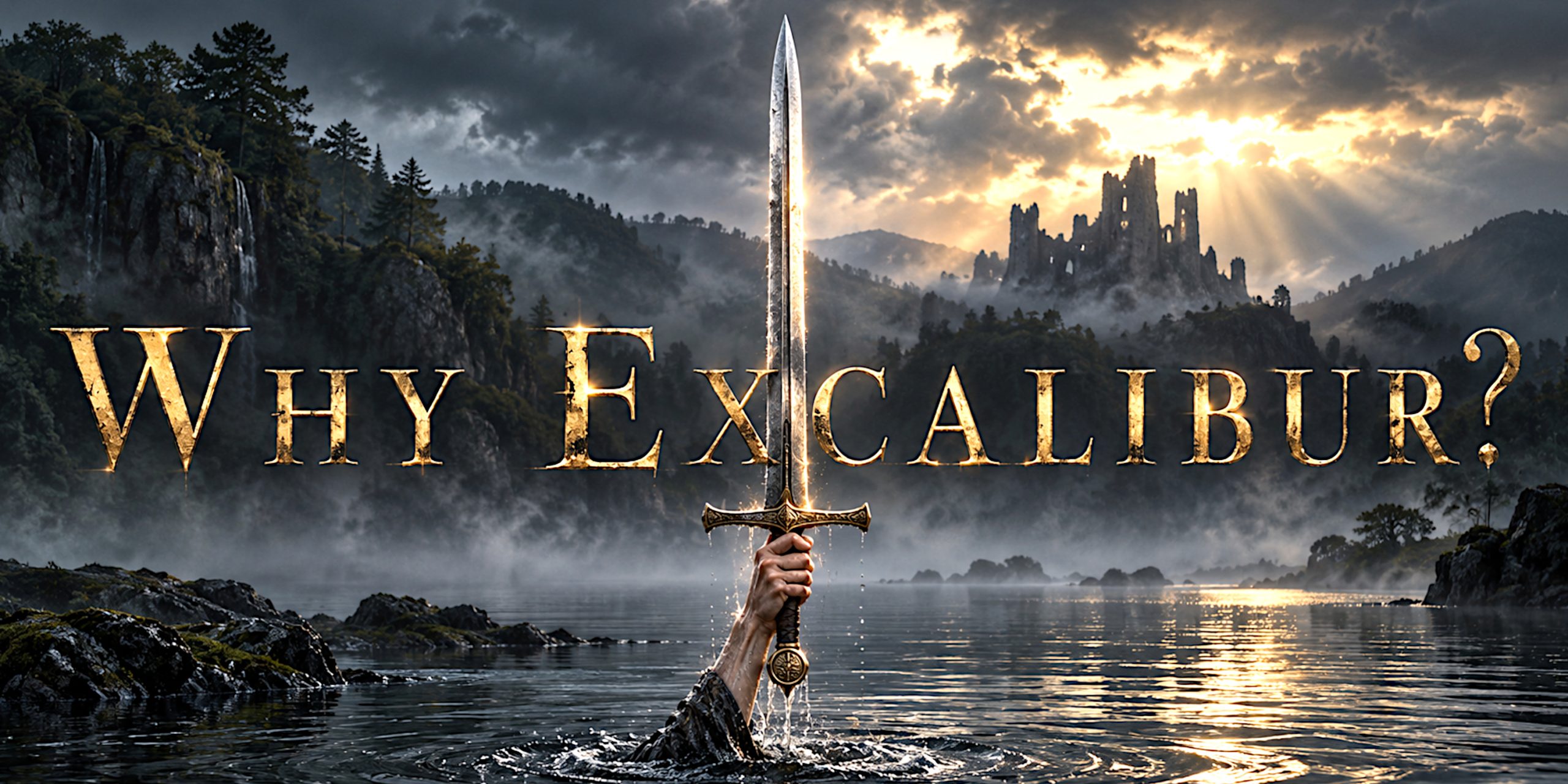
The lake offers a different image. An arm emerges from the water holding a weapon, making the supernatural briefly tangible. At the other end of Arthur’s reign, the sword returns beneath the surface.
These episodes do not form one consistent tradition. In the main sequence followed by Thomas Malory, the sword drawn from the stone breaks, and Arthur subsequently receives Excalibur from the Lady of the Lake. Malory nevertheless uses the name Excalibur for the earlier sword in one passage. The neat distinction often made today is therefore slightly neater than the medieval text. d.lib.rochester.edu
For Excalibur’s fame, that confusion has probably helped. Popular retellings could gather the strongest images around one name. Literary consistency suffered a little; recognition did rather well.
Excalibur Made Authority Look Convincing

Many swords demonstrate that their owners are dangerous. Arthur’s sword traditions also help explain why he should rule.
The drawing of the sword turns a disputed succession into a public test. Arthur possesses a qualification that the assembled nobility cannot reproduce, however impressive their ancestry or their opinion of themselves.
There is an appealing promise here: the right person might be overlooked by society, yet recognised by something beyond it.
That promise needs qualification. Arthur is not simply an ordinary boy defeating hereditary privilege. In influential versions, he is Uther Pendragon’s son, and the miracle reveals his concealed royal identity. Medieval romance has not quietly introduced an open recruitment process.
Even so, the scene allows audiences to experience authority as something demonstrated rather than merely announced. That makes an abstract political claim unusually satisfying to watch.
Arthur Gave the Sword a Larger Emotional Life
Excalibur’s reputation cannot be separated from Arthur’s.
Geoffrey of Monmouth helped establish Arthur as a powerful monarch in his twelfth-century History of the Kings of Britain. Later writers expanded the court around him, developing its fellowship, romances, rivalries and eventual destruction. The surviving manuscripts show a legend repeatedly reshaped for different audiences.
The sword consequently belongs to a much larger emotional world. It accompanies the hope that a kingdom can be ordered well, then survives long enough to witness that hope collapse.
I think this gives Excalibur much of its staying power. A weapon associated only with victories has a limited dramatic range. Arthur’s sword carries the memory of what his reign promised and what it failed to preserve.
We remember the blade partly because we know it cannot save him.
Medieval Writers Allowed the Legend to Grow
Excalibur did not arrive fully formed.
The Welsh tale Culhwch and Olwen names Arthur’s sword as Caledfwlch, one of the possessions he specifically excludes from an otherwise generous offer. Geoffrey calls the weapon Caliburnus and associates its manufacture with Avalon. Later traditions develop the sword’s identity and adventures further.
This gradual development mattered. The sword could acquire new associations as Arthurian material moved between languages and literary cultures.
No single author controlled its meaning. A writer could emphasise its marvellous origins, its effectiveness in battle or its relationship with kingship. Another could concentrate on the sorrow of surrendering it.
That flexibility helped Excalibur survive changes in taste. Readers did not have to value every part of Arthurian romance equally to find something compelling in the sword.
Its Most Interesting Power Was a Limitation
A less thoughtful version of Excalibur would simply make Arthur unbeatable. The medieval material is more interesting.
In Malory, Merlin tells Arthur that the scabbard is worth more than the sword because its wearer will lose no blood, however badly wounded. Morgan le Fay later steals and disposes of it. The splendid blade remains, but its owner has lost a crucial protection.
I have always preferred this detail to extravagant claims about an indestructible weapon. Arthur admires the object that helps him fight. Merlin values the object that keeps him alive. One suspects Merlin would have been tiresome, but useful, on a procurement committee.
More seriously, the episode prevents possession of the sword from becoming a complete answer to Arthur’s problems. He remains vulnerable to deception, misplaced trust and the consequences of his own choices.
Excalibur can be extraordinary without making its story predictable.
The Return to the Lake Gave It an Unforgettable Ending

The sword’s departure may explain its enduring appeal as much as its arrival.
In the familiar ending, Arthur orders Bedivere to throw Excalibur into the water. Bedivere hesitates and initially conceals his disobedience. Giving up something so precious seems intolerable.
Tennyson later developed this reluctance in The Passing of Arthur, making the surrender of the sword part of the anguish of losing Arthur’s world.
Bedivere’s hesitation gives the scene its emotional credibility. We understand why he wants to preserve the weapon. It is beautiful, valuable and connected to someone he cannot bear to lose.
Yet keeping it would violate Arthur’s final command.
My reading is that this is where Excalibur becomes most affecting. The great heroic object demands an act of relinquishment. Its last important action is to leave human hands.
Later Generations Kept Finding Uses for It
Excalibur also benefited from repeated exposure through new forms of storytelling.
Tennyson brought Arthurian material to Victorian readers. Illustrated books gave the sword a visual identity. Cinema introduced the legends to audiences who might never encounter their medieval sources, including through Disney’s The Sword in the Stone and John Boorman’s Excalibur. The University of Rochester’s Camelot Project documents the continuing interaction between these literary and screen traditions.
Each adaptation offered another point of entry. Someone might discover Arthur through a childhood film, return through a novel and eventually become curious about Malory.
The sword is particularly suited to that movement. Its central scenes can be understood quickly, while the surrounding literature rewards closer attention. It works as an image before an audience knows its history.
Why Excalibur Became More Widely Recognised Than Other Legendary Swords
Gram, Durandal, Joyeuse and Kusanagi belong to substantial traditions of their own. Their significance should not be measured solely by how readily an English-speaking audience recognises their names.
Excalibur’s particular advantage is its place within an exceptionally adaptable body of stories.
It can represent rightful succession, supernatural assistance, military power, personal vulnerability or the end of a kingdom. It also has several memorable settings and actions. The stone, the lake and the final surrender give artists and storytellers material that remains recognisable even when the details change.
Its broad fame reflects centuries of circulation and adaptation, rather than proof that its original legend was inherently superior to every other sword story.
A Famous Sword That Could Not Save Its King
For me, Excalibur endures because its splendour never entirely conceals the sadness around it.
Arthur receives an extraordinary weapon, but extraordinary equipment cannot prevent a kingdom from coming apart. The sword survives the ambitions and relationships that gave it meaning, then disappears when its work is finished.
That combination is powerful: the pleasure of imagining a weapon touched by another world, followed by the recognition that even such a weapon has limits.
We remember Excalibur being drawn and raised. We also remember that, eventually, someone has to let it go.