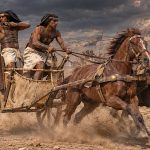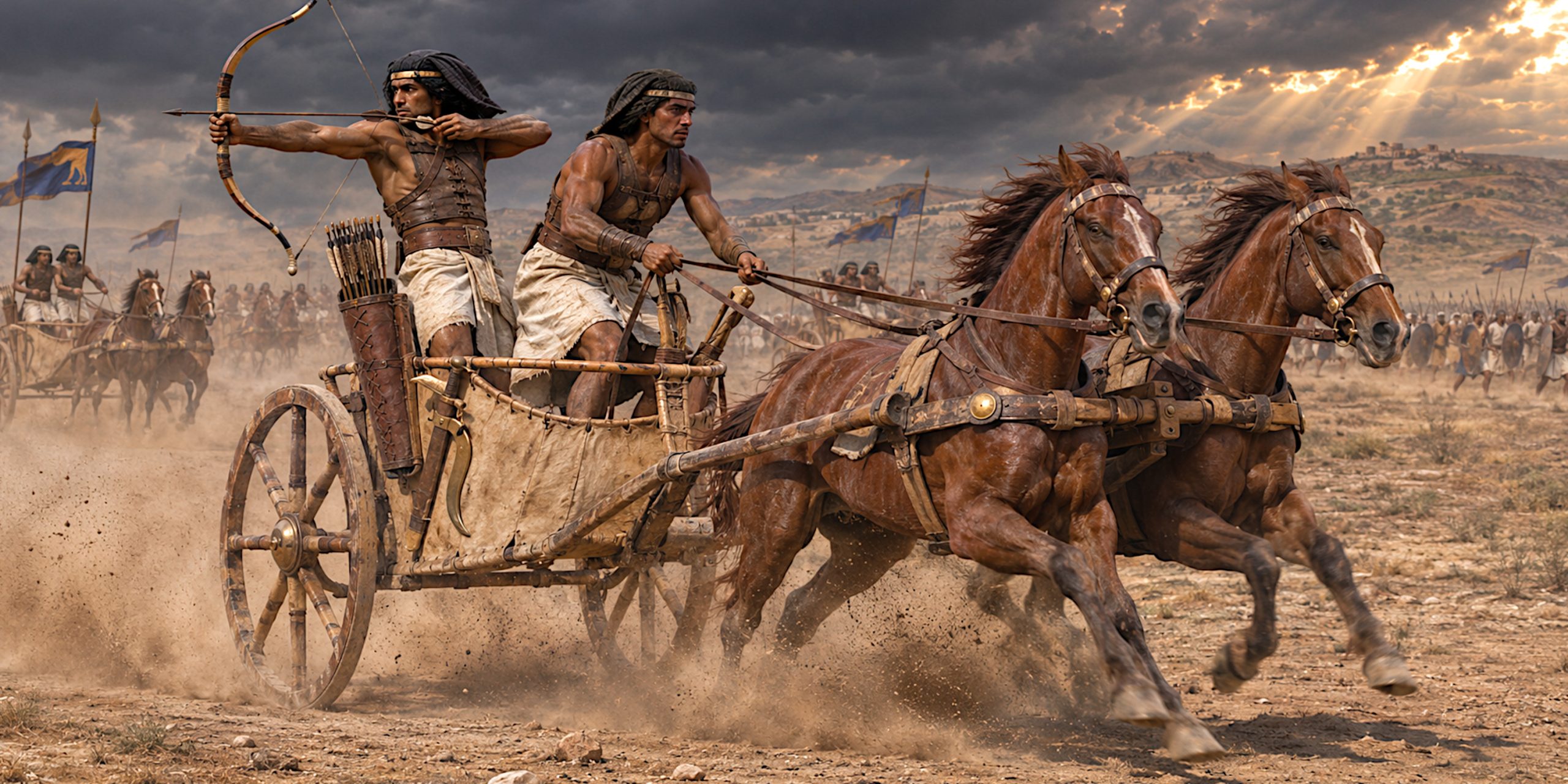
Egyptian charioteers helped turn the armies of the New Kingdom into an imperial force. Working in pairs aboard light vehicles drawn by two horses, they combined speed, archery and the ability to reach a vulnerable enemy before slower troops could respond.
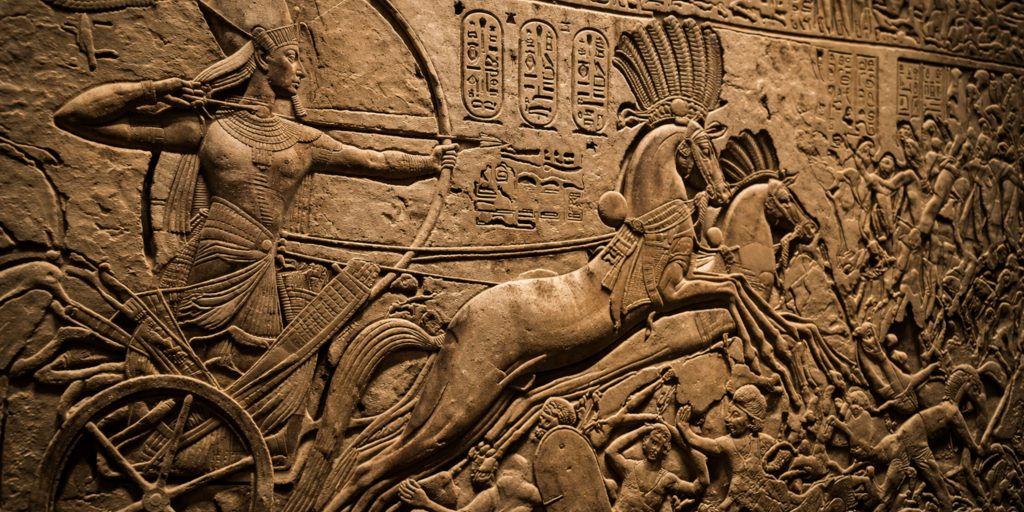
Their reputation has survived rather better than their working conditions. Temple walls show magnificent horses, composed kings and enemies obligingly falling beneath the wheels. The experience inside a moving chariot would have involved dust, noise, jolting timber and the constant possibility that a frightened horse might make an executive decision.
What interests me most is the partnership behind the spectacle. The archer needed the driver to place him where his weapons mattered. The driver needed the archer to discourage anyone trying to kill the horses. Neither could achieve very much without the grooms, craftsmen and infantry who rarely receive equal space on a temple wall.
Who Were the Egyptian Charioteers?
Egyptian charioteers were specialist soldiers whose military importance became particularly pronounced during the New Kingdom, conventionally dated to around 1550–1070 BCE.
A typical fighting chariot carried two men: a driver and a warrior, usually associated with archery. The driver could also handle a shield. Chariot service had strong connections with wealth and status, and the corps formed an elite element within the army. However, describing every crewman as a hereditary aristocrat would make the evidence tidier than it is.
| Feature | Typical arrangement | Qualification |
|---|---|---|
| Crew | Driver and fighting companion | Royal images sometimes show the king alone |
| Horses | A pair harnessed together | Additional animals required support beyond the vehicle |
| Principal battlefield weapon | Bow and arrows | Other weapons varied with period and circumstances |
| Military role | Mobile missile fighting and pursuit | Chariots also supported command and display |
| Main period discussed here | New Kingdom | Chariot use continued afterwards |
“Charioteer” can mean the person driving or, more broadly, someone serving in the chariot corps. Keeping that distinction in mind prevents the driver from disappearing behind his more conspicuous passenger.
How Chariots Reached Egypt
The horse-drawn chariot entered Egypt through its connections with western Asia during the Second Intermediate Period. Its arrival is commonly associated with the Hyksos, whose rulers controlled much of northern Egypt before the emergence of the New Kingdom.
The familiar account of an entirely unprepared Egypt being overwhelmed by a single foreign invention is too neat. The transfer involved horses, vehicle construction, harnessing, weapons and the knowledge needed to maintain them. Egyptian adoption was a process, rather than one afternoon of military enlightenment.
Chariots appeared in Egypt around 1600 BCE and subsequently became important to royal and elite life as well as warfare.
An early royal example appears in the autobiography of Ahmose, son of Abana, a soldier and naval officer who served during the wars surrounding the foundation of the Eighteenth Dynasty. His account places the king in a chariot while Ahmose accompanies him on foot. This is valuable evidence for chariot use, although it does not establish how large the Egyptian chariot force then was.
How an Egyptian War Chariot Was Built
The characteristic Egyptian chariot was a light, two-wheeled vehicle with an open rear, a small platform and a pole connecting it to a pair of horses.
Wood provided the frame, while leather and rawhide served important structural and protective functions. The wheels sat towards the rear of the body. Many familiar later New Kingdom examples have six spokes, though wheel designs changed over time.
The surviving vehicles also warn against treating every chariot as a battlefield machine. The Metropolitan Museum’s discussion of the chariot from the tomb of Yuya and Tjuyu identifies that vehicle as probably too light for combat. Its account likewise distinguishes between the sturdier and lighter vehicles buried with Tutankhamun.
This was purposeful engineering, but lightness carried compromises. A chariot needed room to turn and ground its wheels could negotiate. Broken terrain, ditches and crowded approaches could deprive it of the mobility that justified its expense.
The absence of heavy bodywork should not be mistaken for primitive construction. Making a vehicle light enough to move effectively, yet strong enough to carry two men over uneven ground, required considerable skill.
Training, Crew Partnership and Daily Service
Driving a horse team demanded more than holding the reins and hoping for royal favour. The driver had to judge speed, spacing, ground conditions and the movement of nearby vehicles.
The warrior faced a different difficulty: using his weapons from a platform that was itself moving. Accurate shooting required balance, familiarity with the horses’ movement and trust in the man controlling them.
Their likely training needs included:
- Handling and conditioning the horse team.
- Mounting, dismounting and changing direction.
- Shooting from a stationary and moving vehicle.
- Maintaining spacing around other crews.
- Responding to damaged equipment or an injured horse.
These are practical requirements inferred from the task, rather than a surviving Egyptian training syllabus.
The wider support system mattered just as much. Horses needed feed, water and care; vehicles needed spare components and repair; crews needed replacement arrows. Research into Egyptian campaigning in the Levant stresses the importance of supply and organisation alongside the better-known combination of chariot, composite bow and armour. A prestigious weapon still becomes an expensive obstruction when its horses cannot eat.
Arms and Armour
There was no single, unchanging equipment set issued to every Egyptian chariot crew. Royal burials, surviving weapons and battle scenes represent different dates, purposes and levels of wealth.
Bows and arrows
The bow was central to Egyptian chariot warfare. Composite bows combined different materials to produce powerful weapons in a relatively compact form, making them well suited to use aboard a vehicle.
Quivers and bow cases allowed ammunition and weapons to travel with the crew. Their positioning was part of the vehicle’s working design, rather than incidental decoration.
Exact claims about effective range should be treated cautiously. A maximum-distance shot, an aimed shot at an individual and an arrow directed into a formation are different things.
Sword types and other close-combat weapons
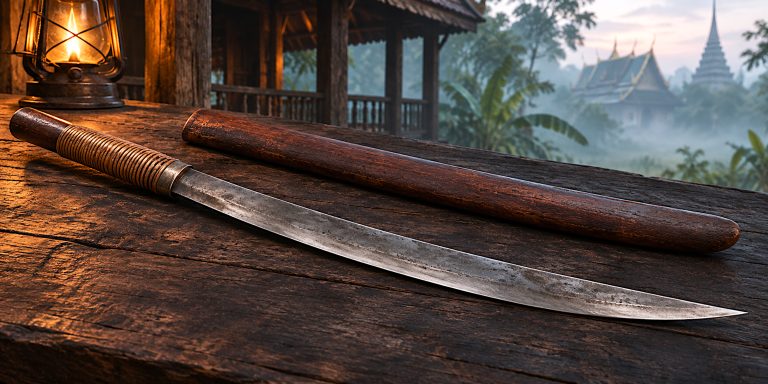
The khopesh, also written khepesh, is the sword most closely associated with New Kingdom Egypt. Its distinctive curved blade belonged to a wider Near Eastern weapons tradition. Egyptian kings adopted it as a conspicuous symbol of military authority, but royal depictions do not prove that every chariot warrior carried one.
| Weapon type | Characteristics | Relevance to chariot crews |
|---|---|---|
| Khopesh sickle sword | Curved bronze blade, generally cutting along the outer curve | A possible close-combat sidearm and an important royal symbol |
| Straight copper-alloy sword | Straight blade, with forms varying by date | Part of the wider weapons available, without proof of universal chariot issue |
| Bronze dagger | Compact secondary blade | Useful at close quarters, though individual carriage is difficult to establish |
| Spear or javelin | Thrusting or throwing weapon | Could supplement missile and close-combat options |
| Axe or mace | Short-range striking weapon | Present in the broader Egyptian military arsenal |
A surviving early Eighteenth Dynasty copper-alloy sword in the Metropolitan Museum measures 52 cm. Objects such as this are a useful corrective to the idea that Egyptian edged weapons consisted entirely of khopesh swords. Its burial context does not, however, identify it as a charioteer’s weapon.
For a crewman, a sidearm offered protection when the engagement became dangerously close or the vehicle could no longer move. We should resist reconstructing a standard Egyptian style of chariot swordsmanship from a few dramatic images.
Shields and body armour
Shields could provide protection for the crew, while scale armour offered another possibility for those with access to it.
New Kingdom armour is supported by physical evidence. Bronze scales from Amenhotep III’s palace at Malqata survive, and a leather-scale cuirass was found in Tutankhamun’s tomb. Nevertheless, the evidence does not justify dressing every Egyptian chariot crew in matching armour. The Metropolitan Museum considers body armour probably uncommon in Egypt.
Older translations sometimes describe Egyptian protection as “mail”. This should not automatically be understood as interlinked metal rings of the sort familiar from later European armour.
How Egyptian Charioteers Fought
Egyptian chariots are best understood as mobile fighting platforms whose effectiveness depended on their relationship with the rest of the army.
Their speed allowed crews to approach a threatened sector, deliver missiles, change position and pursue troops whose cohesion had broken. They could also carry commanders, making the battlefield easier to observe and traverse.
Precisely how formations manoeuvred remains debated. Egyptian scenes compress events and organise them around the king, rather than supplying a sequence of tactical diagrams.
A plausible reconstruction gives chariot forces several overlapping tasks:
- Engage enemy chariots and missile troops.
- Threaten exposed flanks.
- Exploit gaps or disorder.
- Pursue retreating soldiers.
- Support the movement and authority of commanders.
These possibilities should not become a rigid drill imposed on every battle.
The description of chariots as ancient “tanks” is especially unhelpful. Horses were vulnerable, the crews were exposed and the vehicle depended heavily on suitable ground. Driving into an intact body of determined infantry carried obvious risks.
Nor should the familiar distinction between agile Egyptian chariots and heavy Hittite chariots be treated as a complete explanation of their respective armies. Crew size, weapons, terrain and the circumstances of an engagement all mattered.
Megiddo and Kadesh: Chariots in Major Campaigns
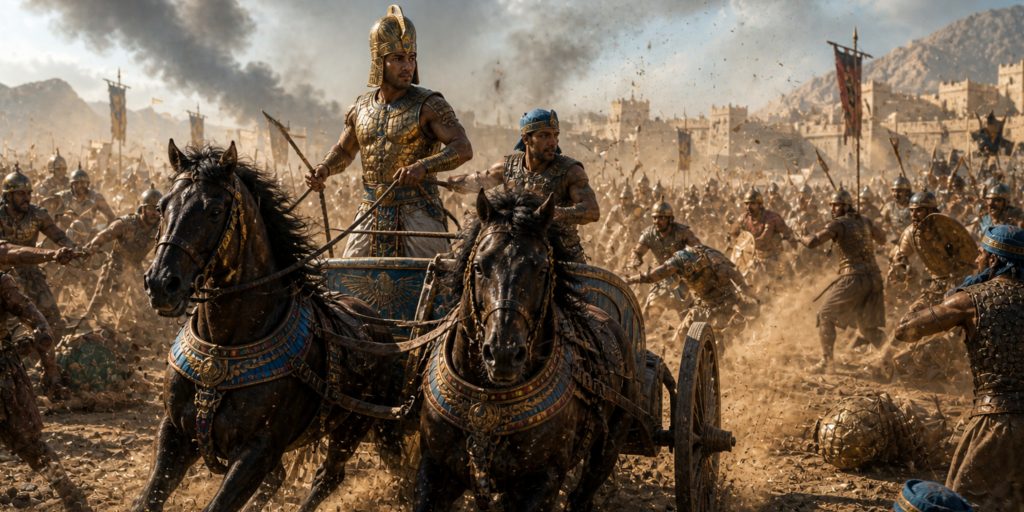
Megiddo, conventionally dated to 1457 BCE
Thutmose III’s victory at Megiddo demonstrates how deeply chariots were embedded in the military culture of Egypt and its opponents.
The royal annals list captured horses, bows, armour and chariots, including richly decorated vehicles belonging to enemy rulers. The recorded total of 924 captured chariots conveys the scale of the claim, although royal booty lists require the same critical reading as other official accounts.
The equipment also had political value. Capturing a ruler’s chariot deprived him of transport, military property and a visible expression of status.
Kadesh, conventionally dated to 1274 BCE
At Kadesh, Ramesses II’s army encountered the forces of the Hittite king Muwatalli II. Egyptian accounts describe enemy chariots striking the division of Re while it was marching and throwing Egyptian troops into confusion.
The episode illustrates the danger of an army becoming separated and surprised. Chariots could exploit disorder with devastating speed.
Ramesses’ subsequent recovery became the centre of a formidable publicity campaign. His inscriptions emphasise personal courage and divine support, presenting the king as the decisive force in a desperate situation.
Egypt retained its king and army, but failed to secure a lasting conquest of Kadesh. Reading the battle as an uncomplicated Egyptian victory requires accepting rather too much of Ramesses’ own assessment.
Archaeology: What Actually Survives?
Egypt offers exceptional evidence for ancient chariots, although much of it comes from elite tombs rather than battlefields.
Tutankhamun’s six chariots
Six dismantled chariots were recovered from Tutankhamun’s tomb. The Griffith Institute’s excavation archive records their removal and reconstruction.
They preserve evidence for woodworking, wheels, fittings and vehicle assembly. Their royal funerary setting also creates a limitation: this is a remarkably privileged collection, rather than a representative sample from an ordinary military depot.
The Tano chariot leather
The material known as the Tano chariot leather preserves parts of a vehicle’s leather equipment, including body casing, bow-case components and horse furnishings.
Its importance lies partly in what other surviving chariots have lost. Timber alone cannot reveal the full appearance or construction of a vehicle whose leatherwork has disappeared.
The material lacks a secure excavation provenance, however. Its reconstruction must therefore rely on technological study and comparison with better-contextualised finds.
Armour, weapons and images
Armour scales and surviving blades establish that particular technologies existed. They do not automatically establish who used them, how frequently they were worn or whether they belonged to chariot soldiers.
Reliefs supply another kind of evidence, but their priorities differ from ours. A king shown fighting alone may be expressing supreme authority rather than documenting the absence of a driver.
For me, the most convincing reconstructions are those that let the objects complicate the pictures.
Contemporary Voices
Ancient Egyptian accounts bring us close to the language of military service, though neither a tomb autobiography nor a royal inscription is an impartial report. The following passages are translated from contemporary Egyptian texts.
Ahmose, son of Abana
Describing service during the siege of Avaris, Ahmose states:
“I showed valour on foot in His Majesty’s presence.”
His account places fighting on foot, royal chariot use and naval service within the same military career. It is a welcome reminder that Egyptian warfare cannot be divided into perfectly sealed categories. Translation by Mark-Jan Nederhof.
Ramesses II’s account of Kadesh
The royal narrative declares:
“I charged all countries, while I was alone, my infantry and my chariotry having forsaken me.”
This is evidence for how Ramesses wanted the crisis remembered. It should be read alongside the wider battle narrative, rather than accepted as proof that one man defeated an army without assistance. Translation reproduced by Fordham University’s Ancient History Sourcebook.
What We Still Do Not Know
The surviving evidence leaves substantial questions unresolved.
We cannot confidently assign a uniform weapons set to all crews, reconstruct every battlefield manoeuvre or establish one fixed social background for everyone serving in the corps. Precise battlefield speeds and shooting performance also depended on conditions that modern summaries often flatten into a single impressive number.
The evidence is uneven in a more fundamental way. Royal equipment survives disproportionately well, while royal imagery dominates the visual record. The everyday experience of a less privileged driver is much harder to recover.
That uncertainty is useful. It keeps an extraordinary military institution from becoming a collection of confident claims supported chiefly by attractive illustrations.
The Legacy of Egyptian Charioteers
Egyptian charioteers combined imported technology, skilled craftsmanship and sustained investment in horses and people. Their effectiveness rested on crew partnership and the army around them.
Their cultural importance extended beyond combat. At Amarna, chariot journeys formed part of the public presentation of the royal family, showing how closely mobility and kingship had become connected.
What survives most clearly is a tension between practical teamwork and royal self-presentation. The monuments celebrate a solitary ruler. The vehicle itself tells a more cooperative story: two men, two horses and a great many people working beyond the edge of the scene.
Sources and Further Reading
- The Metropolitan Museum of Art: Model of a Chariot from the Tomb of Yuya and Tjuyu, with discussion of crew and construction.
- The Griffith Institute: Tutankhamun excavation photographs, including the handling of chariot remains.
- The Metropolitan Museum of Art: New Kingdom armour scales.
- The Metropolitan Museum of Art: Early Eighteenth Dynasty sword.
- The autobiography of Ahmose, son of Abana, transcription and translation by Mark-Jan Nederhof.
- Fordham University: Egyptian accounts of Kadesh.
- Lisa Sabbahy: Moving Pictures, Context of Use and Iconography of Chariots in the New Kingdom, in Chariots in Ancient Egypt.