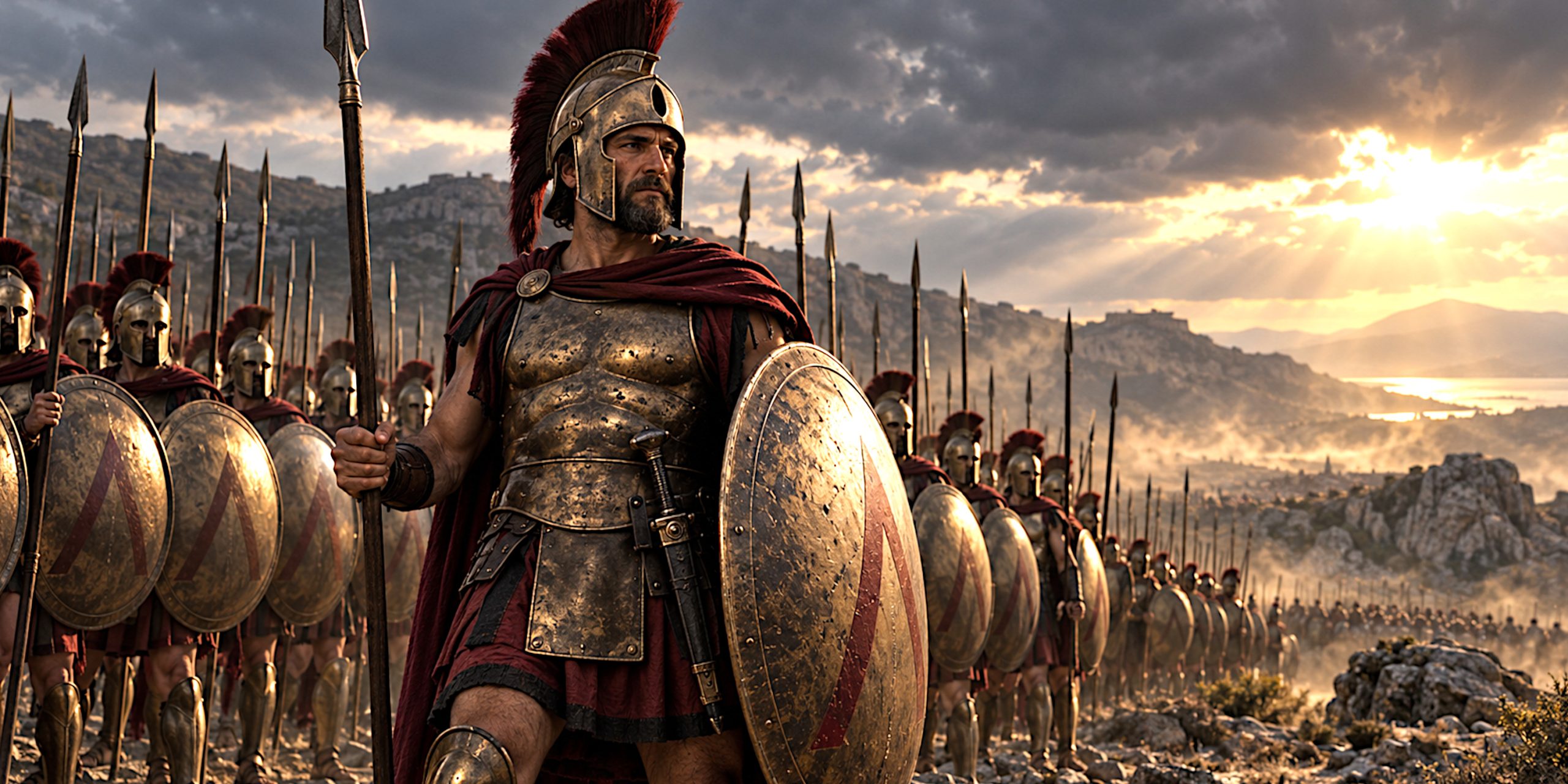
The Homoioi were the full male citizens of ancient Sparta, the men permitted to take part in its political life and expected to fight in its army. The Greek word is usually translated as “Equals” or “Peers”. It is an attractive name, although Sparta’s idea of equality came with several rather substantial qualifications.
These citizens stood at the top of a society sustained by the labour of helots and surrounded by free but politically subordinate communities known as the perioikoi. Within the citizen body, wealth and influence were never distributed as evenly as later legend suggested. A Homoios was equal in legal standing to another Homoios, not equal to everyone living under Spartan power.
That distinction matters. The Homoioi were neither a professional army in the modern sense nor simply a hereditary warrior caste. They were members of an exclusive political community whose citizenship had to be maintained through education, economic contributions, military service and obedience to an unusually demanding civic code.
Who Were the Homoioi?
In its strictest sense, Homoioi referred to adult Spartan men who possessed full civic rights. Modern writers also call them Spartiates, distinguishing them from the wider population of Lacedaemon, which included perioikoi, helots, freed people and men who had lost or never acquired full citizen standing.
A Homoios could attend the Spartan assembly, vote on proposals put before it and be considered for public office. He was also liable for military service. Citizenship united political privilege with collective obligation so closely that it is difficult to separate the citizen from the soldier.
Full membership was not secured by ancestry alone. A prospective citizen normally needed to:
- Be born into the Spartan citizen community
- Complete the state-supervised upbringing commonly called the agoge
- Be admitted to a communal dining group, or syssition
- Provide regular contributions of food to that mess
- Maintain conduct considered worthy of a citizen
Failure at any of these points could shut a man out of the Homoioi or cause him to lose his standing. Spartan citizenship was therefore exclusive, conditional and surprisingly fragile.
What Did “Equals” Actually Mean?
The name did not mean that every citizen possessed identical wealth, land or authority. It indicated membership in a shared civic rank. Homoioi underwent a common educational system, ate in public messes, served in the army and lived under the same body of civic expectations.
Yet equality of status sat beside obvious inequality in practice. Kings belonged to royal houses. Members of the Gerousia, Sparta’s council of elders, held exceptional influence. Some families owned far more property than others. Personal connections, ancestry, military distinction and wealth still mattered because, even in Sparta, human beings remained stubbornly human.
Aristotle, writing in the fourth century BCE, criticised the concentration of Spartan land in relatively few hands. His complaint is especially revealing because citizens who could no longer supply their mess contributions risked losing full status. Economic inequality was therefore capable of eating away at the supposedly equal citizen body from within.
The Society Beneath the Citizen Warriors
The lifestyle of the Homoioi depended on other people performing most agricultural and commercial work.
The helots were an unfree population tied to the land, especially numerous in Messenia after Spartan conquest. They supplied agricultural produce and allowed citizen men to devote themselves to military and civic duties. Their exploitation was not an incidental flaw in the Spartan system. It was one of its foundations.
The perioikoi, meaning those who lived “around” Sparta, inhabited self-governing communities within the Lacedaemonian state. They lacked Spartan citizen rights but served in the army and played major roles in trade, craft production and manufacture. Much of the equipment carried by Spartan troops was probably made by perioikic craftspeople rather than by the men celebrated for carrying it.
Other groups complicate the neat social diagram. These included freed helots, men of disputed or reduced status, and the hypomeiones, or “Inferiors”, who had fallen below the rank of the Homoioi. Spartan society liked clear categories. Life did not always oblige.
Childhood and the Agoge
Spartan boys destined for citizenship entered the educational system traditionally associated with Lycurgus. The surviving descriptions come mostly from outside observers and later authors, so they should not be treated as an administrative handbook preserved intact from the archaic period.
From around the age of seven, boys were organised into groups and subjected to a communal regime that emphasised obedience, physical endurance, competition and resourcefulness. Xenophon says they went barefoot, wore limited clothing and received restricted rations. The intention, at least as admirers understood it, was to produce men able to endure discomfort and act effectively within a disciplined group.
The agoge also taught music, dance, religious performance and social conduct. Reducing it to an endless military assault course misses much of what Greek education meant. Choral competition and ritual participation helped turn boys into members of the civic community just as surely as wrestling did.
Young men passed through age-defined stages before reaching full adult standing. The best-known elite group was the hippeis, a royal guard of 300 selected men. Despite the name, which normally suggests cavalry, these Spartans fought as infantry during the classical period.
Women did not belong to the Homoioi as a male political class, but citizen women occupied an unusually prominent economic and social position by Greek standards. They trained physically, managed estates during male absences and could inherit property. Any account that presents the Spartan citizen household as a purely male institution misses who often kept it functioning.
The Syssitia and the Price of Citizenship
Every adult Homoios was expected to belong to a communal mess. These dining groups strengthened bonds between men who trained, campaigned and participated in public life together. Admission was selective, and ancient accounts suggest that existing members could reject a candidate.
Members supplied regular quantities of produce, including grain, wine, cheese and figs, with meat added through hunting and sacrifice. The notorious Spartan black broth also appears in later accounts. Its precise recipe is less important than its reputation, which has survived rather better than anyone’s enthusiasm for recreating it.
The syssition embodied the Spartan ideal of shared discipline, but it also exposed a weakness. A citizen who lacked sufficient land or produce could not meet his required contribution. He might then lose his place among the full citizens. What looked like communal equality rested on private resources and coerced agricultural labour.
Political Rights and Public Discipline
The Homoioi participated in the Apella, the assembly of Spartan citizens. The assembly could accept or reject proposals and make decisions on matters such as war, peace and succession, although its freedom to debate may have been limited.
Power was divided among several institutions:
- Two hereditary kings led armies, performed major religious duties and embodied separate royal lines
- The Gerousia consisted of the two kings and 28 elders over the age of 60
- Five annually elected ephors supervised public affairs and could exercise authority over the kings
- The citizen assembly voted on measures presented to it
This was a mixed constitution rather than a democracy in the Athenian manner. Full citizens possessed a political voice, but a small number of magistrates and elders shaped what that voice could decide.
Public judgement followed a Homoios throughout life. Cowardice, failure to meet civic duties or loss of mess membership could bring disgrace and reduced status. The system encouraged conformity through honour, shame and constant observation. Sparta did not need a motivational poster. It had neighbours.
Arms and Armour of the Homoioi
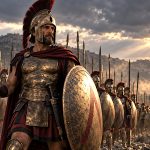
The Homoioi fought primarily as hoplites, heavy infantrymen arranged in close formation. Their equipment changed over time, and there was no single timeless “Spartan kit”. The polished red cloak, crested Corinthian helmet and lambda shield familiar from popular culture combine genuine elements with a good deal of visual compression.
| Equipment | Form and purpose |
|---|---|
| Dory | A thrusting spear commonly around 2 to 3 metres long, fitted with an iron spearhead and often a bronze butt-spike called a sauroter |
| Aspis | A large round shield of wood faced or edged with bronze, carried on the left arm using a central armband and handgrip |
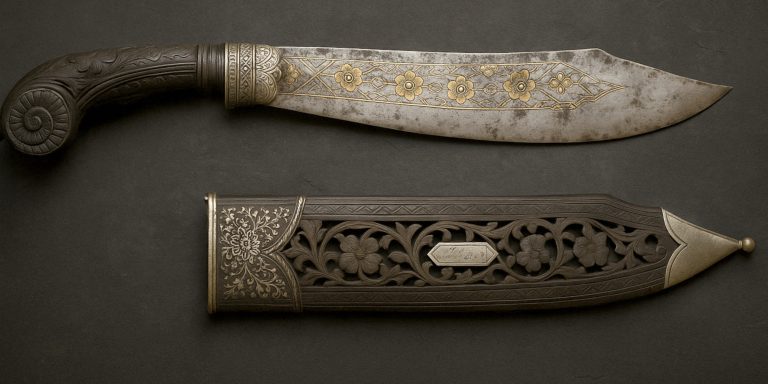
| Xiphos | A straight, double-edged sword used as a secondary weapon for cutting and thrusting |
| Kopis | A forward-curving, single-edged cutting sword known in the Greek world and sometimes represented in Laconian art, though the xiphos is more strongly associated with the Spartan hoplite |
| Helmet | Corinthian, Illyrian and later more open pilos-type helmets were used across different periods |
| Body armour | Bronze bell cuirasses, linen or composite corselets, and later lighter arrangements depending on date, wealth and tactical preference |
| Greaves | Bronze lower-leg protection, common in archaic and early classical hoplite equipment but less universal in later periods |
The Spartan xiphos
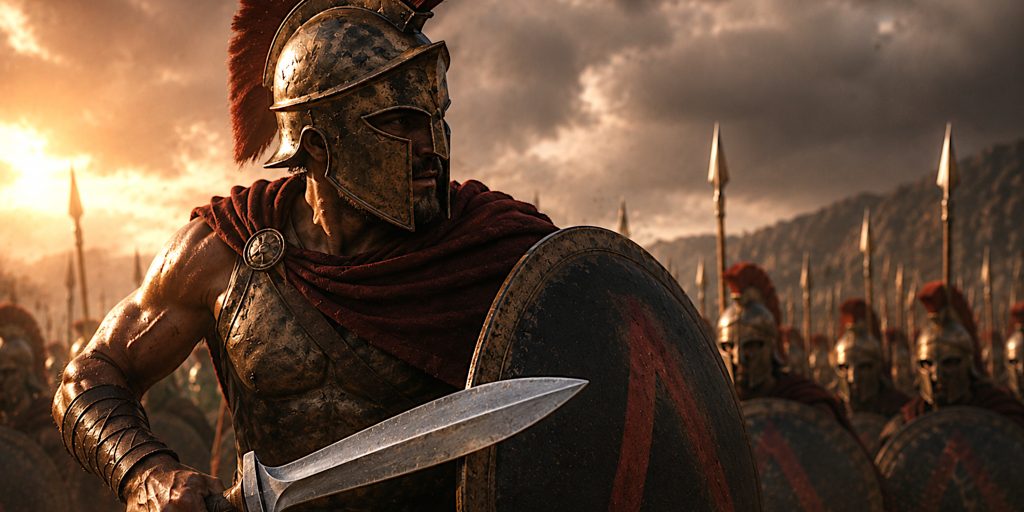
Spartans became famous for carrying a particularly short sword. Plutarch preserves a joke in which an Athenian mocked the length of Spartan swords, prompting the reply that they were long enough to reach the enemy. It is an excellent Spartan answer and a rather late literary tradition.
The weapon was a form of xiphos, not a unique sword type created in isolation from the rest of Greece. A short blade made sense as a compact secondary weapon in the crush of a hoplite formation, but ancient references do not establish one universal regulation length for every period.
The shield and the lambda
The aspis protected both its bearer and the man to his left, making cohesion essential. The famous Greek letter lambda, for Lacedaemon, is associated with Spartan shields in ancient literary tradition, although it should not be projected automatically onto every Spartan army across every century.
The red cloak
Spartan red or crimson clothing had strong civic and military associations. Xenophon praised the contrast between the crimson garment and bronze equipment. The cloak itself was not worn as a convenient blanket over the fighting arm in the middle of combat, despite what dramatic art sometimes implies. Cloaks and shield walls are rarely close friends.
How the Homoioi Fought
Spartan strength lay less in superhuman individual skill than in organisation, confidence and collective discipline. A phalanx required men to maintain alignment, keep their shields overlapping and advance despite noise, casualties and fear. The Spartans trained civic obedience into a military advantage.
Herodotus places a revealing description in the mouth of the exiled Spartan king Demaratus, speaking to Xerxes before the Persian invasion:
“Free they are, yet not wholly free; for law is their master.”
Demaratus continues that Spartan law required them to remain in formation and conquer or die. The passage is not a transcript from a Persian royal tent, but it captures how Herodotus understood Spartan discipline. The source is contemporary with the fifth-century reputation of Sparta, though shaped by literary purpose.
Spartan formations were divided into units commanded through a clear hierarchy. Flute players accompanied the advance, helping the line maintain pace and order. This was not background music added for atmosphere. Rhythm could prevent a formation from becoming a heavily armed crowd with several conflicting ideas about direction.
The Homoioi rarely fought alone. Perioikic hoplites, allied contingents, helot attendants, light infantry and, in later campaigns, freed helots all supported Spartan operations. Calling every Lacedaemonian soldier a Spartiate badly exaggerates the number of full citizens on the field.
Battles and the Limits of the Legend
The Homoioi built their reputation through sustained service rather than one battle. Important episodes included:
- Thermopylae, 480 BCE: King Leonidas and 300 Spartiates formed part of a wider Greek force that resisted the Persian army. Thespians and Thebans were also present in the final stand, a detail regularly trampled by the legend.
- Plataea, 479 BCE: A large Greek victory in which the Spartan-led force helped defeat Mardonius and the Persian army.
- Tanagra, 457 BCE: Spartan and allied hoplites defeated an Athenian-led coalition during the First Peloponnesian War.
- Mantinea, 418 BCE: Sparta restored its damaged prestige by defeating an alliance led by Argos.
- Leuctra, 371 BCE: The Thebans under Epaminondas defeated the Spartan army and broke the aura of Spartan invincibility.
The surrender on Sphacteria in 425 BCE caused particular shock. Thucydides reports that 292 men were captured, including 120 Spartiates. Greeks had imagined that Spartans would die rather than surrender. The prisoners demonstrated that even men raised under the Spartan system could choose survival when trapped, hungry and tactically outmatched. This should not make them seem cowardly. It makes the historical Spartans visible beneath the marble expression.
Contemporary and Ancient Voices
No surviving account gives us an unfiltered Homoios explaining his society in his own words. The major literary witnesses were outsiders, admirers, critics or authors writing centuries later.
Herodotus, writing in the fifth century BCE, gave Spartan law its most famous voice:
“Law is their master.”
Xenophon, an Athenian closely connected with Sparta, admired its institutions. In his Constitution of the Lacedaemonians, he argued that Lycurgus made citizens dine together so that misconduct would be harder to conceal. His praise is invaluable, but praise is not neutrality.
Thucydides, also a fifth-century Athenian, offered a cooler picture. His account of Sphacteria shows Spartan authorities negotiating urgently for captured citizens, evidence of how valuable each Homoios had become.
Aristotle, writing in the fourth century BCE, supplied the sharpest structural criticism:
“Some of the Spartans own too much property and some extremely little.”
He connected this imbalance to the concentration of land and the dangerous decline in citizen numbers. By his time, the celebrated equality of the Homoioi looked decidedly frayed.
Archaeology and the Material World of the Homoioi
Archaeology does not allow us to point at a grave and confidently declare, “Here lies an Equal.” Spartan burial customs, disturbed contexts and the difficulty of connecting objects to precise legal status make that impossible in most cases. Material evidence is better at revealing the society in which the Homoioi lived than identifying individual citizen warriors.
The Sanctuary of Artemis Orthia
Excavations at the Sanctuary of Artemis Orthia uncovered large quantities of lead figurines, pottery, masks, ivory carvings and other votive material. Many lead offerings depict warriors, shields and armed figures. They show the importance of martial identity, youth ritual and cult, while also revealing a Sparta that produced and consumed far more art than its austere reputation suggests.
The sanctuary is closely connected in later sources with the education and ritual testing of Spartan youths. Its long sequence of deposits is valuable, but archaeologists must distinguish archaic practice from the more theatrical whipping contests witnessed under Roman rule.
Bronze warriors and Laconian craftsmanship
Laconian bronze figurines of helmeted warriors and hoplites survive in museum collections across Europe and Greece. Their equipment helps trace changing representations of shields, helmets, spears and body armour. Laconian workshops also produced accomplished bronze vessels and luxury goods for export. Evidently, a society may praise austerity while making very handsome objects. Few civilisations have resisted that arrangement.
The Spartan acropolis and Athena Chalkioikos
The sanctuary of Athena Chalkioikos, “Athena of the Bronze House”, stood on the Spartan acropolis. Excavations produced bronze plaques, nails, votives and inscriptions. Literary sources link the sanctuary with public life and military crisis, including the final refuge of the regent Pausanias. Its remains connect religion, warfare and civic identity at the centre of Spartan space.
The Amyklaion and Menelaion
The Amyklaion, the sanctuary of Apollo at Amyclae, was a major religious centre whose festival drew together different elements of the Spartan community. The Menelaion, associated with Menelaus and Helen, preserves evidence for heroic cult and Sparta’s engagement with the legendary past.
These sites remind us that a Homoios did not live only in a barracks and appear only when Persia needed invading. He participated in festivals, sacrifices, processions and a landscape crowded with ancestral meaning.
What weapons can tell us
Individual spearheads, bronze armour fragments and artistic representations establish that Laconian warfare belonged to the wider Greek military world. They do not support the fantasy that every Spartan carried identical state-issued equipment for centuries. Armour varied with date, resources and changing practice. Archaeology is rather good at spoiling uniform costume departments.
Why the Number of Homoioi Declined
The shrinking citizen body was one of Sparta’s most serious long-term problems. Herodotus implies that several thousand Spartiates were available during the Persian Wars. By the fourth century BCE, Aristotle claimed that the number had fallen below 1,000.
No single cause explains this decline. Likely pressures included:
- Battlefield deaths and the cumulative burden of long campaigns
- Earthquake losses, especially the destructive earthquake traditionally dated to 464 BCE
- Concentration of land through inheritance, gift and bequest
- Inability of poorer citizens to make syssition contributions
- Strict rules governing citizenship and admission
- Demographic limits within a closed elite population
Sparta responded by using larger numbers of perioikoi, allied troops, mercenaries and emancipated helots. These measures kept armies in the field but weakened the old identification between the Spartan state and a numerous body of Homoioi.
The defeat at Leuctra was disastrous because it killed a meaningful portion of an already reduced citizen body. The subsequent liberation of Messenia deprived Sparta of much of the helot labour and land revenue supporting its system. Military defeat exposed the economic machinery beneath the famous discipline.
Were the Homoioi Truly Elite Warriors?
By Greek standards, the Homoioi enjoyed unusually sustained preparation for war and a powerful culture of collective discipline. Their army could manoeuvre effectively, retain cohesion and command allies. Those advantages were real.
The label “elite”, however, needs care. Not every citizen was a peerless swordsman, and most Spartan victories depended on allies and subordinate populations. Spartan armies lost battles, surrendered and made poor strategic decisions. Their reputation itself became a weapon, but reputations can become expensive to maintain.
The most distinctive feature of the Homoioi was institutional rather than anatomical. Sparta attempted to organise an entire citizen class around readiness for war. It succeeded long enough to dominate Greek politics, but the system narrowed the number of people qualified to sustain it.
Legacy of the Spartan Homoioi
Later writers turned the Homoioi into models of obedience, austerity and courage. Political thinkers admired Sparta’s mixed constitution. Military authors praised its discipline. Modern popular culture stripped away much of the social structure and kept the red cloaks, shields and excellent abdominal definition.
The historical legacy is less comfortable and more useful. The Homoioi show how a privileged citizen body could develop formidable cohesion while depending on mass coercion beneath it. They also show how equality within an elite can conceal profound inequality beyond it and growing divisions inside it.
I find their decline as revealing as their victories. Sparta demanded that a full citizen possess the resources to live according to the civic ideal, then allowed the economic basis of that citizenship to contract. The state became famous for producing ideal citizens while steadily producing fewer of them.
Frequently Asked Questions
What does Homoioi mean?
Homoioi is an ancient Greek term meaning “Equals”, “Peers” or “Those Who Are Alike”. It referred to men holding full Spartan citizen status.
Were all Spartan soldiers Homoioi?
No. Spartan armies included perioikoi, allies, helots, freed helots, mercenaries and other troops. The Homoioi formed the full citizen component, not the entire army.
Did the Homoioi use very short swords?
Ancient literary tradition associates Spartans with a short form of the xiphos. The precise dimensions probably varied, and the weapon should not be treated as a single standardised design used unchanged throughout Spartan history.
How could a Spartan lose citizenship?
A man could lose full standing by failing to meet communal mess contributions or through conduct judged incompatible with citizen status. Cowardice and civic disgrace could bring severe social penalties.
Did Homoioi own helots?
Citizen households received produce from land worked by helots. The exact legal relationship between individual citizens, the Spartan state and helot communities remains debated, but the Homoioi’s way of life depended fundamentally on helot labour.
Why did the Homoioi disappear?
Their numbers fell through warfare, demographic pressure, restrictive citizenship rules and the concentration of land. The loss of Messenia after Leuctra severely damaged the economic base that had sustained the citizen system.
Selected Sources and Further Reading
- Herodotus, Histories, Book 7.104
- Xenophon, Constitution of the Lacedaemonians
- Aristotle, Politics, Book 2
- British School at Athens, early excavations at Sparta and Artemis Orthia