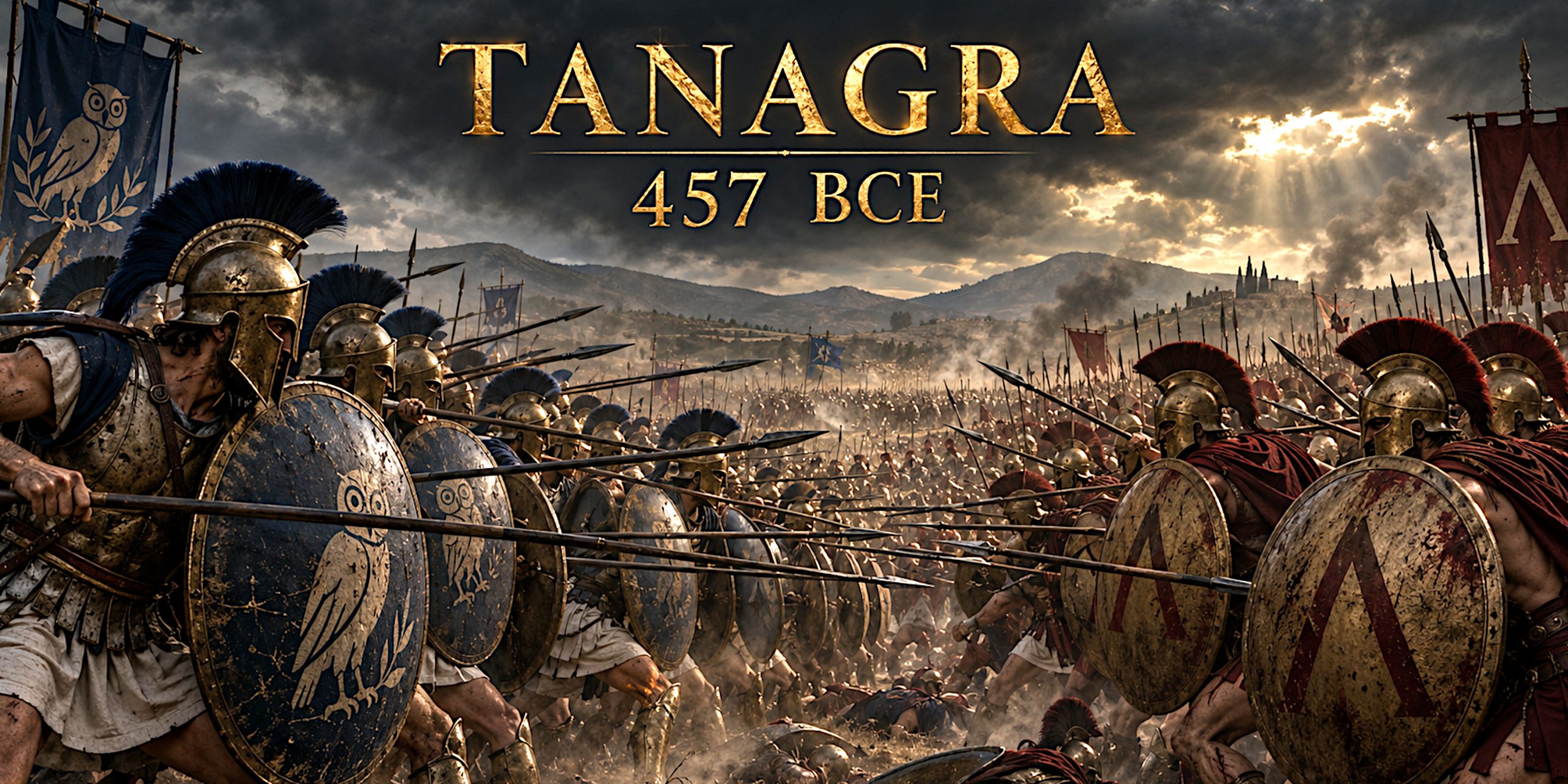
The Battle of Tanagra in 457 BCE was the first major land battle fought directly between Athens and Sparta. It ended in a Spartan victory, but not the sort that settles much. Both armies suffered heavily, the Spartans withdrew, and Athens conquered much of Boeotia only sixty-two days later.
Tanagra therefore matters less as a clean tactical triumph than as a warning. The two leading powers of Greece were no longer uneasy partners from the Persian Wars. They were now willing to meet in the dust with massed shields and levelled spears.
The frustrating part, at least for a historian, is that Thucydides gives us the march, the numbers and the result, but almost none of the fighting. Ancient authors could be wonderfully economical just when one would prefer them to become talkative.
Battle of Tanagra at a Glance
| Detail | What we know |
|---|---|
| Date | Usually dated to 457 BCE, although 458 BCE has also been argued |
| Location | Near Tanagra in eastern Boeotia, central Greece |
| War | First Peloponnesian War |
| Belligerents | Athens, Argos and other allies against Sparta and its Peloponnesian allies |
| Spartan commander | Nicomedes, acting as regent for the young king Pleistoanax |
| Athenian commander | Not named by Thucydides; often identified as Myronides in modern accounts, but not securely |
| Estimated strength | About 14,000 on the Athenian side; 11,500 Spartan and allied hoplites, plus Thessalian cavalry whose exact number is not stated |
| Result | Spartan and Peloponnesian victory after heavy losses on both sides |
| Strategic effect | Sparta returned home, while Athens defeated the Boeotians at Oenophyta sixty-two days later |
Why the Battle Was Fought
Tanagra grew out of the rapid collapse of relations between Athens and Sparta after the Persian Wars. Athens had become the leading naval power of the Aegean through the Delian League. Sparta remained the dominant land power and head of the Peloponnesian League. Each increasingly regarded the other as a problem waiting to become a crisis.
The breach widened after a major helot revolt in Sparta. Athens sent troops under Cimon to help, only for the Spartans to dismiss the Athenian contingent while retaining other allies. The insult damaged the pro-Spartan political faction at Athens. Athens then allied with Sparta’s old enemy Argos and gained control of Megara, giving it a strategically valuable position beside the routes linking central Greece with the Peloponnese.
The immediate cause of the Tanagra campaign lay farther north. Phocis attacked the cities of Doris, a small region regarded as the ancestral homeland of the Dorians. Sparta sent a substantial army across the Gulf of Corinth to restore the Dorian towns.
That explanation is genuine, but it may not be complete. Sending 11,500 hoplites to rescue a comparatively minor region was an impressively large answer to a limited quarrel. Some modern historians suspect that Sparta also intended to reinforce friendly interests in Boeotia and challenge Athenian expansion in central Greece.
Once the Spartan-led force had completed its task, returning home became difficult. Athenian naval power threatened a sea crossing, while Athenian control of Megara obstructed the land route across the Isthmus. The Peloponnesians remained in Boeotia. Athens marched out to confront them.
Forces
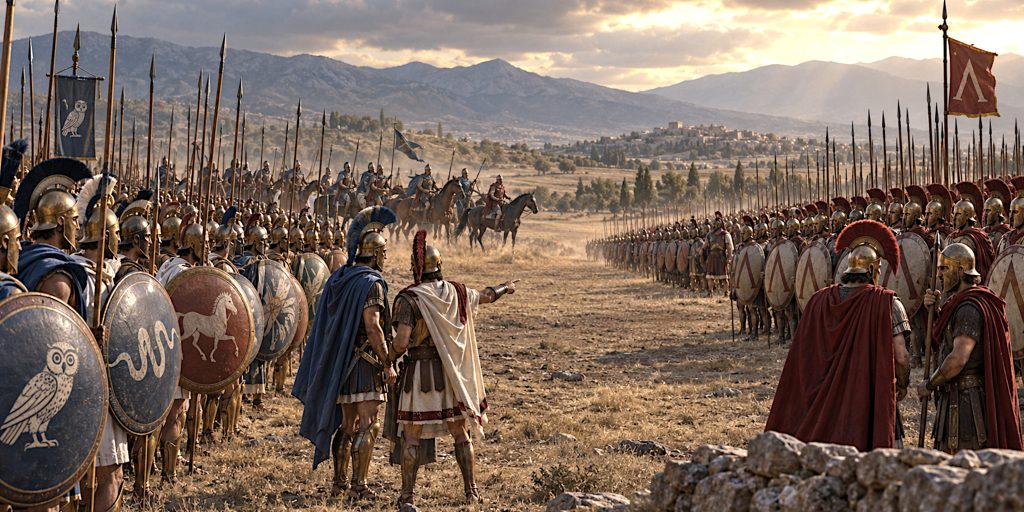
Thucydides supplies unusually useful totals, but he does not provide a complete unit-by-unit order of battle. The figures should therefore be treated as ancient estimates, not modern parade returns.
Leaders
| Side | Leader | Historical position |
|---|---|---|
| Sparta and the Peloponnesian League | Nicomedes, son of Cleombrotus | Regent and commander on behalf of the under-age Spartan king Pleistoanax |
| Athens and its allies | Commander not securely recorded | Myronides is frequently named in modern retellings, partly because he commanded the later Athenian victory at Oenophyta, but Thucydides does not name him at Tanagra |
| Athenian exile seeking readmission | Cimon | Asked to fight with his tribe but was rejected because his political loyalty was mistrusted; he was not a commander in the battle |
Troop Composition
| Force | Recorded or probable composition | Strength |
|---|---|---|
| Spartan-led army | 1,500 Lacedaemonians and 10,000 allied Peloponnesian hoplites | About 11,500 hoplites |
| Athenian-led army | Athenians, 1,000 Argives and contingents from other allies | About 14,000 in total |
| Thessalian cavalry | Cavalry initially serving with Athens, then changing sides during the campaign | Number not preserved |
The word “Lacedaemonians” should not automatically be read as 1,500 full Spartan citizens. It may have included perioikoi and other men from the Spartan state. Likewise, the Athenian total cannot safely be broken down into 10,000 Athenians plus several precisely sized allied contingents. The source simply does not indulge us.
The armies probably included:
- Heavy hoplites drawn from citizen levies and allied contingents
- Light infantry such as archers, slingers and javelinmen, although their numbers are not recorded
- Thessalian cavalry attached initially to the Athenian coalition
- Camp followers, servants and possibly helot attendants with the Spartan force, none of whom appear in the headline total
Arms and Armour
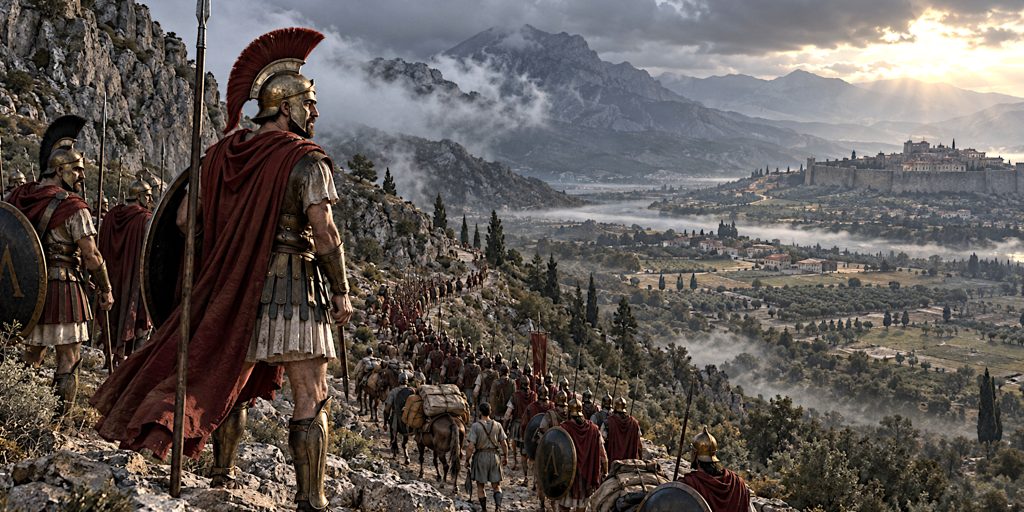
Tanagra was primarily a hoplite battle. Both coalitions used broadly similar equipment, so victory depended less on a secret weapon than on cohesion, depth, morale and the deeply unpleasant business of maintaining formation under pressure.
Hoplite Equipment
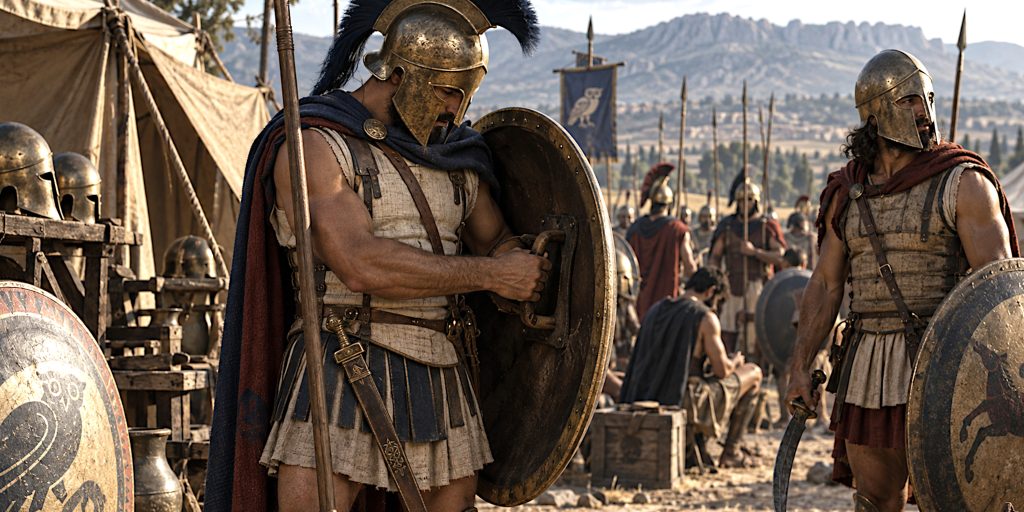
- Dory: A thrusting spear normally around 2.1 to 2.7 metres long. This was the hoplite’s principal weapon.
- Aspis: A large round shield of wood faced with bronze or leather. Its double grip helped bind the phalanx together.
- Helmet: Corinthian, Chalcidian and simpler open-faced forms were in use during the fifth century BCE.
- Body armour: Wealthier men might wear a bronze bell cuirass or muscled cuirass. Linen or composite armour is also depicted, while some hoplites may have fought with lighter protection.
- Greaves: Bronze shin guards remained common, although equipment varied according to wealth and local practice.
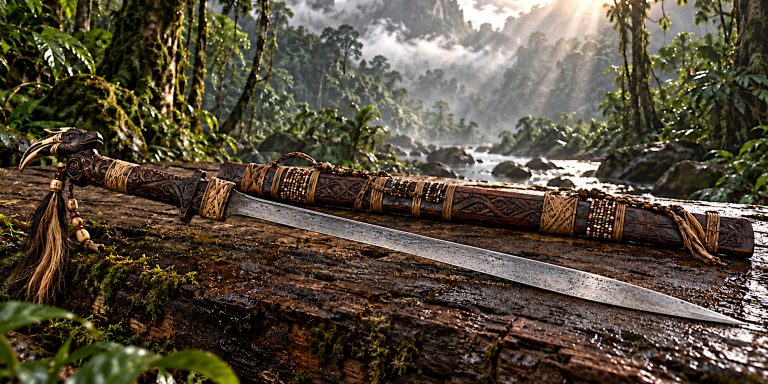
Swords Used at Tanagra
The sword was a secondary weapon, drawn when spears broke or the formations compressed into close combat.
| Sword type | Form | Likely battlefield role |
|---|---|---|
| Xiphos | Straight, double-edged sword, often with a leaf-shaped blade | Thrusting and cutting at very close range after loss of the spear |
| Kopis | Single-edged blade with a forward-weighted cutting profile | Powerful downward cuts, particularly useful to cavalry and also carried by some infantry |
Spartan swords were later remembered as exceptionally short, but we should be cautious about projecting every later anecdote onto Tanagra. A Spartan with a short xiphos still had the same immediate preference as any sensible hoplite: keep the spear working for as long as possible.
Cavalry Equipment
The Thessalian horsemen probably carried thrusting or throwing spears and may also have used the kopis. They rode without stirrups and relied on skill, formation and mobility rather than the armoured shock tactics of much later cavalry.
The Battle
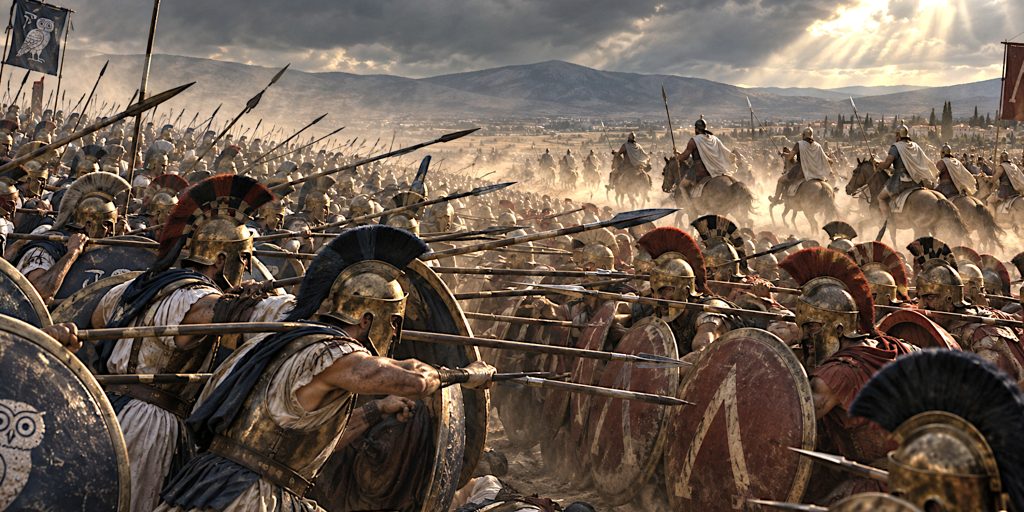
The precise battlefield has not been identified securely, and no ancient account preserves a tactical narrative. We do not know the formations, which wing advanced first, where the line broke or whether the armies fought in unusual depth.
What we can say is that the Athenians and their allies approached Tanagra with a larger reported force. The Spartan-led army faced the danger of being trapped in central Greece, so battle offered a way to reopen its route towards the Peloponnese.
The Thessalian cavalry deserted the Athenian alliance and went over to the Peloponnesians. Thucydides places this betrayal during the period of confrontation, though he does not explain exactly how it affected the fighting. It certainly deprived Athens of valuable mounted troops and may have exposed light infantry, flanks or retreating men.
The hoplite battle itself was bloody. Thucydides records only that Sparta and its allies won and that there was heavy slaughter on both sides. That brevity discourages dramatic reconstructions. We can reasonably picture opposing spear lines colliding on open Boeotian ground, but claims about a decisive Spartan manoeuvre or a particular cavalry charge go beyond the evidence.
Sparta held the field and secured the practical objective. The Peloponnesian army marched home through Megarid territory, cutting down fruit trees as it went. This was both economic damage and a pointed reminder that a Greek army rarely passed through hostile land without making its feelings agricultural.
Why Sparta Won
No surviving source explains the victory in tactical detail. Several factors may have mattered, but they remain informed possibilities rather than facts.
- The Spartan-led force contained a large body of experienced Peloponnesian hoplites.
- Nicomedes had a strong reason to force a route home and avoid strategic isolation.
- The defection of the Thessalian cavalry weakened the Athenian coalition.
- The Athenian army contained contingents from several states, which may have made coordination more difficult.
- Spartan battlefield discipline may have helped, although it should not be used as a universal explanation whenever the evidence goes quiet.
Tanagra was nevertheless a narrow strategic success. The scale of the bloodshed appears to have prevented Sparta from exploiting the victory in Boeotia or Attica.
Cimon at Tanagra
Cimon’s presence gives the campaign a distinctly Athenian political edge. He had long argued for cooperation with Sparta and had recently been ostracised. According to Plutarch, Cimon attempted to join his tribal contingent before the battle, hoping to disprove accusations of sympathy with Sparta. The Athenian authorities refused to let him fight.
He then asked his companions to behave bravely and clear his name. This story was written down centuries later and cannot be treated like an eyewitness report, but it reflects a genuine political division. Tanagra was fought against Sparta while Athenians were still arguing over whether Sparta ought to be an enemy at all.
Archaeology and the Search for the Battlefield
Tanagra was an important ancient city, and its wider region has produced cemeteries, inscriptions, pottery and material from many periods. That is not the same as having an excavated battlefield from 457 BCE.
At present:
- The exact location of the battle near Tanagra remains uncertain.
- No securely identified mass grave can be assigned to the battle.
- No published assemblage of weapons has been conclusively tied to the fighting.
- Individual spearheads, armour fragments or burials from the region cannot be labelled as Tanagra casualties without firm dating and archaeological context.
Ancient Greek battlefields are notoriously difficult to locate. Victors collected equipment, bodies were removed for burial, and agricultural use disturbed the ground for centuries. The archaeology of Tanagra helps us understand the landscape and communities involved, but it does not yet allow a confident reconstruction of the clash itself.
This distinction matters. A plausible object is not automatically a battlefield find, however obligingly spear-shaped it may be.
Battle Timeline
| Stage | Event |
|---|---|
| Before 457 BCE | Relations between Athens and Sparta deteriorate; Athens allies with Argos and Megara |
| 458 or 457 BCE | Phocis attacks the cities of Doris |
| Spartan intervention | Nicomedes leads 1,500 Lacedaemonians and 10,000 Peloponnesian allies into central Greece and forces Phocis to submit |
| Route home blocked | The Spartan-led army remains in Boeotia because the sea and land routes are threatened by Athens |
| Athenian mobilisation | Athens marches to Tanagra with Argive and other allied troops; Thessalian cavalry also joins the expedition |
| Before the battle | Cimon offers to fight with his tribe but is refused |
| Battle of Tanagra | The Thessalian cavalry changes sides; Sparta and its allies win after heavy losses on both sides |
| Immediate aftermath | The Peloponnesian army returns home through the Megarid, damaging the countryside |
| Sixty-two days later | Athens defeats the Boeotians at Oenophyta and establishes dominance over much of central Greece |
Ancient Voices
Thucydides was born close to the period and remains the most important surviving source. His account of the result is brutally concise:
“The Lacedaemonians and their allies were victorious, and there was much slaughter on both sides.”
That single sentence is more useful than several elaborate later reconstructions. It confirms the victor, but also shows the cost.
Aristophanes, writing within living memory of the battle, invokes the older Athenians who had “fought at Tanagra” in Knights. The reference is brief, yet revealing. Tanagra had become part of the civic memory of hard service, even though Athens lost the field.
Plutarch preserves a later tradition in which Cimon urges his friends to “wipe away the charges” made against him through their conduct in battle. The wording is not contemporary and should be read as biography rather than transcript, but the episode captures the uneasy politics surrounding the campaign.
Casualties
No reliable casualty total survives. Modern figures sometimes repeated online, including precise losses for each side, are not supported by Thucydides.
The safest conclusion is simply that losses were severe on both sides. The Spartan victory allowed withdrawal but not lasting exploitation. Athens, meanwhile, retained enough military strength to return to Boeotia and win at Oenophyta little more than two months later.
Aftermath and the Battle of Oenophyta
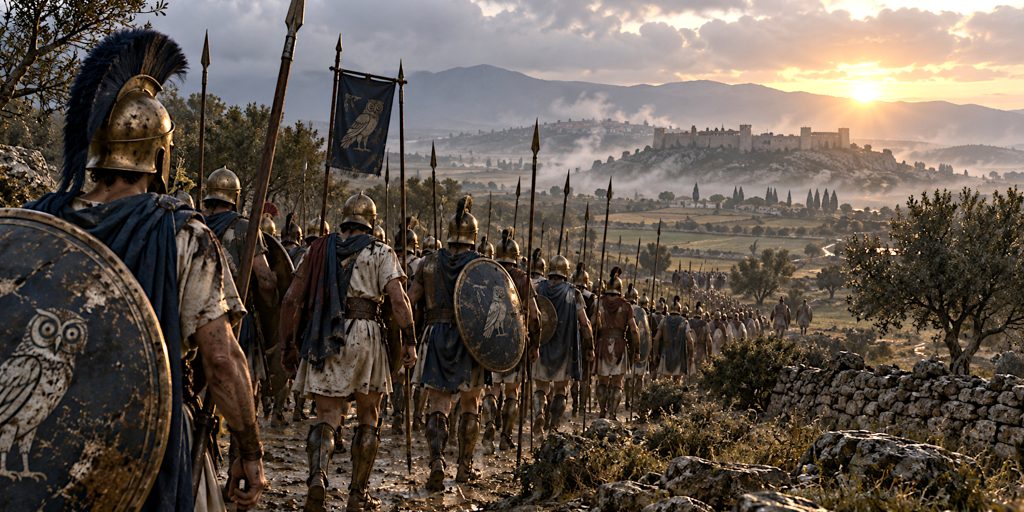
The Spartans returned to the Peloponnese, leaving the Boeotians to face the renewed Athenian offensive. Sixty-two days after Tanagra, an Athenian army under Myronides defeated the Boeotians at Oenophyta.
Athens then gained control over Boeotia and Phocis, compelled Opuntian Locris to provide hostages, completed its Long Walls and forced Aegina to surrender. In strategic terms, Athens recovered with startling speed.
This does not make Tanagra an Athenian victory in disguise. Sparta won the battle and escaped a dangerous position. Yet the campaign shows the limits of tactical success. A victory that leaves the enemy able to overturn the regional balance within sixty-two days is useful, but hardly conclusive.
Why Tanagra was Important
Tanagra deserves attention for four reasons:
- It was the first large, direct clash between Athenian and Spartan armies.
- It exposed how far the alliance system of the Persian Wars had unravelled.
- It demonstrated that Athens could absorb a major land defeat and resume campaigning almost immediately.
- It foreshadowed the larger Peloponnesian War, when naval power, hoplite armies, alliances and internal political tensions would again become inseparable.
The battle also resists easy mythology. Sparta won, but could not turn the victory into control of central Greece. Athens lost, but soon achieved the broader strategic advantage. Tanagra is therefore an excellent lesson in the difference between winning a battlefield and winning a campaign.
Frequently Asked Questions
Who won the Battle of Tanagra?
Sparta and its Peloponnesian allies won the battle after heavy fighting. The victory allowed their army to return safely to the Peloponnese.
When was the Battle of Tanagra fought?
It is usually dated to 457 BCE, although some scholarly chronologies place the campaign in 458 BCE.
Did the Thessalian cavalry betray Athens?
Yes. Thucydides states that the Thessalian cavalry changed sides and joined the Peloponnesians. He does not describe the precise moment or tactical effect of the defection.
Was Myronides the Athenian commander?
Possibly, but it is not securely established. Thucydides does not name the Athenian commander at Tanagra. Myronides certainly commanded the Athenian victory at Oenophyta sixty-two days later.
How many men fought at Tanagra?
Ancient estimates suggest about 14,000 Athenians and allies against 11,500 Spartan and Peloponnesian hoplites. Thessalian cavalry also took part, but its strength is unknown.
Has the battlefield been found?
The battle was fought near ancient Tanagra, but its precise location has not been securely identified and there is no conclusively recognised battlefield assemblage.
Sources and Further Reading
- Thucydides, History of the Peloponnesian War, 1.107–108
- Plutarch, Life of Cimon, 17
- Diodorus Siculus, Library of History, 11.79–80
- Aristophanes, Knights, 781
- Joseph Roisman, “The Background of the Battle of Tanagra and Some Related Issues”, L’Antiquité Classique, 62, 1993