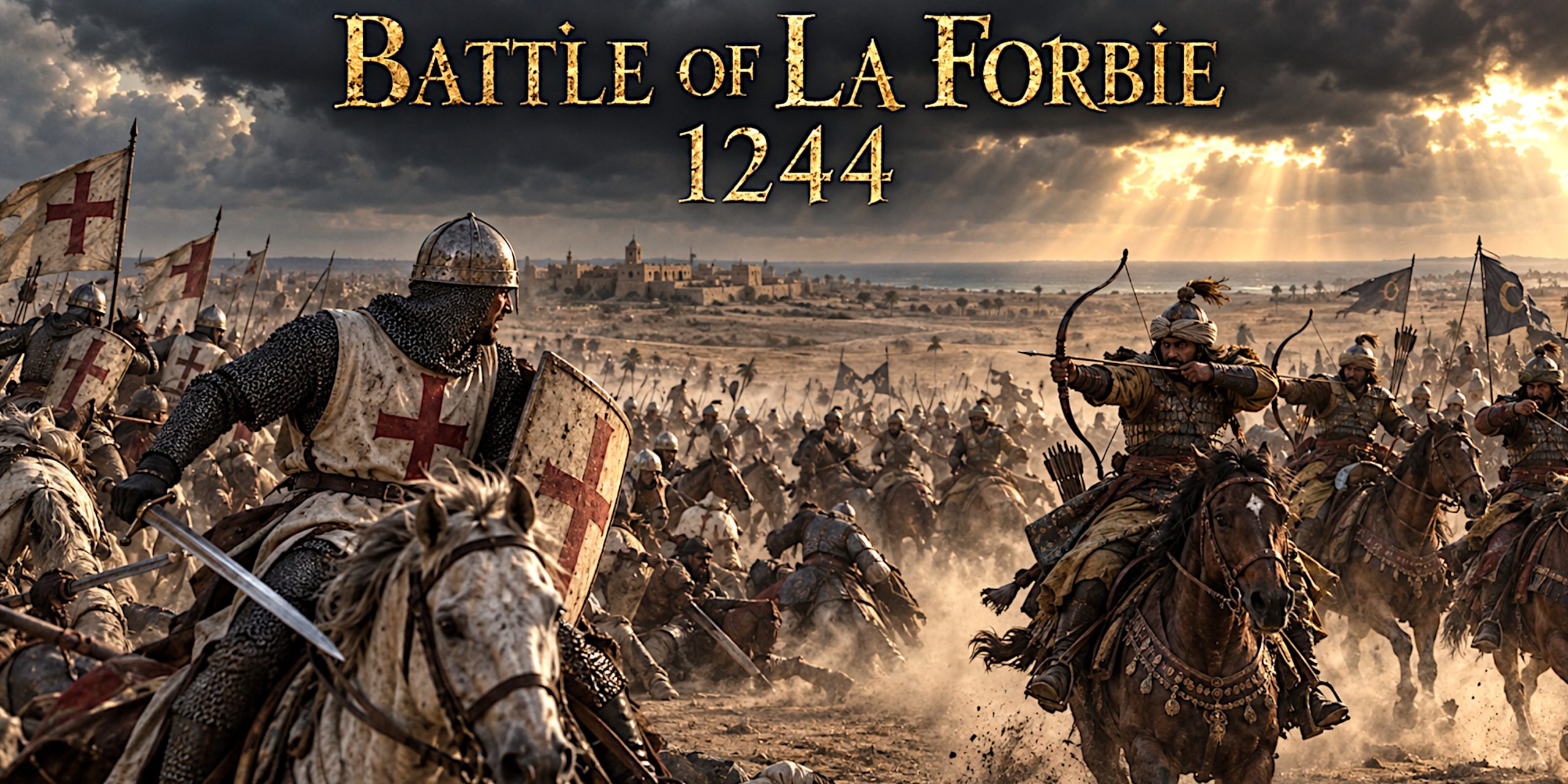
The Battle of La Forbie was fought near Gaza on 17 October 1244, with some accounts extending the fighting into 18 October. A coalition of Frankish forces and Muslim rulers from Syria and Transjordan faced the army of Egypt’s Ayyubid sultan, reinforced by Khwarazmian horsemen. The coalition was crushed. Its defeat cost the crusader states much of the army they could still put into the field, although their coastal settlements survived for decades.
This was no tidy contest of Christians against Muslims. The Ayyubid rulers of Damascus and Homs had reasons of their own to fear Egyptian power. Medieval politics rarely respects the labels we put on a map.
| At a glance | Detail |
|---|---|
| Date | 17 October 1244; fighting is sometimes described as continuing on 18 October |
| Place | Near Hiribya, or La Forbie, in the Gaza region |
| Opponents | Frankish and Syrian Ayyubid coalition against Egyptian Ayyubids and Khwarazmians |
| Result | Decisive Egyptian Ayyubid victory |
| Immediate consequence | Destruction of much of the coalition’s field army and capture of leading commanders |
Why did the armies meet at La Forbie?
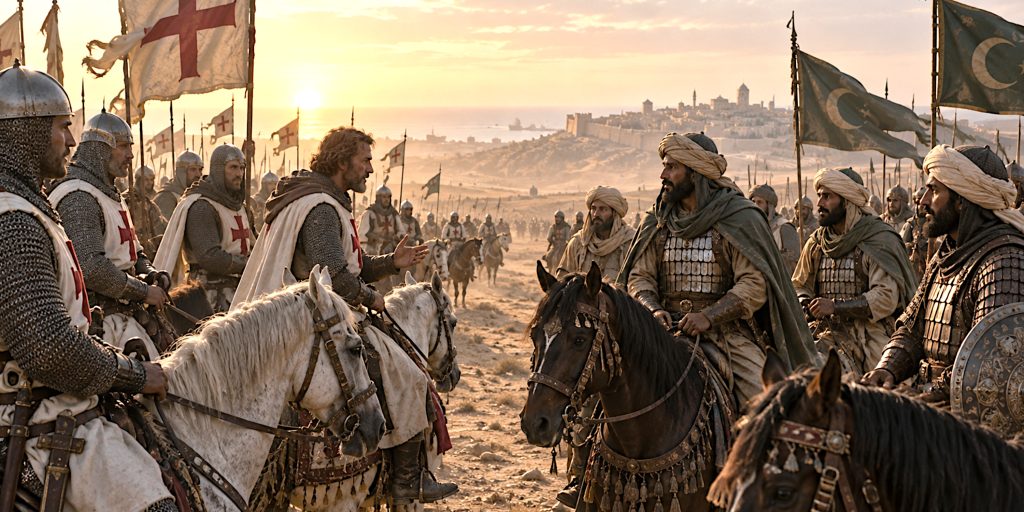
The Khwarazmians were displaced soldiers and horsemen whose political world had been shattered by the Mongol conquests. In 1244 they entered Palestine in the orbit of Egypt’s Ayyubid sultan, al-Salih Ayyub. They seized Jerusalem in August. The city had returned to Frankish control through diplomacy in 1229, though control and access remained politically fragile. Its loss now prompted an army to gather.
The opposing alliance brought together the military orders, the Frankish nobility and the forces of Ayyubid leaders hostile to Egypt. Their shared aim was to stop an Egyptian advance and deal with the Khwarazmian threat. Whether the coalition ought to have offered open battle was disputed even before swords came out. Al-Mansur Ibrahim of Homs is reported to have favoured waiting, in the hope that the Khwarazmians would lose cohesion. It is an attractive plan in hindsight, a notably safe place to stand while discussing medieval tactics.
Forces: leaders and troop composition
No surviving muster roll gives a secure total for either side. Figures repeated for La Forbie often combine incompatible medieval estimates. The composition and broad roles of the contingents are more reliable than a precise headcount.
| Coalition contingent | Leaders | Troops and battlefield role |
|---|---|---|
| Frankish lords of the Kingdom of Jerusalem | Walter IV of Brienne, count of Jaffa; Philip of Montfort was also present | Mounted knights, sergeants and foot soldiers; formed the main Frankish part of the line |
| Knights Templar | Grand Master Armand de Périgord | Armoured brothers, mounted sergeants and supporting troops |
| Knights Hospitaller | Grand Master Guillaume de Châteauneuf | Armoured brothers and supporting troops |
| Teutonic Order | Its contingent fought with the Frankish host | Knights and sergeants; exact numbers uncertain |
| Syrian Ayyubid allies | Al-Mansur Ibrahim of Homs; forces associated with al-Salih Ismail of Damascus | Predominantly mounted troops, including archers; held part of the coalition’s centre |
| Transjordanian allies | Forces associated with al-Nasir Dawud of Kerak | Mounted troops on the coalition’s other wing; precise command and strength disputed |
| Egyptian side | Leaders | Troops and battlefield role |
|---|---|---|
| Ayyubid army of Egypt | Sultan al-Salih Ayyub ruled in Egypt; field command is commonly attributed to Rukn al-Din Baybars al-Salihi | Armoured cavalry, mounted archers and infantry; held and pressed the opposing line |
| Khwarazmian contingent | Individual battlefield command is less securely established | Mobile mounted fighters whose attack on the coalition’s Syrian allies helped decide the battle |
A note on Baybars: the commander named in accounts of this battle was Baybars al-Salihi, not Baybars al-Bunduqdari, the later Mamluk sultan. Confusing the two makes an already complicated battle harder to understand.
Arms and armour: what did they carry?
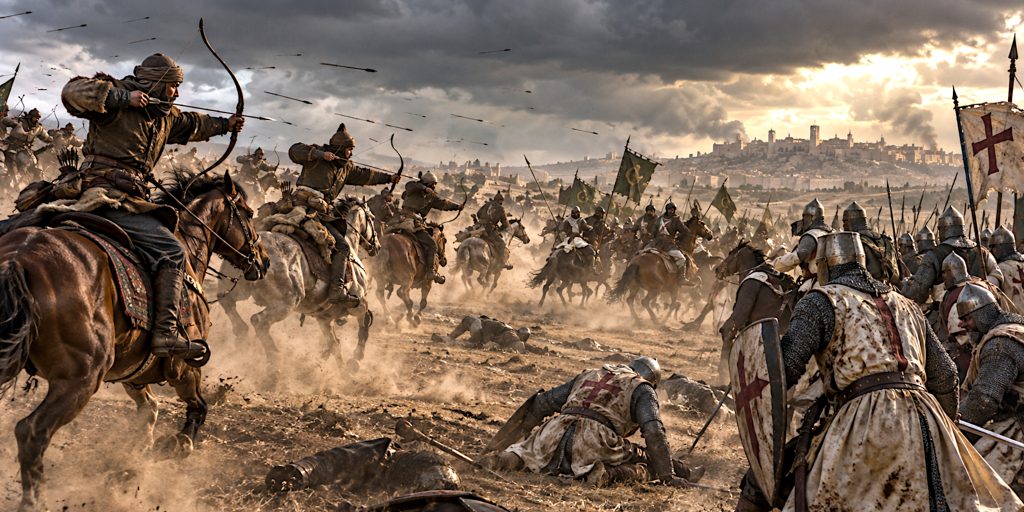
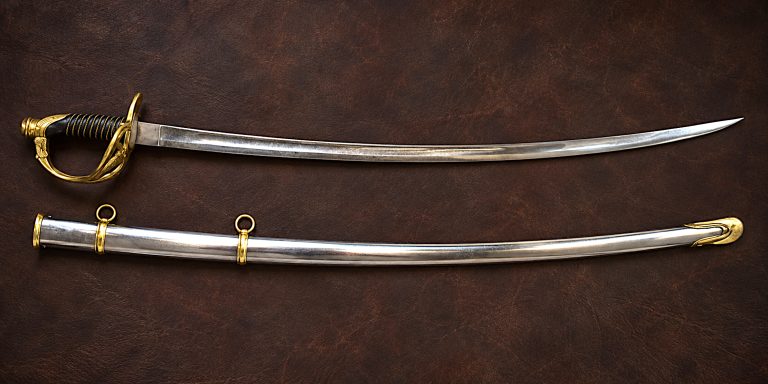
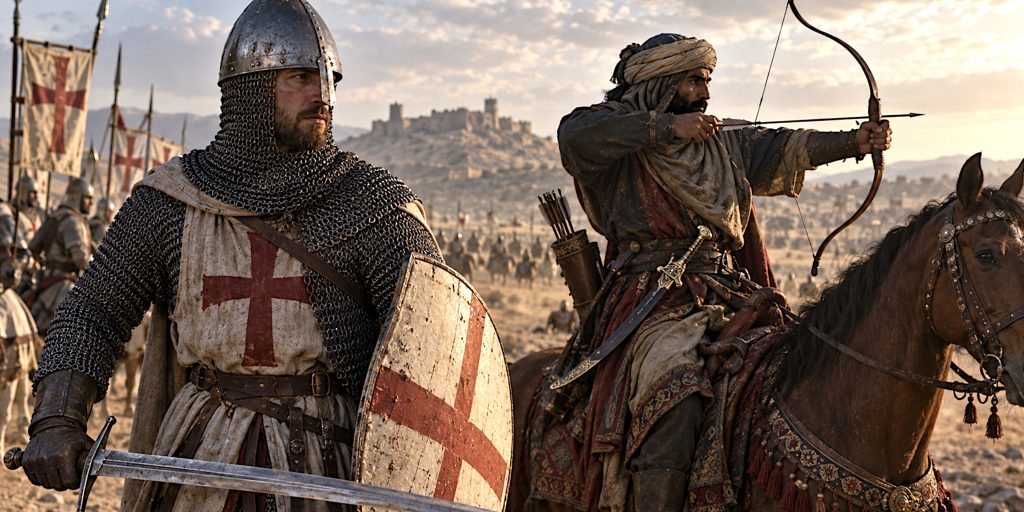
The armies did not carry uniform equipment. Wealth, rank, origin and service mattered. The weapon names below describe forms appropriate to the mid-thirteenth-century Levant; they do not identify individual swords recovered from this battlefield.
| Fighters | Likely arms | Protection |
|---|---|---|
| Frankish knights and military-order brothers | Couched lance; one-handed, double-edged cruciform arming sword as a sidearm; dagger or mace | Mail hauberk and coif, helmet, shield; some wore additional rigid or textile protection |
| Frankish infantry and sergeants | Spear, crossbow or bow; falchions and arming swords among some better-equipped men | Variable mail or padded armour and shields |
| Egyptian Ayyubid cavalry | Composite bow, lance or spear; straight double-edged sword or curved sabre according to individual equipment | Mail or lamellar armour and helmet among better-equipped horsemen |
| Khwarazmian horsemen | Composite bow, spear and curved sabre suited to mounted fighting | Mixed protection, from lighter gear to mail and lamellar |
| Syrian and Transjordanian allies | Composite bows, lances, spears and straight or curved swords | Varied by status and unit |
The crucial contrast was tactical as much as material. A Frankish lance charge could be formidable against a front that held still. Mobile archers and a strike into an exposed allied wing could make that same armoured cavalry dangerously isolated. The arming sword, rather than a later two-handed longsword, is the safer identification for a Frankish knight’s usual sword in 1244. Nor should every sword in an Egyptian or Syrian hand be pictured as a dramatically curved scimitar.
Battle timeline
| When | What happened |
|---|---|
| August 1244 | Khwarazmian forces seized Jerusalem, sharpening the crisis across the region. |
| Before 17 October | Frankish forces and their Syrian and Transjordanian allies assembled near Gaza. |
| 17 October | The armies met near Hiribya. Accounts differ over the pace and exact opening sequence of the fighting. |
| During the main engagement | Egyptian forces occupied the Franks while Khwarazmian horsemen struck the coalition’s allied Muslim contingents. |
| As the centre and wing gave way | Khwarazmian troops turned against the Frankish flank and rear. The remaining coalition forces lost room to manoeuvre. |
| By the end of the battle, possibly 18 October | The coalition army was routed. Walter of Brienne and Guillaume de Châteauneuf were captured; many knights, soldiers and commanders were killed. |
| 1245 and after | Appeals for reinforcements followed. Louis IX’s later crusade ultimately targeted Egypt, while the Frankish coastal settlements continued to hold out. |
How the battle was lost
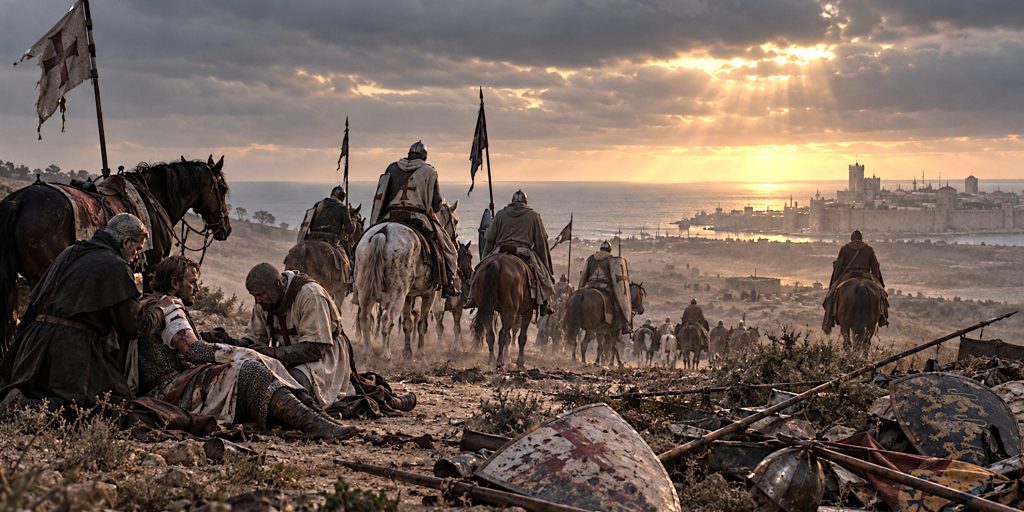
The familiar outline is that the Egyptian army fixed the Frankish troops while the Khwarazmians overwhelmed their Syrian allies. Once a substantial part of the coalition line broke, the Frankish force faced attack from more than one direction. Mounted troops need space to charge, recover and reform. Hemmed in beside collapsing allies, the knights could still fight hard, but courage could not rebuild the line.
The surviving narratives do not give us a minute-by-minute map. They were written for different audiences and disagree on details, including the length of the fighting. What they do agree on is the scale of the coalition defeat. Walter of Brienne and the Hospitaller grand master were taken prisoner. The Templar grand master Armand de Périgord disappeared in the disaster and is generally counted among its dead. Reported totals of those killed or captured are best read as indications of catastrophe, not as an audited casualty return.
Contemporary voices
The most immediate testimony is a letter sent by Robert of Nantes, patriarch of Jerusalem, to church leaders in France and England after he escaped the battle. Describing his arrival at Ascalon, he wrote “evasimus semivivi”, meaning “we escaped half alive”. It is a brief phrase, but it carries more weight than a later writer’s polished speech put into a commander’s mouth. The patriarch was appealing for help, so his account is both valuable evidence and a purposeful call to action.
Another contemporary voice is the Hospitaller master Guillaume de Châteauneuf, whose letter to M. de Marly survives in Matthew Paris’s Chronica majora. Its value lies in what an order’s leadership thought urgent to communicate during the crisis. The letters should be read alongside other Latin and Arabic accounts, rather than treated as an unchallenged transcript of events on the field.
Archaeology: what can the ground tell us?
The battle is associated with the Hiribya area near Gaza, but a securely excavated battlefield with a mapped distribution of weapons, graves and projectiles has not established the precise positions of its armies. That matters. A sword displayed as a thirteenth-century Crusader weapon is not thereby a sword from La Forbie.
Archaeology is more useful for understanding what came afterwards. Excavations at coastal settlements such as Jaffa, considered alongside documents by historian Shlomo Lotan, show why the defeat did not immediately extinguish Frankish rule. Fortified towns, maritime connections and later reinforcement sustained the remaining kingdom. The absence of a proven battlefield assemblage also means reconstructions of each charge or flank attack remain readings of written sources, not plans confirmed by finds in the soil.
Outcome and legacy
La Forbie wrecked the coalition’s immediate military effort and gravely weakened the military orders and Frankish nobility in the region. Jerusalem was not recovered. Appeals for help fed into the wider campaign for a new crusade, although Louis IX did not leave France until 1248 and chose Egypt as his main objective.
It is tempting to call La Forbie the moment the crusader states ended. They did not. Acre and other coastal possessions endured until 1291, and their leaders rebuilt garrisons and defences after 1244. That survival makes the defeat more historically interesting, not less. La Forbie shows how badly a field army could be broken while the political world behind it struggled on for another generation. I find the gap between those two facts more revealing than any neat claim that everything ended in one afternoon.
Watch the guide:
Sources and further reading
- Shlomo Lotan, “The Battle of La Forbie (1244) and its Aftermath”, Ordines Militares Colloquia Torunensia Historica (2012). Discusses contemporary letters, the battle and archaeology of the surviving coastal settlements.
- Matthew Paris, Chronica majora, manuscript record at the Parker Library. Contemporary chronicle tradition preserving correspondence from the crisis; the specific patriarchal letter is cited by Lotan from the printed edition, volume 4, pages 337–344.
- Ilya Berkovich, “The Battle of Forbie and the Second Frankish Kingdom of Jerusalem”, The Journal of Military History 75 (2011), pages 9–44. A detailed modern study of the battle and its political context.