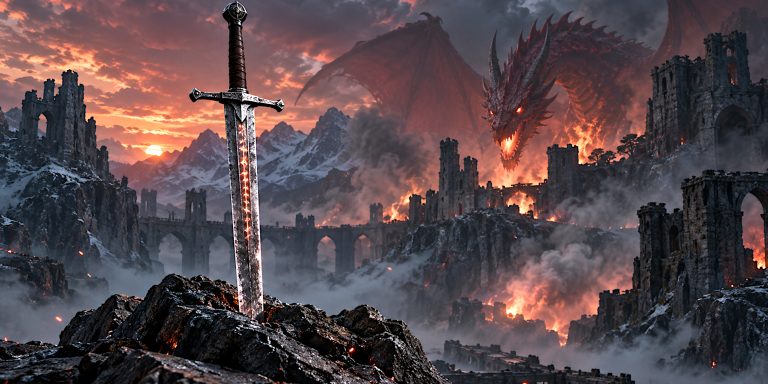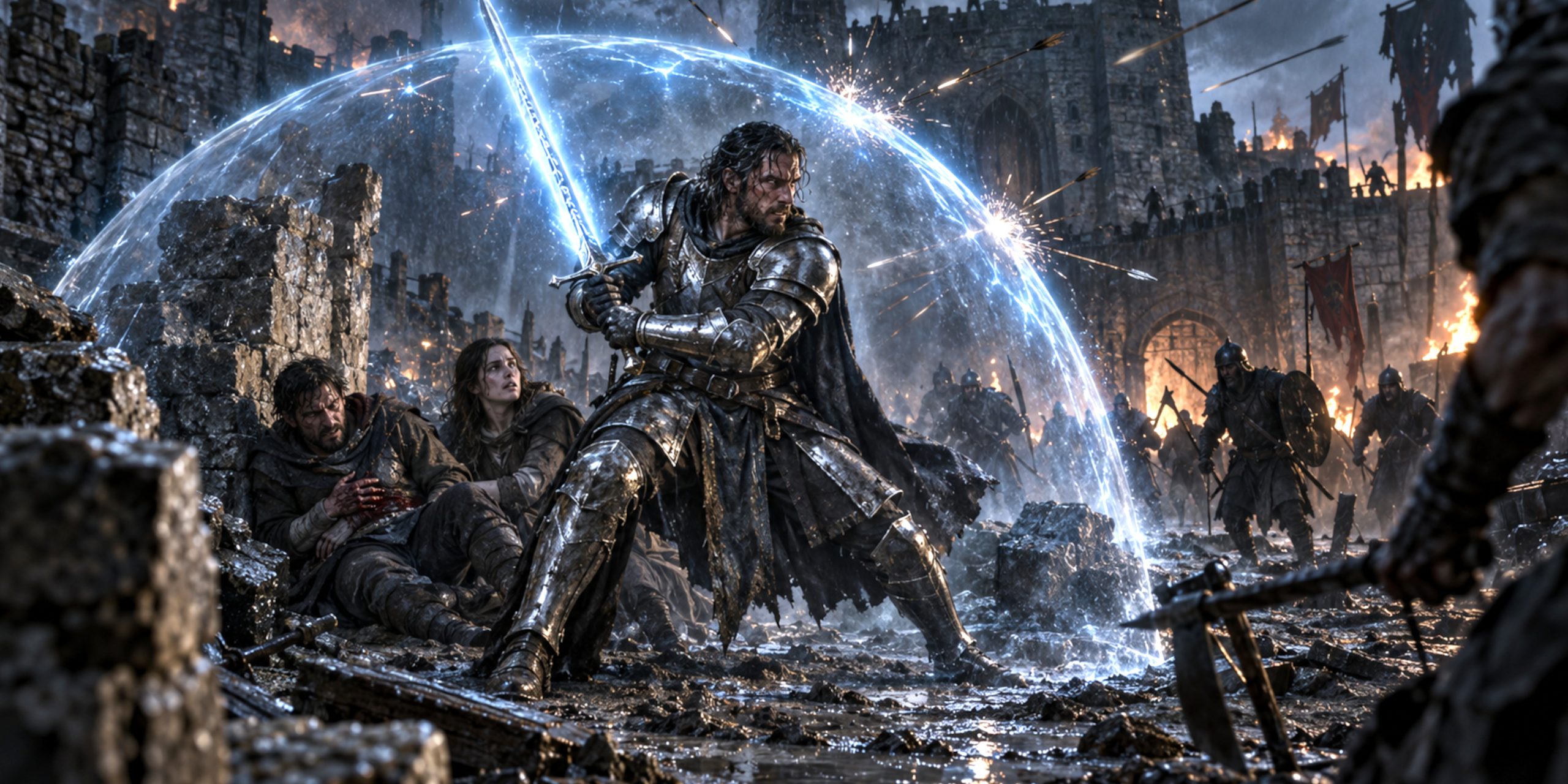
Some legendary Dungeons & Dragons weapons announce themselves with flames, thunder or the trapped soul of someone who really should have read the inscription first. The Defender is quieter. It offers a powerful +3 bonus, then asks the wielder a deceptively difficult question: how much of that power do you want to sacrifice so you are still standing next round?
That choice makes the Defender one of the most tactically interesting swords in D&D. It can strike with the accuracy and force expected from a legendary weapon, reinforce its wielder’s Armor Class, or divide its magic between attack and defence. The arithmetic is simple. Deciding what to do with it rarely is.
This guide explains how the Defender works in fifth edition, who benefits most from it, how to use it effectively and why Dungeon Masters should think carefully before placing one in a treasure hoard.
Defender at a Glance
| Property | Detail |
|---|---|
| Item type | Any sword |
| Rarity | Legendary |
| Attunement | Required |
| Base magical bonus | +3 to attack and damage rolls |
| Defensive feature | Transfer some or all of the bonus to Armor Class |
| Decision point | The first attack made with the sword on each turn |
| Defensive duration | Until the start of the wielder’s next turn |
| Important condition | The wielder must continue holding the sword to retain the AC bonus |
Because the item can be any sword, a Defender might appear as a longsword, rapier, greatsword, shortsword or another sword permitted by the campaign. That flexibility matters. A Dexterity-based duellist may want a rapier, while a heavily armoured fighter may prefer a longsword and shield. A greatsword Defender sounds imposing, although giving up attack power while also giving up a shield creates a slightly stranger defensive arrangement.
How the Defender Works
The sword begins each turn as a +3 magic weapon. When its wielder makes their first attack with it during that turn, they may transfer some or all of that +3 bonus to their Armor Class.
The available configurations are straightforward:
| Attack and damage bonus | AC bonus |
|---|---|
| +3 | None |
| +2 | +1 |
| +1 | +2 |
| None | +3 |
The chosen split applies to the sword’s attacks for the turn and the AC bonus lasts until the start of the wielder’s next turn. The wielder must keep holding the Defender to benefit from the improved AC.
The decision applies from the first attack. A character cannot make one attack with the full +3 bonus, inspect the result like a suspicious restaurant bill, then move the bonus into AC for later attacks. The split is chosen as that first attack is made, and the reduced offensive bonus applies to every attack with the sword during that turn.
If the character does not attack with the Defender, the defensive feature is not activated. Simply carrying it does not provide +3 AC. The weapon rewards active combat rather than cautious sword-shaped accessorising.
Why the Defender Is a Legendary Weapon
A normal +3 weapon is already extremely powerful. It improves accuracy and damage without consuming an action, reaction or spell slot. The Defender adds the ability to convert that premium offensive bonus into one of the most valuable defensive improvements in the game.
Armor Class becomes especially influential when it is already high. Raising AC from 15 to 18 is useful. Raising it from 21 to 24 can be brutal against creatures that rely on repeated attack rolls. A heavily armoured character using a shield may reach a level of defence that forces even dangerous enemies to roll well.
The sword also lets its wielder adapt every round. Against a badly injured enemy, the full +3 attack bonus may help end the fight. When surrounded by several attackers, moving two or three points into AC may prevent far more damage than the sword would have inflicted. When the situation is uncertain, the +2 attack and +1 AC split is a respectable compromise.
That flexibility is the actual legendary feature. Plenty of weapons make numbers larger. The Defender lets a player decide which numbers matter right now.
The Best Ways to Use a Defender
The ideal allocation changes with the encounter. There is no universal setting, despite the natural player instinct to discover one good configuration and use it until the campaign ends.
Use the full +3 for urgent damage
Keep the complete offensive bonus when defeating the target quickly is the safest option. This is usually sensible when:
- The enemy is close to defeat
- The target has a high AC
- Your party needs to break an enemy’s concentration
- You have advantage and want to maximise the value of multiple attacks
- The enemy mainly uses saving throw effects rather than attack rolls
- You are unlikely to be targeted before your next turn
An AC bonus does very little against a dragon’s breath weapon, a spell requiring a saving throw or an enemy who has decided the wizard looks more edible. Defence should answer the threat actually present, not the one your character sheet finds most flattering.
Shift the full +3 into AC under heavy pressure
The maximum defensive setting becomes attractive when the wielder expects several incoming attacks. It works particularly well while holding a doorway, protecting a vulnerable ally or engaging a dangerous melee creature.
This choice gives up the sword’s bonus to attack and damage rolls for that turn, but it does not make the weapon nonmagical. The Defender remains a magic weapon, which may still matter against resistance or immunity to nonmagical attacks.
Split the bonus for general combat
The +2 attack and +1 AC arrangement is probably the easiest everyday setting. The sword remains extremely accurate and gains a modest defensive benefit. A +1 AC improvement may look small, but it applies against every qualifying attack until the start of the wielder’s next turn.
The +1 attack and +2 AC split is more defensive. It suits characters who already have strong attack modifiers, reliable advantage or other ways to improve their chance to hit.
Which Characters Benefit Most?
Fighters
Fighters are the most obvious users. They make several attacks, remain close to dangerous enemies and often have the armour needed to turn an additional AC bonus into a genuine problem for the Dungeon Master.
The sword is particularly effective for a sword-and-shield fighter serving as the party’s front line. Action Surge also makes the offensive bonus valuable, since every additional attack benefits from the chosen attack modifier. The tension is deliciously inconvenient: the turns when a fighter attacks most often are also the turns when surrendering offensive power costs the most.
Paladins
Paladins combine strong armour, saving throw support and explosive melee damage. A Defender can push their AC higher while Divine Smite supplies damage that does not depend on the sword retaining its full +3 damage bonus.
They are also natural protectors. A paladin blocking access to weaker allies can use the defensive allocation to make that position much harder to break. On a critical hit or a decisive smite turn, switching back to the full offensive bonus remains tempting.
Rangers
A melee ranger can use the Defender well, especially in a rapier or shortsword form. Rangers often have competing demands on their bonus actions and concentration, so a defence that requires neither has real value.
The item is less compelling for an archer, for the fairly conclusive reason that it is a sword.
Rogues
A rapier Defender can be excellent for a rogue, but there is a trade-off. Rogues usually make fewer attacks than fighters and care enormously about landing the attack that delivers Sneak Attack. Transferring the full bonus to AC can make that crucial hit less reliable.
On the other hand, a rogue with advantage may be able to spare one or two points of attack bonus. The resulting AC increase can help a swashbuckling character survive in melee without abandoning the general aesthetic of making questionable decisions with confidence.
Barbarians
Barbarians appreciate magic weapons, but Reckless Attack complicates the Defender’s purpose. Raising AC is less impressive when enemies gain advantage against the character. Even so, the item offers flexibility on turns when Reckless Attack is unnecessary, and a +3 weapon is never exactly unwelcome.
Strong Combinations and Tactical Synergy
The Defender becomes especially effective when combined with other defensive tools.
- A shield: A one-handed Defender and shield provide an obvious foundation for a high-AC build.
- The Defense Fighting Style: Another point of AC makes the complete package even harder to hit.
- Shield of Faith: The spell can raise AC further, provided concentration survives.
- The Shield spell: A multiclass character or other wielder with access to this reaction can create a severe temporary AC spike.
- Disadvantage on enemy attacks: Effects that impose disadvantage become more punishing when the target already has high AC.
- Reliable advantage: Advantage helps compensate for transferring part of the sword’s attack bonus into defence.
- Critical-hit damage: Paladin smites and similar features preserve explosive potential even when the weapon’s damage bonus has been reduced.
These combinations can become oppressive if the campaign relies heavily on conventional attack rolls. A Dungeon Master does not need to counter the sword constantly, but encounters should contain varied threats. Saving throws, movement, grapples, environmental dangers and objectives beyond reducing hit points all keep the game from becoming a lengthy demonstration of missed attack rolls.
Rules Questions and Common Misunderstandings
Does the AC bonus apply to the first attack?
Yes. The wielder chooses the allocation when making the first attack, and the reduced attack bonus applies to that attack as well as later attacks during the turn.
Can the wielder change the split between attacks?
No. The adjusted bonuses remain in place until the start of the wielder’s next turn.
Does dropping or sheathing the sword remove the AC bonus?
The wielder must hold the sword to receive its AC bonus. Dropping it, sheathing it or otherwise ceasing to hold it removes that benefit.
Does the Defender stack with a shield and magic armour?
Generally, yes. It provides a bonus to AC rather than establishing a new method of calculating AC. Normal rules concerning features with the same name and any campaign-specific restrictions still apply.
Can the bonus protect against saving throws?
No. Armor Class affects attack rolls. It does not improve Dexterity, Constitution, Wisdom or other saving throws.
Does the weapon require concentration?
No. Its defensive property requires attunement and continued possession of the sword, but not concentration.
Can a character gain the AC bonus before their first turn?
No. The ability is triggered through the first attack with the sword on the wielder’s turn. If combat begins and enemies act before the wielder has attacked, the Defender has not yet supplied its transferable AC bonus.
Advantages and Disadvantages
| Advantages | Disadvantages |
|---|---|
| Exceptional +3 weapon bonus | Legendary items normally appear very late in a campaign |
| Flexible balance between attack and defence | Requires attunement |
| Defensive effect uses no action or concentration | AC does not help against saving throws |
| Can support several different sword-based builds | Must attack to activate the defensive transfer |
| Particularly strong for high-AC front-line characters | Giving up accuracy can be costly against well-armoured enemies |
| Remains useful in almost every melee encounter | Can create encounter-balance problems in attack-heavy campaigns |
Its chief weakness is not really weakness at all. The Defender asks its wielder to trade one excellent benefit for another. That feels much healthier than a legendary item which simply grants everything at once and leaves tactical thought lying quietly beside the road.
How It Compares with Other Legendary Swords
The Defender occupies a different niche from the more theatrical legendary blades.
| Weapon | Primary identity | Best suited to |
|---|---|---|
| Defender | Adjustable offence and defence | Front-line tacticians and protectors |
| Vorpal Sword | Devastating critical-hit potential | Characters making many attacks |
| Holy Avenger | Anti-fiend and anti-undead power with protective support | Paladins in suitable campaigns |
| Luck Blade | Limited reality-changing magic and rerolls | Characters who value broad utility |
| Sword of Answering | Reactive attacks and alignment-themed identity | Characters frequently attacked in melee |
The Vorpal Sword produces bigger stories when its signature feature activates. The Holy Avenger has more flavour and can dominate the right campaign. The Luck Blade can alter the direction of an entire adventure. The Defender is less cinematic, but its power is dependable and available in almost every ordinary fight.
I rather like that restraint. A sword does not need to remove heads or rewrite reality to feel legendary. Sometimes refusing to die is sufficiently dramatic.
Advice for Dungeon Masters
A Defender should feel important. It is not suitable as anonymous loot in the third chest from the left. Give it a history, a former owner and a visual identity connected to its protective role.
Possible origins include:
- The ceremonial blade of a royal bodyguard who died defending an empty throne
- A dwarven sword forged for tunnel fighting, broad enough to serve as a final barrier
- A silvered rapier carried by an order sworn to protect diplomats and witnesses
- A weathered longsword which grows brighter as danger closes around its wielder
- A greatsword made for a giant-slayer who learned that surviving the first blow mattered more than boasting about the second
Before awarding it, consider the wielder’s existing AC, access to defensive spells and typical party tactics. An optimised character may become extremely difficult to hit. That is not automatically a problem. The player has acquired a legendary item and should feel powerful. The aim is to preserve varied challenges, not to invalidate the reward five minutes after presenting it.
Enemies can recognise a defensive specialist and change tactics. They may restrain the wielder, target allies, force saving throws or pursue an objective elsewhere. Use this sparingly. If every enemy instantly understands the sword and carries the perfect countermeasure, the world begins to feel less like fantasy and more like an annoyed rules forum.
Roleplaying a Defender
The official item is mechanically defined rather than burdened with a fixed personality or history. That leaves useful space for the table.
A Defender might respond to selfless action, becoming warm when placed between danger and an innocent. It could resent reckless aggression, dulling visibly whenever its wielder refuses to protect an ally. A sentient version might continually advise caution, which is helpful until the party needs to cross a bridge, open a door or do almost anything associated with adventuring.
Its visual transformation can reflect the chosen allocation. Runes might migrate from the edge to the guard as power moves into AC. The blade could become less luminous while a faint geometric barrier forms around the wielder. These details make the mechanical choice visible without changing the rules.
Is the Defender Worth an Attunement Slot?
For a front-line sword user, usually yes. A +3 weapon already competes strongly for attunement, and the adjustable AC bonus adds a rare form of defence without using an action, reaction or concentration.
The decision becomes less obvious for characters whose build depends on another weapon type, who rarely face attack rolls or who already possess several campaign-defining items. Legendary-tier characters can have crowded attunement choices. A sword that is excellent in every melee round may still lose out to an artefact that enables flight, spellcasting or resistance to a major recurring threat.
In a conventional high-level campaign, however, the Defender is remarkably reliable. It does not depend on a particular creature type, terrain or limited number of charges. It works when the party is fresh, exhausted, underground or standing in a throne room while negotiations follow their traditional path towards initiative.
Final Verdict
The Defender is one of D&D’s cleanest legendary weapon designs. Its +3 bonus establishes the expected power level, while the option to transfer that magic into Armor Class creates a meaningful decision every turn.
Aggressive characters can treat it as a superb magic sword. Defensive characters can turn it into a mobile bulwark. Thoughtful players will move between those roles as the encounter changes, which is where the weapon becomes genuinely satisfying.
It may lack the spectacle of a Vorpal Sword or the mythic presence of a Holy Avenger, but the Defender understands something many adventurers discover rather late: the most impressive sword in the dungeon is often the one that gets you back out.