The most convincing thing about Dungeons & Dragons: Honor Among Thieves is how often its heroes make their own lives harder. Plans collapse, confidence exceeds ability, and someone invariably touches something they should have left alone. Anyone who has played a tabletop roleplaying game will recognise the atmosphere.
You do not need that experience to enjoy it, though. This is a fantasy heist film with an unusually likeable group of people at its centre. The magic matters, the monsters earn their screen time, and the comedy generally comes from characters dealing badly with very specific problems.
Directed by Jonathan Goldstein and John Francis Daley, the pair behind Game Night, the 2023 film approaches its fantasy world with affection and a useful lack of solemnity. It has weaknesses, particularly when its plot starts collecting magical objects like items on a shopping list. But it understands something that expensive fantasy sometimes forgets: spending time with the adventurers should be enjoyable.
What Is Honor Among Thieves About?
Edgin Darvis, a thief and former Harper, wants to reunite with his daughter Kira after a disastrous robbery leaves him imprisoned alongside his closest companion, Holga. Their former associate Forge Fitzwilliam has taken charge of Kira’s upbringing, along with a rather profitable new position in Neverwinter.
Getting their family back requires another heist, a new party and considerably better judgement than Edgin has demonstrated so far.
The adventure draws in Simon, a sorcerer whose confidence regularly abandons him, and Doric, a tiefling druid with good reasons to distrust the people running the city. Their journey also brings them into contact with Xenk, a paladin so relentlessly upright that standing beside him looks exhausting.
That is enough setup to follow the film. Its appeal lies in how these personalities collide, rather than in keeping track of every relic and place name.
Minor plot and scene spoilers follow, but the ending is left unspoilt.
The Cast Makes the Adventure Work
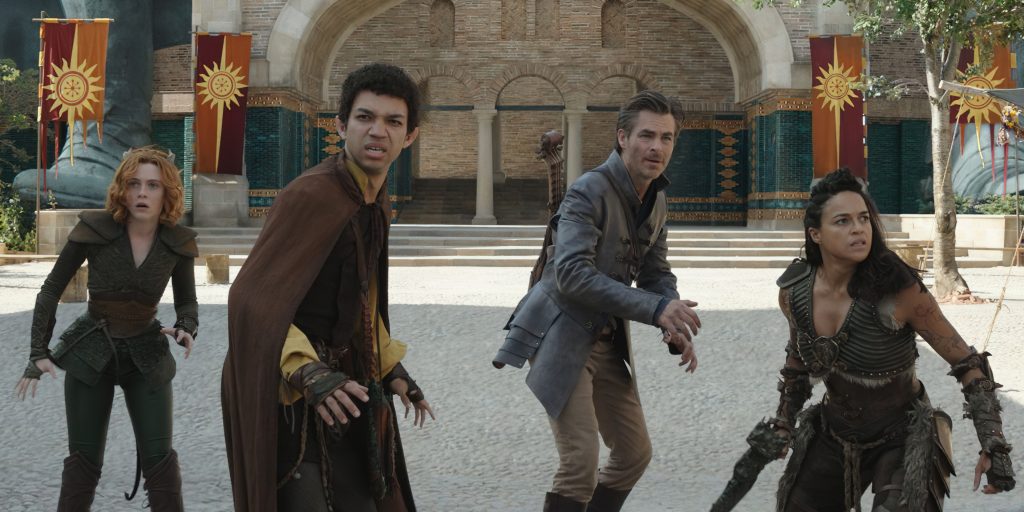
Chris Pine gives Edgin the confidence of a man who thinks explaining a plan counts as successfully executing it. He is persuasive, funny and occasionally quite selfish. Crucially, the film allows those qualities to coexist.
His grief explains his behaviour without excusing every decision. Beneath the speeches and frantic improvisation is someone who finds it easier to organise an impossible robbery than confront what his daughter actually needs.
Michelle Rodriguez’s Holga provides the necessary counterweight. She is direct where Edgin is evasive, practical where he is theatrical, and usually much better prepared for the moment somebody starts swinging a weapon.
Their friendship is the film’s strongest relationship. It feels comfortable and established, with an affection that does not need constant explanation. Holga’s bond with Kira also gives her a place in the story beyond being the person who wins fights.
The supporting performances bring distinct rhythms:
| Character | Actor | What they bring |
|---|---|---|
| Simon Aumar | Justice Smith | Nervous humour and a believable fear of failure |
| Doric | Sophia Lillis | Reserve, scepticism and inventive physical action |
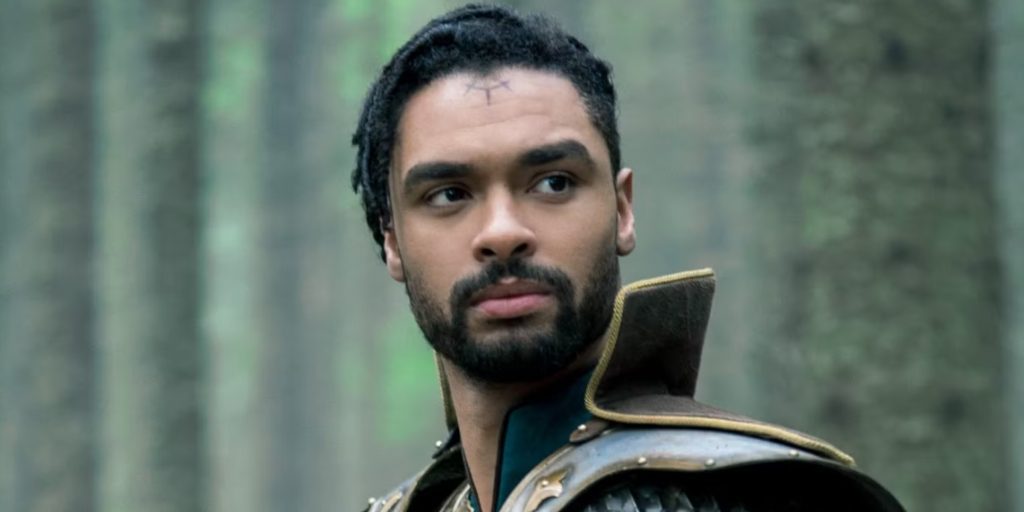
| Xenk Yendar | Regé-Jean Page | Heroic certainty played with excellent comic restraint |
| Forge Fitzwilliam | Hugh Grant | Vanity and manipulation beneath polished manners |
The principal cast and character roles are also detailed in the official D&D film guide. Dungeons & Dragons
Grant is especially enjoyable. Forge makes dishonesty sound like a small administrative misunderstanding. Page, meanwhile, gets impressive mileage from refusing to join everyone else’s comic wavelength. Xenk takes the adventure completely seriously, which makes him funnier than another character delivering sarcastic commentary would have been.
Doric receives less emotional development than she deserves, however. Lillis gives her a clear presence, but the script often finds more interesting things for her to transform into than things for her to say.
Why It Feels Like a D&D Campaign
The film captures the social rhythm of Dungeons & Dragons particularly well.
A problem arrives. Someone proposes an elaborate solution. Another person misunderstands the instructions. The group discovers a much simpler option after wasting everybody’s time.
That pattern could become repetitive, but the screenplay keeps changing its application. A carefully explained obstacle becomes a joke about impatience. A magical tool becomes useful in ways its owner did not initially consider. An apparently straightforward conversation with the dead develops into an exercise in asking better questions.
For me, this is where the adaptation feels most convincing. The characters share responsibility for the adventure, including responsibility for making a mess of it. Success depends on combining abilities and recovering from mistakes.
The film also lets failure remain funny without making everyone incompetent. Holga can fight. Doric is resourceful. Simon possesses real ability. They simply cannot solve every problem through their preferred method.
That is a much more satisfying version of party dynamics than five heroes taking turns being impressive.
Do You Need to Know Dungeons & Dragons?
No. Honor Among Thieves works without prior knowledge of the game.
Its immediate concerns are easy to understand: a separated family, a betrayal, a robbery and a threat that becomes larger than the original job.
Experienced players get an additional layer of recognition. The creatures include mimics, a displacer beast and a gelatinous cube, alongside dragons and Doric’s conspicuous owlbear form. These are established D&D creatures rather than inventions created solely for the film.
However, recognising them is optional. You can understand why a treasure chest full of teeth presents a problem without knowing its entry in the Monster Manual.
The film generally introduces its world through action. That helps it avoid the familiar fantasy problem of stopping an urgent adventure so somebody can deliver a short lecture about a kingdom.
Combat, Weapons and Magic
The action works best when a character’s abilities shape the entire scene.
Holga’s fights are physical and opportunistic. She uses leverage, nearby objects and whatever space is available. Rodriguez sells the effort involved, giving the combat a satisfying weight even when the circumstances are absurd.
Xenk offers a different style. His swordsmanship is controlled, precise and almost irritatingly assured. The contrast tells us who these people are without requiring another exchange of dialogue.
This is fantasy choreography rather than historical fencing. Its strength is clarity: the fighters have different habits, and their encounters are more interesting because of it.
Doric’s transformations
Doric’s escape sequence is one of the film’s strongest passages. Her changing forms turn the environment into a series of opportunities, with each transformation answering a new obstacle.
It gives shapeshifting a practical purpose beyond providing a large creature for the next fight. Doors, rooftops, confined spaces and pursuers all become part of the same moving puzzle.
Magic as a tool
The film is also good at making magic useful outside direct combat. Portals and illusions create possibilities for deception, movement and problem-solving.
I find those sequences more engaging than another exchange of coloured energy. When a magical object has a clear function, there is pleasure in anticipating how the characters might exploit it, then watching them find a better or considerably worse application.
Simon’s uncertainty adds tension, although his development follows a familiar path. The film sometimes leans too heavily on confidence as the answer to his difficulties.
How Accurate Is It to D&D Rules?
It is closer to the experience of a lively campaign than a strict demonstration of the rules.
Doric’s owlbear transformation is the obvious example. Under the standard 2014 fifth-edition rules relevant to the film’s release, a druid’s Wild Shape uses beast forms. An owlbear is classified as a monstrosity, so it would not normally qualify. The official D&D material nevertheless identifies the film’s owlbear as Doric’s Wild Shape form. Dungeons & Dragons Honor Among Thieves Dungeons & Dragons
Her rapid sequence of transformations also takes cinematic liberties with the normal limitations of the ability.
That distinction matters when discussing the adaptation. Calling every flourish an exact representation of a class feature gives the film credit for something it is not attempting.
Holga’s aggression evokes a barbarian, but an energetic attack does not prove she has activated a particular ability. Likewise, Simon’s growing self-belief should not automatically be treated as a visual explanation of Metamagic.
The film borrows the game’s abilities and vocabulary, then adjusts them for pacing and spectacle. Usually, the choices serve the scene.
The Humour Works Because the World Still Matters
There is a difficult balance in comic fantasy. Too much solemnity makes the sillier details feel awkward. Too much mockery makes it hard to care about anything.
Honor Among Thieves usually finds a comfortable position between them.
The characters accept that their world contains undead warriors, dangerous relics and enormous underground creatures. The humour comes from how they respond, or fail to respond sensibly.
The graveyard sequence is a good example. Its central joke grows from a magical restriction and the party’s inability to manage a conversation properly. It feels specific to this setting.
The film also benefits from allowing some emotional moments to finish without immediately puncturing them. Edgin’s relationship with Kira needs that space. So does Holga’s quieter disappointment about her own past.
A few jokes are broader than they need to be, and the modern conversational style will not suit everyone. Still, I would take this group’s bickering over two hours of people whispering ominously about destiny.
Where Honor Among Thieves Falls Short
The plot is busy, and some of that activity feels mechanical.
The party needs an object, which requires another journey, which introduces another obstacle. Individual sequences are often entertaining enough to carry this structure, but the joins remain visible.
The villains are uneven too. Forge has a recognisable personality and a pleasantly specific brand of selfishness. Sofina, played by Daisy Head, supplies menace, but receives much less room to become interesting as a person.
Visually, the film is strongest when the environments have texture and the action gives us a clear sense of space. Some larger effects sequences feel less distinctive. The finale is energetic, though its broader threat is more conventional than several of the smaller problems encountered along the way.
The emotional arcs are similarly mixed. Edgin and Holga have enough detail to make their choices matter. Simon’s journey is more predictable, while Doric could have used another substantial scene away from the action.
None of these weaknesses destroys the film’s appeal. They do explain why its best moments are often individual encounters rather than the larger plot connecting them.
A Fantasy Film That Understands Friendship
What stays with me is the group’s growing willingness to trust one another.
Edgin begins as someone who treats leadership partly as a performance. He can supply the words, but listening is harder. Holga’s loyalty has substance because we see what she contributes when nobody is applauding. Simon needs opportunities to act, rather than endless reminders that he should believe in himself.
Their progress gives the adventure an emotional direction beneath the heist machinery.
The film is particularly good at showing how family can be built through ordinary care. For all its magical possibilities, it understands the value of the person who actually turns up and stays.
That gives its sentiment some weight. A fantasy adventure can survive a familiar plot when the relationships feel worth protecting.
Seven Swords Verdict
Dungeons & Dragons: Honor Among Thieves is funny, warm and inventive enough to overcome its uneven villains and occasionally overcomplicated plotting.
Its strongest achievement is making the party enjoyable company. Pine and Rodriguez give the story a firm emotional centre, Grant makes a splendidly slippery antagonist, and the action regularly finds clever uses for the setting’s magic.
You do not need to play D&D to appreciate it. An affection for fantasy, heists or people confidently making questionable decisions should be sufficient.
I would happily spend another adventure with this group. Ideally after someone has checked the plan.