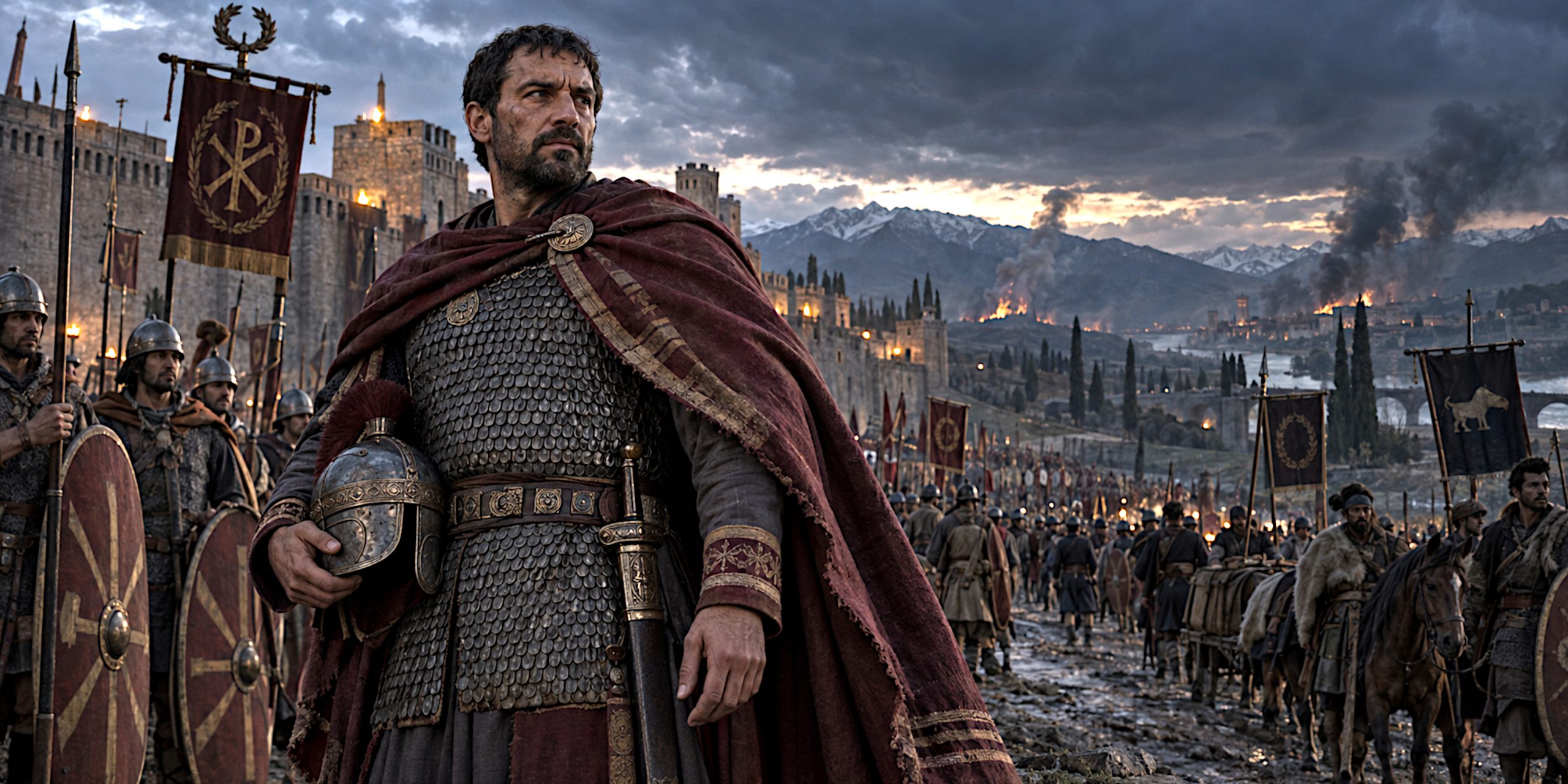
Flavius Stilicho was the soldier who held the Western Roman Empire together while its emperor remained safely behind palace walls. From the death of Theodosius I in AD 395 until his own execution in 408, Stilicho commanded armies, defeated invasions, managed an unpromising imperial court and tried to turn dangerous Gothic war bands into usable Roman manpower.
He was also a ruthless political operator. He interfered in the Eastern Empire, destroyed rivals, promoted his family and repeatedly negotiated with Alaric rather than eliminating him. Admirers have called him Rome’s last great defender. Critics have seen him as an overmighty general whose ambitions made an unstable empire worse.
Both portraits contain some truth. Stilicho’s tragedy is that he understood the military world Rome had entered, but could not make the Roman political class accept it. Once he was killed, the system he had improvised collapsed with remarkable speed.
Stilicho at a Glance
| Detail | What we know |
|---|---|
| Full name | Flavius Stilicho |
| Born | Probably around AD 359, though the precise date and place are uncertain |
| Died | 22 August AD 408 at Ravenna |
| Background | Son of a Vandal cavalry officer in Roman service and a Roman mother |
| Wife | Serena, niece and adopted daughter of Theodosius I |
| Children | Eucherius, Maria and Thermantia |
| Highest office | Magister utriusque militiae, commander of both infantry and cavalry |
| Consulships | AD 400 and 405 |
| Emperor served | Honorius in the Western Roman Empire |
| Best-known victories | Pollentia in 402, Verona in 402 or 403, and Faesulae in 406 |
| Executed by | The government of Honorius after a court coup led by Olympius |
Who Was Stilicho?
Stilicho belonged to the late Roman military aristocracy, a world in which ancestry mattered but service mattered more. His father was a Vandal who had served as a cavalry officer under the emperor Valens. His mother was Roman. Calling Stilicho simply a “Vandal general” is therefore misleading. He was born within the empire, pursued a Roman career, married into the imperial family and spent his life defending Roman government.
Late Roman identity was not a tidy matter of modern nationality. Men of Frankish, Gothic, Vandal, Alan and other backgrounds served as officers, became consuls and married into prominent Roman families. Stilicho’s enemies later weaponised his paternal ancestry because it was politically useful. Roman court politics has never been accused of wasting a convenient insult.
His date of birth is usually placed around 359. Almost nothing reliable survives about his childhood or early military training. The historical record begins to sharpen only after he entered the service of Theodosius I.
Rise Under Theodosius I
In about 383, Theodosius sent Stilicho on an embassy to the Persian king Shapur III. The mission helped negotiate a settlement over Armenia. Diplomatic work of this sensitivity suggests that Stilicho had already acquired the emperor’s confidence. He was not merely a talented swordsman who wandered into high command by accident.
Stilicho married Serena, Theodosius’s niece and adopted daughter, probably in the 380s. The marriage drew him firmly into the Theodosian dynasty. Their children were Maria, Thermantia and Eucherius. Both daughters would later marry the emperor Honorius, a striking sign of Stilicho’s power and of his determination to bind his family to the throne.
By 393, Stilicho held the office of magister utriusque militiae, giving him senior command over infantry and cavalry. He served in the campaign against the usurper Eugenius and the general Arbogast, which ended at the Battle of the Frigidus in September 394. The fighting was savage, and Gothic federate troops suffered heavy losses in Theodosius’s army. Among their leaders was Alaric, the man who would dominate Stilicho’s later career.
When Theodosius died in January 395, the empire passed to his young sons. Arcadius ruled in the East and Honorius in the West. Stilicho claimed that the dying emperor had entrusted both boys to his guardianship. No independent source confirms such a sweeping commission. It may have been a genuine instruction, a creative interpretation or an especially ambitious piece of deathbed administration. The dead emperor was not available for clarification.
Guardian of Honorius and Master of the West
Honorius was about ten years old when he inherited the Western Empire. Stilicho became its effective military ruler. He controlled access to the emperor, commanded the field army and presented himself as the protector of the Theodosian settlement.
The arrangement had an obvious weakness. Stilicho possessed enormous practical authority but was not emperor. His position depended on military success, court influence and Honorius’s continued trust. Any failure could be presented as treason, and every victory made him look more threatening to lesser men around the throne.
The court poet Claudian became Stilicho’s most gifted publicist. In On Stilicho’s Consulship, he placed a splendid declaration in Roma’s mouth, praising Stilicho because “for me alone he reserves his toils”. The line captures the official image: Stilicho as the selfless servant of Rome. It is stirring poetry. It is also government messaging in hexameters, and should be handled accordingly.
The Struggle with the Eastern Court
The Roman Empire was divided administratively, but contemporaries still regarded it as one empire under two emperors. That distinction created endless room for quarrels. Stilicho believed that the prefecture of Illyricum, or at least its disputed dioceses, should belong to the West. The Eastern court at Constantinople had no wish to surrender territory or accept Stilicho as guardian of Arcadius.
In 395, Alaric and his Goths rebelled and moved through the Balkans and Greece. Stilicho marched east with forces drawn from both halves of the empire. The government of Arcadius ordered him to return the Eastern troops. Stilicho obeyed, sending them under the Gothic commander Gainas. Soon afterwards, the Eastern praetorian prefect Rufinus was murdered by soldiers in Arcadius’s presence.
Ancient writers suspected Stilicho of arranging the killing, although certainty is impossible. He benefited from Rufinus’s death, but benefit is not proof. His relations with Constantinople remained poisonous. In 397, the Eastern government declared him a public enemy while Alaric received a Roman military command in Illyricum.
This was the central contradiction of late Roman politics. Alaric could be an enemy, a Roman officer, a bargaining partner and an invading king, sometimes within the same political season.
Alaric in Greece
Stilicho campaigned against Alaric again in 397, landing in the Peloponnese. Claudian claimed that he trapped the Goths near Pholoe and could have destroyed them. Alaric nevertheless escaped into Epirus. Hostile tradition blamed Stilicho for negligence or secret dealings. A more practical explanation is that supply problems, divided command and orders from rival courts made decisive victory difficult.
The campaign illustrates a recurring feature of Stilicho’s strategy. He did not always seek the annihilation of Alaric’s following. Gothic troops were potential recruits, and Alaric could serve as leverage against Constantinople. This was rational statecraft in an empire short of dependable soldiers. It was also extremely dangerous, because a useful armed partner remained useful only while paid, fed and politically satisfied.
The Revolt of Gildo
In 397, Gildo, the comes Africae who controlled Roman North Africa, withheld the grain supply from Italy and aligned himself with the Eastern court. The threat was severe. Rome’s population depended heavily on African grain, and food shortages could turn political inconvenience into urban revolt rather quickly.
Stilicho entrusted the campaign to Mascezel, Gildo’s brother and bitter enemy. Mascezel crossed to Africa with a relatively small force and defeated Gildo at the River Ardalio in 398. Gildo was captured and died, probably by suicide, while being taken east.
Mascezel then died in suspicious circumstances after returning to Italy, reportedly after falling from a bridge while in Stilicho’s company. Zosimus presents the death as deliberate. The evidence cannot prove murder, but the episode is a useful warning against treating Stilicho as a gentle constitutional caretaker. He survived at the summit of late Roman power for thirteen years. One did not do that through excellent manners.
Britain, the Rhine and the Northern Provinces
Claudian credits Stilicho with restoring security in Britain and along the Rhine around 398. In his poem on the Gothic War, Britannia is made to say that Stilicho protected her when the Scots, Picts and Saxons threatened her frontiers. The poetry probably reflects real military or administrative measures, perhaps reinforcements, coastal defence and diplomacy.
The precise operations remain unclear. No detailed campaign narrative survives, and Claudian naturally transforms sensible frontier management into something approaching the rescue of civilisation before breakfast. Even so, evidence suggests that Stilicho inspected or strengthened the Rhine frontier and cultivated relationships with neighbouring peoples.
Later tradition associates him with the removal of troops from Britain, especially around 401 or 402. Some redeployment is plausible as Italy faced invasion, but the notion that Stilicho simply “abandoned Britain” in a single decision is too neat. Roman authority there unravelled through mutiny, usurpation, fiscal strain and continental crisis over several years.
Alaric’s First Invasion of Italy
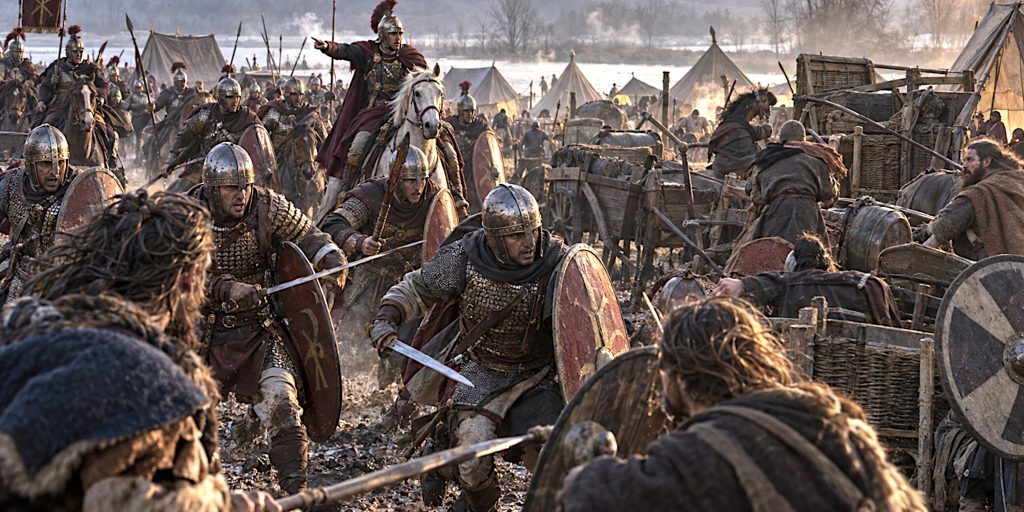
Alaric invaded Italy in 401. The imperial court at Milan was threatened, and Honorius reportedly considered flight. Stilicho hurriedly gathered troops from Raetia, Noricum and other frontier regions. The decision weakened peripheral defences, but Italy and the emperor could not be sacrificed to preserve a tidy map.
Stilicho confronted Alaric at Pollentia on Easter Day, 6 April 402. The Roman attack may have begun while the Goths were observing the festival. The battle was hard fought rather than a clean Roman triumph. Stilicho captured Alaric’s camp, baggage and family, but Alaric’s army remained intact.
Claudian celebrated the result extravagantly, presenting Rome as freed from terror. The practical outcome was more modest. Alaric withdrew but did not cease to be a threat. Stilicho fought him again near Verona, probably in 402 or 403, and again forced him to retreat.
Why was Alaric not destroyed? Perhaps Stilicho lacked the strength to finish him. Perhaps he preferred negotiation. Perhaps both men needed the other as a potential partner in the struggle over Illyricum. Military history often offers a choice between conspiracy and logistics; logistics deserves rather more attention than it receives.
The invasion also encouraged the transfer of the Western court from Milan to Ravenna. Protected by marshes and connected to the sea, Ravenna was easier to defend. It was also easier for the emperor to become isolated from the provinces he nominally governed.
Radagaisus and the Battle of Faesulae
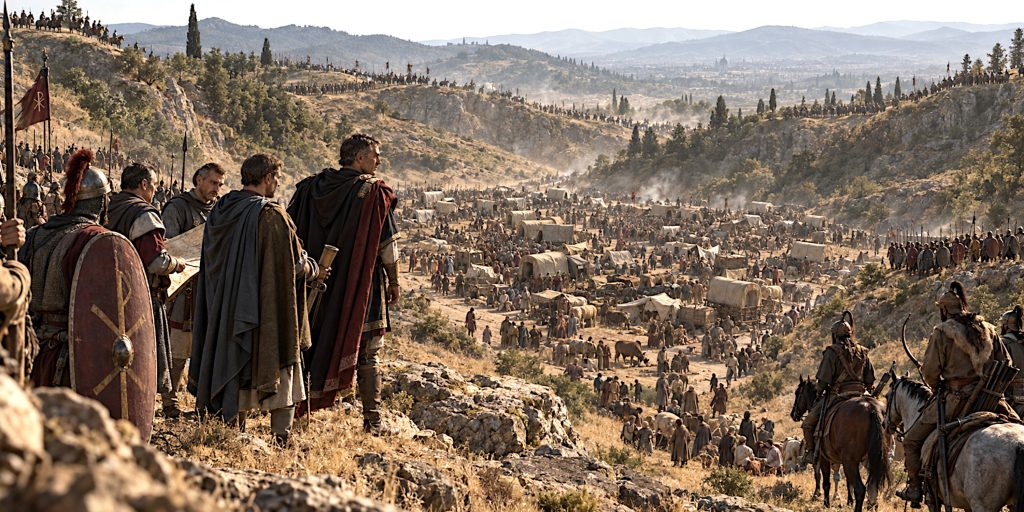
In 405 or 406, a large confederation led by Radagaisus crossed into Italy. Ancient estimates of its size are wildly inflated. The invasion was nevertheless serious and reached as far as Florence.
Stilicho assembled Roman regulars, federate troops, Huns under Uldin and Goths under Sarus. He surrounded Radagaisus near Faesulae, modern Fiesole, cutting off supplies and forcing surrender. Radagaisus was executed. Many prisoners were enslaved, while others were recruited into the Roman army.
This was probably Stilicho’s clearest victory. He combined mobility, allied manpower and blockade rather than seeking a theatrical frontal battle. The victory also exposes the absurdity of treating “Roman” and “barbarian” as simple opposing armies. Stilicho, the son of a Vandal officer, defended Italy with Roman, Gothic and Hunnic forces against another mixed confederation.
The Collapse of the Rhine Frontier
On the last day of 406, groups of Vandals, Alans and Suebi crossed the Rhine, traditionally near Mainz. Whether the river was frozen is uncertain. What is certain is that the frontier system failed and Gaul was subjected to prolonged violence and political fragmentation.
Stilicho did not mount an effective immediate response. Italy had only recently survived Radagaisus, the army was stretched and Britain produced a succession of usurpers. The last of them, Constantine III, crossed into Gaul in 407 and established control over much of the region. Stilicho sent the Gothic commander Sarus against him, but the campaign failed to destroy the usurpation.
This is the strongest case against Stilicho’s strategic record. His Italian victories came at the cost of weakened frontiers, and the government could not recover once several crises overlapped. Yet blaming the whole Rhine collapse on one general gives the Western Empire rather more spare strength than it possessed. Stilicho was managing scarcity, not commanding the resources of Augustus.
Stilicho’s Army and Way of War
Stilicho inherited an army that remained formidable but was increasingly difficult to replace. The Western field forces contained Roman citizens, provincials, federate contingents and soldiers of varied ethnic backgrounds. Recruitment labels did not automatically dictate loyalty. Pay, leadership, family security and prospects of settlement mattered enormously.
His campaigns reveal several consistent methods:
- Rapid concentration of troops from different regions
- Extensive use of federate Gothic and Hunnic forces
- Blockade and manoeuvre when these offered better odds than direct battle
- Negotiation after victory rather than indiscriminate destruction
- Use of military appointments and subsidies to manage potential enemies
This approach was not evidence that Stilicho was secretly betraying Rome. It was how a cash-poor, manpower-poor empire fought. The danger lay in politics. Senators resented payments, courtiers distrusted non-Roman troops and soldiers could defect if the government murdered their families or refused agreed rewards.
Family Ambition and the Imperial House
Stilicho strengthened his position through marriage. His daughter Maria married Honorius in 398. After Maria’s death in 407, Honorius married her sister Thermantia. Neither marriage produced an heir. Stilicho’s son Eucherius may have been intended to marry Galla Placidia, Honorius’s half-sister, although the evidence is disputed.
These arrangements can be read in two ways. They made Stilicho’s family a stabilising part of the Theodosian dynasty, but they also gave enemies ample grounds to accuse him of planning a dynasty of his own. Later reports claimed that he wanted to place Eucherius on the imperial throne, perhaps in the East. No convincing evidence shows that such a plot existed before the coup against him.
Stilicho undoubtedly pursued family power. Almost every senior Roman statesman did. The important question is whether he intended to overthrow Honorius, and on that point the surviving accusations look suspiciously like the justification written after a purge.
The Agreement with Alaric
By 405, Stilicho appears to have reached an arrangement with Alaric for a joint campaign against the Eastern Empire, probably over Illyricum. The plan stalled as Radagaisus invaded Italy, the Rhine frontier collapsed and Constantine III seized Gaul.
Alaric moved into Noricum and demanded payment for his expenses. According to the surviving fragment of Olympiodorus, the sum was 4,000 pounds of gold. Stilicho persuaded the Roman Senate to approve it. The senator Lampadius reportedly protested, “This is not peace, but a pact of servitude,” before prudently seeking sanctuary in a church.
The phrase is memorable because it captures senatorial disgust at paying an armed outsider. Stilicho probably saw the money as the cost of preserving a military asset and avoiding another invasion. Both readings were reasonable. Unfortunately for Stilicho, “complicated strategic payment” has never been as politically effective a slogan as “humiliating tribute”.
The Court Coup of 408
Arcadius died in May 408. The succession of the young Theodosius II created another dispute. Honorius considered travelling east, while Stilicho argued that he should go instead, or at least prevent the emperor from abandoning the Western crisis. His enemies alleged that he intended to place Eucherius on the Eastern throne.
The palace official Olympius turned Honorius against him. At Ticinum, modern Pavia, Roman troops mutinied and murdered many of Stilicho’s supporters. Stilicho was at Bononia when news arrived. His federate commanders offered resistance, but he refused to unleash them against the emperor’s forces.
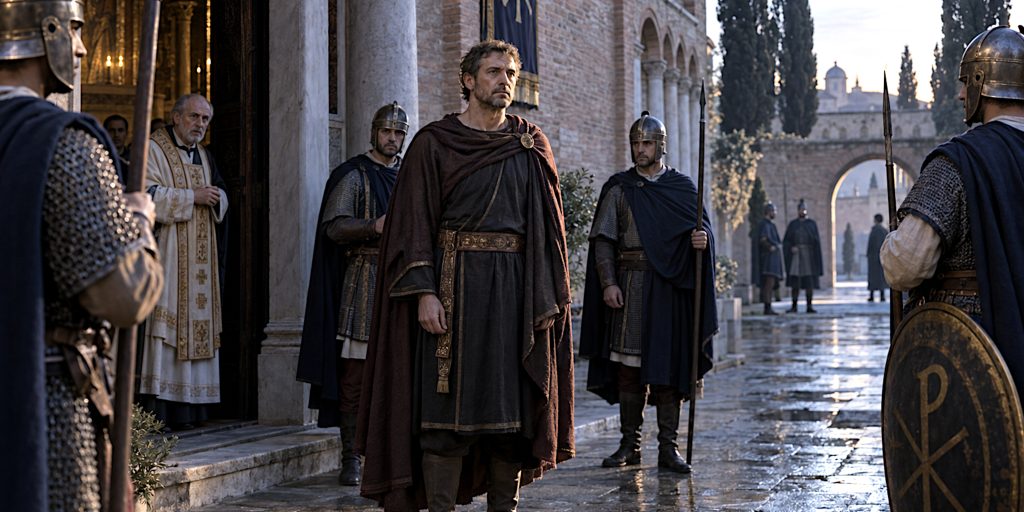
He withdrew to Ravenna and took sanctuary in a church. Soldiers lured him out with an assurance that he would be arrested but spared. A second order condemned him to death. Stilicho submitted and was beheaded on 22 August 408.
Zosimus records that, when Stilicho was led to execution, his supporters were ready to rescue him, but he prevented them. Even in a hostile narrative, the final image is one of restraint. He would not begin a civil war in his own defence.
Eucherius was soon killed. Thermantia was separated from Honorius and returned to her mother. Serena was later executed during Alaric’s siege of Rome, accused of collusion with the Goths. The family that had stood beside the throne was methodically erased.
The Massacre After Stilicho’s Death
Following the coup, Roman troops attacked the wives and children of federate soldiers living in Italian cities. Zosimus describes soldiers killing the families of the men who had served under Stilicho and plundering their property.
The result was catastrophic. Thousands of federate soldiers defected to Alaric. Estimates vary, and the ancient figure of 30,000 should not be treated as a census return, but the political effect is beyond doubt. The Western government converted its own military dependants into enemies through panic and organised murder.
Alaric invaded Italy again. Without Stilicho, the court lacked a negotiator with the authority and experience to manage him. Rome was besieged and finally sacked in August 410. Stilicho’s death did not single-handedly cause the sack, but the purge destroyed the last workable relationship between the Western court and Alaric’s following.
What Contemporary Writers Said About Stilicho
The surviving sources disagree sharply, and none is neutral.
Claudian
Claudian wrote during Stilicho’s ascendancy and depended upon the regime he praised. His poems provide detailed political evidence, but they turn campaigns into epics and opponents into pantomime villains. In On Stilicho’s Consulship, Roma praises the general as the man who labours for her alone. Elsewhere Claudian depicts him as the empire’s shield and the faithful guardian of Theodosius’s sons.
The praise tells us how Stilicho wished to be seen: Roman in loyalty, restrained in power and tireless in defence. It does not prove that the portrait was accurate.
Zosimus
Zosimus wrote in the early sixth century and drew on earlier histories now lost. His account can be hostile, inconsistent and shaped by his belief that the abandonment of traditional religion harmed Rome. Yet he preserves indispensable detail about the coup and its consequences.
His description of Stilicho’s final moments emphasises that the general restrained armed supporters and accepted execution. That detail sits awkwardly beside accusations that Stilicho was plotting to seize the empire. A determined usurper had chosen an unusually passive method of usurpation.
Olympiodorus
Olympiodorus of Thebes was a fifth-century historian and diplomat whose work survives only in summaries and fragments. He was generally more sympathetic to Stilicho and preserves the 4,000-pound demand made by Alaric. His fragments are especially valuable because he understood court diplomacy and the practical negotiations hidden beneath moralising accounts.
Orosius
The Christian historian Orosius portrayed Stilicho as treacherous and alleged that Eucherius planned persecution of Christians. These accusations are difficult to reconcile with Stilicho’s career and family connections. They reflect the hostile tradition that developed after his execution, when dead ministers acquired responsibility for every recent failure. It is a venerable administrative custom.
Was Stilicho a Traitor?
There is no solid evidence that Stilicho intended to destroy the Roman Empire, restore paganism or place his son on the throne. Those charges emerged from the political environment of his fall and served the government that killed him.
He did, however, blur the boundary between public policy and personal power. He monopolised command, married his daughters to Honorius, promoted family interests and used Alaric against the Eastern court. His strategy exposed the West to serious risks. If treason means deliberate betrayal, the case is weak. If it means placing one’s own network at the centre of the state, then most late Roman courts would require a much larger scaffold.
The better judgement is that Stilicho was loyal to a particular vision of the empire. In that vision, the Theodosian dynasty remained supreme, he served as its military guardian and Gothic forces were integrated through command, payment and negotiation. His enemies preferred a narrower Roman politics, but possessed no workable military alternative.
Did Stilicho Save the Western Roman Empire?
For thirteen years after Theodosius’s death, Stilicho kept Honorius on the throne and prevented major invading armies from breaking Italy. His victories over Alaric and Radagaisus were real. His handling of Gildo preserved the African grain supply. His alliances compensated for shortages of regular troops.
He did not reverse the West’s deeper problems:
- The tax base was shrinking and unevenly controlled
- Civil wars had consumed troops and legitimacy
- Provincial armies increasingly made and unmade emperors
- Relations between the Eastern and Western courts were bitter
- The Rhine and British frontiers could not be defended while Italy absorbed the field army
- The emperor Honorius offered little active leadership
Stilicho bought time, and he sometimes bought it at a punishing price. Yet the speed of deterioration after his death is the strongest argument for his importance. Within two years, Rome had been sacked. That does not make him infallible. It does suggest that the men who removed him had mistaken the load-bearing wall for an unpleasant piece of decoration.
Appearance, the Monza Diptych and Surviving Objects
The famous ivory diptych in Monza Cathedral is often identified as portraying Stilicho, Serena and Eucherius. The male figure wears military dress and carries a spear and shield, while the woman and child appear on the companion panel. The identification is traditional rather than certain. Some scholars have proposed other late Roman commanders, including Aetius.
The so-called Sarcophagus of Stilicho in the Basilica of Sant’Ambrogio at Milan is also named by tradition. It probably predates his death and may not have held him at all. Stilicho’s actual burial place is unknown.
These disputed objects are revealing in their own way. Stilicho became so representative of the late Roman generalissimo that later viewers attached his name to the surviving image of an armed courtly commander. He fits the part almost too well.
Timeline of Stilicho’s Life
| Date | Event |
|---|---|
| Around 359 | Probable birth |
| Around 383 | Embassy to Persia on behalf of Theodosius I |
| 380s | Marriage to Serena |
| 393 | Appointed senior commander of infantry and cavalry |
| 394 | Serves at the Battle of the Frigidus |
| 395 | Theodosius dies; Stilicho becomes dominant minister of Honorius |
| 395 to 397 | Campaigns connected with Alaric in Greece and the Balkans |
| 398 | Gildo defeated in North Africa by Mascezel |
| 400 | First consulship |
| 402 | Battle of Pollentia and confrontation near Verona |
| 405 | Second consulship; agreement develops with Alaric |
| 405 to 406 | Defeat of Radagaisus near Faesulae |
| 406 | Rhine crossing by Vandals, Alans and Suebi |
| 407 | Constantine III establishes himself in Gaul |
| 408 | Court coup, arrest and execution at Ravenna |
| 410 | Rome sacked by Alaric, two years after Stilicho’s death |
Stilicho’s Legacy
Stilicho is often grouped with Aetius and Ricimer as a late Roman strongman who ruled through an emperor. The comparison is useful but incomplete. Stilicho was unusually close to the imperial family, operated while the empire still possessed substantial institutions and tried to preserve a united Theodosian order across East and West.
His career shows that the Western Empire did not fall because Romans suddenly forgot how to fight. Stilicho won major campaigns. The more corrosive problem was political: victories could not reliably be converted into stability. Courts distrusted generals, generals needed federate armies, senators resisted the cost, and rival emperors treated one another as threats even while frontiers collapsed.
I find it difficult to admire Stilicho without reservation. He was too fond of dynastic manoeuvre, too willing to gamble with Alaric and never found a durable answer to the West’s recruitment crisis. Yet it is harder still to admire his accusers. They killed the one commander capable of coordinating the Western war effort, massacred the families of their own soldiers and then appeared surprised when those soldiers changed sides.
Stilicho was neither Rome’s spotless saviour nor a barbarian traitor hiding inside the palace. He was a Roman soldier and politician attempting to govern an empire whose military realities had outrun its political imagination. His methods were compromised because the world he managed was compromised. For a time, they worked. When he fell, the margin for error went with him.
Frequently Asked Questions
Was Stilicho a Roman or a Vandal?
He was a Roman imperial officer of mixed ancestry. His father was a Vandal cavalry officer serving Rome and his mother was Roman. Stilicho’s career, marriage and political identity were Roman.
Why did Honorius execute Stilicho?
Honorius was persuaded that Stilicho was plotting against the dynasty, possibly to place his son Eucherius on the throne. The accusations emerged during a court coup led by Olympius and are not supported by firm evidence.
Did Stilicho defeat Alaric?
He defeated or checked Alaric at Pollentia and Verona, but did not destroy his army. Stilicho later attempted to use Alaric as an ally in imperial politics.
Did Stilicho cause the fall of Rome?
No. Some of his decisions weakened frontier defence and his policy towards Alaric carried risks, but his execution damaged the Western military system. Rome was sacked two years later after the new government alienated federate troops and failed to manage Alaric.
Where was Stilicho killed?
He was executed at Ravenna on 22 August 408 after seeking sanctuary in a church.
Is the famous ivory diptych really Stilicho?
Possibly, but the identification is disputed. It may depict another senior late Roman commander and his family.
Watch the documentary:
Sources and Further Reading
- Claudian, On Stilicho’s Consulship, The Gothic War and The War Against Gildo
- Zosimus, New History, Book V
- Olympiodorus of Thebes, surviving fragments in Photius
- Orosius, Seven Books of History Against the Pagans, Book VII
- Sozomen, Ecclesiastical History, Book IX
- J. B. Bury, History of the Later Roman Empire
- Alan Cameron, Claudian: Poetry and Propaganda at the Court of Honorius
- John Matthews, Western Aristocracies and Imperial Court AD 364 to 425
- Guy Halsall, Barbarian Migrations and the Roman West, 376 to 568
- Peter Heather, The Fall of the Roman Empire