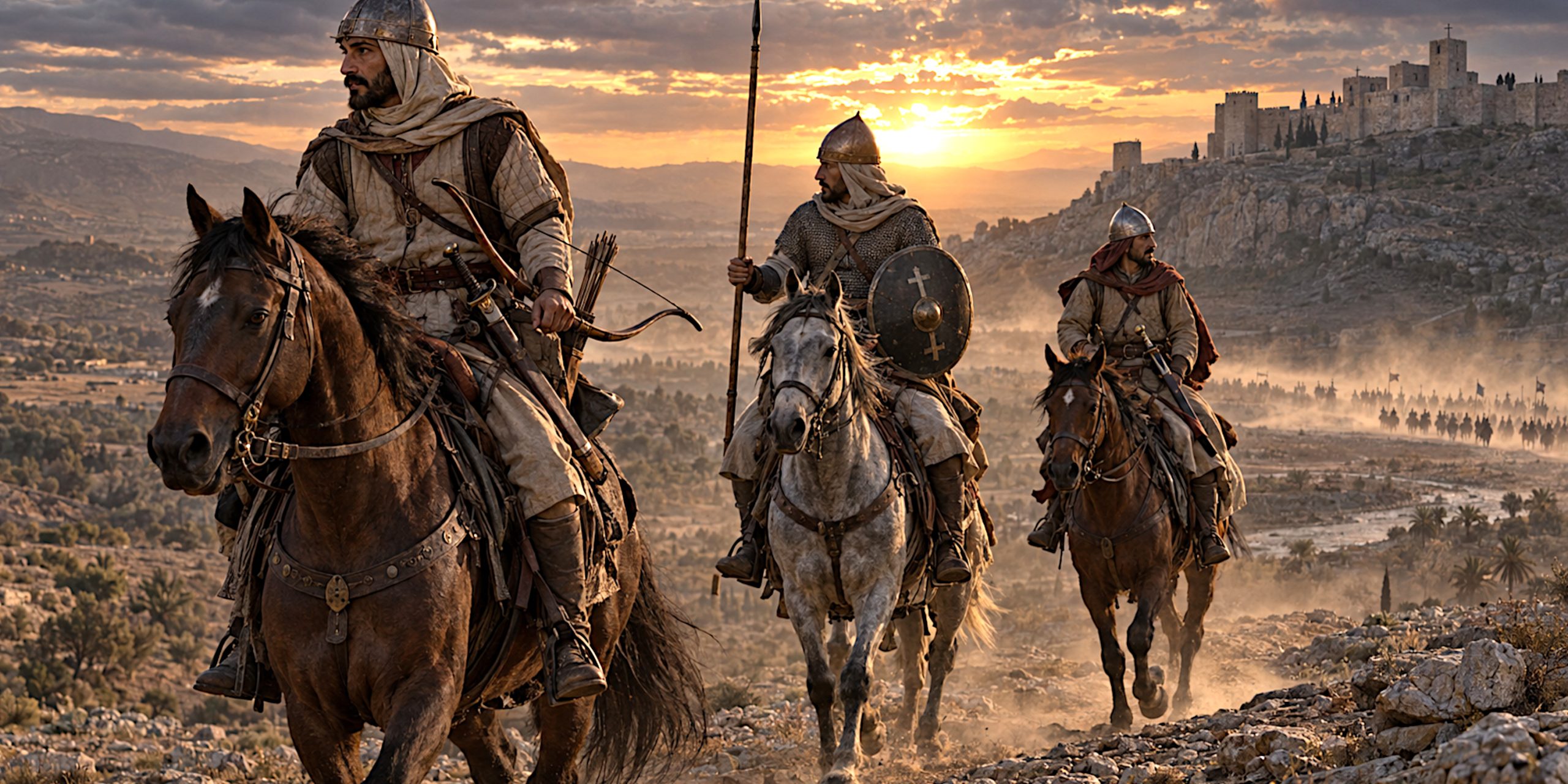
Turcopoles were locally recruited cavalrymen who served the Byzantine Empire, the Crusader states and the military orders. They operated between two military cultures, combining knowledge of Levantine warfare with the organisation and strategic needs of Latin Christian armies.
They are commonly described as lightly equipped mounted archers. That definition is convenient, but rather too tidy. Turcopoles included scouts, skirmishers, escorts and battlefield cavalry. Some probably carried bows, while others fought primarily with lance, sword and shield. Their equipment, status and ethnic background varied across more than two centuries.
What united them was function rather than ancestry. They gave armies dominated by Frankish heavy cavalry a faster, more adaptable mounted force. Crusader knights supplied considerable impact. Turcopoles helped them find the enemy, screen the march and, ideally, avoid charging confidently into a situation they had not properly examined.
Who were the Turcopoles?
The word derives from the Greek tourkopouloi, usually translated as “sons of Turks”. Byzantine writers used it for people of mixed or culturally blended background, particularly those connected with Turkic fathers and Christian mothers.
Raymond of Aguilers, writing about the First Crusade, explained that they were called Turcopoles because they had either been raised among Turks or were born to Turkish fathers and Christian mothers. Albert of Aachen offered a similar explanation, describing Turkish fathers and Greek mothers.
These accounts should not be treated as a precise recruitment register. Medieval writers liked simple categories, even when the people concerned refused to fit inside them.
By the twelfth century, Turcopole had become a military label. In the Crusader states it could describe locally recruited cavalry trained or equipped in an eastern manner, regardless of whether the individual had any Turkish ancestry.
Possible recruits included:
- Indigenous Greek and Syriac Christians
- Armenian Christians
- Christian Arabs
- Converts from Islam
- Men of mixed Turkic and Christian ancestry
- Locally born Franks accustomed to Levantine warfare
- Mercenary cavalrymen serving under contract
It would therefore be misleading to describe the Turcopoles as a single ethnic community. They were a changing category of soldiers drawn from the complicated human landscape of the eastern Mediterranean.
Turcopoles at a glance
| Feature | Likely characteristics |
|---|---|
| Period | Eleventh to fourteenth centuries, with the title surviving later |
| Main employers | Byzantine Empire, Crusader states, Templars, Hospitallers and Teutonic Knights |
| Battlefield role | Scouting, screening, skirmishing, pursuit and cavalry support |
| Recruitment | Primarily local or regional |
| Mounts | Light and medium riding horses |
| Principal weapons | Bow, lance, sword, mace and shield |
| Armour | Padded coat, mail, helmet and occasionally heavier protection |
| Commander | Turcopolier |
| Social status | Variable, including paid auxiliaries, household troops and soldiers attached to military orders |
Byzantine origins
Turcopoles existed in Byzantine service before the establishment of the Crusader states. The Byzantine army had a long tradition of employing foreign, converted and culturally mixed troops. Turkic horsemen were particularly useful because of their experience with mobile archery, scouting and campaigning across difficult terrain.
During the First Crusade, Emperor Alexios I Komnenos provided the crusaders with Byzantine troops, guides and interpreters. Sources mention a small contingent of Turcopoles accompanying part of the crusading army.
These men helped the western forces operate in territory where water, fodder and reliable intelligence could matter as much as courage. Medieval warfare regularly punished armies that possessed plenty of the latter and rather less of the former.
The Byzantine Turcopoles probably provided one model for the locally recruited cavalry later used in Outremer. However, the Frankish version developed according to the particular needs of the new Crusader states.
Why the Crusader states needed them
The armies of Jerusalem, Antioch, Tripoli and Edessa were usually short of manpower. Western knights were formidable but expensive. Their horses required food, care and replacements, while new recruits had to cross the Mediterranean before they could be of any use.
Turcopoles offered several advantages:
- They could be recruited locally
- They understood the terrain and climate
- They rode horses suited to regional conditions
- They could communicate with local communities
- They were familiar with the methods of neighbouring Muslim armies
- They could scout and screen slower Frankish forces
- They were generally cheaper to maintain than fully equipped knights
The Franks faced opponents who made extensive use of mounted archers and other mobile cavalry. Turkish and Syrian horsemen could approach, shoot, withdraw and repeat the process, testing formations without accepting a close fight.
An army consisting only of knights and infantry could find itself reacting blindly. Turcopoles allowed commanders to contest the space in front of their main formation.
Recruitment and identity
Older popular histories sometimes describe Turcopoles simply as the Christian sons of Turkish fathers. Modern scholarship is considerably more cautious.
Some Turcopoles may indeed have come from mixed families. Others were probably native Christians whose communities had lived in Syria, Palestine, Anatolia or Cyprus long before the First Crusade. Converts and Muslim-born soldiers may also have served, although their precise numbers remain uncertain.
Religious identity mattered because the military orders were Christian institutions, but employment practices could be pragmatic. The frontier societies of Outremer depended upon interpreters, guides, merchants, farmers and soldiers who crossed linguistic and cultural boundaries every day.
A Turcopole might speak Arabic, Greek, Armenian, Turkish or one of the Syriac languages. Some would also have understood the Old French used by the ruling elites.
They should not be imagined as a permanently separate caste. Turcopoles were part of the wider military labour market of the eastern Mediterranean.
What did Turcopoles do?
Scouting
Turcopoles could move ahead of the main army to locate enemy forces, water sources, roads and suitable campsites. Their regional knowledge was particularly valuable when an army was operating away from the coast.
Screening a marching army
They protected columns from enemy scouts and sudden attacks. A cavalry screen also prevented an opponent from observing the main army too closely.
Skirmishing
Some Turcopoles fought as mounted archers or javelin-armed horsemen. They could harass enemy cavalry and disrupt formations before heavier troops became engaged.
Protecting the flanks
Frankish armies were vulnerable when marching in column. Turcopoles could patrol the sides and rear, where fast enemy horsemen were most likely to appear.
Supporting knights
During battle they might operate beside sergeants and knights, pursuing broken troops or preventing enemy cavalry from surrounding the heavy Frankish formation.
Carrying messages
Fast local riders were natural couriers. Communication between castles, towns, patrols and field armies was essential to the defence of Outremer.
Raiding and counter-raiding
Turcopoles could take part in small expeditions against livestock, crops, roads or exposed settlements. Such warfare rarely earned a grand illuminated manuscript, but it occupied far more time than the famous charges.
Were all Turcopoles mounted archers?
No. This is one of the most important qualifications.
Some contemporary evidence connects Turcopoles with bows and light cavalry tactics. Their Byzantine background and similarity to regional mounted troops make the use of composite bows entirely plausible.
However, historian Yuval Harari has challenged the assumption that every Frankish Turcopole was primarily a mounted archer. The sources also place them in close combat, organised cavalry formations and direct support of Frankish knights.
The most realistic interpretation is that their equipment varied.
One unit might contain skilled mounted archers. Another could operate as light lancers. Better-funded soldiers serving the Templars or Hospitallers may have worn mail and fought in closer order. The word described a military category, not a regulation equipment package issued identically from Antioch to Acre.
Arms and armour
Turcopole equipment blended western, Byzantine and Islamic traditions. Much depended on wealth, employer, location and date.
Composite bow
The recurved composite bow was constructed from wood, horn and sinew. It was shorter than the English longbow but well suited to use from horseback.
A mounted archer could shoot while approaching, passing or withdrawing from an enemy. Effective mounted archery required considerable training, so it should not be assumed that every locally recruited cavalryman possessed the same ability.
Lance
A relatively light cavalry lance or spear could be used for thrusting, pursuit and close fighting. Turcopoles probably employed lighter weapons than the large lances associated with heavily armoured Frankish knights.
Not every lance attack required a dramatic couched charge. Spears could be wielded overarm, underarm or used to stab at enemies during a confused cavalry encounter.
Swords used by Turcopoles
No surviving sword can be securely labelled as having belonged to a Turcopole. Their likely sword types must be reconstructed from regional finds, artistic evidence and the equipment of comparable forces.
| Sword type | Probable use |
|---|---|
| Straight double-edged sword | Cutting and thrusting weapon influenced by Byzantine and Frankish forms |
| Arming sword | Single-handed western sword used with a shield |
| Paramerion | Byzantine-associated single-edged or curved sword |
| Early sabre | Curved cutting sword influenced by Turkic and Islamic cavalry traditions |
| Short sidearm | Compact blade carried as a secondary weapon |
The straight, double-edged arming sword would have been familiar in armies controlled by Frankish rulers and military orders. These usually had a cruciform hilt, a blade suited to both cutting and thrusting, and a belt-mounted scabbard.
The Byzantine paramerion provides another plausible influence. It was a single-edged sidearm, sometimes slightly curved, associated with Byzantine military equipment. Soldiers recruited through Byzantine or eastern Christian networks may have been familiar with related blades.
Curved sabres were used by Turkic and Islamic cavalry, although their prevalence varied by period and region. A Turcopole serving in the thirteenth century was more likely to encounter such weapons than one accompanying the First Crusade. Modern illustrations have a habit of giving every Turcopole a dramatically curved sabre. The evidence is less obliging.
Maces and axes
A mace was useful in mounted combat and required less maintenance than a sword. Metal-headed maces were common across Byzantine, Islamic and Frankish military cultures.
Small axes may also have been carried, although evidence for their use specifically by Turcopoles is limited.
Shields
Likely shield forms included:
- Small round shields
- Round or slightly convex eastern shields
- Kite-shaped shields
- Smaller heater-style shields during the thirteenth century
Mounted archers benefited from compact shields that did not interfere with bow use. Turcopoles fighting as lancers or close-support cavalry could carry more substantial protection.
Helmets
Simple iron helmets were probably common among those able to afford them. Possible forms included:
- Conical helmets
- Segmented helmets
- Nasal helmets
- Rounded iron caps
- Kettle hats in later service
Mail aventails or cloth wrapping could protect the neck and reduce the discomfort of wearing iron beneath the Levantine sun, which was rarely impressed by anyone’s military status.
Body armour
Turcopoles were generally lighter than Frankish knights, but “light cavalry” does not necessarily mean unarmoured.
Their protection may have included:
- Quilted or padded coats
- Mail shirts
- Short mail hauberks
- Scale or lamellar armour
- Reinforced leather garments
- Cloth surcoats worn over armour
Soldiers employed by wealthy military orders could be better equipped than irregular local auxiliaries. A senior or experienced Turcopole might possess mail, a helmet, shield, bow, lance and sword.
Horse equipment
Their mounts were generally lighter than the powerful warhorses preferred by knights. Regional horses offered speed, endurance and lower maintenance requirements.
Saddles, bridles, reins, saddlecloths and bow cases probably followed a mixture of local and imported designs. Horse armour would have been unusual for ordinary Turcopoles, although elite eastern cavalry traditions certainly included protected mounts.
Turcopoles in the Knights Templar
The Templars developed a formal system for commanding their Turcopoles. The officer responsible was called the Turcopolier.
The later Templar Rule states:
“All the sergeant brothers should go to the Turcopolier.”
This short instruction is revealing. It places the Turcopolier within the Order’s battlefield command structure and shows that his authority could extend beyond the Turcopoles themselves.
In wartime, the Turcopolier directed the Turcopoles and could exercise authority over mounted sergeants. He was therefore not simply an interpreter supervising a handful of local scouts. He held a serious operational command.
Templar Turcopoles may have undertaken:
- Reconnaissance around castles and roads
- Escort duty
- Patrols
- Screening of Templar columns
- Communication between strongholds
- Support for mounted sergeants
- Pursuit after a successful charge
The Rule distinguishes their equipment and organisation from that of knight-brothers. Turcopoles were attached to the Order without necessarily becoming full professed brothers.
Turcopoles in the Knights Hospitaller
The Hospitallers also maintained Turcopole contingents under a Turcopolier. As with the Templars, the office eventually became an important position within the Order.
After the fall of the mainland Crusader states, the Hospitaller title survived on Rhodes and later Malta. Its responsibilities changed with the Order’s circumstances. The Turcopolier became associated with the English Langue and held responsibilities connected with coastal defence.
By that stage, the title had travelled far from its original connection with locally recruited Levantine cavalry. Medieval institutions were quite capable of preserving an office after transforming nearly everything the office once involved.
Numbers and organisation
Precise numbers are difficult to establish. Medieval chroniclers often reported army sizes with more confidence than accuracy.
Accounts of the Battle of Hattin in 1187 claim that the army of the Kingdom of Jerusalem included thousands of Turcopoles. One tradition gives a figure of 4,000. Many historians consider this exaggerated, particularly given the kingdom’s limited manpower and resources.
Smaller contingents are more credible for normal campaigns. Turcopoles may have been organised into units attached to:
- The royal army
- Noble households
- Castles and frontier garrisons
- Templar commands
- Hospitaller commands
- Urban forces
- Temporary expeditionary armies
The Kingdom of Jerusalem reportedly had a senior royal officer sometimes described as the Grand Turcopolier. This suggests that Turcopoles could form an organised component of the crown’s forces rather than merely appearing as occasional mercenaries.
Turcopoles at the Battle of Hattin
The Battle of Hattin was fought on 4 July 1187 between the army of the Kingdom of Jerusalem and Saladin’s forces. Turcopoles were present with the Frankish army, although their exact number and deployment remain uncertain.
During the march from Sepphoris towards Tiberias, Saladin’s mounted troops surrounded and harassed the Christian column. The army suffered from heat, smoke, exhaustion and lack of water.
This was precisely the type of situation in which Turcopoles should have been useful. They could contest enemy scouts, screen the column and respond to mounted harassment. Yet they could not overcome the Christian army’s larger strategic problems.
Once the formation began to disintegrate, lightly equipped cavalry had little chance of reversing the disaster. Captured Turcopoles may have faced especially severe treatment because Saladin’s soldiers could regard them as apostates or collaborators, though the details are not completely secure.
Hattin illustrates both their value and their limits. Mobile auxiliaries could strengthen an army. They could not rescue one from thirst, divided leadership and a march that should never have been attempted.
Contemporary descriptions
The earliest writers tried to explain Turcopoles through ancestry.
Raymond of Aguilers associated the name with men raised among Turks or born to Turkish fathers and Christian mothers. Albert of Aachen similarly described mixed Turkish and Greek parentage. Their accounts reflect how Latin writers understood unfamiliar frontier communities, rather than proving that all Turcopoles shared one background.
The Templar Rule offers firmer evidence for their institutional position. Its directions concerning the Turcopolier show that these troops had recognised leadership and an established place in the Order’s field organisation.
Later chronicles mention Turcopoles during battles, patrols and expeditions, but rarely describe individual soldiers. Medieval authors were generally more interested in kings, nobles and disasters of suitable moral significance. The scout who correctly identified an enemy column tended to receive less attention than the lord who ignored him.
Archaeology and material evidence
Archaeology presents an awkward problem. Turcopoles were defined by employment and military role, neither of which leaves a convenient label in the ground.
No helmet, sword or saddle can be confidently identified as “Turcopole equipment” without an inscription or unusually clear context. A locally made sword found in a Crusader fortress could have belonged to a Frankish settler, an Armenian soldier, an Arab Christian, a Turcopole or an opponent who lost it during an attack.
Evidence from Crusader castles
Excavations at sites associated with the military orders and the Kingdom of Jerusalem have uncovered:
- Arrowheads
- Horseshoes
- Spurs
- Bits and bridle fittings
- Iron buckles
- Mail fragments
- Spearheads
- Sword fragments
- Armour scales
- Stable buildings and tethering arrangements
Relevant sites include Acre, Arsuf, Belvoir, Montfort, Vadum Jacob and other fortified centres. Such discoveries reveal the mixed cavalry culture in which Turcopoles served, but rarely allow a weapon to be assigned to a particular troop category.
Arrowheads
Arrowheads found at battlefields and fortified sites demonstrate widespread archery, though distinguishing arrows shot by Turcopoles from those used by Muslim horse archers or infantry is normally impossible.
Forms include narrow armour-piercing heads, broader cutting heads and compact points suitable for military arrows. Context matters more than shape alone.
Horse equipment
Bits, horseshoes and spurs provide evidence for cavalry activity. Differences in horse size, shoe construction and riding equipment may help archaeologists examine regional practices, but they do not map neatly onto medieval ethnic labels.
Weapons from the Levant
Archaeological and museum collections preserve both straight and curved blades from the eastern Mediterranean. This supports the presence of overlapping weapon traditions. It does not prove that all Turcopoles preferred one sword form.
The absence of securely identified Turcopole graves is also significant. Religious practice, disturbed sites and the difficulty of assigning identity from burial goods all restrict what can be said.
The honest archaeological conclusion is therefore modest. Material evidence confirms a varied cavalry environment in which western and eastern equipment circulated together. It does not provide a standard Turcopole uniform.
How Turcopoles differed from other cavalry
| Troop type | Principal role | Typical protection |
|---|---|---|
| Frankish knight | Heavy charge and close combat | Mail, helmet, shield and later plate elements |
| Mounted sergeant | Support, escort and combat | Mail or padded armour |
| Turcopole | Scouting, skirmishing and flexible cavalry support | Padded armour, mail or lighter regional equipment |
| Muslim horse archer | Missile harassment and manoeuvre | Light to medium armour |
| Bedouin auxiliary | Scouting, raiding and local warfare | Usually light equipment |
These distinctions were never absolute. A wealthy Turcopole could be better armoured than a poor mounted sergeant, while some Muslim cavalry fought as armoured lancers rather than horse archers.
Strengths and limitations
Advantages
- Familiarity with local terrain
- Greater mobility than heavy knights
- Ability to screen marching forces
- Knowledge of regional languages
- Experience with eastern cavalry tactics
- Lower logistical demands
- Usefulness in patrols and reconnaissance
- Ability to pursue retreating enemies
Disadvantages
- Less protection in close combat
- Vulnerability to disciplined heavy cavalry
- Variable training and equipment
- Possible mistrust from western commanders
- Dependence on reliable pay or patronage
- Limited ability to withstand prolonged infantry combat
- Exposure to accusations of religious or political disloyalty
Their cultural position could make them valuable and vulnerable at the same time. They understood several worlds, which meant that each world could question where their loyalties lay.
Turcopoles after the fall of Acre
Acre, the last major mainland stronghold of the Crusader states, fell to the Mamluks in 1291. Surviving personnel of the military orders withdrew to Cyprus and other Mediterranean bases.
Turcopoles continued to appear in the forces of the Templars and Hospitallers. The term also travelled beyond the Levant. The Teutonic Order used the related term Turkopolen for locally recruited light cavalry in eastern Europe, where the soldiers had no meaningful connection to Turkish ancestry.
This development confirms that the name had become functional. It could mean light, locally recruited cavalry serving a western military institution.
Within the Hospitaller Order, the office of Turcopolier survived on Rhodes and Malta. By then it was a senior administrative and defensive command rather than direct leadership of the same troops who had once ridden across the hills of Palestine.
Common myths about Turcopoles
They were all half-Turkish
Some may have been of mixed Turkic and Christian parentage. Many were probably not. The term broadened into a military classification.
They were all mounted archers
Mounted archery was part of their tradition, but Turcopoles also fought with lances and swords. Their role varied between armies and periods.
They wore no armour
Some were lightly protected, while others used padded coats, helmets, mail or scale armour. Military-order contingents could be relatively well equipped.
They were converted Muslim prisoners
Converts probably served among them, but there is no evidence that the entire force came from captured or converted Muslims.
They were Templar soldiers only
Turcopoles served Byzantium, secular rulers in the Crusader states, the Hospitallers, the Templars and other military organisations.
Historical importance
Turcopoles reveal how warfare in the Crusader states actually worked. Latin armies did not simply transplant a western feudal system into the Levant and leave it untouched. They adapted, recruited locally and borrowed practices from their neighbours.
The Turcopoles were central to that adaptation. They connected the shock power of the Frankish cavalry with the mobile warfare of the eastern Mediterranean. Their service also complicates any simple picture of crusading armies divided cleanly into western Christians and eastern Muslims.
These soldiers crossed linguistic, cultural and tactical boundaries. Their identities were varied, their equipment was mixed and their exact status could shift from one employer to another.
That uncertainty is part of their importance. Turcopoles belonged to the lived reality of Outremer, where survival often depended upon local knowledge and practical cooperation. The chroniclers preferred heroic knights. Commanders still needed someone who knew which road contained water.
Frequently asked questions
What does Turcopole mean?
The term derives from a Greek expression meaning “son of a Turk”. It later became a broader label for locally recruited light or medium cavalry serving Byzantine and Latin Christian armies.
Were Turcopoles Christians?
Many were eastern Christians or converts to Christianity. Their religious and ethnic backgrounds were not uniform.
Did Turcopoles use curved swords?
Some probably did, especially in later periods, but straight double-edged swords were also available. There was no single Turcopole sword.
Did they fight for the Knights Templar?
Yes. The Templars employed Turcopoles and placed them under an officer called the Turcopolier.
Were they mercenaries?
Some were paid soldiers, but the category could also include household troops, military-order dependants and locally recruited auxiliaries.
What happened to them after the Crusader states fell?
Some withdrew with the military orders to Cyprus, Rhodes and other Mediterranean possessions. The title of Turcopolier survived long after the original Levantine cavalry organisation had changed.
Sources and further reading
- Yuval Harari, The Military Role of the Frankish Turcopoles: A Reassessment
- Jean Richard, Les Turcoples au service des royaumes de Jérusalem et de Chypre
- Christopher Marshall, Warfare in the Latin East, 1192–1291
- John France, Victory in the East
- Helen Nicholson, The Knights Templar: A New History
- Malcolm Barber, The New Knighthood
- Denys Pringle, The Churches of the Crusader Kingdom of Jerusalem
- The Templar Rule in translation
- Fordham University’s Crusader States resources
- William of Tyre in translation