The Blade of Tyshalle is the second novel in Matthew Stover’s The Acts of Caine series, and this is roughly the point where anyone expecting a conventional fantasy adventure realises they have wandered into something considerably stranger.
Published in 2001, the novel follows Heroes Die, but expands the series far beyond the murderous adventures of Hari Michaelson and his alter ego Caine. What initially looked like a vicious combination of dystopian science fiction and sword-and-sorcery fantasy becomes a much larger examination of violence, celebrity, power, identity and the uncomfortable business of turning human suffering into entertainment.
It is also enormous, angry and frequently exhausting.
I mean that as a compliment. Mostly.
For readers coming to The Acts of Caine because they have heard whispers about an underrated fantasy series with spectacular combat, The Blade of Tyshalle is the book that explains why the series has developed such a devoted following.
The Blade of Tyshalle at a Glance
| Detail | Information |
|---|---|
| Author | Matthew Woodring Stover |
| Series | The Acts of Caine |
| Position | Book 2 |
| First published | 2001 |
| Preceded by | Heroes Die |
| Followed by | Caine Black Knife |
| Main character | Hari Michaelson / Caine |
| Primary settings | Earth and Overworld |
| Genre | Science fantasy, dystopian fiction, dark fantasy |
| Major themes | Violence, identity, power, entertainment, oppression |
| Recommended reading order | After Heroes Die |
The novel works best when read directly after Heroes Die. Technically, Stover provides enough context to understand the basic situation, but beginning here would be rather like arriving halfway through a duel and asking everyone to explain the political background.
What Is The Blade of Tyshalle About?
The story takes place after the events of Heroes Die, when Hari Michaelson’s life has changed dramatically.
Hari is an Actor.
In the future Earth imagined by Stover, Actors travel to another world known as Overworld and participate in real adventures that are transmitted back to audiences on Earth as entertainment. Viewers experience their exploits through sophisticated technology.
Caine is Hari’s enormously popular persona.
Except Caine’s adventures are not staged.
People actually bleed. People actually die. Political upheavals have genuine consequences. The fantasy world consumed as entertainment by Earth’s population is a real place inhabited by real people.
That moral problem sits underneath the entire series, but The Blade of Tyshalle pushes it much further.
Hari is no longer simply the lethal superstar audiences remember. His physical circumstances, political position and relationship with the institutions controlling his life have changed profoundly.
Yet Caine has not disappeared.
That distinction between Hari Michaelson and Caine becomes one of the central tensions of the novel.
Hari Michaelson and Caine
Caine is one of those fantasy protagonists who would probably be unbearable if he were written even slightly differently.
He is violent, arrogant, intelligent, sarcastic and frighteningly competent.
Fortunately, Stover understands exactly what makes that personality interesting.
Caine’s violence has consequences.
He does not move through the story effortlessly carving through disposable enemies while everyone admires how cool he looks. Violence damages bodies, relationships and societies. Caine himself is shaped by what he has done.
That makes the distinction between Hari and Caine increasingly fascinating.
Hari Michaelson is the human being.
Caine is the constructed identity.
Except the boundary is not remotely tidy.
The question becomes whether Caine is merely a role Hari performs or whether Hari is actually the disguise worn by Caine.
The answer keeps changing depending on who is holding the knife.
Why Caine Is Such an Effective Fantasy Antihero
Fantasy is absolutely overflowing with dangerous men carrying swords and complicated emotional baggage. There are enough of them to populate a reasonably large kingdom.
Caine still feels different.
Part of that comes from Stover’s refusal to romanticise him completely.
Caine can be heroic, but heroism does not make him pleasant. He can defend people while simultaneously terrifying them. He can understand injustice while remaining capable of astonishing brutality.
Most importantly, his ability to inflict violence does not automatically make him morally correct.
The series repeatedly asks whether violence can genuinely liberate people or whether it simply creates another structure of domination.
Caine’s answer tends to involve breaking someone’s jaw.
The novel’s answer is considerably more complicated.
The Blade of Tyshalle and the Meaning of the Title
The title has a deliberately mythic quality that suits the increasingly metaphysical direction of the story.
Tyshalle becomes connected to the novel’s larger ideas about destiny, transformation and the relationship between individuals and forces much greater than themselves.
The word “blade” therefore operates on several levels.
There is the obvious martial association. Caine’s identity is inseparable from physical conflict, and blades remain important symbols of personal power throughout the series.
But the blade can also be understood as an instrument of division.
Hari and Caine.
Earth and Overworld.
Actor and audience.
Reality and entertainment.
Human agency and destiny.
Stover keeps cutting through these supposedly clear distinctions until they become increasingly difficult to separate.
Is the Blade of Tyshalle a Literal Sword?
This is where the title can cause some confusion, particularly for readers encountering the name outside the context of the novels.
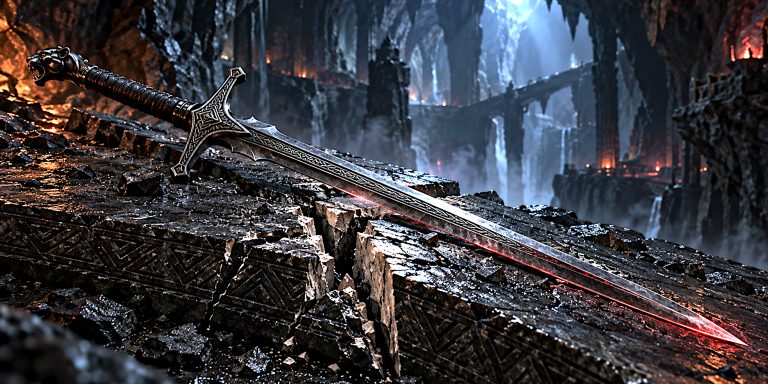
The Blade of Tyshalle should not be approached as though it were simply the name of a famous fantasy sword in the manner of Stormbringer, Andúril or Excalibur.
The title is more deeply connected to the novel’s mythology, symbolism and Caine’s changing role within the story.
Weapons certainly matter in The Acts of Caine. Stover writes physical combat with unusual attention to leverage, positioning, pain and momentum. Yet reducing the title to a collectible magical weapon rather misses what the book is doing.
This is a story about the person who becomes the blade.
That is considerably worse news for everyone standing nearby.
Combat in The Blade of Tyshalle
One reason The Acts of Caine continues to attract readers interested in historical combat and martial arts is Stover’s approach to violence.
Fights have physical structure.
Characters deal with distance, balance, injuries, fatigue and environmental constraints. Caine’s effectiveness comes partly from his ability to understand what is happening faster than his opponents.
He improvises constantly.
That separates the combat from fantasy where swordsmanship becomes a vague exchange of flashing blades until somebody dramatically falls over.
Stover is interested in what violence actually does.
Bones break.
People become exhausted.
Injuries alter what fighters can physically accomplish.
Fear matters.
The environment matters.
Perhaps most importantly, willingness matters. Caine is dangerous partly because he understands how far he is prepared to go before a fight even begins.
The Fantasy and Science Fiction Worlds
The central conceit of The Acts of Caine remains wonderfully nasty.
Earth possesses advanced technology but has developed an intensely stratified society. Overworld resembles a fantasy realm populated by humans and other peoples, with magic functioning as a genuine force.
Earth turns Overworld into entertainment.
That allows Stover to combine genres without treating either side as decoration.
The fantasy setting is not simply a simulation.
Overworld exists independently of the people exploiting it.
This creates one of the series’ strongest ideas. Earth’s audiences can consume suffering while remaining physically detached from it.
There is an obvious connection to reality television, celebrity culture and violent entertainment, although the novel appeared before social media turned ordinary existence into a permanent audition.
On that point, Stover may have been unpleasantly early.
Violence as Entertainment
This is probably the theme that has aged most interestingly.
Caine is famous because people enjoy watching him kill.
His adventures have audiences. His suffering has commercial value. His identity has effectively become intellectual property within a larger entertainment system.
The distinction between authentic experience and manufactured celebrity therefore becomes increasingly unstable.
Hari experiences pain.
Caine generates ratings.
The same event can be both.
That tension gives the violence an uncomfortable edge. Readers are consuming Caine’s adventures for entertainment while reading a novel criticising a society that consumes Caine’s adventures for entertainment.
Stover knows exactly what he is doing there.
We are part of the joke.
Power, Class and Control
The future Earth of The Acts of Caine is organised through rigid social hierarchies.
People are assigned positions within a system that determines opportunities and status. The entertainment industry does not sit outside this structure. It reinforces it.
Actors may become celebrities, but celebrity does not necessarily mean freedom.
Caine is valuable because he generates attention.
That makes him powerful.
It also makes him property.
The Blade of Tyshalle becomes increasingly concerned with what happens when a person whose identity has been constructed by a system begins resisting the system itself.
The answer, predictably, is not a polite discussion with management.
The Novel’s Darker Tone
Readers who thought Heroes Die was dark may discover that Stover had apparently been conserving ammunition.
The Blade of Tyshalle is heavier.
Physical suffering becomes more prominent. Political oppression becomes more explicit. Characters experience humiliation, grief and psychological damage alongside the spectacular violence.
Some readers find this exhausting.
That criticism is understandable.
The novel deliberately spends long stretches placing Hari in situations where his former identity as Caine appears almost impossibly distant. The pacing can consequently feel oppressive.
Yet that discomfort serves a purpose.
Caine’s eventual re-emergence only matters because Stover spends so much time dismantling the fantasy surrounding him.
Philosophy Without Putting the Swords Away
One of Stover’s great strengths is his willingness to let ridiculous fantasy concepts coexist with serious philosophical questions.
There are battles.
There is magic.
There are monsters.
There are people doing deeply inadvisable things with sharp objects.
But underneath all of this sits a sustained argument about human agency.
Can people escape the identities imposed upon them?
Does suffering create meaning?
Can violence destroy oppressive systems without reproducing their logic?
Is identity something we possess or something performed for other people?
Stover rarely pauses the story to provide neat answers. The questions emerge through what happens to the characters.
That makes the philosophy feel embedded rather than attached afterwards with literary duct tape.
How The Blade of Tyshalle Compares With Heroes Die
| Element | Heroes Die | The Blade of Tyshalle |
| Structure | Relatively focused adventure | Much broader and more complex |
| Tone | Violent and cynical | Darker and more philosophical |
| Caine | Established superstar | Identity increasingly dismantled |
| Politics | Important | Central |
| Metaphysics | Present | Greatly expanded |
| Action | Frequent | Intense but surrounded by longer dramatic sections |
| Accessibility | Easier entry point | More demanding |
| Scale | Personal and political | Personal, political and metaphysical |
Heroes Die is probably the easier book to recommend.
The Blade of Tyshalle is arguably the more ambitious one.
Whether that makes it better depends heavily on what you want from the series.
Why the Book Can Be Difficult
There are legitimate criticisms of The Blade of Tyshalle.
The novel is long. Its tone can become relentlessly grim. Stover’s philosophical ambitions sometimes slow the narrative considerably, particularly compared with the savage momentum of Heroes Die.
Hari also spends substantial portions of the story in circumstances that deliberately undermine the power fantasy associated with Caine.
Readers wanting several hundred pages of Caine being spectacularly dangerous may become impatient.
That frustration is partly intentional.
The novel is interrogating precisely the fantasy that made Caine famous.
Still, intentional frustration remains frustration. A reader is perfectly entitled to understand what the author is attempting and still wish everyone would get on with it.
Why The Blade of Tyshalle Has a Cult Following
The novel has never achieved the mainstream profile of major fantasy series such as A Song of Ice and Fire, The First Law or The Witcher.
Yet among readers who discover it, The Acts of Caine regularly inspires unusually enthusiastic recommendations.
Part of that comes from how difficult the series is to categorise.
It is fantasy.
It is science fiction.
It is dystopian fiction.
It is an action story.
It is a satire of entertainment culture.
It is philosophical fiction featuring a man who can solve an impressive range of problems by hitting them.
Few books combine those ingredients without becoming completely incoherent.
Stover somehow keeps the machinery running.
The Blade of Tyshalle and Modern Grimdark Fantasy
The novel also looks surprisingly modern when placed beside later grimdark fantasy.
Caine predates many of the genre’s best-known morally compromised protagonists.
Yet Stover’s treatment of violence differs from simple nihilism.
The world can be cruel without cruelty being meaningless.
Characters still make choices. Loyalty matters. Love matters. Resistance matters.
The darkness exists partly because those things have value.
That distinction prevents the series from becoming an endless competition to determine who can behave most horribly before breakfast.
Reading Order for The Acts of Caine
The complete series should be read in publication order:
- Heroes Die (1998)
- Blade of Tyshalle (2001)
- Caine Black Knife (2008)
- Caine’s Law (2012)
The later novels continue expanding the metaphysical and philosophical ideas introduced in Blade of Tyshalle.
Anyone primarily interested in the action may find Heroes Die the most immediately satisfying novel. Readers fascinated by the stranger ideas behind Caine will probably find the second book essential.
Is The Blade of Tyshalle Worth Reading?
Yes, although with qualifications.
This is not lightweight fantasy.
It is violent, bleak and occasionally demanding. The novel expects readers to tolerate extended suffering, political discussion and increasingly strange metaphysical ideas.
But it also attempts things most fantasy novels never touch.
Caine is simultaneously an action hero, celebrity, commodity, revolutionary and philosophical problem. Hari Michaelson’s struggle with that identity gives the spectacular violence something substantial to push against.
And when Stover finally lets Caine loose, the violence feels dangerous precisely because the novel has spent so much time establishing what Caine actually represents.
The Legacy of The Blade of Tyshalle
The Blade of Tyshalle remains one of the more unusual fantasy novels of the early 2000s.
Its mixture of dystopian science fiction, brutal fantasy combat, media satire and philosophy makes it difficult to place neatly within a single genre. That probably contributed to the series remaining relatively obscure.
It is also exactly why people keep discovering it.
The most interesting thing about Caine is not that he is exceptionally good at violence. Fantasy has plenty of characters who can claim that particular achievement.
It is that Stover keeps asking what such a person means.
What happens when violence becomes entertainment? What happens when an identity becomes a commodity? And what happens when the man playing the role decides that the role belongs to him?
The Blade of Tyshalle spends hundreds of pages tearing Caine apart to find the answer.
Turns out putting him back together is the dangerous part.