The ghulams, more accurately ghilmān in the Arabic plural, were professional military retainers who became one of the defining features of warfare and political power across the medieval Islamic world. Purchased, captured or otherwise brought into a ruler’s household, converted and trained for service, they could become guardsmen, cavalrymen, commanders, governors and, on occasion, rulers themselves.
The English label “slave soldier” is accurate but inadequate. A ghulam was legally unfree at least at the beginning of his career, yet an accomplished ghulam might command thousands of men, own property, receive estates and exercise considerably more power than most free subjects. The institution produced one of medieval history’s stranger social arrangements: men acquired as dependants could eventually decide who occupied a throne.
Ghulams became particularly important from the ninth century under the Abbasid caliphs, although related forms of military slavery existed before them. Their use subsequently spread through the Samanid, Ghaznavid, Seljuk and other Islamic states. Centuries later, the Safavids created their own gholam establishment from predominantly Caucasian recruits.
There was therefore no single “Ghulam army”. The term describes an institution that changed considerably across several centuries and regions.
What Does Ghulam Mean?
The Arabic word ghulām literally means a boy or young man and could also denote a servant or slave. Its military meaning developed through its association with young male dependants trained for service.
The plural is ghilmān, although “ghulams” has become perfectly normal in English historical writing.
Several related terms cause understandable confusion:
| Term | General meaning | Historical usage |
|---|---|---|
| Ghulam | Youth, servant or slave | Often a military retainer or slave soldier |
| Ghilman | Plural of ghulam | Groups of military retainers |
| Mamluk | “Owned” or possessed person | Military slave, eventually associated particularly strongly with the Mamluk states |
| Gholam | Persian form of ghulam | Used especially in Iranian contexts, including Safavid Iran |
| Amir | Commander or prince | A rank which successful ghulams could attain |
The terminology in medieval sources is not always consistent. Ghulam and mamluk can overlap considerably.
That matters because it is tempting to imagine the Ghulams as a single ethnic military order resembling a regiment. They were nothing of the sort.
Origins of the Ghulam System
Military slavery was not invented from nothing by the Abbasids. Rulers across Eurasia had long used foreign guards, captives and dependent warriors. What developed within the Islamic world from the ninth century was unusually systematic.
The expanding Islamic frontier provided access to potential recruits from Central Asia, the Caucasus, eastern Iran, Afghanistan and regions bordering India.
Turkic recruits became particularly prized.
Central Asian steppe societies possessed strong traditions of horsemanship and mounted archery. A young recruit brought into a ruler’s household could be converted to Islam, trained within a military establishment and separated from the tribal and political networks that might otherwise compete with royal authority.
That last point was crucial.
A ruler surrounded by tribal nobles had a problem. Those nobles possessed families, estates, followers and ambitions of their own. A foreign military dependant theoretically possessed none of these things.
His advancement came from the ruler.
At least, that was the theory.
The Abbasids and the Rise of the Ghulams
The decisive expansion came during the Abbasid Caliphate.
Turkish slave soldiers were already appearing in caliphal service under Harun al-Rashid, but the system expanded dramatically under Caliph al-Mu’tasim, who ruled from 833 to 842.
Al-Mu’tasim recruited Turkish military slaves on a substantial scale and formed them into an important element of his personal military establishment. This reflected a wider transformation of Abbasid warfare in which older Arab and Khurasani military formations increasingly gave way to professional troops.
The Turks were especially valuable as cavalry.
Their arrival was not universally popular.
Tensions between the soldiers and the population of Baghdad contributed to al-Mu’tasim establishing a new capital at Samarra in 836. The move physically separated much of the military establishment from Baghdad’s inhabitants while placing the caliph among forces whose loyalty he expected to control.
Samarra therefore became something rather remarkable: an imperial capital whose enormous scale was closely connected with the requirements of a military court.
The arrangement initially strengthened the caliph.
It also created a heavily armed political constituency living next door to him.
History tends to become interesting at precisely this point.
Why Rulers Wanted Ghulams
The attraction was political as much as military.
A ghulam ideally owed his status directly to the sovereign. Unlike tribal warriors, he did not initially possess an independent local power base.
The system offered rulers several advantages:
- professional soldiers available throughout the year
- highly trained cavalry
- reduced dependence on tribal levies
- personal loyalty to the ruler or royal household
- soldiers without strong connections to local aristocracies
- a pool of potential officers and administrators
- military forces capable of counterbalancing existing elites
There was another advantage. Ghulams could be trained from youth within the military culture of a particular court.
Weapon handling, riding, archery, discipline and court etiquette could therefore become parts of the same education.
The soldier was being created alongside the courtier.
Recruitment and Training
Recruitment varied enormously according to period and state.
Central Asian Turks were particularly prominent during the Abbasid, Samanid and Ghaznavid periods. Other recruits came from the Caucasus, eastern Iranian territories, Afghanistan and elsewhere.
Some were captives of war. Others entered the slave markets through established commercial networks.
Young recruits were particularly desirable because they could be trained within the ruler’s household before developing substantial external loyalties.
Training could include:
- horsemanship
- mounted archery
- lance fighting
- swordsmanship
- formation manoeuvres
- hunting
- physical conditioning
- court discipline
- Islamic religious instruction
The best recruits could progress into positions of extraordinary responsibility.
This was not slavery resembling plantation labour. It remained coercive human ownership, and romanticising it would be a serious mistake, but its social and political operation was very different. Military slavery could paradoxically provide routes to wealth and authority unavailable to most of the free population.
The Ghulam as a Horseman
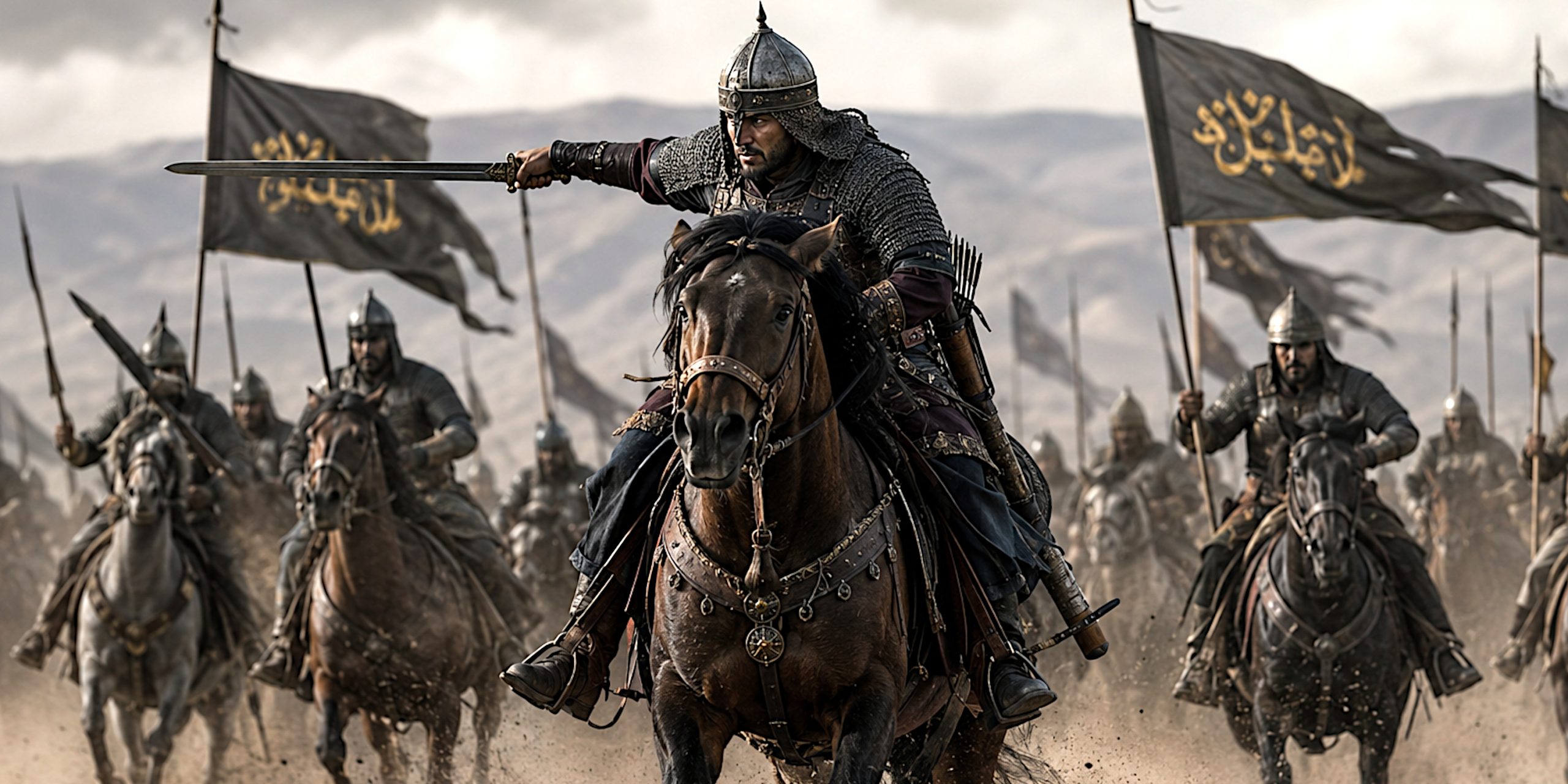
The classic image of the early Turkic ghulam is the mounted warrior.
Central Asian cavalry traditions were particularly useful to Islamic rulers because these troops could combine missile warfare with close combat. A competent horse archer could harass an opponent, withdraw rapidly and return to attack without surrendering battlefield mobility.
The composite bow was central to this style of warfare.
Constructed from combinations of wood, horn and sinew, the reflex composite bow could deliver considerable power from a weapon compact enough to use effectively on horseback.
A ghulam cavalryman might therefore begin an engagement with arrows before closing with lance, sword or mace.
This combination produced a remarkably flexible soldier.
Arms and Armour
Equipment differed considerably between a ninth-century Abbasid Turk and an eleventh-century Ghaznavid ghulam. Wealth and rank mattered too. Senior guardsmen and commanders could possess exceptionally fine equipment.
Swords
The sword was an important secondary or close-combat weapon.
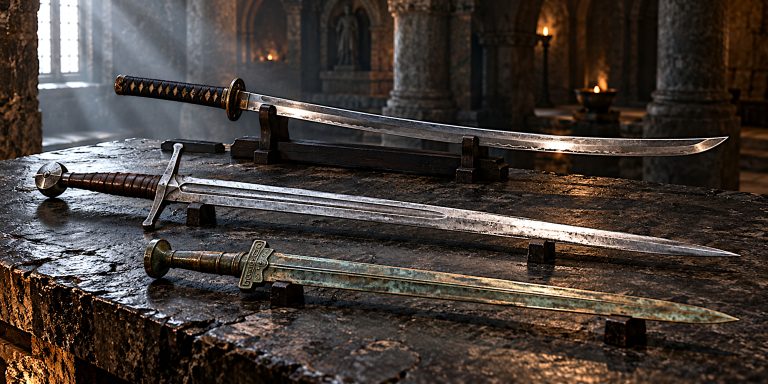
Early Islamic swords were frequently straight and double-edged, contrary to the popular assumption that every medieval Muslim cavalryman carried a dramatically curved scimitar.
Among weapons associated with the broader military environment of the Ghulams were:
Straight Arab and Persian swords
Straight, double-edged blades remained common during the early Abbasid period. Surviving Islamic swords and artistic representations show that curved sabres did not immediately replace earlier forms.
Early Turkic sabres
Curved single-edged swords had strong associations with Eurasian steppe cavalry cultures. Their presence became increasingly important as Turkic military traditions entered the Islamic world.
Qalāchūr
Ghaznavid sources refer to the qalāchūr, apparently a long curved sword associated with their soldiery. The weapon reflects the increasing importance of sabre-like blades within eastern Islamic cavalry traditions.
Shamshir-type curved swords
The deeply curved Persian shamshir familiar from later centuries should not simply be projected backwards onto Abbasid Ghulams. Curved swords developed over time, and the extreme curvature associated with later Persian examples belongs to a considerably later military environment.
For an illustration of a ninth-century ghulam, therefore, a moderately curved steppe sabre or straight sword is more defensible than a seventeenth-century Persian shamshir.
Composite Bow
For many Turkic ghulams, the composite bow was arguably more tactically important than the sword.
Mounted archers could shoot while manoeuvring and use repeated missile attacks to disrupt infantry and cavalry formations.
Lance and Spear
The lance gave cavalry the ability to deliver shock attacks once an enemy formation had been weakened or disorganised.
Ghulams were not simply horse archers circling perpetually at a convenient distance. They could close aggressively when battlefield conditions demanded it.
Maces and Axes
Maces appear frequently in the military culture of Iran and Central Asia and were particularly useful against armoured opponents.
Battle axes were also known, although their prevalence varied considerably between armies.
Shields
Round shields constructed from hide, wood or composite materials were widely used.
Some could be relatively small and suited to mounted fighting, allowing the rider to retain mobility while protecting the torso.
Body Armour
Mail was among the most important forms of protection.
A wealthy or well-equipped ghulam might wear:
- mail shirt or hauberk
- padded textile armour
- lamellar protection
- reinforced coats
- arm and leg defences
- helmet
- mail aventail
Lamellar armour had particularly strong traditions across Central Asia and the Eurasian steppe.
Helmets
Conical helmets were widespread and practical for cavalry warfare. Some included nasal guards or mail protection around the neck.
Senior warriors could possess decorated helmets and equipment which proclaimed status as much as it provided protection.
Medieval soldiers were apparently no more immune to expensive military fashion than anyone else.
How Ghulams Fought
Ghulams could fulfil several battlefield roles.
Their most celebrated role was cavalry, particularly mounted archery and mobile warfare.
A typical engagement might involve missile exchanges before cavalry units attempted to disrupt an enemy formation. Mounted troops could threaten flanks, pursue retreating opponents or rapidly reinforce vulnerable sections of the army.
Against less mobile forces, the combination of horse archery and manoeuvre could be devastating.
However, Ghulams usually fought as part of mixed armies.
Abbasid and later Iranian armies might contain Arabs, Persians, Turks, Daylamites, tribal cavalry, infantry, mercenaries and other contingents.
Under the Ghaznavids, the military mixture became particularly colourful. Turkic slave cavalry operated alongside infantry, regional troops and war elephants.
Subtlety has occasionally been overrated in military history. A charging elephant remained a persuasive argument.
The Samanid Ghulams
The Samanids of Central Asia and Khurasan developed one of the most influential ghulam systems.
Their geographical position gave them excellent access to the Central Asian slave trade. Turkic recruits entered Samanid service and could rise through a carefully structured military hierarchy.
The tenth-century geographical and administrative tradition portrays the Samanid military establishment as highly organised. Army personnel were registered and paid through a central bureaucracy.
Promotion depended upon experience and royal service.
This system produced commanders who became extremely powerful.
One of its most consequential products was Alp Tigin, a Turkic slave soldier who rose to senior command before establishing himself at Ghazna.
His political legacy helped create the circumstances from which the Ghaznavid dynasty emerged.
From Ghulam to Sultan: The Ghaznavids
Few developments demonstrate the possibilities of the system better than the rise of the Ghaznavids.
Sebuktigin had entered the military world as a slave and became associated with Alp Tigin. He eventually ruled Ghazna and established the foundations of a dynasty.
His son Mahmud of Ghazni became one of the most powerful rulers of the early eleventh century.
A military institution designed to produce loyal servants had therefore helped produce a royal dynasty.
The irony would have been difficult to improve upon.
Under the Ghaznavids, Turkic ghulams remained important elements of the army. They operated alongside other cavalry, infantry and the dynasty’s famous war elephants.
Ghaznavid forces employed the composite bow, lance, mace and curved qalāchūr sword.
Ghulams Under the Seljuks
The Seljuk conquests of the eleventh century were initially driven heavily by free Turkmen tribal cavalry rather than slave soldiers.
Once the Seljuks established a territorial empire, however, they encountered the same problem experienced by earlier rulers.
Tribal warriors were excellent for conquest but considerably less convenient for running a centralised state.
Seljuk rulers consequently developed professional military establishments which included ghulams.
The great vizier Nizam al-Mulk discussed military organisation in his Siyasatnama, recommending that rulers avoid excessive dependence upon any single ethnic military group and maintain an elite force close to the court.
His advice reflected hard experience.
A ruler needed strong soldiers.
He also needed those soldiers not to discover that they were stronger than him.
Contemporary Voices
Our picture of the Ghulams comes largely from chroniclers, administrators and writers connected with elite society. Their testimony is invaluable, but it must be read with the usual caution reserved for men writing about rulers who could have them dismissed, imprisoned or worse.
The eleventh-century statesman Nizam al-Mulk, discussing the composition of royal armies, argued for deliberate diversity among troops. In the Siyasatnama, his underlying concern is clear: a ruler should not allow one military group to become overwhelmingly dominant.
It was advice born from centuries of political experience.
Earlier, Ibn al-Muqaffaʿ, writing in the eighth century about the Khurasani military forces upon which the early Abbasids depended, praised their discipline:
“They possess discipline and obedience.”
His comments predate the great expansion of the Turkish ghulam system, but they reveal the political problem that later recruitment sought to solve. Caliphs wanted disciplined professional soldiers whose loyalty rested upon the dynasty rather than older tribal structures.
The later Persian administrative tradition similarly emphasised inspection and organisation. Abbasid military authorities maintained registers of troops and horses, while soldiers and their equipment could be reviewed before the ruler.
These were professional military establishments, not simply collections of slaves handed weapons and pointed towards an enemy.
The Problem of Loyalty
The entire ghulam system rested upon an attractive proposition.
A slave soldier separated from his original family and political community would be loyal to the ruler who trained, paid and promoted him.
Sometimes he was.
Sometimes he was loyal to his commander.
Sometimes he was loyal to his regiment.
Sometimes he concluded that he would make a better ruler himself.
The Abbasid experience illustrates the danger particularly well.
As Turkish military forces became increasingly powerful during the ninth century, commanders gained enormous influence over the caliphate. During the period sometimes called the Anarchy at Samarra, between 861 and 870, military factions participated directly in the removal and elevation of caliphs.
The institution created to protect rulers had become capable of controlling them.
This was not an inexplicable failure. It was almost built into the system.
Professional soldiers concentrated near the ruler possessed weapons, organisation, money and access to political decision-making. Their commanders could accumulate patronage networks of their own.
Personal dependence gradually became corporate power.
Ghulams and Mamluks: What Is the Difference?
There is no perfectly clean distinction.
Both terms could describe military slaves, and medieval writers sometimes used them in overlapping ways.
“Ghulam” is particularly useful when discussing the Abbasid and eastern Iranian military systems of the ninth to eleventh centuries.
“Mamluk” became especially associated with the highly developed military slave institutions that eventually produced the Mamluk Sultanate in Egypt and Syria.
The Mamluks therefore did not appear from nowhere in the thirteenth century. They belonged to a much longer tradition in which rulers recruited foreign military dependants and turned them into professional soldiers.
The political consequences were ultimately spectacular.
In Egypt, military slaves ceased merely influencing rulers and became the ruling elite themselves.
Safavid Gholams
The institution did not simply disappear with the medieval Turkish military systems.
Under Shah Abbas I of Persia, who ruled from 1588 to 1629, a new gholam establishment became an important part of Safavid government.
These recruits differed from the earlier predominantly Turkic ghulams.
Many were Georgians, Circassians and Armenians originating in the Caucasus. They were incorporated into royal service and could become soldiers, administrators and governors.
Shah Abbas used them partly as a counterweight to the powerful Qizilbash tribal establishment.
The underlying political logic would have been immediately recognisable to an Abbasid caliph seven centuries earlier.
Create a body of men whose position depended upon the monarch and use them to restrain aristocrats whose power did not.
Safavid gholams could rise remarkably high. The Georgian Allahverdi Khan, for example, became one of Shah Abbas’s most important commanders.
The Safavid corps therefore represents a later adaptation rather than a straightforward continuation of the Abbasid system.
Archaeology and Material Evidence
Archaeology presents an awkward problem when studying Ghulams.
There is no distinctive archaeological object that can simply be labelled a “Ghulam sword” or “Ghulam helmet”. Their material culture overlapped with the wider military worlds of Central Asia, Iran, Iraq and the Islamic courts they served.
The most important archaeological landscape associated with the early Abbasid military transformation is Samarra in Iraq.
Founded as the Abbasid capital under al-Mu’tasim, Samarra developed into an enormous palatial and military landscape along the Tigris. Its scale reflects the extraordinary resources of the ninth-century caliphate and the presence of large court and military establishments.
Excavation and survey have revealed palaces, residential districts, mosques, administrative structures and extensive planned development.
For historians of the Ghulams, Samarra matters because architecture provides evidence for something literary texts also describe: the physical reorganisation of Abbasid government around a professional military court.
Weapons from the broader Islamic and Central Asian worlds provide additional evidence.
Archaeological finds and surviving museum pieces demonstrate the continued presence of straight swords alongside the gradual spread of curved sabres associated with steppe traditions. Arrowheads, horse equipment, mail fragments and lamellar components help reconstruct the equipment available to cavalry forces.
But attribution should remain cautious.
Finding a ninth-century sabre in an Abbasid context does not mean its owner was a ghulam. Archaeology rarely provides such obligingly tidy labels.
Ghulams and the Transformation of Islamic Warfare
The rise of the Ghulams formed part of a wider movement towards professional standing armies.
Earlier Islamic armies had relied heavily upon Arab tribal military structures and regional forces. By the ninth and tenth centuries, rulers increasingly employed salaried professionals, slave soldiers and specialised military households.
This altered warfare.
Mounted archery became increasingly prominent as Turkic soldiers entered armies across Iran and Iraq. The composite bow, already known across Eurasia for centuries, became deeply embedded within the military systems of the Islamic East.
It also altered government.
Maintaining professional soldiers required taxation, payroll systems, military registers, armouries, horses and administrative departments.
The army became more expensive but potentially more reliable.
Until it stopped being reliable.
How Effective Were Ghulam Soldiers?
At their best, ghulam cavalry represented elite professional manpower.
Their strengths included:
- excellent horsemanship
- effective mounted archery
- professional training
- battlefield mobility
- proficiency with several weapons
- close association with military commanders
- capacity for both skirmishing and close combat
Their weaknesses were primarily institutional rather than tactical.
Professional military households were expensive. They required continual recruitment and payment. Commanders could accumulate personal followings. Rival military factions could become involved in succession disputes.
Most dangerously, rulers could become dependent upon the very forces intended to make them independent.
The Abbasids discovered this painfully.
The Samanids discovered it too.
Later dynasties nevertheless continued using similar systems because the alternative, relying entirely upon unpredictable tribal or aristocratic forces, was hardly reassuring.
Medieval statecraft rarely offered comfortable choices.
Common Myths About the Ghulams
They were all Turks
No. Turkic soldiers were extremely important, particularly in the early eastern Islamic systems, but Ghulams could come from many backgrounds. Later Safavid gholams were heavily Caucasian.
They all carried curved scimitars
No. Straight swords remained widespread during the early Abbasid period. Curved steppe sabres became increasingly influential, but the deeply curved Persian shamshir belongs largely to a later weapon tradition.
They were ordinary conscript soldiers
No. Their defining relationship was personal dependency and, usually, servile status rather than territorial conscription.
They were always loyal
Very definitely not.
They were simply Mamluks under another name
The terminology overlaps, but the institutions varied according to time and place. It is safer to examine each military system in its own political context.
Historical Legacy
The ghulam system helped change the balance of power across the medieval Islamic world.
It strengthened rulers by providing professional troops independent of traditional aristocratic and tribal structures. It encouraged the spread of Central Asian cavalry traditions. It contributed to the development of sophisticated standing armies and military bureaucracies.
Yet it also created new elites.
Men who began as purchased outsiders could become generals. Generals became governors. Governors could become kingmakers. Some of their descendants became sultans.
The Ghaznavid experience demonstrates just how far that process could go.
There is a tendency to treat the Ghulams simply as exotic elite cavalry, which misses the more interesting story. Their importance lies as much in politics as warfare. They were an attempted solution to one of monarchy’s oldest problems: how does a ruler create an army powerful enough to defeat his enemies without creating commanders powerful enough to replace him?
The medieval Islamic world tried one of history’s most unusual answers.
It worked remarkably well.
Right up until the moments when it very much did not.