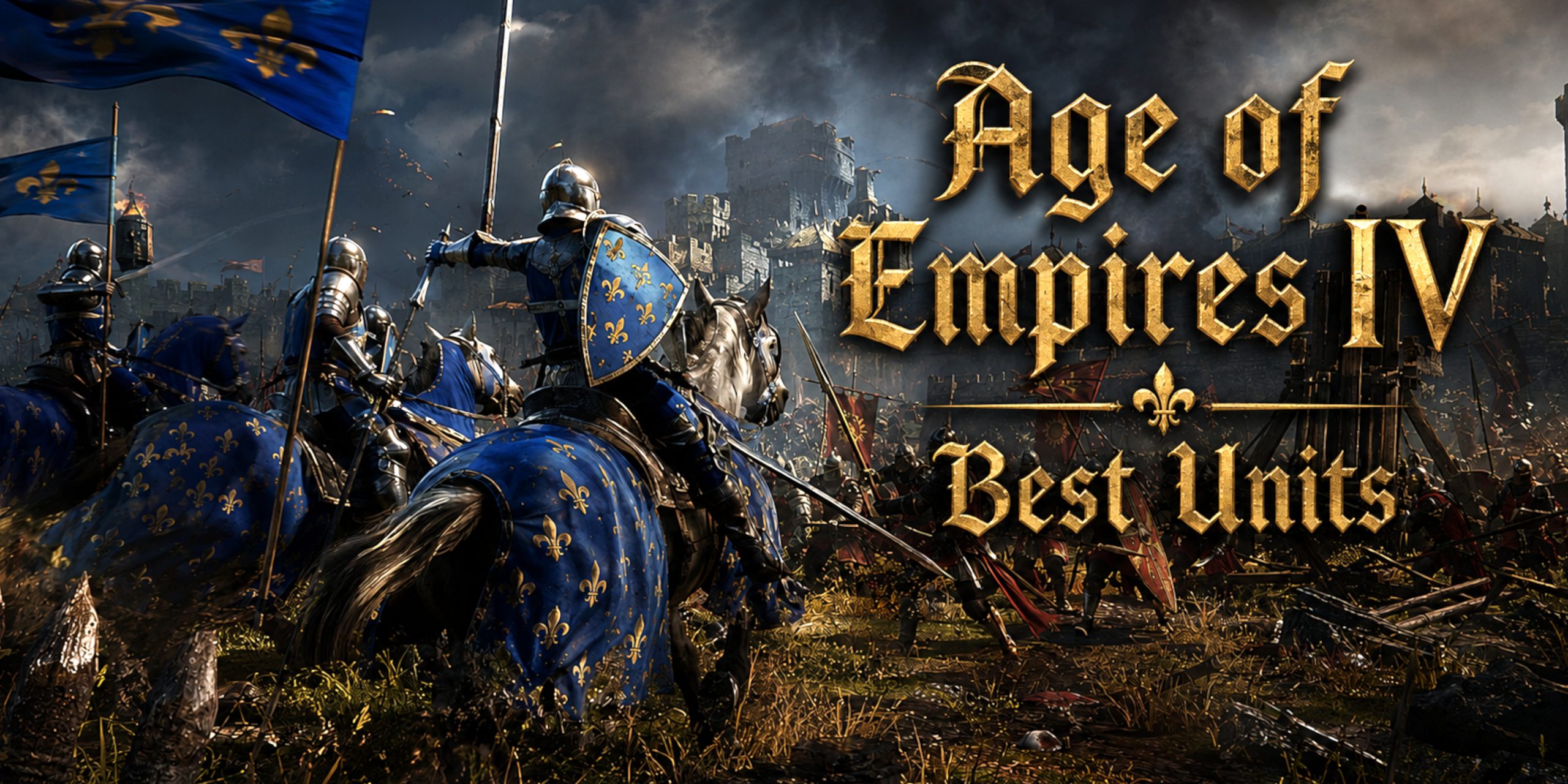
Age of Empires IV has reached the point where asking for the “best unit” requires a few follow-up questions. Best at what? Raiding? Winning a straight fight? Deleting siege? Making your opponent reconsider their evening plans?
The roster has also grown considerably. The game now includes the original civilisations alongside Byzantines, Japanese, variant civilisations and newer additions from Knights of Cross and Rose, Dynasties of the East and Yue Fei’s Legacy. Balance patches continue to change individual match-ups, so any ranking pretending there is a permanent mathematical answer is asking for trouble.
Instead, this ranking looks at the qualities that tend to survive patches: combat efficiency, mobility, timing, versatility, scaling, ease of supporting the unit economically and its ability to force an opponent to change their strategy.
Some units are terrifying because of their raw statistics. Others make the list because they give you control over the match.
And yes, elephants are involved.
15. English Longbowman
Civilisation: English
Available: Feudal Age
Role: Long-range anti-light infantry
The Longbowman might be the most recognisable unique unit in Age of Empires IV. It is basically an Archer that has been eating properly and has considerably more ambitious ideas about personal space.
Its defining advantage is range. Longbowmen can begin dealing damage before ordinary Archers can answer, making them particularly dangerous against Spearmen and other lightly armoured targets.
The English can also produce them rapidly through the Council Hall, giving the civilisation one of the game’s classic Feudal pressure strategies.
Their weakness is hardly mysterious. Horsemen can ruin the party very quickly, while heavily armoured units eventually reduce their effectiveness.
Still, few units have shaped AoE IV multiplayer quite as consistently.
Why it ranks: Range, early availability and excellent English production synergy.
Main counters: Horsemen, Mangonels and heavy armour.
Verdict: Still one of the best early-game units in Age of Empires IV.
14. Landsknecht
Civilisation: Holy Roman Empire
Available: Castle Age
Role: High-damage infantry
Landsknechte look like someone asked, “What if infantry had almost no interest in self-preservation?”
The answer is enormous damage.
Their area attacks can tear through tightly packed infantry formations with astonishing speed. If Landsknechte reach Archers, Spearmen or other massed infantry, health bars start disappearing at a rate that feels mildly unreasonable.
The problem is getting them there.
They are relatively fragile for their cost and can be shredded by focused ranged fire. They therefore work best mixed into tougher infantry formations rather than sent charging ahead like Renaissance festival enthusiasts who have become dangerously committed to the bit.
Why it ranks: Devastating area damage and excellent performance inside mixed infantry armies.
Main counters: Archers, Handcannoneers and concentrated ranged fire.
Verdict: Fragile, expensive and capable of completely wrecking an infantry battle.
13. Zhuge Nu
Civilisations: Chinese and related Chinese variants where available
Role: Rapid-fire ranged infantry
The Zhuge Nu demonstrates why judging units purely by attack damage is a mistake.
Its individual projectiles are not particularly intimidating. The problem is that it fires several of them.
Against lightly armoured units, Zhuge Nu formations produce a ridiculous volume of fire. Villagers, Spearmen and other low-armour units can disappear frighteningly quickly.
They become much less impressive against substantial ranged armour, so this is not a unit you blindly mass into every opponent.
Used in the correct match-up, however, they are one of the most efficient ranged killing machines available.
Why it ranks: Exceptional damage output against low-armour targets.
Main counters: Heavy armour, Mangonels and cavalry.
Verdict: Situational, but brutally efficient when given the right targets.
12. Camel Archer
Civilisation: Abbasid Dynasty
Available: Feudal Age
Role: Mobile ranged cavalry and support
Camel Archers are awkward to fight, which is one of the greatest compliments you can give an RTS unit.
They combine mobility with ranged damage and can harass infantry while avoiding unfavourable engagements. Their support effects against enemy cavalry also make them valuable beyond their direct damage output.
The cost prevents them from simply replacing ordinary Archers, but that is not really their purpose.
Camel Archers are battlefield manipulators. They kite, harass, support and punish poor positioning.
Why it ranks: Mobility, utility and excellent performance against infantry-heavy armies.
Main counters: Dedicated ranged units and well-positioned anti-cavalry forces.
Verdict: A unit that becomes better as the player’s micro improves.
11. Samurai
Civilisation: Japanese
Role: Heavy infantry
Samurai are among the most dependable frontline units available to the Japanese.
They combine strong armour, good melee performance and excellent staying power. Their defensive mechanics can make the opening exchange of a fight particularly favourable, especially against units relying on slower, heavier attacks.
They are not invincible. Crossbows and other dedicated anti-heavy options remain dangerous, and massing expensive infantry can leave a Japanese army vulnerable to counter-compositions.
But when you need something to stand in front of your more delicate units and refuse to leave, Samurai are very good at the job.
Why it ranks: Durability, strong melee performance and excellent frontline value.
Main counters: Crossbowmen, gunpowder infantry and concentrated anti-heavy damage.
Verdict: One of the game’s most reliable heavy infantry units.
10. War Elephant
Civilisation: Delhi Sultanate
Role: Heavy cavalry and siege support
The War Elephant is one of those units that causes your brain to temporarily stop doing strategy and start doing “that is an enormous elephant.”
Fortunately, it is also useful.
War Elephants bring huge health pools and substantial battlefield presence. They can pressure fortified positions, disrupt formations and absorb an extraordinary amount of punishment.
Their greatest weakness is efficiency. Elephants are expensive, slow and vulnerable to concentrated counter-fire. Spearmen and other anti-cavalry units can turn an expensive investment into an equally expensive corpse.
This makes them less universally useful than the units above them.
But properly supported War Elephants remain among the most intimidating units in the game.
Why it ranks: Massive durability and enormous battlefield presence.
Main counters: Spearmen, ranged anti-heavy units and concentrated fire.
Verdict: Not subtle. Sometimes subtlety is overrated.
9. Ghulam
Civilisation: Abbasid Dynasty
Role: Heavy infantry
The Ghulam is less flashy than several units on this list, but that is partly why I like it.
It does the job.
Ghulams are durable heavy infantry capable of anchoring Abbasid armies while ranged and mounted units work around them. Their strong sustained combat performance makes them particularly effective in prolonged engagements.
They are still vulnerable to proper anti-heavy counters, so marching a solid block of Ghulams into massed Crossbowmen is not tactical innovation.
Used intelligently, though, they provide exactly what a good frontline unit should: time.
Time for your Archers to shoot. Time for cavalry to flank. Time for siege to fire.
Why it ranks: Reliability, durability and strong synergy with combined-arms armies.
Main counters: Crossbowmen and other anti-heavy specialists.
Verdict: One of the game’s best examples of a unit being excellent without needing a gimmick.
8. Janissary
Civilisation: Ottomans
Role: Gunpowder infantry
Janissaries are unusual gunpowder troops because their value extends beyond simply shooting things very hard.
They are particularly dangerous around cavalry and can also support Ottoman siege, making them a natural part of the civilisation’s powerful late-game army compositions.
That creates an awkward problem for opponents. Charging the Ottoman gun line with cavalry can go badly, while allowing the Ottoman siege train to operate freely can go even worse.
They do have vulnerabilities, particularly against ranged pressure, and positioning matters enormously.
But inside a properly constructed Ottoman army, Janissaries are superb.
Why it ranks: Anti-cavalry performance, siege synergy and strong ranged damage.
Main counters: Archers and other efficient ranged units.
Verdict: The bodyguards of one of AoE IV’s nastiest late-game siege compositions.
7. Royal Knight
Civilisation: French
Available: Feudal Age
Role: Heavy cavalry
There are units that win fights, and there are units that make your opponent play differently because they might be somewhere nearby.
The Royal Knight belongs to the second category.
French players can field heavy cavalry remarkably early. Once Royal Knights appear, exposed villagers become liabilities and opponents often have to invest in Spearmen, defensive structures or altered resource routes.
Their charge damage makes them excellent at picking engagements, while their mobility allows French players to attack one location and disappear before the counter-army arrives.
That strategic pressure is why they remain so highly ranked.
Why it ranks: Early heavy cavalry, exceptional mobility and devastating raiding potential.
Main counters: Spearmen, massed Crossbows and defensive positioning.
Verdict: One of the best tempo units ever added to Age of Empires IV.
6. Streltsy
Civilisation: Rus
Available: Imperial Age
Role: Elite gunpowder infantry
If Streltsy are standing still and shooting comfortably, something has probably gone wrong for the other player.
The Rus unique gunpowder infantry becomes more dangerous when allowed to maintain its firing position. That makes Streltsy particularly effective behind a durable frontline where opponents cannot easily disrupt them.
Their damage output against expensive units can be brutal.
Mobility and positioning remain the catches. Streltsy are considerably less impressive when constantly repositioning or being jumped by cavalry.
Give them protection, however, and they become one of the game’s strongest late-game ranged units.
Why it ranks: Exceptional stationary damage and excellent late-game scaling.
Main counters: Mangonels, cavalry flanks and anything capable of forcing constant movement.
Verdict: Basically a sign saying “please do not walk towards this army.”
5. Cataphract
Civilisation: Byzantines
Role: Elite heavy cavalry
Cataphracts take the basic concept of heavy cavalry and turn the armour slider slightly beyond what seems socially acceptable.
Their durability allows them to survive engagements that would force ordinary cavalry away, while their offensive capabilities make them dangerous against both isolated targets and organised formations.
What really makes elite cavalry valuable, however, is mobility.
Infantry can dominate one location. Cataphracts can threaten several.
They raid, reinforce, flank and chase retreating armies while remaining tough enough to participate in major engagements.
The obvious downside is cost. Losing elite cavalry unnecessarily is a wonderful way to convert a strong economy into sadness.
Why it ranks: Elite durability combined with heavy-cavalry mobility.
Main counters: Spearmen, anti-heavy ranged units and resource-efficient defensive formations.
Verdict: Expensive, imposing and extremely difficult to ignore.
4. Great Bombard
Civilisation: Ottomans
Available: Imperial Age
Role: Heavy siege artillery
The Great Bombard answers an important tactical question: how much cannon is too much cannon?
Apparently this much.
It is one of the signature pieces of Ottoman artillery and can inflict enormous damage on buildings and valuable enemy targets. Supported by Janissaries and a proper frontline, Great Bombards can transform a late-game Ottoman army into a slowly advancing problem that becomes harder to solve with every metre.
They are expensive and vulnerable when isolated, which prevents them from being automatic victory machines.
But allowing several protected Great Bombards to establish themselves outside your base is generally considered a poor life choice.
Why it ranks: Exceptional siege power and terrifying late-game pressure.
Main counters: Anti-siege weapons, cavalry dives and aggressive flanking.
Verdict: One of the most intimidating siege units in Age of Empires IV.
3. Handcannoneer
Civilisations: Multiple
Available: Imperial Age
Role: Elite ranged infantry
Yes, a broadly available unit makes the top three.
Unique does not automatically mean better.
Handcannoneers provide tremendous ranged damage and are particularly effective against expensive armoured targets. Once economies can sustain significant numbers of them, they become a central component of many Imperial Age armies.
Their weakness is equally important. They are expensive and vulnerable to siege, especially when packed into neat formations that practically send a handwritten invitation to enemy Mangonels.
But in terms of straightforward killing power, very few units are as dependable.
Why it ranks: Huge ranged damage and strong performance against elite units.
Main counters: Mangonels, cavalry and efficient ranged pressure.
Verdict: Expensive men with guns remain surprisingly persuasive.
2. Warrior Monk
Civilisation: Rus
Available: Castle Age
Role: Religious support cavalry
This might be the controversial pick.
Good.
The Warrior Monk is not second because it will beat everything in a duel. It obviously will not.
It ranks this highly because Age of Empires IV battles are about armies rather than individual stat cards.
Warrior Monks can provide combat benefits to surrounding Rus forces after attacking, while retaining the religious functions needed to collect Relics, capture Sacred Sites and perform conversions. Their mounted mobility makes them much easier to reposition than conventional religious units.
One unit can therefore contribute to military combat, map control and the relic economy.
That is absurdly useful.
A Royal Knight is stronger individually. A Streltsy kills things faster. A Great Bombard destroys buildings.
The Warrior Monk can make an entire army better while helping secure strategic objectives.
Why it ranks: Army-wide support, mobility and strategic utility.
Main counters: Focus fire and careless positioning.
Verdict: Possibly the best force multiplier in the game.
1. Knight
Civilisations: Multiple, with unique variants across several factions
Role: Heavy cavalry
My choice for the best overall unit in Age of Empires IV is surprisingly boring.
The Knight.
Not one particular civilisation’s supercharged version. The basic concept itself.
Knights combine almost everything that matters in AoE IV: speed, armour, health, burst damage, raiding potential and the ability to choose engagements.
That final point is enormous.
A slow army can be incredibly powerful and still spend half the match arriving five seconds after something important happened. Knights decide where pressure occurs.
They can raid villagers, reinforce fights, destroy exposed siege, chase retreating units, threaten trade and punish players who move around the map without sufficient Spearmen.
Their counters are very real. Spearmen are dramatically cheaper, Crossbowmen punish heavy armour and massing Knights requires a substantial food and gold economy.
But that actually strengthens the argument.
The mere possibility of Knights forces opponents to prepare counters.
Few units influence the battlefield so completely.
Why it ranks: Mobility, durability, raiding, burst damage and extraordinary strategic flexibility.
Main counters: Spearmen, Crossbowmen and disciplined defensive positioning.
Verdict: The best all-round military unit archetype in Age of Empires IV.
Best Age of Empires IV Units by Role
| Category | Best Pick | Why |
|---|---|---|
| Best overall unit | Knight | Mobility, armour and versatility |
| Best early-game unit | Royal Knight | Feudal heavy cavalry creates immediate pressure |
| Best ranged unit | Streltsy | Exceptional late-game damage when positioned correctly |
| Best infantry | Samurai | Excellent durability and frontline performance |
| Best siege unit | Great Bombard | Extraordinary destructive potential |
| Best support unit | Warrior Monk | Improves armies while providing religious utility |
| Best raiding unit | Royal Knight | Speed and charge damage |
| Best anti-infantry specialist | Landsknecht | Devastating area damage |
| Best ranged pressure unit | Longbowman | Range and early availability |
| Best gunpowder unit | Streltsy | Outstanding sustained ranged damage |
| Best “please deal with this immediately” unit | Great Bombard | Because ignoring it rarely ends well |
What Actually Makes a Unit Good in Age of Empires IV?
Raw damage is only one part of the equation.
A genuinely top-tier unit usually succeeds in several areas at once.
Mobility determines whether you can choose fights rather than simply accept them.
Resource efficiency matters because an amazing unit that destroys your economy is considerably less amazing.
Timing can make an otherwise ordinary unit oppressive. Royal Knights and Longbowmen are dangerous partly because of when they become available.
Counter pressure matters too. A powerful unit forces the enemy to spend resources preparing for it.
Then there is army synergy. Janissaries become nastier around Ottoman siege. Warrior Monks improve surrounding Rus troops. Landsknechte become much safer when hidden inside tougher infantry formations.
The strongest armies in Age of Empires IV therefore rarely consist of one unit endlessly duplicated until the population cap starts complaining.
Combined arms usually wins.
Are Unique Units Better Than Standard Units?
Not necessarily.
This is one of the cleverer parts of Age of Empires IV’s design.
Unique units tend to specialise rather than simply replace the standard roster with something objectively superior. Longbowmen gain range. Streltsy gain exceptional damage potential. Royal Knights improve the heavy cavalry formula. Landsknechte offer devastating area damage while sacrificing durability.
That creates trade-offs.
Meanwhile, ordinary units such as Knights, Crossbowmen, Spearmen and Handcannoneers remain enormously important throughout competitive play.
A civilisation’s strength comes from how its economy, technologies, landmarks and military units interact.
The coolest-looking unit is not automatically the correct one to build.
Sadly.
Which Unit Should You Build?
If you are staring at six military production buildings wondering what on earth to queue, stop thinking about tier lists for a moment.
Look at the enemy army.
Against heavy cavalry, build Spearmen and appropriate anti-heavy support.
Against massed infantry, consider Archers, Mangonels or specialist anti-infantry units.
Against armoured infantry, Crossbowmen and gunpowder units become increasingly attractive.
Against siege, mobility and dedicated anti-siege options matter enormously.
Against an opponent massing one unit exclusively, congratulations. They have made your decision considerably easier.
The best unit is often simply the unit your opponent least wants to see.
Final Verdict
If I had to choose one unit type to represent what makes Age of Empires IV combat work, I would take the Knight.
Heavy cavalry has the combination of mobility, durability and offensive power needed to influence almost every part of a match. The Royal Knight pushes that concept even further by bringing the threat online exceptionally early.
For pure late-game destruction, Streltsy and Handcannoneers are harder to argue against. Great Bombards dominate when properly protected. Longbowmen remain one of the game’s defining early pressure units, while Warrior Monks demonstrate that the strongest unit on the battlefield does not necessarily need the biggest damage number.
That is ultimately why ranking AoE IV units is so interesting.
The game gives almost everything a counter. A supposedly unstoppable army can encounter exactly the wrong composition and suddenly become several thousand resources’ worth of historical re-enactment.
And frankly, that is how it should be.