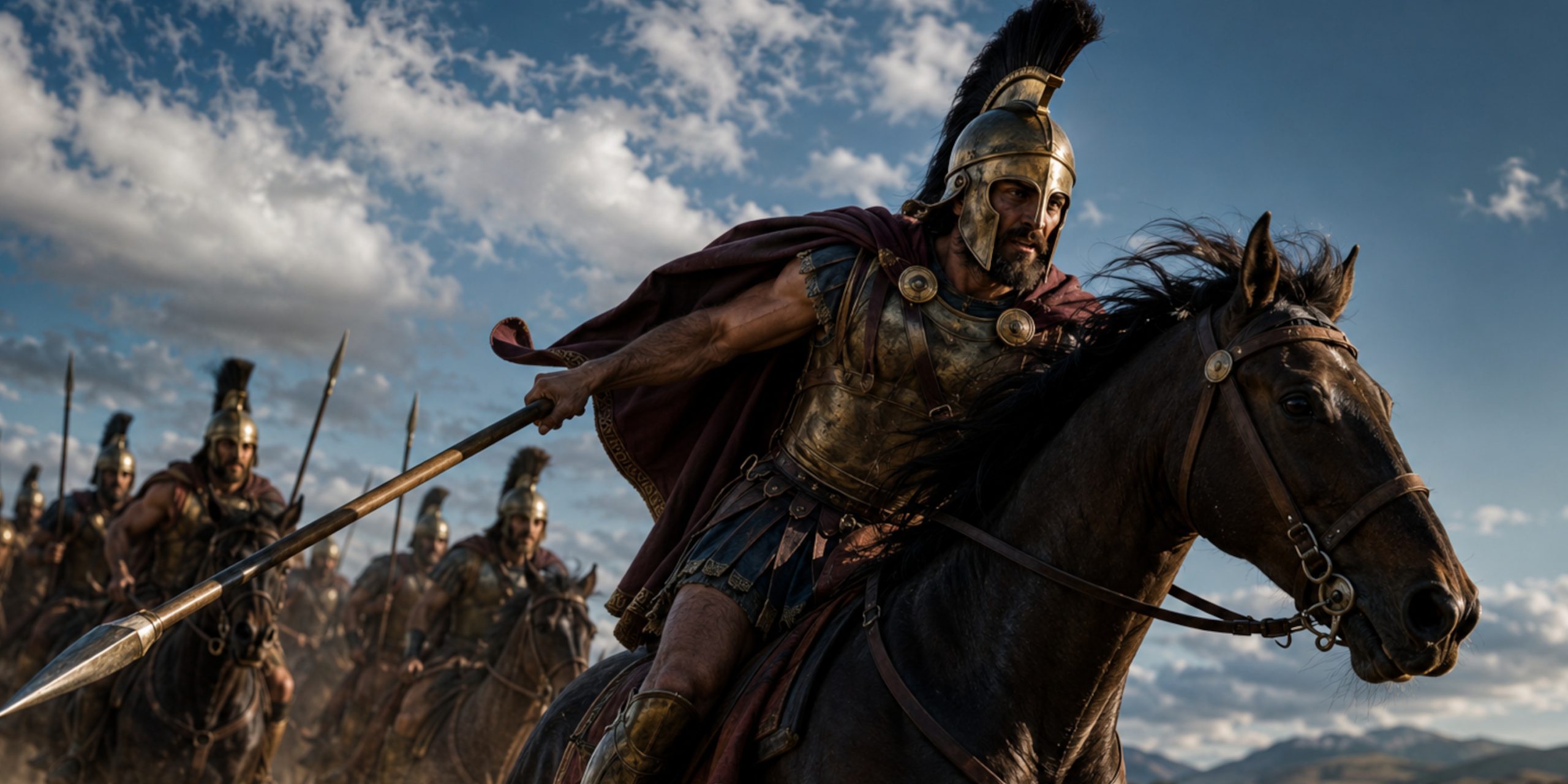
In the popular imagination ancient Greek warfare often belongs to the hoplite. Bronze shields, spear walls, heroic speeches and a lot of very uncomfortable marching. Yet on the wide plains of Thessaly, another military tradition developed. Here, the horseman rather than the heavy infantryman became the symbol of power.
The Thessalian cavalry of the 5th and 4th centuries BCE were regarded as some of the finest mounted troops in the Greek world. Before the rise of Macedonian cavalry under Philip II and Alexander the Great, Thessaly provided the benchmark for Greek horse warfare.
Their riders served as scouts, raiders, battlefield shock troops and mobile support. They were not simply men who happened to own horses. They represented a specialised military culture built around generations of aristocratic horsemanship.
As someone looking back at Greek warfare, it is refreshing to see the spotlight move away from yet another discussion about hoplites standing shoulder to shoulder. Effective? Absolutely. Glamorous? Sometimes. Comfortable? Almost certainly not.
Why Thessaly Produced Elite Cavalry
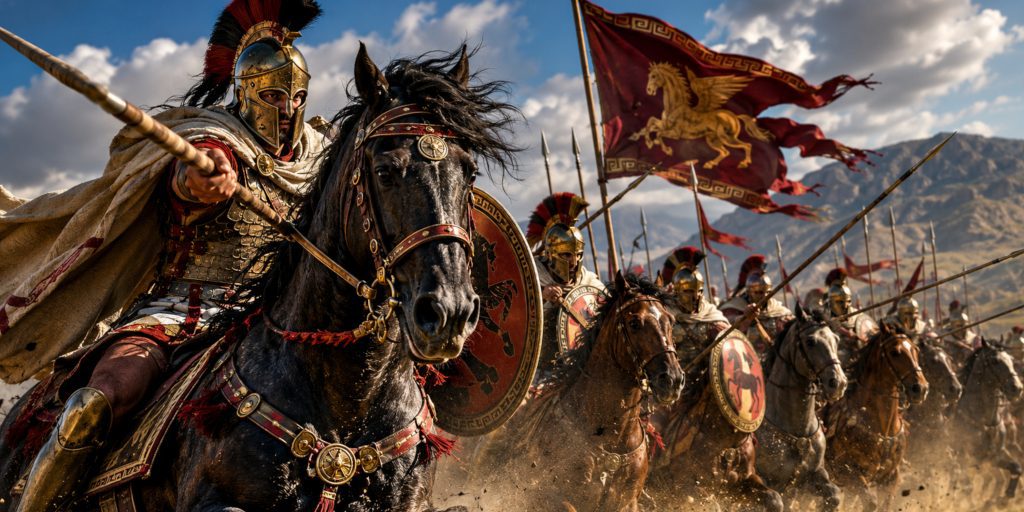
Thessaly was unusual in mainland Greece because geography favoured horses.
Unlike the mountainous regions of central and southern Greece, Thessaly contained large open plains suitable for:
- Horse breeding
- Cavalry manoeuvres
- Large agricultural estates
- Aristocratic warrior elites
The wealthy Thessalian landowners could afford horses, equipment and the time needed to master riding. This produced a cavalry tradition closer to that of Macedonia, Persia and other regions where mounted warfare dominated.
By the 5th century BCE, Thessalian cavalry had gained a reputation across Greece. They fought as allies and mercenaries, and their support could significantly strengthen an army.
Organisation And Battlefield Role
Thessalian cavalry were generally organised into regional contingents provided by the cities and noble families of Thessaly.
Their battlefield roles included:
- Screening infantry movements
- Harassing enemy formations
- Protecting vulnerable flanks
- Pursuing defeated enemies
- Preventing enemy cavalry from gaining control of open ground
Unlike later medieval cavalry, they were not heavily armoured knights designed to smash directly through infantry formations. A frontal charge into prepared hoplites with long spears was usually an excellent way to turn an expensive horse into a historical footnote.
Instead, they relied on:
- Mobility
- Discipline
- Repeated attacks
- Coordination
- Exploiting weaknesses
The Rhomboid Formation
One of the most famous features associated with Thessalian cavalry was the rhomboid formation.
Rather than forming a simple rectangular block, Thessalian riders could arrange themselves in a diamond shape. Ancient writers credited this formation with allowing better control and flexibility.
Advantages included:
- Easier changes of direction
- Strong command visibility
- Effective movement across uneven terrain
- Ability to respond quickly during battle
The commander usually rode at the front point of the diamond, while experienced officers controlled the sides and rear.
This formation later influenced Macedonian cavalry organisation, particularly under Philip II, who understood the value of Thessalian military traditions.
Famous Battles And Campaigns
Peloponnesian War (431 To 404 BCE)
During the Peloponnesian War, Thessalian cavalry were considered valuable allies. Athens benefited from Thessalian mounted support early in the conflict.
Their mobility complemented Athenian strengths, especially since Athens itself was not famous for producing elite cavalry.
Battle Of Delium (424 BCE)
At Delium, fought between Athens and Boeotia, cavalry played an important supporting role.
The battle demonstrated how Greek warfare was evolving beyond a simple collision between hoplite lines. Mounted troops could influence movement, pursuit and battlefield control.
Rise Of Macedon Under Philip II
The greatest transformation came during the 4th century BC.
Philip II of Macedon recognised the quality of Thessalian cavalry and incorporated them into his expanding military system after establishing influence over Thessaly.
Thessalian horsemen became an important part of the Macedonian army alongside the famous Companion Cavalry.
Alexander The Great’s Campaigns
Under Alexander, Thessalian cavalry fought across Asia and proved themselves against some of the greatest mounted armies of the ancient world.
They participated in major battles including:
While Alexander’s Companion Cavalry often gained the most attention, Thessalian cavalry frequently protected the crucial left wing under commanders such as Parmenion.
The Companions may have received the heroic artwork. The Thessalians often received the harder job of stopping everything from collapsing.
Arms And Armour Of The Thessalian Cavalry
Helmets
Thessalian cavalry used several Greek helmet styles.
Common examples included:
Boeotian Helmet
The Boeotian helmet became especially associated with cavalry.
Advantages:
- Excellent visibility
- Good hearing
- Lightweight construction
- Practical for mounted combat
Unlike some earlier enclosed helmets, it allowed a rider to actually see what was happening around him, a surprisingly useful feature when controlling a horse during a battle.
Phrygian Helmet
Some riders used the Phrygian style, recognisable by its forward-curving peak.
Features:
- Bronze construction
- Neck protection
- Distinctive appearance
- Popular in northern Greece and Macedonia
Body Armour
Protection varied depending on wealth and period.
Common armour included:
Linothorax
A layered linen or composite cuirass widely used by Greek warriors.
Benefits:
- Lighter than bronze
- Flexible
- Suitable for cavalry movement
Bronze Muscle Cuirass
Used by wealthier cavalrymen.
Features:
- Shaped bronze chest protection
- High status appearance
- Strong defence against cuts and missiles
Scale Armour
Some elite riders may have adopted scale armour influenced by eastern traditions, especially during later campaigns.
Weapons Of The Thessalian Cavalry
Cavalry Spear (Xyston)
The main weapon was the xyston, a long cavalry spear.
Typical features:
- Length often around 3 to 4 metres
- Wooden shaft
- Iron spearhead
- Sometimes fitted with a secondary point at the rear
It allowed riders to strike enemies before closing into sword range.
Swords Used By Thessalian Cavalry
Kopis
The kopis was one of the most effective cavalry swords of the Greek world.
Design:
- Single-edged curved blade
- Forward-weighted cutting profile
- Length commonly around 50 to 65 cm
The shape made it especially dangerous from horseback because a rider could combine the sword’s chopping power with the momentum of the horse.
Xiphos
Some cavalrymen also carried the xiphos.
Features:
- Straight double-edged blade
- Leaf-shaped profile
- Bronze or iron examples
- Effective for thrusting and cutting
While often associated with hoplites, it remained a practical secondary weapon.
Makhaira
Closely related to the kopis, the makhaira was another curved cutting sword used by Greek cavalry.
Its design favoured powerful downward strikes, making it ideal for mounted combat.
Shields
Unlike heavy infantry, Thessalian cavalry generally avoided large hoplite shields.
Some riders may have used:
- Small round shields
- Light pelte-style shields
Many preferred keeping both hands available for controlling the horse and using weapons effectively.
Horses And Equipment
Ancient Thessalian horses were highly valued.
They were:
- Stronger than many southern Greek breeds
- Well suited to open terrain
- Carefully bred by aristocratic families
Equipment included:
- Simple bridles
- Cloth saddle pads
- Decorative horse gear
- No stirrups
The absence of stirrups is worth remembering. These riders performed complex manoeuvres and combat techniques without a piece of equipment later cavalry considered essential.
Archaeology And Surviving Evidence
Physical evidence for Thessalian cavalry comes from several sources.
Tombs And Burials
Elite graves in Thessaly and northern Greece have revealed:
- Horse equipment
- Weapons
- Armour fragments
- Decorative fittings
These finds support literary evidence that cavalry carried both military and social importance.
Weapon Finds
Greek cavalry equipment discovered from the Classical and early Hellenistic periods includes:
- Iron spearheads
- Sword blades
- Bronze helmet examples
- Armour remains
The survival of iron weapons is often poor because corrosion has spent two thousand years doing what enemy soldiers failed to finish.
Artistic Evidence
Important sources include:
- Vase paintings
- Relief sculpture
- Coin imagery
These show riders with:
- Spears
- Short cloaks
- Helmets
- Cavalry clothing
- Light armour
Thessalian coinage especially reflects the region’s strong association with horses.
Contemporary Ancient Quotes
Ancient authors repeatedly noted the quality of Thessalian horsemen.
The historian Thucydides wrote about Thessalian cavalry involvement during the Peloponnesian War, describing their importance among Greek mounted forces.
Xenophon, who wrote extensively on horsemanship, emphasised the importance of training, control and skilled riding:
“The man who is to be a good horseman must take care that his horse is trained.”
His works show the level of discipline expected from effective cavalry, not simply bravery in the saddle.
Arrian, writing about Alexander’s campaigns, highlighted the role of Thessalian cavalry within the Macedonian army and their reliability during major battles in Asia.
Decline And Legacy
The independent importance of Thessalian cavalry declined after Macedonian domination, but their influence continued.
Their traditions helped shape:
- Macedonian cavalry tactics
- Hellenistic warfare
- Combined-arms armies
The age when Greek battles were decided almost entirely by infantry was ending. Cavalry became a decisive battlefield arm, and Thessaly had helped lead that transformation.
The Cavalry Greece Often Forgets
The Thessalian cavalry deserve a much larger place in discussions of ancient warfare. They were not a decorative addition to hoplite armies or wealthy nobles riding around the edges of battle looking impressive.
They represented a different Greek military tradition, one based on movement, adaptability and professional skill.
The Macedonian Companion Cavalry may have become the famous name, but they developed in a world where Thessalian horsemen had already shown what disciplined cavalry could achieve. History often remembers the final masterpiece more than the earlier sketches, even when those sketches were rather brilliant.