Few fictional weapons have achieved legendary status with so little explanation. The Vorpal Sword appears briefly in Lewis Carroll’s Through the Looking-Glass, and What Alice Found There, yet somehow managed to carve its way into fantasy history.
It has no detailed origin story, no blacksmith with a tragic past, no ancient prophecy stretching across ten novels. It simply appears in the poem Jabberwocky, does exactly what it needs to do, and leaves everyone wondering what “vorpal” even means.
That mystery is probably why it works.
Origins Of The Vorpal Sword
The Vorpal Sword first appeared in the 1871 novel Through the Looking-Glass by Lewis Carroll. Inside the book, Alice discovers the strange nonsense poem Jabberwocky, a work filled with invented words that somehow feel understandable.
The poem follows an unnamed hero who is warned about the monstrous Jabberwock:
“Beware the Jabberwock, my son!”
To face the creature, the hero takes up the Vorpal Sword and waits for his enemy. When the monster arrives, the weapon delivers the famous finishing blow:
“One, two! One, two! And through and through
The vorpal blade went snicker-snack!”
The hero returns victorious, carrying the creature’s head.
For a poem built from playful language, it is surprisingly close to a classic heroic myth: a young warrior, a terrifying beast, a magical weapon and a triumphant return.
Basically, a fantasy boss fight before fantasy boss fights existed.
What Does “Vorpal” Mean?
The strange part is that nobody knows exactly.
Lewis Carroll never provided a clear definition of “vorpal”. Unlike some of his invented words, where he explained the meaning later, the sword’s description remained mysterious.
Theories suggest it could imply:
- Extremely sharp
- Deadly or destructive
- Magical in nature
- Designed specifically for defeating monsters
- Something with a strange, unnatural cutting power
The lack of explanation became the weapon’s greatest strength. “Vorpal” sounds dangerous before you even know what it does.
Fantasy writers have spent more than a century trying to recreate that feeling.
Appearance And Design Of The Vorpal Sword
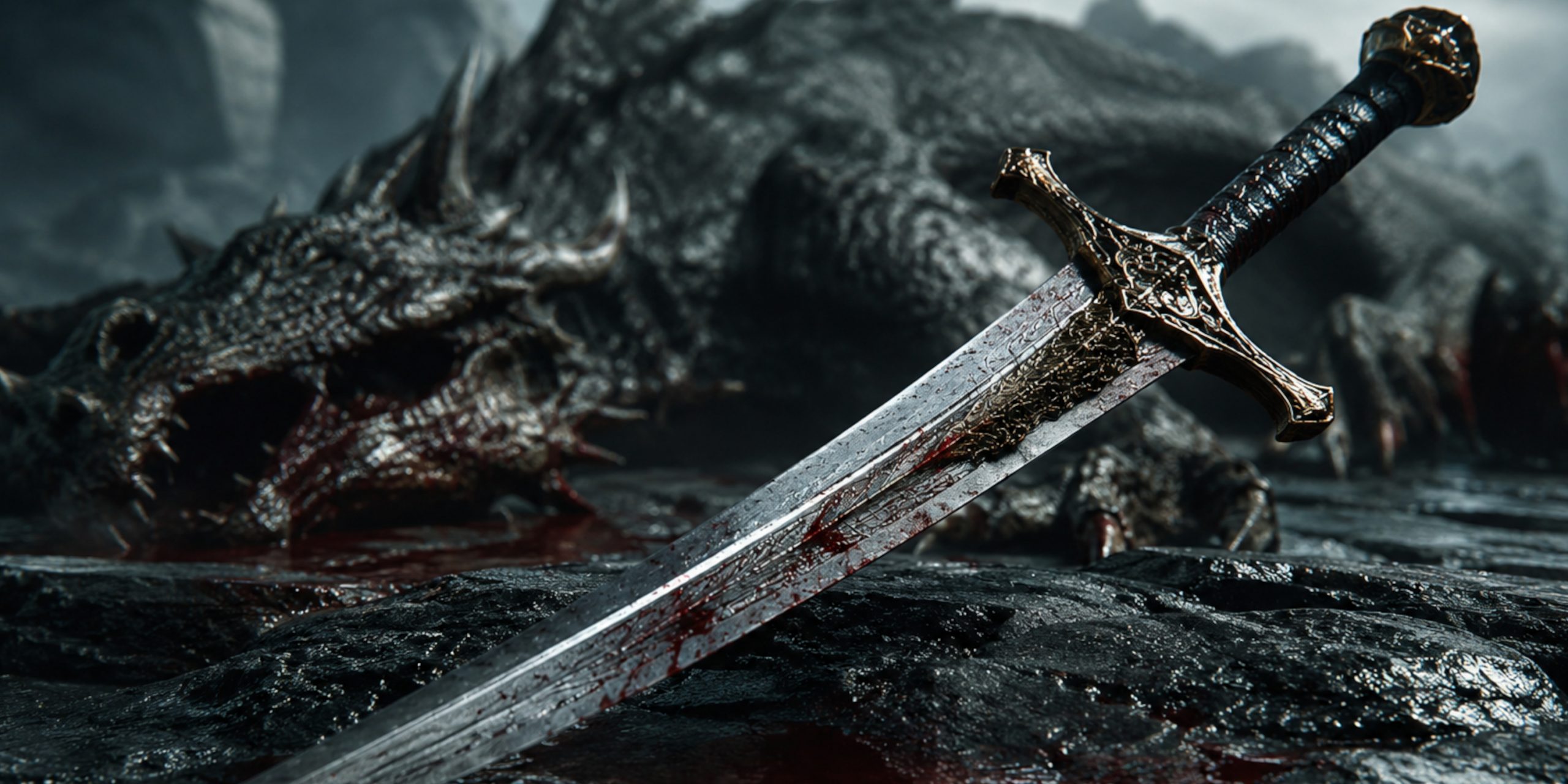
Carroll never described the sword’s physical appearance, leaving artists and readers to imagine it.
Common interpretations show it as:
- A medieval knightly sword
- A glowing magical blade
- A weapon decorated with unusual symbols
- A monster-slaying greatsword
- A perfectly sharp silver sword
Since the hero in Jabberwocky resembles a traditional knight figure, many illustrations lean towards a European arming sword or longsword style.
The original mystery gives artists complete freedom. It can be elegant, terrifying, oversized or strangely alien and still feel correct.
The Vorpal Sword And The Jabberwock
The Jabberwock is one of literature’s most famous monsters despite being described mostly through nonsense language.
Words like:
- “jaws that bite”
- “claws that catch”
- “eyes of flame”
create a creature that feels threatening without revealing too much.
The Vorpal Sword exists as the opposite force. It is the impossible weapon designed to defeat the impossible monster.
That pairing is why the scene feels timeless. The reader does not need a detailed explanation. Big scary creature arrives. Hero has weird magical sword. Problem solved.
Sometimes storytelling really is that simple.
Powers And Abilities
The original text gives the Vorpal Sword one confirmed ability: it is capable of killing the Jabberwock.
Later fantasy adaptations expanded its powers considerably.
Common abilities include:
- Supernatural sharpness
- Instant killing strikes
- Monster-slaying abilities
- Magical cutting effects
- The power to bypass armour or defences
The idea of the “blade so sharp it can cut anything” became one of fantasy’s most repeated weapon concepts.
Influence On Fantasy And Gaming
The Vorpal Sword became far larger than its original appearance.
Its biggest transformation came through fantasy role-playing games, where the term “vorpal” became associated with magical weapons capable of devastating critical strikes.
Its influence can be found across:
- Tabletop role-playing games
- Fantasy novels
- Video games
- Anime and manga
- Collectable card games
A single nonsense word from Victorian literature became shorthand for “this sword is ridiculously dangerous”.
That is a fairly impressive achievement for a weapon that appears for only a few lines.
Could The Vorpal Sword Be Based On A Real Weapon?
There is no evidence that Carroll based it on a specific historical sword, but its role connects with many legendary blades.
It shares themes with:
- Monster-killing swords from mythology
- Medieval heroic weapons
- Magical blades from folklore
Similar legendary weapons include:
- Gram from Norse mythology, used by Sigurd against the dragon Fafnir
- Excalibur from Arthurian legend
- Durandal, the sword of Roland
The idea is ancient: when a hero faces something beyond human strength, they need a weapon beyond normal craftsmanship.
The Vorpal Sword fits perfectly into that tradition.
The Seven Swords Takeaway
The Vorpal Sword survives because Lewis Carroll understood something important about imagination. Explaining everything can sometimes make fantasy smaller.
We do not know who forged it. We do not know what metal it uses. We do not know where it came from.
And somehow that makes it better.
The Vorpal Sword is a reminder that a few unforgettable words can create something bigger than pages of backstory. More than 150 years later, fantasy fans still recognise the blade that went “snicker-snack”.
Not bad for a sword nobody can actually explain.