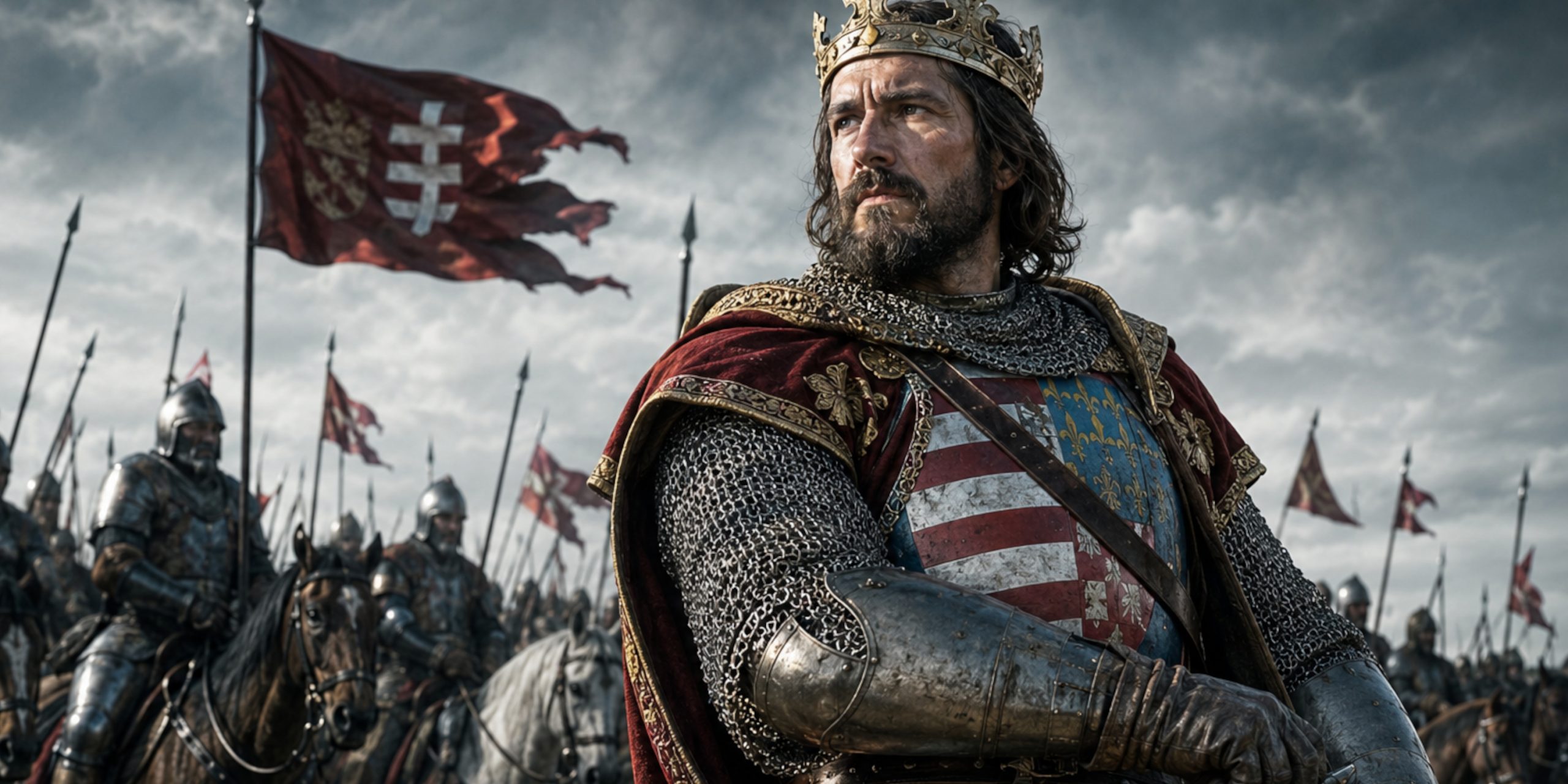
Louis I of Hungary, better known as Louis the Great, was obsessed with expansion. By the time he died in 1382, he had transformed Hungary into one of the strongest kingdoms in Europe, fought campaigns from the Balkans to Italy, tangled with Venice, Naples, Lithuania and the rising Ottoman threat, and somehow still found time to cultivate a court famous for chivalry and culture.
Hungarian chroniclers adored him. His enemies respected him. Modern historians still debate whether he was a brilliant strategist or simply an extraordinarily energetic medieval monarch who solved most political problems by arriving with cavalry.
Probably both.
Who Was Louis the Great?
Louis I was born in 1326, the son of Charles I of Hungary from the Angevin dynasty and Elizabeth of Poland. He inherited the Hungarian throne in 1342 and later became King of Poland in 1370 after the death of his maternal uncle, Casimir III.
At his height, Louis ruled a kingdom stretching across much of Central Europe. Hungary during his reign was wealthy, militarily aggressive, and politically influential. Gold and silver mines filled royal coffers, trade expanded, and the nobility remained largely loyal through a mixture of reward, pressure, and military prestige.
What makes Louis fascinating is that he represented a rare medieval balance. He was deeply religious yet highly pragmatic. He promoted knightly ideals while conducting brutally efficient campaigns. He admired western chivalric culture but ruled a kingdom sitting directly on Europe’s eastern frontier.
He looked westward culturally and eastward militarily. That tension shaped much of his reign.
The Political Landscape of Fourteenth-Century Hungary
When Louis became king, Hungary was already recovering from earlier internal chaos under his father. The crown had reasserted authority over powerful regional lords, allowing Louis to inherit a relatively stable state.
This stability mattered enormously.
Unlike many western kings who spent half their reigns begging nobles for money, Louis possessed substantial royal income from mining and taxation. Hungary was one of Europe’s major producers of precious metals. Wealth translated directly into military capability.
The kingdom also occupied a strategically awkward position. To the south lay the Balkans and expanding Ottoman influence. To the west stood Venice and the Holy Roman Empire. To the north and east were Poland and Lithuania.
Louis spent most of his reign ensuring Hungary remained stronger than all of them.
Medieval kings often claimed universal ambitions. Louis occasionally came close to achieving them.
Battles and Military Acumen
Louis earned his reputation largely through warfare. Contemporary chroniclers praised his personal courage almost obsessively. According to several accounts, he fought directly alongside his troops and maintained strict discipline within campaigns.
That mattered in the fourteenth century. Soldiers expected kings to lead visibly.
The Neapolitan Campaigns
One of Louis’s most famous military episodes involved his invasions of Naples.
His younger brother Andrew had married Queen Joanna I of Naples and was later murdered amid political intrigue in 1345. Louis believed Joanna and her supporters were involved. Whether this was entirely true remains debated, but Louis treated the situation as both a family blood feud and a geopolitical opportunity.
In 1347 he launched a major invasion into Italy.
The campaign initially succeeded spectacularly. Hungarian armies advanced rapidly through the peninsula, and Louis entered Naples itself. Contemporary observers described him as imposing, disciplined, and terrifyingly determined.
Then plague arrived.
The Black Death devastated Italy during the campaign and forced Louis to withdraw. Even hardened medieval armies struggled against an enemy that ignored armour, tactics, and courage alike.
Louis later returned to Italy and continued intervention there, though he never permanently secured Naples. Still, the campaigns demonstrated Hungary’s ability to project military power deep into southern Europe, which was astonishing for the period.
Wars Against Venice
Louis also fought multiple wars against the Republic of Venice.
Control of Dalmatia along the Adriatic coast became the central issue. Venice viewed the eastern Adriatic as essential to trade dominance. Louis viewed Venetian expansion as intolerable.
After prolonged conflict, Louis achieved one of his greatest diplomatic and military victories in the Treaty of Zara in 1358. Venice surrendered much of Dalmatia to Hungary.
For a time, Hungary became the dominant power along significant parts of the Adriatic coastline.
That is not something most people expect when thinking about medieval Hungary, yet under Louis it was entirely real.
Campaigns in the Balkans
Louis campaigned repeatedly in Bosnia, Serbia, Wallachia, and Bulgaria. These expeditions combined crusading rhetoric with strategic calculation.
He understood that the Balkans formed Hungary’s defensive shield against future invasions.
The Ottoman Turks had not yet become the overwhelming force they would later become, but warning signs were already visible. Louis attempted to strengthen Christian frontier states while extending Hungarian influence southward.
His campaigns achieved mixed success. Some rulers became vassals temporarily, others rebelled almost immediately after Hungarian armies departed. Medieval Balkan politics had a habit of changing direction every Tuesday afternoon.
Still, Louis recognised the strategic reality earlier than many western rulers did. He understood the Ottoman problem before most of Europe fully grasped its scale.
Louis as a Military Commander
Louis was not merely a ceremonial king riding behind banners.
Sources consistently describe him as energetic, organised, and personally brave. He moved rapidly between fronts and appears to have possessed a strong understanding of logistics and siege warfare.
His military strengths included:
- Rapid mobilisation of noble cavalry
- Effective use of heavy cavalry shock tactics
- Strong financial organisation for sustaining campaigns
- Diplomatic manipulation alongside warfare
- Ruthless persistence during prolonged conflicts
He also understood symbolism. Medieval warfare depended heavily on reputation, and Louis cultivated an image of ideal kingship and martial authority.
Frankly, half of medieval geopolitics involved convincing everyone you were harder to kill than the neighbouring monarch.
Louis excelled at that game.
Arms and Armour During Louis’s Reign
The military culture of Louis’s Hungary blended western European knightly traditions with eastern frontier influences.
This produced some fascinating combinations in arms and armour.
Armour of the Hungarian Nobility
During Louis’s reign, elite Hungarian cavalry increasingly adopted full western-style plate reinforcement over mail.
Common features included:
- Mail hauberks with plate additions
- Early bascinet helmets
- Great helms for tournaments and heavy combat
- Coat-of-plates and brigandines
- Plate gauntlets and greaves
- Heraldic surcoats displaying family arms
Hungarian nobles often fought as heavily armed cavalry comparable to French or German knights, though frontier warfare demanded greater mobility.
Italian armour imports also became increasingly prestigious during the fourteenth century. Wealthy Hungarian nobles purchased finely crafted Milanese equipment where possible.
Weapons Used in Louis’s Armies
Hungarian forces under Louis employed a broad range of weapons.
These included:
- Long arming swords
- Knightly lances
- Maces and war hammers
- Spears and javelins
- Crossbows
- Composite bows influenced by steppe traditions
The sword culture of Hungary remained especially important. Knightly arming swords with cruciform hilts dominated elite combat, though eastern sabre influences slowly appeared along frontier regions.
One particularly interesting aspect of Hungarian warfare was the continued integration of mounted archery traditions alongside western heavy cavalry doctrine.
Hungary sat between worlds militarily. You can see it clearly in the weapons themselves.
Chivalry and Court Culture
Louis cultivated a deeply chivalric royal image.
His court drew influence from French Angevin traditions, Christian kingship ideals, and Hungarian martial culture. Chroniclers portrayed him as the model Christian ruler: brave in war, pious in faith, and just in governance.
Naturally, medieval chroniclers occasionally exaggerated. If you relied entirely on royal chronicles, every king apparently looked magnificent on horseback while enemies collapsed in terror before breakfast.
Still, Louis genuinely appears to have inspired admiration even among rivals.
His reign saw increased literary and artistic patronage. Gothic architecture flourished, royal courts expanded ceremonially, and Hungarian identity became more closely linked with Christian kingship and military prestige.
Religion and Kingship
Religion shaped Louis profoundly.
He supported monasteries, churches, and religious foundations throughout his reign. Campaigns against pagan or Orthodox neighbours were frequently framed in crusading language, though political motives remained inseparable from religious rhetoric.
Louis also promoted the cult of Hungarian saints and strengthened ties with the papacy.
Yet his religiosity never prevented political realism. Like many effective medieval rulers, he could transition from prayer to siege warfare with alarming efficiency.
Where to See Artefacts From Louis the Great’s Reign
Several museums and collections preserve artefacts connected to Louis and fourteenth-century Hungary.
Hungarian National Museum, Budapest
Hungarian National Museum houses medieval Hungarian regalia, weapons, coins, manuscripts, and material from the Angevin period.
Visitors can see objects linked to noble culture, warfare, and royal administration from Louis’s reign.
The museum remains one of the best places to understand medieval Hungary as a functioning kingdom rather than merely a battlefield.
Matthias Church and Royal Sites in Budapest
Matthias Church contains later medieval connections to Hungarian kingship and preserves aspects of royal ceremonial culture rooted partly in the Angevin era.
Meanwhile, the wider Buda Castle district preserves the physical landscape shaped by medieval Hungarian monarchy.
Museum of Fine Arts, Budapest
Museum of Fine Arts contains Gothic and medieval material relevant to the cultural world of Louis’s court, including religious artworks and imported European influences.
Coins and Royal Seals
Coins from Louis’s reign survive in impressive numbers and are highly valued by collectors and historians.
Gold florins minted under Louis reflected Hungary’s immense mineral wealth and political confidence. Royal seals also survive in archives and museums, displaying Angevin heraldry and symbols of authority.
These objects matter because medieval kingship relied heavily on visible legitimacy. A coin was propaganda you could carry in your pocket.
Latest Archaeological Findings
Archaeology relating to fourteenth-century Hungary has expanded significantly in recent decades.
Excavations across Hungary, Croatia, and Slovakia have revealed more about settlement patterns, fortifications, and noble life during Louis’s reign.
Recent findings include:
- Excavated fortification upgrades linked to frontier defence
- Noble burials containing weapons and riding equipment
- Gothic church restorations from Angevin patronage
- Coin hoards associated with fourteenth-century conflicts
- Urban development layers in Buda connected to royal expansion
Archaeologists have also studied battlefield landscapes connected to Hungarian campaigns and frontier warfare.
One particularly valuable area of study involves castle networks in southern Hungary and Croatia. These fortifications became increasingly important as Ottoman pressure gradually intensified during and after Louis’s reign.
Researchers continue uncovering evidence showing how militarised the frontier already was by the late fourteenth century.
That detail changes how historians interpret Louis. He was not simply an ambitious conqueror. He was also preparing Hungary for an increasingly dangerous future.
Legacy of Louis the Great
Louis died in 1382 without a surviving son, which created succession problems that eventually weakened the kingdom politically.
Yet his reign represented the high point of medieval Hungarian power.
He expanded Hungarian influence across Central Europe, strengthened royal authority, developed military prestige, and left behind a kingdom respected across the continent.
Modern Hungarian historical memory still treats him as one of the nation’s greatest rulers, and honestly, it is difficult to argue otherwise.
He was not perfect. His campaigns could be brutal, his ambitions overstretched at times, and some conquests proved temporary. But medieval greatness rarely came packaged with moderation.
Louis understood power in a deeply medieval sense. Kingship required wealth, movement, spectacle, warfare, faith, and relentless visibility. He embodied all of it.
Few rulers of fourteenth-century Europe cast a larger shadow.