The Battle of Sentinum, fought in 295 BC, sits quietly in the shadow of Cannae, Zama, and Actium. That feels slightly unfair. Sentinum was one of the moments when Rome stopped being merely a dangerous regional power and started behaving like a state convinced it owned the future.
It was enormous by the standards of early Italy. Romans, Samnites, Gauls, Umbrians, and Etruscans collided in a struggle that ancient writers described with a sense of dread usually reserved for floods, plagues, and tax collectors. The result reshaped the Italian peninsula and cleared Rome’s path toward domination.
The battle also has everything historians secretly enjoy: heroic self-sacrifice, chaotic cavalry fighting, tribal warbands, stubborn infantry, contradictory sources, and enough patriotic embellishment from Roman writers to make one raise an eyebrow every few paragraphs.
Still, beneath the legend, Sentinum mattered enormously.
Background to the Battle
The Battle of Sentinum took place during the Third Samnite War, a long and bitter conflict between Rome and the Samnite peoples of central and southern Italy.
By 295 BC, Rome faced a dangerous coalition. The Samnites had persuaded several major enemies of Rome to unite against the republic:
- Samnites
- Senone Gauls
- Etruscans
- Umbrians
For Rome, this was close to a nightmare scenario. Individually, these enemies were manageable. Together, they threatened to overwhelm Roman manpower and fracture Roman influence across Italy.
The Roman response was ruthless and methodical. Consuls Quintus Fabius Maximus Rullianus and Publius Decius Mus manoeuvred aggressively to prevent the coalition from coordinating effectively. Roman forces successfully distracted the Etruscans and Umbrians before the main engagement, leaving the Samnites and Gauls to face the Roman army near Sentinum in Umbria.
Ancient historians later portrayed the battle as a kind of civilisation-defining struggle. That may be Roman hindsight speaking rather loudly, but the stakes were undeniably high.
Forces at Sentinum
Estimating troop numbers in ancient battles is always hazardous work. Ancient writers routinely inflated figures with cheerful abandon. Livy’s numbers, while useful, should be approached with caution.
Most modern historians estimate total forces between 70,000 and 90,000 men combined.
Roman Army
| Commander | Estimated Troops | Troop Types |
|---|---|---|
| Quintus Fabius Maximus Rullianus | 20,000 to 25,000 | Roman infantry, allied infantry, cavalry |
| Publius Decius Mus | 20,000 to 25,000 | Roman infantry, allied infantry, cavalry |
Roman Composition
- Roman citizen infantry
- Latin allied infantry
- Cavalry contingents
- Hastati-style heavy infantry formations
- Allied Italian troops
The Roman manipular system was becoming increasingly flexible and dangerous. Rome had not yet perfected the legionary machine of later centuries, but the foundations were visible.
Coalition Army
| Commander | Estimated Troops | Troop Types |
|---|---|---|
| Gellius Egnatius (Samnite leader) | Unknown | Samnite infantry |
| Senone Gallic chieftains | Unknown | Gallic warbands, cavalry |
Coalition Composition
- Samnite heavy infantry
- Gallic tribal warriors
- Chariots and wagons used by Gallic forces
- Cavalry contingents
- Supporting allied troops
The Gauls were especially feared by the Romans. Memories of the Gallic sack of Rome in 390 BC lingered like an unpleasant smell that refused to leave the room.
Arms and Armour
The Battle of Sentinum was fought during a transitional period in Italian warfare. Equipment varied considerably between armies.
Roman Arms and Armour
| Equipment | Description |
|---|---|
| Gladius Hispaniensis precursor | Early short swords used by Roman infantry |
| Hasta | Spear used by heavy infantry |
| Scutum | Large body shield |
| Montefortino helmets | Bronze helmets with neck guards |
| Chainmail | Increasingly common among elite troops |
| Greaves | Bronze shin protection |
Roman Fighting Style
- Disciplined infantry formations
- Rotational fighting lines
- Heavy shield use
- Coordinated cavalry support
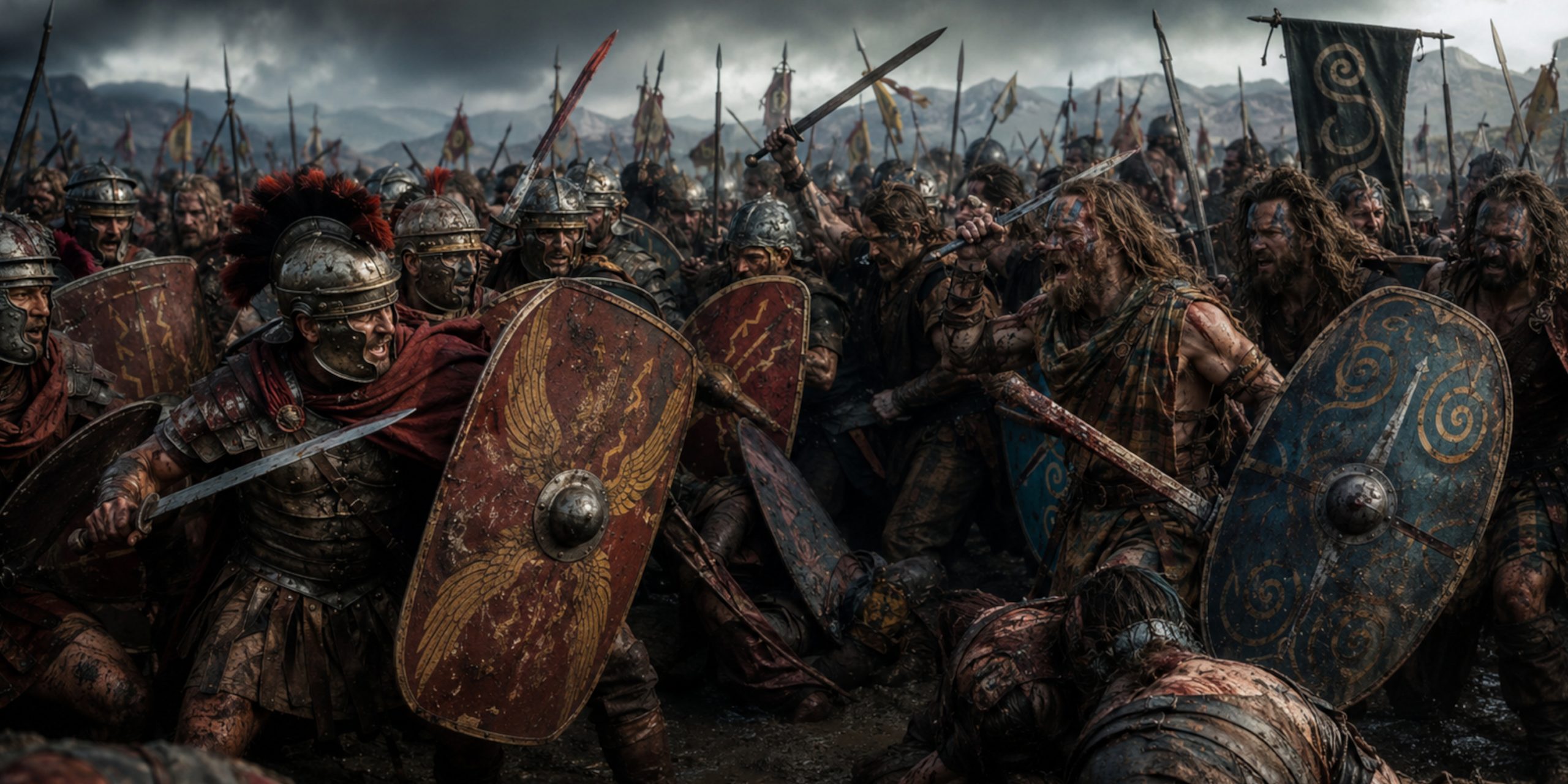
Roman discipline often mattered more than equipment quality. Their enemies could be individually ferocious, but Roman armies usually remained coherent under pressure. That is less glamorous than heroic charges, though generally more useful in war.
Samnite Arms and Armour
| Equipment | Description |
|---|---|
| Long spears | Primary infantry weapons |
| Curved Samnite shields | Distinctive oval shields |
| Short swords | Used in close combat |
| Bronze helmets | Crested and highly decorated |
| Linen cuirasses | Common torso protection |
Samnite warriors were experienced mountain fighters with a long martial tradition. Roman military reforms were heavily influenced by earlier encounters with them.
Gallic Arms and Armour
| Equipment | Description |
|---|---|
| Long slashing swords | Designed for sweeping cuts |
| Large oval shields | Wooden shields with metal bosses |
| Spears and javelins | Common secondary weapons |
| Torcs | Decorative neck rings |
| Minimal armour | Many warriors fought lightly protected |
Gallic swords of this period were often longer than Roman blades and suited aggressive charges. Ancient Roman writers loved emphasising the terrifying appearance of Gallic warriors, though they were perhaps less enthusiastic about mentioning occasions when those same warriors won.
The Battle Timeline
Early Morning
The armies deployed near Sentinum. Roman forces faced Samnites on one wing and Gauls on the other.
Fabius commanded the Roman right. Decius Mus held the left.
The Gallic forces reportedly positioned wagons behind their lines, creating a kind of defensive barrier and rally point.
Initial Engagement
The fighting began fiercely.
Roman troops under Decius Mus struggled against the Gallic assault. Chariots and aggressive infantry attacks caused disorder among Roman cavalry and front ranks.
The Roman left began to collapse under pressure.
The Devotio of Decius Mus
At the critical moment, Publius Decius Mus performed the ritual known as devotio.
Following Roman religious tradition, he dedicated himself and the enemy army to the gods of the underworld before charging into the enemy ranks and dying in battle.
Whether every detail occurred precisely as Livy describes is impossible to know. Roman historians adored noble self-sacrifice almost as much as modern films adore slow-motion scenes.
Still, Decius Mus almost certainly died leading a desperate counterattack.
His death rallied Roman morale.
Fabius Takes Control
While Decius fought and died on the left, Fabius maintained discipline on the Roman right.
He deliberately avoided reckless attacks, exhausting the Samnites before committing reserves and cavalry.
Eventually, Roman forces broke through.
The coalition army collapsed into retreat.
Final Rout
Roman cavalry pursued fleeing enemies aggressively.
Ancient accounts claim enormous casualties among the Samnites and Gauls. Exact numbers are uncertain, though losses were undoubtedly severe.
The coalition never fully recovered from the defeat.
Contemporary Quotes
Livy provides the most famous surviving account of the battle.
“The consul devoted himself for the army and the legions of the Roman people.”
Another passage captures Roman admiration for Decius Mus:
“He rode into the thickest of the enemy and fell covered with darts.”
These accounts were written centuries later, but they reflect how Romans wanted the battle remembered: disciplined, sacred, and heroic.
Polybius, writing later on Roman warfare more broadly, also emphasised the resilience of Roman military organisation during this era.
Archaeology and Historical Evidence
The archaeology of Sentinum remains frustratingly incomplete.
The exact battlefield location is still debated, though it is generally associated with the area near modern Sassoferrato in Umbria.
Archaeological discoveries in the region include:
- Samnite and Roman weapon fragments
- Spearheads and iron blades
- Helmet remains
- Burial evidence from the broader conflict period
- Fortified settlement remains linked to the wider war
Unlike later Roman battlefields, Sentinum lacks a single dramatic archaeological discovery that conclusively maps the engagement. Historians must therefore rely heavily on literary evidence, particularly Livy.
That creates difficulties because Roman historians often blended patriotism with history. Livy was an extraordinary writer, though not exactly what one would call emotionally detached.
Why the Battle Mattered
Sentinum effectively shattered large-scale resistance to Rome in central Italy.
The Samnites continued fighting for several years, but the coalition strategy failed permanently. Rome emerged as the dominant military power in Italy.
The consequences were immense:
- Roman control over Italy accelerated
- Rival coalitions became increasingly difficult to form
- Roman military prestige grew dramatically
- The republic gained manpower and resources for future expansion
Without victories like Sentinum, Rome may never have become the Mediterranean superpower that later confronted Carthage, Greece, and eventually half the known world.
It was one of those battles where the future tilted quietly in one direction.
Legacy of Sentinum
Roman writers later remembered Sentinum as a triumph of discipline, sacrifice, and divine favour.
Modern historians see something slightly more practical beneath the legend: superior organisation, effective command structure, and strategic flexibility.
The battle also highlights a recurring Roman advantage. Rome could absorb losses that would cripple rival states. Even after disasters, Roman political systems and allied networks kept producing armies.
That quality would become terrifyingly important later.
Sentinum may not possess the celebrity of Cannae or Thermopylae, but its consequences were arguably greater than many more famous battles. It marked the moment when Rome ceased merely surviving Italy and began mastering it.
And once Rome learned that lesson, everyone else eventually had to learn it too.