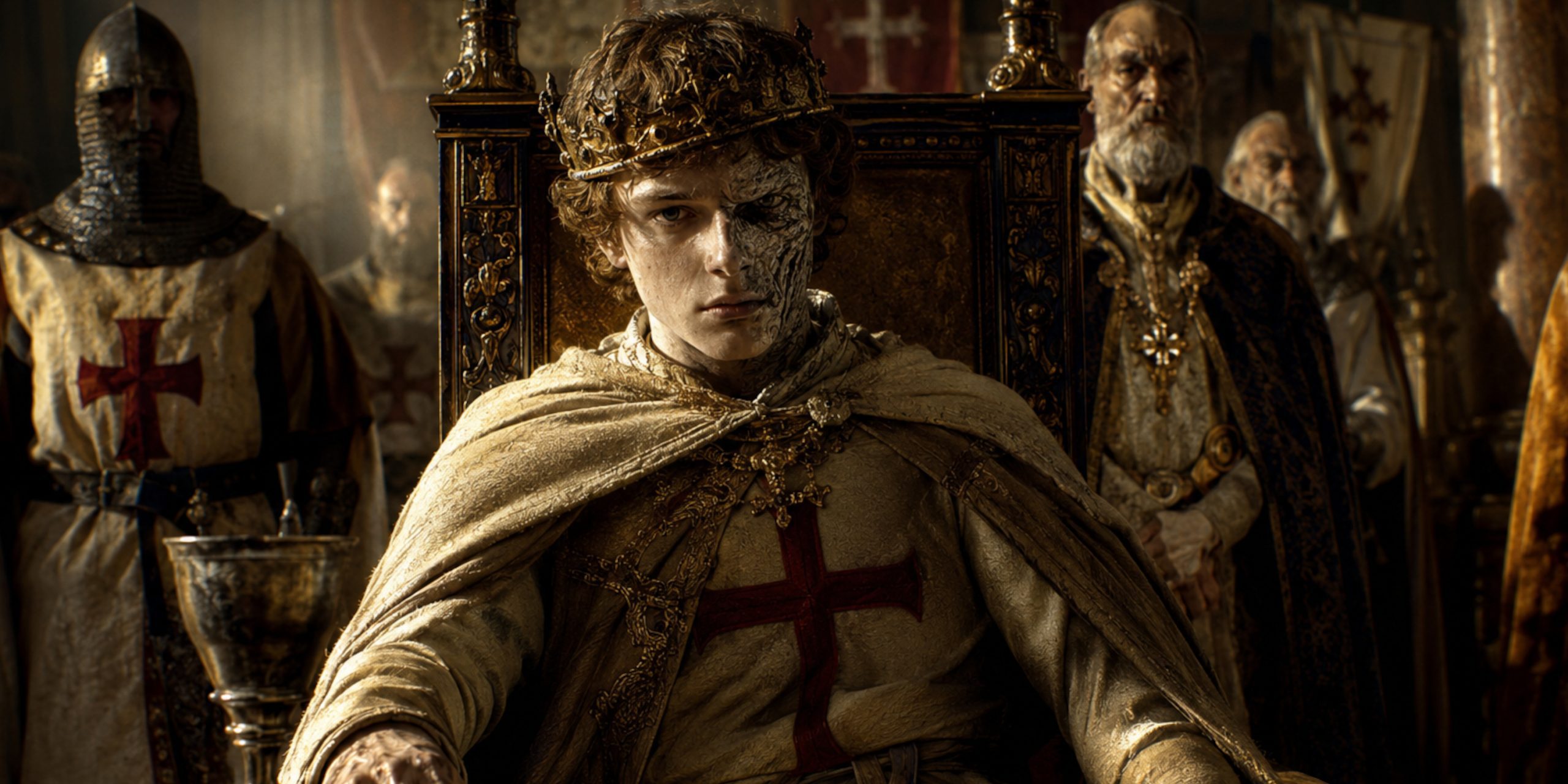
Baldwin IV of Jerusalem has drifted into legend as the “Leper King”, a tragic young ruler carrying both a crown and a disease that medieval people barely understood. Yet Baldwin’s story was never his alone. His reign was crowded with ambitious relatives, loyal knights, opportunistic nobles, exhausted bishops, Italian merchants, and one extraordinarily capable rival in Saladin.
The Kingdom of Jerusalem in the late twelfth century was not a stable medieval monarchy. It was more like a pressure cooker balanced on a fault line. Every marriage mattered. Every inheritance dispute risked civil war. Every noble family carried enough pride to ruin a campaign before the first sword left its scabbard.
Baldwin himself often appears as the lonely centre of the drama, but the kingdom around him was full of powerful personalities. Some tried to preserve Jerusalem. Others tried to inherit it before the king had even died.
Baldwin IV and the Royal Family
Baldwin IV was born in 1161, the son of Amalric I of Jerusalem and Agnes of Courtenay. His family tree looked impressive on parchment, though in practice it produced enough political tension to power a siege engine.
Amalric I, The Father

Amalric I was an intelligent and energetic king who spent much of his reign fighting Egypt and trying to hold together the fragile Crusader states.
William of Tyre, Baldwin’s tutor and later chronicler, noticed signs of Baldwin’s illness while the boy was still young. He wrote:
“He was deprived of feeling in his right hand and arm.”
That observation changed the future of Jerusalem.
Amalric reportedly hoped Baldwin’s condition might stabilise. Medieval medicine was optimistic in the same way gamblers are optimistic after losing three houses and a vineyard.
When Amalric died in 1174, Baldwin became king at around thirteen years old.
Agnes of Courtenay, The Mother
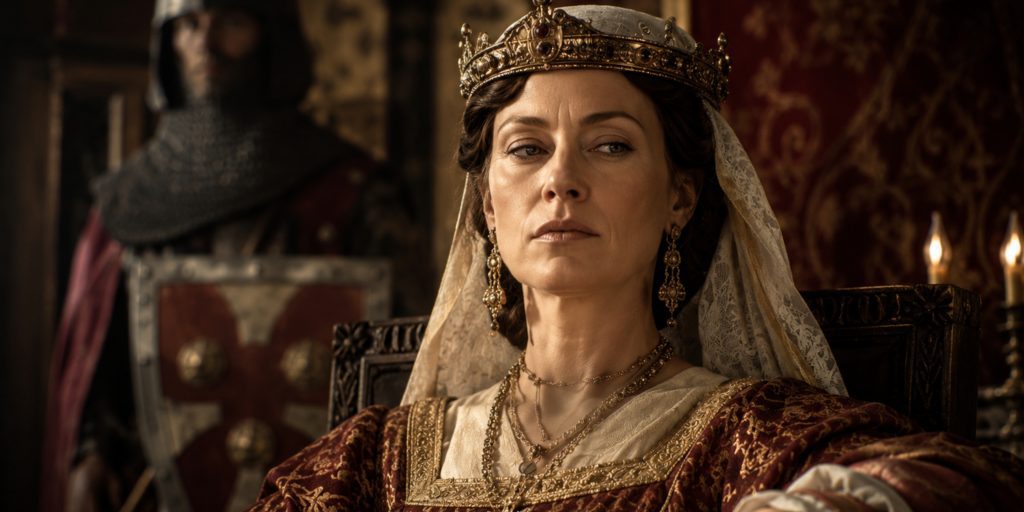
Agnes of Courtenay remains one of the most controversial women in Crusader history. Chroniclers hostile to her portrayed her as manipulative, ambitious, and dangerously influential. Modern historians tend to be more cautious because medieval writers often blamed politically active women for almost everything short of poor weather.
She certainly possessed influence at court. She also understood survival in a kingdom where widows and queens could lose everything overnight.
Agnes supported the careers of allies and relatives, particularly members of the Courtenay faction. Her enemies believed she interfered too heavily in royal politics. Her supporters probably called it “good judgement”.
Sibylla of Jerusalem, The Sister

Sibylla was Baldwin’s closest immediate family member and eventually the heir to the kingdom.
She became one of the central figures in the succession crisis that consumed Jerusalem during Baldwin’s final years. Intelligent, politically aware, and stubborn, Sibylla inspired fierce loyalty and fierce hatred in almost equal measure.
Her marriages became matters of state.
Her first husband, William of Montferrat, died young. Her second husband, Guy of Lusignan, proved vastly more controversial.
Baldwin IV initially elevated Guy, hoping he might provide military leadership for the kingdom. Instead, Baldwin became deeply disappointed with him.
William of Tyre hinted at Guy’s weaknesses carefully, though other chroniclers were less polite.
The Allies of Baldwin IV
Baldwin’s reign survived as long as it did because several capable figures worked desperately to keep the kingdom functional.
Some were loyal to Baldwin personally. Others were loyal to Jerusalem itself. Those were not always the same thing.
Raymond III of Tripoli
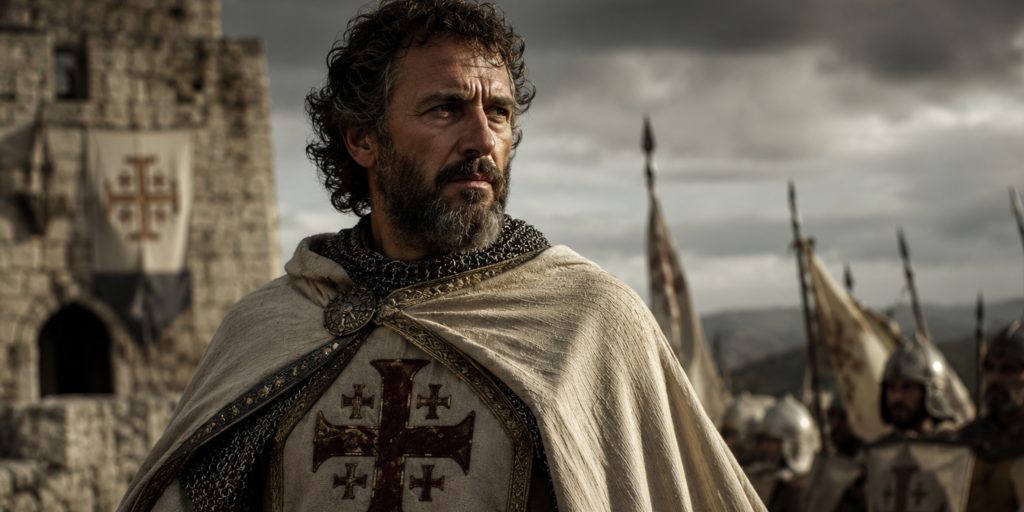
Raymond III was perhaps the most important political ally in Baldwin’s reign.
Experienced, intelligent, and cautious, Raymond often acted as regent and senior adviser. He had spent years in Muslim captivity and understood warfare in the Levant far better than many crusading newcomers.
His enemies accused him of excessive caution. His supporters understood that caution was usually preferable to getting annihilated in the desert.
Raymond frequently clashed with more aggressive nobles who demanded constant offensives against Saladin.
The relationship between Raymond and Baldwin was complicated but largely cooperative. Baldwin trusted Raymond’s experience even when court factions despised him.
William of Tyre

Few individuals shaped Baldwin’s historical reputation more than William of Tyre.
Scholar, archbishop, diplomat, and chronicler, William served as Baldwin’s tutor during childhood. He described the young king with admiration and genuine sadness.
William portrayed Baldwin as intelligent, determined, and astonishingly resilient despite his illness.
He wrote:
“He bore with patience beyond his years the burden laid upon him.”
William also recognised the kingdom’s growing instability. His chronicle increasingly reads like a man watching cracks spread across a cathedral ceiling while everyone argues about seating arrangements.
Reynald of Châtillon

Reynald was technically an ally of Baldwin, though he was the sort of ally capable of causing international incidents before breakfast.
A brutal and unpredictable nobleman, Reynald became lord of Oultrejordain after marriage and frequently attacked Muslim caravans in violation of truces.
Saladin despised him personally.
Reynald’s raids helped provoke renewed conflict at moments when Jerusalem could least afford it. Yet many crusaders admired his aggression and saw him as a fearless frontier lord.
Baldwin tolerated Reynald largely because the kingdom needed experienced military commanders. Also because medieval politics rarely offered clean choices between sensible candidates.
The Military Orders
The Templars and Hospitallers played enormous roles during Baldwin’s reign.
The Knights Templar
The Templars were wealthy, disciplined, and fiercely committed to the defence of the kingdom. They often favoured aggressive military action and occasionally ignored diplomatic nuance entirely.
That tendency caused friction with more cautious nobles.
Still, Baldwin relied heavily on them during campaigns against Saladin.
The Knights Hospitaller
The Hospitallers combined military and medical functions, though medieval battlefield medicine remained alarmingly close to “try not to die”.
They controlled major fortresses and provided professional troops at a time when the kingdom desperately needed reliable manpower.
Both military orders became political powers in their own right.
Baldwin IV and Saladin
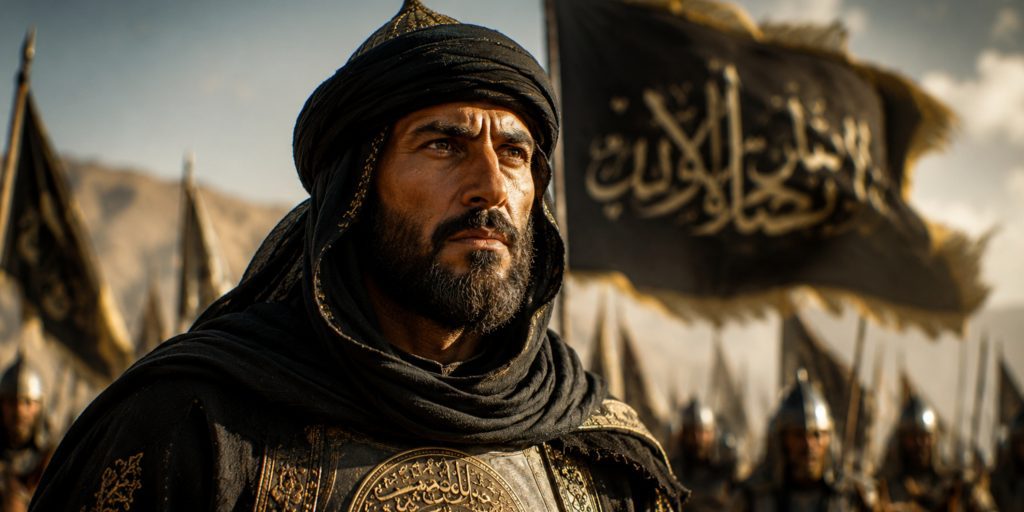
No figure loomed larger over Baldwin’s reign than Saladin.
Salah ad-Din Yusuf ibn Ayyub united Egypt and Syria, creating a powerful Muslim coalition capable of surrounding the Crusader states.
Yet Baldwin repeatedly frustrated him.
The most famous example came at the Battle of Montgisard in 1177.
Despite severe illness, Baldwin led a surprise attack against Saladin’s forces and achieved a remarkable victory. Chroniclers treated the battle almost as divine intervention.
One account described Baldwin being carried into battle because he was too weak to ride for long periods.
Saladin survived and learned from defeat. Baldwin’s kingdom, unfortunately, lacked the same luxury.
The rivalry between the two rulers has often been romanticised. In reality, it was deadly serious. Both understood that control of Jerusalem and the survival of their states depended on military success.
Still, there seems to have been mutual respect.
The Muslim chronicler Ibn al-Athir acknowledged Baldwin’s persistence despite illness, while Latin sources admired Saladin’s ability and discipline, albeit through gritted teeth.
Guy of Lusignan, Baldwin’s Greatest Political Rival
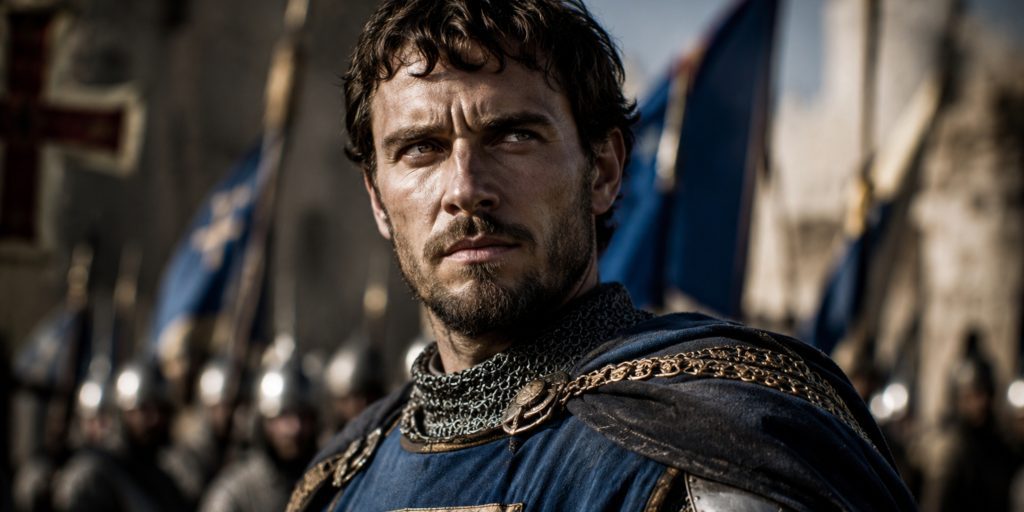
Guy of Lusignan became the central political problem of Baldwin’s later reign.
Originally a Poitevin noble with limited reputation, Guy rose rapidly after marrying Sibylla. Baldwin hoped Guy might become an effective military leader.
That hope faded quickly.
During Saladin’s campaign of 1183, Baldwin became furious with Guy’s hesitation and indecisiveness. He stripped Guy of authority and attempted to prevent him inheriting the kingdom.
This triggered a succession crisis that divided the nobility.
One faction backed Sibylla and Guy.
Another supported Raymond of Tripoli and alternative heirs.
Baldwin’s final years became consumed by efforts to stop the kingdom collapsing into factional conflict before Saladin even attacked again.
It is one of history’s crueller ironies that Baldwin spent enormous energy defending Jerusalem from external enemies, only for internal rivalries to weaken everything he had fought to preserve.
Baldwin V and the Succession Crisis
As Baldwin IV’s health declined, the succession question became unavoidable.
To bypass Guy temporarily, Baldwin crowned the young Baldwin V, the son of Sibylla and William of Montferrat, as co-king.
The child became a political compromise candidate.
It was an unstable solution and everyone knew it.
When Baldwin IV died in 1185, Baldwin V briefly ruled before dying himself soon afterwards. Sibylla then claimed the throne and crowned Guy as king.
Within two years, Jerusalem would suffer catastrophe at Hattin.
One suspects Baldwin IV would not have been surprised.
Rivals Within the Kingdom

Not all Baldwin’s enemies wore Muslim armour.
The Crusader nobility was deeply factional. Noble houses competed constantly for influence, land, and royal favour.
Key tensions included:
- The Courtenay faction versus the Tripoli faction
- Native-born nobles versus newly arrived crusaders
- Supporters of diplomacy versus advocates of aggressive war
- Rivalries between military orders and secular lords
These divisions weakened the kingdom steadily during Baldwin’s reign.
Baldwin himself often acted as mediator despite deteriorating health. It is difficult not to admire the sheer stubbornness involved.
Contemporary Views of Baldwin IV
Contemporary writers often treated Baldwin as both tragic and heroic.
The anonymous chronicler of Ernoul described him as:
“A very brave man, wise beyond his age.”
William of Tyre praised Baldwin’s intellect repeatedly and stressed his determination despite physical suffering.
Even hostile observers rarely questioned his courage.
Modern depictions sometimes exaggerate Baldwin into a saintly figure untouched by politics. The real king appears more impressive than that simplification. He was intelligent, pragmatic, politically engaged, occasionally ruthless, and painfully aware that time was against him.
The Legacy of Baldwin’s Relationships
The family alliances and rivalries surrounding Baldwin IV shaped the final decades of the Kingdom of Jerusalem.
His reign delayed collapse rather than prevented it.
The rivalries between Raymond, Guy, Reynald, Sibylla, and the military orders continued after Baldwin’s death. Saladin exploited those divisions masterfully.
After Hattin in 1187, Jerusalem fell to Saladin, ending the period of Frankish control established after the First Crusade.
Yet Baldwin IV endured in memory because he represented resistance against impossible odds.
A young king with leprosy holding together a kingdom full of quarrelling nobles sounds almost fictional. Medieval history occasionally had a flair for dramatic casting.
Takeaway
King Baldwin IV’s story cannot be separated from the people around him.
His mother fought for influence. His sister carried the succession crisis into the next generation. Raymond of Tripoli tried to preserve stability. Reynald of Châtillon provoked wars. Guy of Lusignan undermined confidence at the worst possible moment. Saladin waited patiently for weakness to spread.
Through all of it stood Baldwin himself, physically deteriorating yet politically active until the end.
Many rulers inherited stronger kingdoms. Few inherited one so fragile while carrying such a burden personally.
That Jerusalem survived as long as it did under Baldwin IV remains one of the more remarkable achievements of the Crusader era.