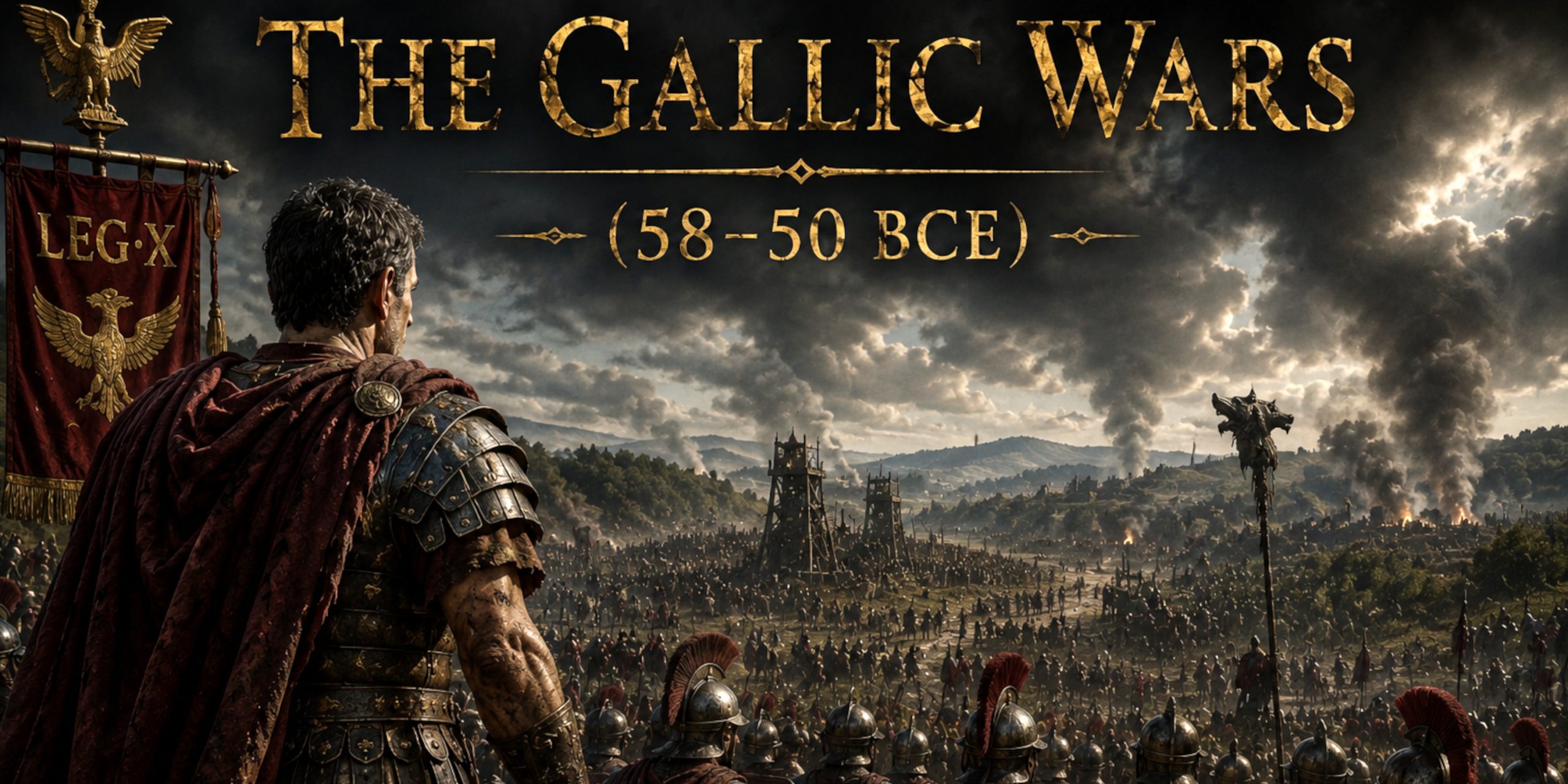
The Gallic Wars were not a single neat conflict. They were a decade of invasions, rebellions, massacres, sieges, political theatre, and relentless Roman ambition. Between 58 and 50 BC, Julius Caesar marched across Gaul, modern France and parts of Belgium, Switzerland, Germany, and Britain, and transformed himself from an indebted politician into the most dangerous man in the Roman Republic.
Caesar presented the wars as defensive campaigns against unruly tribes. Conveniently, those campaigns also made him fabulously wealthy, militarily untouchable, and adored by his soldiers. Roman politics had a habit of rewarding success while quietly ignoring the smell of burnt settlements drifting in from conquered provinces.
The scale of the conflict was staggering. Ancient estimates are wildly inflated, as ancient estimates often are, but hundreds of tribes became entangled in the wars. Entire communities vanished. Others adapted to Roman rule with startling speed. Gaul itself ceased to exist as an independent cultural and military force within a generation.
Much of what we know comes from Caesar himself, which is both useful and deeply suspicious. Reading Commentarii de Bello Gallico is rather like receiving a war report written by the man seeking re-election after setting half the continent on fire.
Background to the War
By the late 1st century BC, Rome already dominated much of the Mediterranean world. Gaul, however, remained fragmented between numerous tribal confederations, rival aristocrats, and shifting alliances.
Several major peoples dominated the region:
- The Aedui
- The Arverni
- The Belgae
- The Helvetii
- The Sequani
- The Veneti
- The Nervii
Trade with Rome was already extensive. Roman merchants moved through Gallic territory, and Gallic elites increasingly adopted Mediterranean goods and styles. Political interference followed naturally. Roman politicians rarely saw another nation’s instability without wondering how much money could be extracted from it.
Caesar received command of Cisalpine Gaul and Illyricum in 59 BC. Soon after, he also gained control of Transalpine Gaul. The opportunity for expansion sat directly on his doorstep.
Caesar and His Army
Julius Caesar was not merely a commander. He was a master propagandist, an aggressive politician, and a remarkably bold operational thinker.
His legions became the finest military force in western Europe during the campaign.
Typical Roman Legionary Equipment
| Equipment | Description |
|---|---|
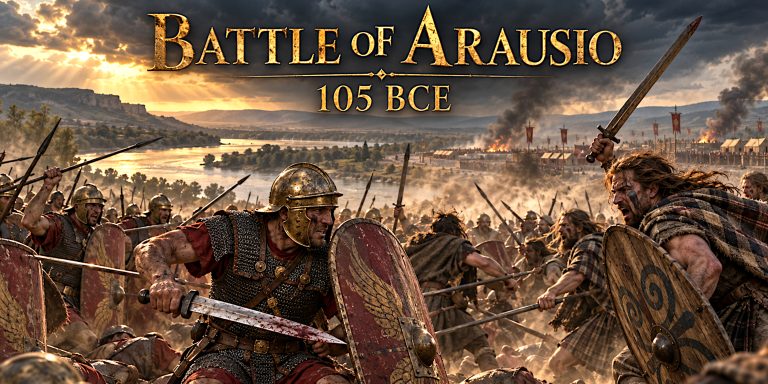
| Gladius | Short stabbing sword designed for close combat |
| Pilum | Heavy throwing spear intended to bend on impact |
| Scutum | Large curved shield |
| Pugio | Side dagger |
| Lorica Hamata | Chainmail armour commonly used by legionaries |
| Galea | Bronze or iron helmet |
Roman officers and cavalry also used longer swords known as the spatha, though the gladius remained the iconic weapon of the infantry.
Gallic warriors carried a wide range of arms:
- Long slashing swords
- Spears and javelins
- Oval shields
- Chainmail armour among elites
- Helmets with elaborate decoration
- Cavalry equipment of impressive quality
Ironically, the Romans likely adopted and refined aspects of chainmail from Gallic craftsmanship. Rome conquered Gaul, then quietly borrowed some of its best ideas.
The Opening Campaign Against the Helvetii
The war began in 58 BC when the Helvetii attempted a large-scale migration from modern Switzerland.
Caesar claimed this movement threatened Roman territory. He moved swiftly to block them and eventually defeated the Helvetii near Bibracte.
This victory established several key themes of the war:
- Caesar’s speed of movement
- Roman engineering superiority
- Ruthless pursuit of defeated enemies
- Use of “defensive war” as justification for expansion
Caesar wrote:
“The Helvetii were by far the bravest of the Gauls.”
One suspects he enjoyed complimenting enemies immediately before annihilating them.
Major Battles of the Gallic Wars
Battle of Bibracte (58 BC)
What Happened
Caesar defeated the migrating Helvetii after a difficult engagement involving Roman infantry discipline against determined tribal assaults.
Importance
- Secured Caesar’s position in Gaul
- Demonstrated Roman battlefield flexibility
- Established Caesar’s growing reputation
Battle Against Ariovistus (58 BC)
Ariovistus, king of the Suebi Germans, had expanded into Gaul and alarmed both tribes and Romans alike.
Caesar defeated him in Alsace after a tense campaign.
Significance
- Prevented major Germanic expansion westward
- Increased Roman influence among Gallic tribes
- Enhanced Caesar’s political standing in Rome
Battle of the Sabis (57 BC)
Often associated with the River Sambre, this was one of Caesar’s closest calls.
The Nervii launched a ferocious surprise attack while the Romans were constructing camp fortifications.
Caesar personally intervened to stabilise the line.
Why It Matters
- Nearly destroyed several Roman legions
- Showed the extraordinary aggression of Belgic tribes
- Became central to Caesar’s heroic self-image
Caesar later described the Nervii as among the bravest peoples in Gaul. Roman authors had a noticeable respect for enemies willing to charge directly into organised slaughter.
Naval War Against the Veneti (56 BC)
The Veneti of Brittany controlled Atlantic trade routes and possessed a strong maritime tradition.
Rome struggled badly at sea against them until improvised tactics neutralised Gallic rigging systems.
Outcome
- Roman victory after brutal fighting
- Veneti leadership executed
- Large portions of the population enslaved
This campaign sent a very deliberate message. Resistance on land was dangerous enough. Resistance at sea invited extermination.
Caesar’s Expeditions to Britain (55 and 54 BC)
Caesar invaded Britain twice, largely for prestige and reconnaissance.
The invasions achieved limited military success but enormous propaganda value.
Key Points
- First Roman crossings into Britain
- Several British tribes submitted temporarily
- No lasting occupation established
The expeditions impressed audiences in Rome enormously. Crossing the Channel sounded dramatic. Roman voters loved dramatic.
The Great Gallic Revolt and Vercingetorix
By 52 BC, widespread resentment exploded into open rebellion under Vercingetorix of the Arverni.
He was intelligent, charismatic, and understood Roman weaknesses better than many previous Gallic leaders.
His strategy relied on:
- Scorched earth tactics
- Cavalry warfare
- Denial of supplies
- Uniting rival tribes
This nearly succeeded.
Siege of Avaricum (52 BC)
Despite Vercingetorix favouring destruction of settlements, Avaricum was spared at local insistence.
Caesar besieged and stormed the city after extensive engineering works.
According to Roman accounts, the aftermath was catastrophic.
Caesar wrote:
“Not more than eight hundred escaped from the whole number.”
Roman siege warfare was efficient in the same way a falling masonry block is efficient.
Battle of Gergovia (52 BC)
One of Caesar’s few major defeats.
Vercingetorix used the terrain brilliantly around the Arvernian stronghold.
Outcome
- Roman assault repelled
- Caesar forced to withdraw
- Gallic morale surged
This battle proved Roman armies were not invincible. It also showed Vercingetorix possessed genuine strategic skill rather than merely inspirational leadership.
Siege of Alesia (52 BC)
The defining battle of the Gallic Wars.
Vercingetorix retreated into the hillfort of Alesia. Caesar surrounded the position with enormous fortifications while simultaneously preparing for an external relief force.
The scale was astonishing.
Roman Engineering at Alesia
| Feature | Purpose |
|---|---|
| Circumvallation lines | Trap defenders inside |
| Contravallation lines | Defend against relief army |
| Ditches | Slow attacks |
| Stakes and traps | Disrupt infantry assaults |
| Towers | Missile support |
Caesar’s forces fought attacks from both inside and outside the fortifications.
Eventually, the Gallic coalition collapsed.
Vercingetorix surrendered dramatically before Caesar.
Later Roman tradition described him laying down his arms at Caesar’s feet. Roman writers adored theatrical submissions almost as much as triumphal parades.
Archaeology of the Gallic Wars
Archaeology has transformed understanding of the conflict over the past century.
Excavations at Alesia remain particularly important. Large defensive earthworks, weapon finds, Roman camps, and Gallic artefacts strongly support Caesar’s account, though debate over exact locations continued for years.
Important Archaeological Discoveries
| Site | Discovery |
|---|---|
| Alesia | Roman siege works and weapons |
| Bibracte | Elite Gallic settlement remains |
| Gergovia | Defensive structures and occupation layers |
| Ribemont-sur-Ancre | Evidence of mass warfare and ritual deposition |
| Titelberg | Gallic urban development and trade |
Archaeology also reveals that Gaul was far from primitive.
Gallic settlements contained:
- Planned streets
- Metalworking industries
- Coin production
- Extensive trade networks
- Sophisticated fortifications
Roman authors occasionally described Gauls as barbarians while simultaneously admiring their engineering, cavalry, craftsmanship, and wealth. Empires do enjoy contradictions.
Contemporary Quotes
Julius Caesar
“All Gaul is divided into three parts.”
Possibly the most famous opening line in Roman military literature.
Plutarch on Caesar
“He had made himself the greatest man in Rome.”
A concise summary of what ten years of conquest can achieve.
Vercingetorix According to Roman Tradition
“I undertook the war for the liberty of all.”
Whether precisely authentic or polished by later writers, the sentiment captured the rebellion perfectly.
The Human Cost
Ancient casualty figures are unreliable and often absurdly inflated, but the destruction was immense.
Entire tribes disappeared from the historical record. Mass enslavement became routine. Settlements were destroyed or forcibly reorganised.
Roman conquest brought:
- Urbanisation
- Roads
- Trade integration
- Roman law
- Latin language influence
It also brought extraordinary violence.
Modern historians continue debating whether Caesar’s actions amounted to systematic extermination in some regions. The evidence certainly points to campaigns of exceptional brutality.
Legacy of the Gallic Wars
The wars reshaped Europe permanently.
Major Consequences
| Consequence | Impact |
|---|---|
| Romanisation of Gaul | Latin culture spread across western Europe |
| Rise of Caesar | Direct path toward civil war |
| Expansion of Roman borders | Rome reached the Atlantic |
| Transformation of warfare | Siegecraft and logistics refined |
| Decline of tribal independence | Gaul absorbed into Roman administration |
Without the conquest of Gaul, the later history of France, Belgium, and much of western Europe would look utterly different.
The wars also accelerated the collapse of the Roman Republic itself. Caesar’s victories gave him immense political leverage. Within a few years, Rome descended into civil war.
Gaul made Caesar unstoppable.
That was excellent news for Caesar and rather less excellent for the Republic.
Seven Swords Takeaway
The Gallic Wars sit uneasily between military brilliance and catastrophic destruction.
Caesar’s campaigns displayed extraordinary operational skill. His speed, adaptability, engineering, and battlefield control remain studied today. Yet the conquest was also deeply opportunistic, often savage, and fuelled by personal ambition as much as Roman security.
The surviving sources glorify Rome because Rome won. Archaeology occasionally gives quieter voices back to the defeated. Burned settlements, shattered weapons, mass graves, and abandoned hillforts tell their own version of events.
History remembers Caesar as a genius.
The dead of Gaul probably had other descriptions in mind.