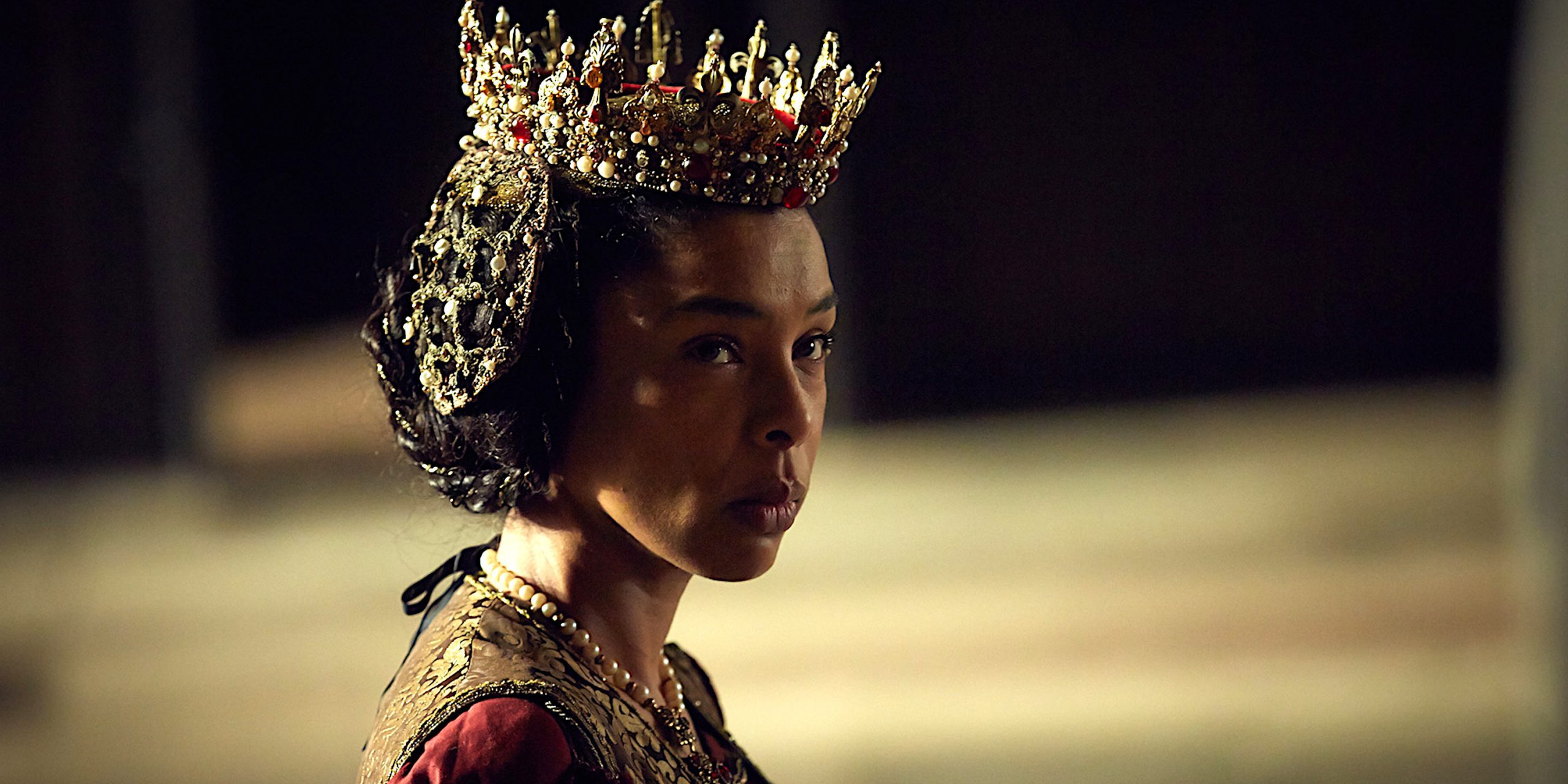
There are characters in The Hollow Crown who feel tragic, noble, foolish, doomed, or quietly exhausted by the sheer effort of wearing a crown in fifteenth-century England. Then there is Margaret of Anjou, who storms into the story like somebody arriving at a funeral carrying a torch.
And honestly, the series becomes far more interesting once she appears.
Margaret is often remembered as the “she-wolf” of the Wars of the Roses, a ruthless queen willing to drag England into chaos to protect her husband and son. That reputation has survived for centuries because, frankly, she terrified people. Men who were perfectly comfortable with violence suddenly became deeply uncomfortable when a woman proved better at power politics than they were.
The Hollow Crown leans into that energy beautifully. This version of Margaret is sharp, furious, politically aware, and completely done with the incompetence surrounding her. Watching her navigate the collapsing world of Lancastrian England feels less like court drama and more like somebody trying to hold together a shopping trolley with one missing wheel while Richard Plantagenet is charging towards her with a sword.
Who Was Margaret of Anjou?
Margaret of Anjou was born in 1430 in eastern France, the daughter of René of Anjou and Isabella of Lorraine. She arrived in England as a teenager to marry King Henry VI, a deeply pious and painfully passive ruler whose main political skill was looking distressed while England collapsed around him.
That imbalance defined their marriage and, eventually, an entire civil war.
Henry VI was not a warrior king in the mould of Henry V. He was scholarly, devout, and politically fragile. Margaret quickly realised that if the Lancastrian dynasty was going to survive, she would have to become its engine.
Which she did.
Very loudly.
In The Hollow Crown, this transformation is handled brilliantly. Margaret begins as an outsider at court but gradually becomes the dominant political force around the king. By the time the Wars of the Roses properly ignite, she is no longer merely queen consort. She is effectively the commander of the Lancastrian cause.
That terrified her enemies because medieval queens were expected to advise gently, produce heirs, smile at ambassadors, and preferably remain decorative. Margaret ignored that script entirely.
England was not emotionally prepared for a queen who behaved like a wartime general.
Margaret and Henry VI, A Marriage Built on Crisis
One of the most fascinating parts of The Hollow Crown is the contrast between Henry and Margaret.
Henry drifts through politics almost like a monk accidentally trapped inside a monarchy. Margaret, meanwhile, looks at England’s problems with the expression of somebody discovering mould behind wallpaper and realising the entire house may collapse.
Their relationship was complicated, but not necessarily loveless. Margaret fiercely defended Henry throughout his reign, even when many nobles considered him incapable of ruling. When Henry suffered periods of mental collapse, including catatonic episodes, Margaret effectively became the political centre of government.
That was extraordinary for the fifteenth century.
It also earned her endless hatred.
Rival nobles spread rumours about her ambition, morality, and even the legitimacy of her son Edward of Westminster. Medieval propaganda tended to become deeply misogynistic the moment a woman gained influence. Apparently England could survive famine, rebellion, and dynastic collapse, but a politically assertive French queen was where people drew the line.
Why Margaret Became So Dangerous
Margaret’s danger did not come from cruelty alone. Plenty of nobles in the Wars of the Roses were brutal. Richard Neville, the Earl of Warwick, switched sides often enough to make modern football transfers look loyal.
What made Margaret frightening was her determination.
She refused compromise repeatedly when others might have surrendered. She built alliances, raised armies, negotiated abroad, and continued fighting even after catastrophic defeats. Most medieval queens disappeared quietly after political collapse. Margaret responded to political collapse by finding another army.
In The Hollow Crown, she becomes almost Shakespearean fury personified. There is grief behind her actions, but also cold calculation. She understands reputation, theatre, fear, and vengeance.
And she absolutely holds grudges.
Her rivalry with Richard, Duke of York, drives much of the drama. The hatred between them feels intensely personal because, by that stage, politics had become personal. Every compromise failed. Every humiliation deepened the divide. England slid from tense instability into outright blood feud.
Margaret did not cause the Wars of the Roses alone, despite what older historians sometimes implied, but she became one of its defining figures because she refused to fade quietly into the background.
Margaret in Shakespeare and The Hollow Crown
Shakespeare adored dramatic personalities, so naturally Margaret became one of his favourites.
Historically, she was already controversial. Shakespeare transformed her into something even larger, a fierce political survivor who haunts the entire Wars of the Roses narrative. In his plays, she becomes almost prophetic, cursing enemies and stalking through court politics like a living reminder that violence always returns.
The Hollow Crown captures much of that theatrical intensity.
The portrayal balances intelligence with rage, vulnerability with menace. Margaret is not presented as a cartoon villain. She is often harsh, but the audience understands why. She is fighting in a world designed to strip power away from women the second they hesitate.
And frankly, many of the men around her are spectacularly incompetent.
That contrast gives her scenes real bite.
There is also something strangely modern about her frustration. Watching Margaret try to manage fragile male egos, collapsing institutions, and political backstabbers feels oddly familiar. Replace the swords with corporate emails and half the scenes could happen in a modern office.
The Wars of the Roses and Margaret’s Campaigns
Margaret became the effective leader of the Lancastrian resistance during the Wars of the Roses.
Some of the major moments associated with her include:
Key Events in Margaret’s Struggle
| Year | Event | Significance |
|---|---|---|
| 1445 | Marriage to Henry VI | Strengthened Anglo-French diplomacy |
| 1453 | Henry VI suffers mental collapse | Margaret becomes politically dominant |
| 1455 | First Battle of St Albans | Beginning of open conflict |
| 1460 | Battle of Wakefield | York killed, Lancastrians gain momentum |
| 1461 | Battle of Towton | Massive Yorkist victory |
| 1470 | Henry VI briefly restored | Lancastrian comeback |
| 1471 | Battle of Tewkesbury | Lancastrian defeat and death of her son |
Towton deserves particular mention because it remains one of the bloodiest battles fought on English soil. The conflict was savage even by medieval standards. Families fought families. Noble houses shattered. Snow mixed with blood in ways chroniclers described with disturbing enthusiasm.
Margaret spent years attempting to recover Lancastrian power after defeats that would have destroyed most political figures completely.
That persistence is central to her legend.
The Death of Her Son Changed Everything
If there is one moment that truly breaks Margaret’s world, it is the death of her son Edward at Tewkesbury in 1471.
For years she had fought to secure his inheritance. Every alliance, campaign, and sacrifice revolved around preserving the Lancastrian dynasty through him. When he died, the entire cause effectively collapsed.
Soon afterwards, Henry VI also died, almost certainly murdered in the Tower of London.
Margaret survived, but the political fire that had defined her life was gone.
She eventually returned to France, where she died in relative obscurity in 1482. Which feels strangely cruel for someone who once dominated English politics so completely. One decade she was directing armies and terrifying noblemen, the next she was largely abandoned by history outside hostile chronicles and Shakespearean drama.
History has a habit of doing that to formidable women.
Was Margaret of Anjou Really a Villain?
This depends entirely on who is telling the story.
Yorkist writers portrayed her as vicious and unnatural. Shakespeare amplified parts of that image because it made for excellent drama. Modern historians tend to see her as a product of catastrophic circumstances.
England during the mid fifteenth century was unstable, violent, and politically fractured. Noble rivalries were already spiralling out of control before Margaret took a leading role. She did not invent the crisis. She reacted to it with extraordinary aggression because weakness would have destroyed her family.
And honestly, many male rulers behaved far worse while receiving far kinder reputations.
Margaret’s real crime, in the eyes of many contemporaries, was refusing to behave passively.
That still makes people uncomfortable centuries later.
Why Margaret Steals Every Scene in The Hollow Crown
Some historical characters dominate through charm. Others through mystery. Margaret dominates through sheer force of will.
Every scene involving her carries tension because she feels dangerous even when standing still. She understands power, symbolism, and fear better than many of the men around her. There is intelligence behind the anger, which makes her far more compelling than a simple antagonist.
She also injects energy into the later parts of The Hollow Crown. Court politics suddenly feel raw and personal rather than ceremonial. The stakes become survival itself.
And there is something weirdly refreshing about a medieval queen who looks at England’s collapsing political system and decides the solution is not restraint, diplomacy, or patience.
It is war.
Margaret’s Legacy Today
Margaret of Anjou remains one of the most debated women in English history.
To some, she represents destructive ambition. To others, she was one of the few competent figures in an age full of indecisive kings and opportunistic nobles. Modern portrayals, including The Hollow Crown, tend to appreciate her complexity far more than older histories did.
She was intelligent, politically ruthless, resilient, and occasionally terrifying.
Which, to be fair, are often the exact qualities celebrated in male rulers.
Margaret simply had the misfortune of displaying them in fifteenth-century England, where ambitious women were treated like minor natural disasters.
And perhaps that is why she still feels so compelling now. She refuses to fit neatly into the role history wanted for her. Even centuries later, she still barges into the story demanding attention.
Usually while everyone else is panicking.