Few video game weapons are recognisable from a silhouette alone. The Buster Sword manages it. So does the Energy Sword from Halo. But the Hidden Blade has an advantage over both: it looks like something you could conceivably hide beneath your sleeve while pretending to behave normally at a Renaissance banquet.
Since the original Assassin’s Creed arrived in 2007, the Hidden Blade has become the defining weapon of the series. Swords, axes, bows and pistols come and go according to the historical setting, but sooner or later somebody straps a suspiciously complicated blade to their forearm.
The interesting part is how much it has changed.
Across more than two millennia of fictional Assassin history, the Hidden Blade evolves from Darius’ relatively simple weapon into dual blades, guns, poison launchers, hooks, rotating knives and miniature projectile weapons. Some versions are wonderfully practical. Others suggest the Brotherhood has a remarkably relaxed attitude towards workplace safety.
Here is how the Hidden Blade evolved, who used each major version and which designs stand out.
What Is the Hidden Blade?
The Hidden Blade is a concealed retractable weapon normally mounted beneath the user’s forearm. It is primarily designed for assassination at extremely close range, allowing the wielder to approach a target without carrying an obvious weapon in their hand.
Within Assassin’s Creed lore, however, it becomes much more than equipment.
The weapon develops into one of the symbols of the Hidden Ones and later Assassin Brotherhood. Its changing design also provides a surprisingly useful timeline of the organisation itself.
| Era | Assassin | Major version | Key feature |
|---|---|---|---|
| 5th century BCE | Darius | First Hidden Blade | Worn above the forearm |
| 1st century BCE | Bayek | Early Hidden Blade | Worn beneath the wrist |
| 12th century | Altaïr | Assassin Hidden Blade | Improved traditional design |
| Renaissance | Ezio | Dual Hidden Blades | Gun, poison and dual wielding |
| 16th century | Ottoman Assassins | Hookblade | Traversal and combat hook |
| 18th century | Connor and Aveline | Pivot Blade | Rotating knife mechanism |
| 18th century | Edward Kenway | Dual Hidden Blades | Simplified combat design |
| French Revolution | Arno Dorian | Phantom Blade | Silent ranged projectile |
| Victorian era | Frye twins | Assassin Gauntlet | Integrated multi-tool |
| Viking Age | Basim and Eivor | Hidden Blade | Return to an older design |
| Sengoku Japan | Naoe | Pivoting Hidden Blade | Rotates into a hand-held knife |
And yes, at some point the supposedly discreet assassination device acquires a firearm. Stealth has always been a flexible concept in Assassin’s Creed.
Darius and the First Hidden Blade
Game: Assassin’s Creed Odyssey: Legacy of the First Blade
Period: 5th century BCE
User: Darius
Chronologically, the story begins with Darius.
Born Artabanus, Darius is presented as an early ideological ancestor of the Assassins. He lived centuries before Bayek and Aya founded the Hidden Ones, yet already employed the weapon that would eventually become their signature.
His Hidden Blade looks noticeably different from later versions because he wears it on top of his right forearm.
That distinction matters.
The blade does not pass alongside his fingers when extended, meaning Darius has absolutely no reason to remove one of them. The infamous ring-finger sacrifice therefore wasn’t part of the weapon’s original design.
According to Assassin lore, Darius used the weapon during his assassination of the Persian king Xerxes I in 465 BCE.
It is a neat piece of retroactive worldbuilding. Ubisoft effectively took the symbol introduced with Altaïr and pushed its origins more than 1,500 years further into the fictional past.
Bayek and the Birth of a Tradition
Game: Assassin’s Creed Origins
Period: 1st century BCE
User: Bayek of Siwa
Bayek receives the Hidden Blade through Aya, with the weapon ultimately connected to Darius.
The important change is how Bayek wears it.
Instead of mounting the mechanism above his forearm, he places it beneath his wrist. During the assassination of Eudoros, Bayek closes his fist while striking and the blade passes through his ring finger.
It is a wonderfully unpleasant origin story for one of the Brotherhood’s longest traditions.
What later becomes ritual begins, essentially, as an accident.
After Bayek and Aya establish the Hidden Ones, removal of the ring finger develops into a sign of commitment. The missing finger creates space for the blade and becomes a physical mark of membership.
The Hidden Blade has now changed from one man’s weapon into an institutional symbol.
Altaïr Ibn-La’Ahad and the Classic Hidden Blade
Game: Assassin’s Creed
Period: 1191
User: Altaïr Ibn-La’Ahad
For most players, this is where the Hidden Blade actually began.
Altaïr’s weapon established almost everything we associate with it: the leather bracer, concealed mechanism, ring-finger sacrifice and sudden extension immediately before an assassination.
The original game deliberately restricted its use. Altaïr could not simply treat the Hidden Blade as another sword. Using it required positioning and timing, which made assassinations feel different from ordinary combat.
There was also something slightly disturbing about the missing finger.
It showed that the Assassins had physically marked themselves for their cause, which feels considerably more committed than wearing matching robes.
Altaïr eventually recognised the obvious problem.
An organisation based around secrecy probably shouldn’t identify its members by removing the same finger from every recruit.
Using knowledge obtained through the Apple of Eden, he helped develop an improved design that could be operated without requiring amputation.
For future Assassins, this was excellent news.
Ezio Auditore and the Hidden Blade Arms Race
Games: Assassin’s Creed II, Brotherhood, Revelations
Period: 15th and 16th centuries
User: Ezio Auditore da Firenze
If Altaïr perfected the Hidden Blade, Ezio turned it into a gadget platform.
Leonardo da Vinci reconstructs and improves the mechanism using pages from Altaïr’s Codex. One of the most memorable scenes in Assassin’s Creed II has Leonardo jokingly suggesting that Ezio’s finger must be removed before revealing that the newer design no longer requires it.
Ezio eventually gains a second Hidden Blade, allowing simultaneous assassinations.
Then things become increasingly elaborate.
His equipment develops to include:
- Dual Hidden Blades
- Poison delivery
- Poison darts
- The Hidden Gun
- Additional armour and bracer improvements
- The Hookblade during Revelations
The Hidden Gun is particularly ridiculous in the best possible way. A firearm is incorporated into the bracer, giving Ezio a concealed ranged weapon alongside his blades.
It isn’t exactly silent, obviously. Renaissance firearms have several qualities. Subtlety isn’t high on the list.
Yet this era establishes something important about the Hidden Blade. It is no longer simply a retractable knife. It has become a modular platform that different Assassin Brotherhoods can adapt to their environment.
The Hookblade
Game: Assassin’s Creed Revelations
Period: 1511
Users: Ottoman Assassins and Ezio Auditore
The Hookblade deserves its own section because it changes how the weapon is used more radically than almost any other variant.
Introduced to Ezio by Yusuf Tazim in Constantinople, the Hookblade combines a conventional Hidden Blade with a retractable curved hook.
Its applications include climbing, extending jumps, using ziplines, tripping opponents and performing special combat manoeuvres.
This is where the Hidden Blade stops being purely an assassination weapon and becomes a movement tool.
Gameplay-wise, I still love the idea. Constantinople is built around vertical movement, and the Hookblade gives an ageing Ezio an appropriately clever way of keeping up.
Lore-wise, it also demonstrates that different branches of the Assassins were developing their own technologies rather than simply copying a single standard design.
Connor and the Pivot Blade
Games: Assassin’s Creed III and Liberation
Period: 18th century
Users: Connor Kenway and Aveline de Grandpré
The Colonial Hidden Blade initially looks simpler than Ezio’s gadget-heavy equipment.
Then the blade rotates.
The Pivot Blade can turn approximately 90 degrees, effectively transforming the extended blade into a conventional knife held in the hand.
This allows Connor to incorporate it much more naturally into direct combat.
It suits him perfectly.
Ezio’s Hidden Blade feels elegant. Connor’s feels like somebody looked at the standard model and asked how it could survive a fist fight in a forest.
The answer was apparently: make it angrier.
Aveline also uses Pivot Blades in Assassin’s Creed III: Liberation, reinforcing the design as part of the Colonial Brotherhood’s arsenal.
Edward Kenway and the Pirate Hidden Blades
Game: Assassin’s Creed IV: Black Flag
Period: Early 18th century
User: Edward Kenway
Edward’s relationship with the Hidden Blades is wonderfully on-brand.
He doesn’t receive them after years of philosophical instruction or solemn initiation. He takes Assassin Duncan Walpole’s equipment and starts using it.
Edward wields dual Hidden Blades throughout Black Flag, but they are comparatively straightforward compared with Ezio’s arsenal.
That simplicity works.
Edward already carries swords and pistols, so another collection of elaborate attachments would be unnecessary. His Hidden Blades are primarily assassination tools that complement his aggressive fighting style.
They also have narrative significance.
Edward begins by stealing the appearance and equipment of an Assassin. Over time, he gradually comes to understand what the Brotherhood actually represents.
The blades therefore precede the belief.
For Edward Kenway, becoming an Assassin starts as cosplay with consequences.
Arno Dorian and the Phantom Blade
Game: Assassin’s Creed Unity
Period: French Revolution
User: Arno Dorian
The Phantom Blade is one of the cleverest developments in the weapon’s history.
Built into Arno’s bracer, it functions as a compact projectile launcher capable of firing small blades at targets from a distance.
This gives Arno something Assassins have always desperately needed: the ability to quietly eliminate somebody without standing directly behind them.
Different ammunition types expand its usefulness further, including Berserk Blades that cause affected enemies to attack those around them.
The design fits Unity particularly well because Paris offers dense crowds, interiors and heavily guarded locations where controlling distance matters.
It also pushes the Hidden Blade towards its logical conclusion.
If you have spent centuries perfecting a concealed blade, eventually somebody is going to ask why the blade can’t simply leave your wrist and travel across the room.
Arno’s Brotherhood found an answer.
Jacob and Evie Frye’s Assassin Gauntlets
Game: Assassin’s Creed Syndicate
Period: 1868
Users: Jacob and Evie Frye
By Victorian London, the Hidden Blade has become part of a much larger gauntlet.
The Frye twins’ equipment incorporates the blade alongside other tools, most notably the rope launcher that allows rapid vertical movement across London’s buildings.
The design reflects the increasingly industrial world around them.
Earlier Hidden Blades often resemble carefully crafted pieces of armour. The Victorian version looks more mechanical, crowded and functional.
It also represents the furthest point in the series’ historical technological escalation.
By now the Assassin gauntlet can help you assassinate somebody, climb a building and cross the street without touching the ground.
Victorian engineering apparently solved everything except London’s traffic.
Eivor and the Return of the Blade
Game: Assassin’s Creed Valhalla
Period: 9th century
User: Eivor Varinsdottir
Valhalla deliberately reverses one of the Hidden Blade’s oldest conventions.
Basim gives Eivor a Hidden Blade, but Eivor chooses to wear it on top of the forearm rather than underneath.
Why hide such an impressive weapon?
It is an extremely Eivor response.
More importantly, it echoes the ancient configuration used by Darius.
This means Valhalla visually reconnects the weapon with its earliest known design while placing it in the hands of someone who isn’t formally an Assassin.
The blade becomes useful mechanically, but it also helps connect Eivor with Basim, the Hidden Ones and the much larger Assassin mythology unfolding around them.
Basim and the Hidden Ones
Game: Assassin’s Creed Mirage
Period: 9th century
User: Basim Ibn Ishaq
Mirage restores the Hidden Blade to centre stage.
After the enormous RPG worlds of Origins, Odyssey and Valhalla, Basim’s adventure deliberately returns to stealth, infiltration and carefully planned assassinations.
The Hidden Blade consequently feels important again.
Basim’s equipment reflects the Hidden Ones before their evolution into the later Assassin Brotherhood. The weapon is comparatively restrained, particularly beside the mechanical excesses of Ezio, Arno and the Fryes.
That simplicity suits Mirage.
There is something satisfying about playing an Assassin’s Creed game where the solution to a heavily guarded target isn’t necessarily setting yourself on fire, summoning some mythological ability and hitting everyone with an enormous axe.
Sometimes a small blade and a convenient haystack are enough.
Naoe’s Hidden Blade in Assassin’s Creed Shadows
Game: Assassin’s Creed Shadows
Period: Sengoku-period Japan
User: Naoe
Naoe brings another major variation to the weapon.
Her Hidden Blade is worn on her left wrist and can rotate 90 degrees into her palm, effectively transforming it into a knife.
If that sounds familiar, it should.
The design recalls Connor’s Pivot Blade, although Naoe’s version is adapted to her own fast, aggressive fighting style.
The decoration also changes. Rather than relying on the familiar eagle imagery associated with the Assassins, Naoe’s blade carries dragon motifs connected with strength and determination.
That makes it a particularly good example of how the Hidden Blade works as a concept.
The Brotherhood does not need every Assassin to carry an identical weapon. The basic mechanism survives because it can be adapted to different cultures, technologies and methods of fighting.
The Most Important Hidden Blade Variants
| Hidden Blade | Game | Main advantage | Main drawback |
|---|---|---|---|
| Darius’ Blade | Odyssey DLC | Simple original design | Limited functionality |
| Bayek’s Blade | Origins | Powerful close assassination | Early design caused injury |
| Altaïr’s Blade | Assassin’s Creed | Concealment and precision | Limited versatility |
| Ezio’s Dual Blades | AC II/Brotherhood | Double assassinations | More complex equipment |
| Hidden Gun | AC II/Brotherhood | Ranged attack | Loud |
| Hookblade | Revelations | Traversal and combat | Highly specialised |
| Pivot Blade | AC III/Liberation | Excellent in direct combat | Less discreet when deployed |
| Phantom Blade | Unity | Silent ranged assassination | Requires ammunition |
| Frye Gauntlet | Syndicate | Multiple integrated tools | Bulky |
| Eivor’s Blade | Valhalla | Powerful assassination tool | Deliberately visible |
| Naoe’s Blade | Shadows | Converts into combat knife | Close-range focus |
Which Assassin Has the Best Hidden Blade?
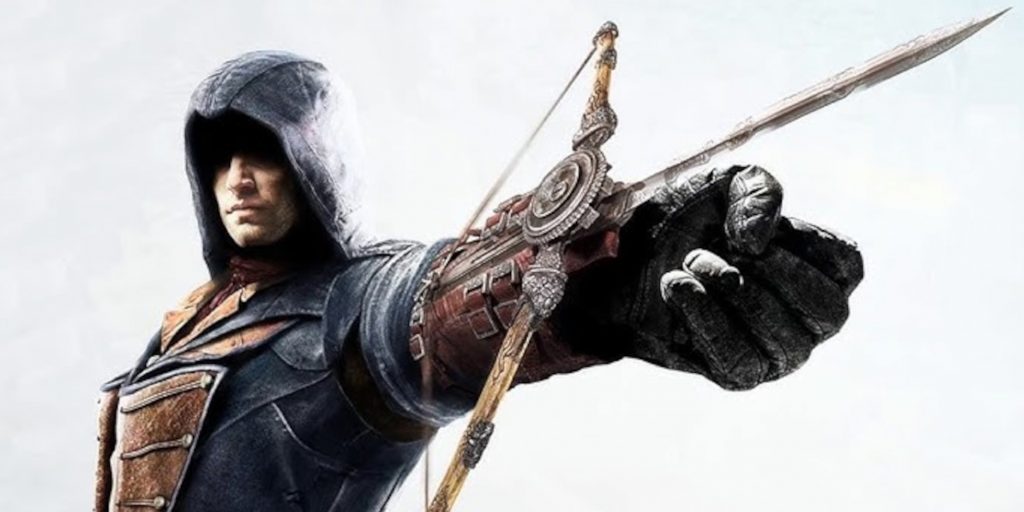
For pure versatility, Ezio probably wins.
Across his three main games, he gets access to dual blades, poison, ranged poison delivery, the Hidden Gun and eventually the Hookblade. His wrists are essentially the Renaissance equivalent of a Swiss Army knife.
For stealth, I’d choose Arno’s Phantom Blade. Being able to eliminate targets silently at range solves one of the fundamental limitations of the traditional weapon.
For combat, Connor’s Pivot Blade is difficult to beat. Its ability to transform into something closer to a conventional knife makes considerably more sense when the situation inevitably deteriorates from “perfect assassination” to “there are now twelve angry guards”.
For style, however, the original Altaïr blade still wins.
It is simple, dangerous and instantly recognisable.
Why Did Assassins Cut Off Their Ring Finger?
The missing ring finger is one of the most famous pieces of early Assassin’s Creed imagery, but it wasn’t an original requirement of the weapon.
Darius wore his Hidden Blade above his arm and retained his fingers.
The tradition develops after Bayek accidentally loses his ring finger while using the blade beneath his wrist. Among the Hidden Ones, removing the finger subsequently becomes both practical and symbolic.
By Altaïr’s period, the sacrifice is deeply associated with the Brotherhood.
Altaïr eventually develops a safer configuration, allowing Assassins to use the weapon without amputation. Later members instead wear rings as a symbolic reference to the older sacrifice.
A painful engineering flaw had become a religious-style tradition, then eventually became jewellery.
Human institutions have been built around stranger things.
Could a Hidden Blade Actually Work?
Sort of.
A retractable wrist-mounted blade is mechanically possible. Replica makers have demonstrated various spring-loaded and gravity-assisted mechanisms, although real versions immediately run into problems that games can politely ignore.
The biggest issue is control.
A conventional knife places the handle directly in the hand, allowing the user to control the angle and absorb force through the wrist and arm. A forearm-mounted blade transfers those forces through a bracer and mounting system instead.
There are other practical problems:
- Accidental deployment would be extremely dangerous
- The mechanism would need to resist considerable lateral force
- Concealing a sufficiently strong blade and mechanism beneath clothing would be difficult
- Maintenance would be essential
- A spring mechanism powerful enough for rapid deployment introduces its own risks
- Retracting the weapon reliably after impact would be challenging
The Pivot Blade is even more mechanically ambitious, while the Phantom Blade happily wanders into the territory where historical engineers would begin asking for considerably more workshop time.
So yes, you could build something resembling a Hidden Blade.
Would I voluntarily strap one to my wrist?
Absolutely not.
Is the Hidden Blade Based on a Real Historical Weapon?
There is no known historical weapon that directly matches the sophisticated retractable Hidden Blade seen in Assassin’s Creed.
There is, however, a historical foundation behind the idea.
The fictional Assassin Brotherhood draws inspiration from the medieval Nizari Ismailis, whose enemies associated them with targeted political killings. Historical accounts frequently describe assassinations carried out at close range with daggers.
That is a very different thing from a spring-loaded wrist weapon.
The Hidden Blade should therefore be understood as historical fantasy built around a plausible concept: a concealed close-range weapon used by an assassin.
Its engineering belongs firmly to Assassin’s Creed.
Why the Hidden Blade Still Matters
The Hidden Blade has survived because Ubisoft resisted the temptation to replace it completely.
It can be redesigned, upgraded or temporarily pushed into the background, but the basic idea remains immediately understandable: get close enough to the target and strike before they know a weapon is there.
That simplicity fits the original Assassin fantasy better than almost anything else in the series.
It also explains why the weapon feels so satisfying when Assassin’s Creed returns to stealth-heavy gameplay. The Hidden Blade rewards observation, positioning and patience rather than raw damage numbers.
Give me a rooftop, a conveniently placed hay cart and one guard who has somehow failed to notice that every colleague on his patrol route has disappeared.
I know exactly which weapon I’m choosing.
Frequently Asked Questions
Who invented the first Hidden Blade?
Within Assassin’s Creed lore, the earliest known user is Darius, also known as Artabanus, during the 5th century BCE. His weapon predates the formal creation of the Hidden Ones.
Why is the Hidden Blade associated with a missing finger?
Bayek accidentally severed his ring finger while using the weapon beneath his wrist. Removal of the finger later became a ritual among the Hidden Ones and early Assassins before Altaïr helped introduce a safer design.
Did Ezio have two Hidden Blades?
Yes. Ezio eventually uses dual Hidden Blades, allowing him to assassinate two nearby targets simultaneously.
What is the Hookblade?
The Hookblade is an Ottoman Assassin modification introduced in Assassin’s Creed Revelations. It combines a conventional blade with a retractable hook used for climbing, ziplines and combat.
What is the Phantom Blade?
Arno Dorian’s Phantom Blade in Assassin’s Creed Unity incorporates a compact projectile system into his Assassin bracer, allowing silent ranged attacks.
Does Connor’s Hidden Blade turn into a knife?
Yes. Connor’s Pivot Blade can rotate approximately 90 degrees, allowing it to function more like a hand-held knife during combat.
Does Naoe use a Hidden Blade in Assassin’s Creed Shadows?
Yes. Naoe wears a Hidden Blade on her left wrist. Her blade can rotate into her palm, giving her a knife-like weapon for close combat.
Is the Assassin’s Creed Hidden Blade historically accurate?
Not as depicted in the games. Concealed knives and close-range assassination certainly have historical precedents, but there is no evidence for the sophisticated retractable wrist mechanism used by the fictional Assassin Brotherhood.