What We Actually Know About History’s Most Famous War
The Trojan War sits in that strange space between myth and history where every answer creates three new arguments. Ancient poets treated it as fact. Modern historians treat it cautiously. Archaeologists keep digging holes in western Turkey hoping the ground will settle the debate once and for all. It never quite does.
Still, beneath the gods, prophecies, golden apples, and men apparently capable of fighting continuously in bronze armour under Mediterranean heat, there appears to be a real historical core. Something destructive happened at Troy during the Late Bronze Age. Powerful kingdoms fought over trade, prestige, and influence across the Aegean world. Cities burned. Alliances shifted. Entire civilisations eventually collapsed into chaos.
The Trojan War may not have unfolded exactly as Homer described it, but dismissing it entirely would be a mistake. Ancient myths usually grow around something real. Human beings are excellent at exaggeration, but rarely invent everything from nothing.
The Traditional Story
According to Greek tradition, the war began after Paris, prince of Troy, abducted or eloped with Helen, wife of Menelaus of Sparta. The Greeks assembled a massive coalition led by Agamemnon, king of Mycenae, and sailed to Troy to retrieve her.
The war supposedly lasted ten years and involved many of the greatest heroes of Greek mythology:
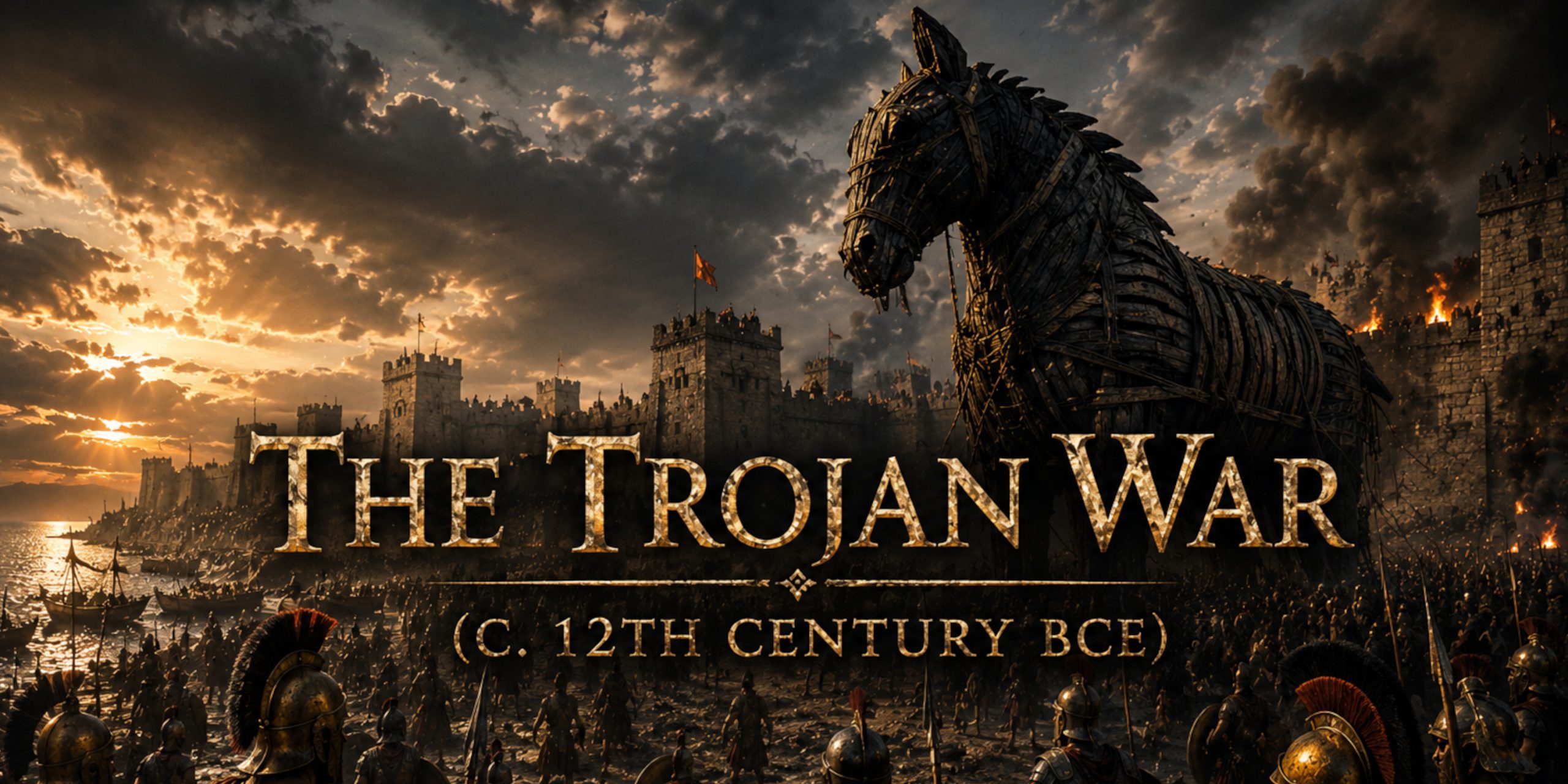
The climax came with the famous Trojan Horse. Greek warriors hid inside a wooden horse left outside the city walls. The Trojans brought it inside, celebrated prematurely, and discovered rather too late that accepting mystery gifts from defeated enemies is generally poor policy.
Troy fell, the city burned, and the survivors scattered across the Mediterranean.
At least according to the poets.
Was the Trojan War Real?
This is the question that has haunted scholars for centuries.
Most historians today believe there was likely some form of conflict centred on Troy during the Late Bronze Age, probably around the 13th or 12th century BC. The issue is separating possible historical reality from epic storytelling layered over centuries.
Several things support the idea of a genuine conflict:
- Troy was a real city
- It occupied a strategically valuable location near the Dardanelles
- Archaeological layers show destruction during the appropriate period
- Hittite records reference western Anatolian conflicts involving a city many scholars associate with Troy
- Mycenaean Greeks were active across the Aegean
The scale and details remain uncertain. A ten-year siege involving thousands of heroes probably belongs more to poetry than military logistics. Bronze Age armies struggled enough with feeding themselves for a few weeks, never mind a decade.
Ancient storytellers, however, loved grandeur. Moderation rarely survives oral tradition.
Troy and the Archaeological Evidence
The Site of Troy
The ancient city identified as Troy lies at Hisarlik in modern-day Turkey.
The site contains multiple layers of settlement built atop one another over thousands of years. Archaeologists refer to these levels numerically.
The most important layers for the Trojan War debate are:
| Layer | Date | Significance |
|---|---|---|
| Troy VI | c. 1700–1250 BC | Wealthy fortified city, possibly destroyed by earthquake |
| Troy VIIa | c. 1250–1180 BC | Signs of destruction and warfare |
| Troy VIII | Greek period | Later identification with Homeric Troy |
Troy VI possessed impressive defensive walls, towers, and evidence of wealth through trade. It looked like the sort of city worth fighting over.
Troy VIIa is even more intriguing. Archaeologists discovered signs of hurried storage, crowded living conditions, and violent destruction. Some scholars interpret this as evidence of siege conditions.
Others remain cautious. Archaeology is rarely as cinematic as people hope. You uncover burnt grain and broken pottery far more often than legendary swords.
Heinrich Schliemann and the Search for Troy
The modern rediscovery of Troy is closely tied to Heinrich Schliemann in the 19th century.
Schliemann was brilliant, obsessive, and catastrophically reckless with archaeology. He believed Homer reflected genuine history and excavated at Hisarlik searching for Priam’s city.
Unfortunately, he also destroyed significant portions of the site by digging enormous trenches through multiple layers. Modern archaeologists tend to speak about this with the same restrained horror one might reserve for a man repairing a medieval tapestry using a chainsaw.
Still, Schliemann’s work proved something vital: Troy was real.
The Bronze Age World
To understand the Trojan War, it helps to understand the wider Late Bronze Age.
This was an interconnected world dominated by major powers:
- Mycenaean Greece
- The Hittite Empire
- Egypt
- Assyria
- Mitanni
Trade routes crossed the eastern Mediterranean carrying:
- Tin and copper for bronze
- Textiles
- Weapons
- Grain
- Luxury goods
Troy occupied a valuable position controlling access between the Aegean and Black Sea regions. That alone could have made it strategically important enough for conflict.
Wars in the Bronze Age were often about trade and influence disguised beneath personal grievances. Human beings have always preferred noble excuses over economic motives.
Major Battles and Legendary Combat
Duel of Paris and Menelaus
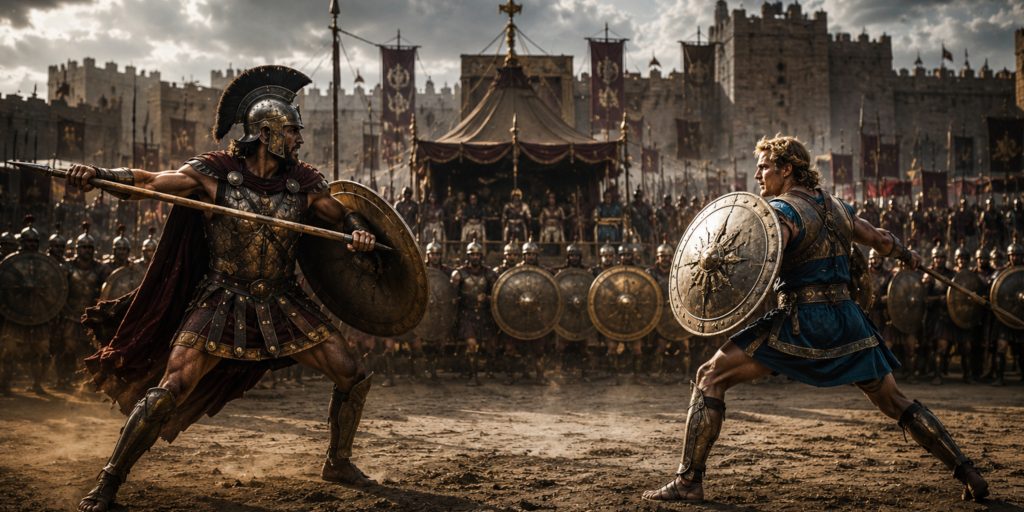
One of the earliest famous confrontations involved Paris and Menelaus fighting to settle the war through single combat.
Menelaus reportedly gained the upper hand before divine intervention saved Paris. Greek mythology often operates on the principle that gods interfere whenever the plot becomes too straightforward.
The duel reflects a broader heroic culture where elite warriors sought glory through personal combat.
The Death of Patroclus
Perhaps the emotional centre of Homer’s Iliad comes with the death of Patroclus, companion of Achilles.
Wearing Achilles’ armour, Patroclus led the Greeks into battle but was killed by Hector. His death drove Achilles back into the war with catastrophic consequences for the Trojans.
Even stripped of mythology, the episode captures something timeless about warfare: grief, rage, revenge, and the terrifying effect a single elite warrior could have on morale.
Achilles vs Hector
The duel between Achilles and Hector became one of the defining scenes of ancient literature.
Hector, defender of Troy, faced Achilles outside the city walls after the deaths of many Trojan warriors. Achilles killed Hector and dragged his body behind his chariot.
Brutal by modern standards, certainly. Yet Homer presents Achilles not as triumphant but consumed by fury and loss.
That emotional complexity is one reason the Iliad still feels surprisingly human.
The Sack of Troy
The final destruction of Troy included:
- Greek infiltration via the Trojan Horse
- Burning of the city
- Slaughter of defenders
- Enslavement of survivors
- Escape of some Trojan refugees
The story of Aeneas fleeing Troy later became central to Roman mythology through Virgil’s Aeneid.
Civilisations love claiming descent from famous survivors. It sounds considerably grander than admitting your ancestors mostly worried about sheep and taxes.
Arms, Armour and Warfare
Greek Weapons and Equipment
Mycenaean Greek warriors likely used:
| Weapon | Description |
|---|---|
| Naue II swords | Long bronze cutting swords common in Late Bronze Age warfare |
| Spears | Primary battlefield weapon |
| Javelins | Used before close combat |
| Large tower shields | Early Mycenaean defensive equipment |
| Boar tusk helmets | Helmets reinforced with stitched boar tusks |
| Bronze cuirasses | Elite body armour |
The famous Dendra Panoply from Greece demonstrates the sophistication of elite Bronze Age armour. It was heavy, expensive, and probably uncomfortable enough to make modern reenactors reconsider their hobbies.
Trojan Warfare
Trojan warriors likely fought similarly to their Mycenaean opponents.
Anatolian influence may have shaped some equipment styles, especially helmets and chariot tactics.
Chariots played an important role in elite warfare during this period, though probably more for transport and command mobility than the dramatic massed charges often shown in films.
Bronze Age combat was violent, close-range, and intensely personal.
Contemporary Quotes
Although written centuries later, Homer’s works preserve the spirit of ancient heroic tradition.
“Rage, goddess, sing the rage of Achilles.”
From the Iliad
“There is the heat of Love, the pulsing rush of Longing, the lover’s whisper, irresistible magic to make the sanest man go mad.”
From the Iliad
“Any moment might be our last. Everything is more beautiful because we are doomed.”
Attributed in later tradition to Homeric sentiment
The ancient Greeks viewed glory and mortality as inseparable. Heroes sought immortality through reputation because actual immortality seemed frustratingly unavailable.
Archaeology Beyond Troy
Archaeological discoveries across the eastern Mediterranean support the broader reality of instability during the Late Bronze Age collapse.
Evidence includes:
- Burned palaces in Mycenaean Greece
- Collapsed trade networks
- Abandoned settlements
- Decline in literacy
- Mass migrations
The Trojan War tradition may preserve cultural memory from this wider era of destruction.
Some historians even argue the war became symbolic of the entire collapse of the Bronze Age world.
Homer and the Problem of Memory
The Iliad and Odyssey were probably written down centuries after the events they describe.
That creates obvious problems for historians.
Yet oral traditions can preserve remarkable details over long periods. Certain descriptions of armour, warfare, and political organisation in Homer appear rooted in genuine Bronze Age memory.
The poems are therefore neither pure fiction nor reliable history. They exist somewhere in between.
Annoyingly for historians, that middle ground is also the most fascinating part.
Legacy of the Trojan War
The Trojan War shaped Western literature more than almost any other ancient story.
Its influence appears in:
- Greek tragedy
- Roman literature
- Medieval romance
- Renaissance art
- Modern novels
- Films and television
- Video games
Characters like Achilles, Hector, and Odysseus remain instantly recognisable nearly three thousand years later.
That endurance says something important. Beneath the mythology lies a story about pride, ambition, grief, honour, and destruction that still resonates.
The setting may be Bronze Age Anatolia, but the emotions feel painfully familiar.
Seven Swords Takeaway
The Trojan War probably was not exactly as Homer described it. Gods likely did not descend onto battlefields to settle arguments. Heroes probably did not deliver lengthy speeches while surrounded by flying spears. Real warfare tends to interrupt eloquence rather abruptly.
Yet there was almost certainly a Troy. There was likely conflict. Cities burned during the Late Bronze Age, kingdoms fought for power, and memories survived long enough to become legend.
That blend of truth and myth is precisely why the Trojan War still matters.
History gives us evidence. Myth gives us meaning.
The Trojan War somehow manages to offer both.