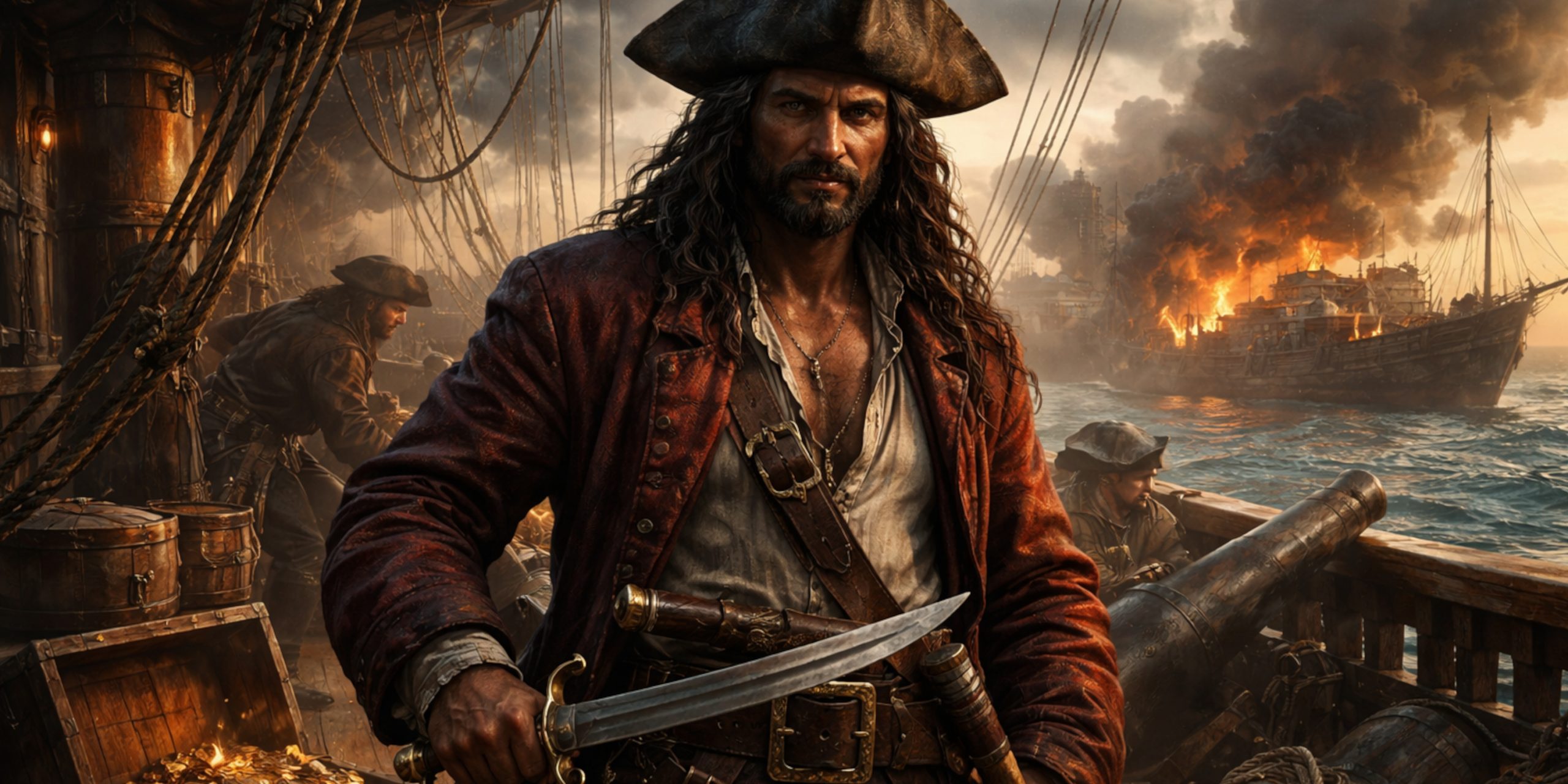
Roche Braziliano is one of those pirates who feels as though he has wandered out of a feverish tavern tale, lurched across the Caribbean with a pistol in one hand and a bottle in the other, then vanished before anyone thought to write down anything sensible about him.
He was brutal, foul-tempered, frequently drunk and, by all surviving accounts, very good at being a pirate. That He was brutal, foul-tempered, frequently drunk and, by all surviving accounts, very good at being a pirate. That last quality mattered rather more in the seventeenth-century Caribbean than charm, moderation, or an agreeable personality.
Unlike the better-known rogues such as Henry Morgan or Blackbeard, Roche Braziliano remains a shadowy figure. Most of what survives comes from frightened Spanish witnesses and later pirate chroniclers. These are not always reliable, although one suspects the stories about his drinking are probably true. Nobody invents that quantity of rum by accident.
Who Was Roche Braziliano?
Roche Braziliano was a Dutch buccaneer and pirate active in the Caribbean during the 1650s and 1660s. His real name is unknown. The nickname “Braziliano” almost certainly came from the fact that he had lived for some time in Brazil before arriving in the Caribbean.
At the time, parts of Brazil had been controlled by the Dutch West India Company. When the Portuguese reconquered much of the region in the 1650s, a number of Dutch settlers, soldiers and adventurers found themselves abruptly unemployed and unwelcome. Roche appears to have been one of them.
He eventually made his way to the buccaneer haven of Tortuga and the coast of Hispaniola, where men with little money and fewer scruples could generally find work shooting cattle, smuggling goods, or robbing Spanish ships.
The buccaneers of Tortuga were an unruly collection of English, French and Dutch freebooters. They hunted wild cattle for hides and meat, raided shipping when the opportunity arose, and maintained an impressive ability to turn every political dispute into an excuse for theft.
Roche fitted in splendidly.
The Reputation of Roche Braziliano
Even among pirates, Roche Braziliano developed a reputation for violence. The principal source for his life, Alexandre Exquemelin, described him as extraordinarily cruel, particularly towards Spanish prisoners.
Exquemelin wrote that Roche would become dangerous when drunk, which unfortunately appears to have been often.
“When he was drunk, he would often commit the most barbarous cruelties imaginable.”
According to Exquemelin, Roche once captured several Spanish prisoners and roasted them over a fire when they refused to reveal where valuables had been hidden. Whether every detail is true is difficult to say. Pirate chroniclers enjoyed a sensational story, and Spanish officials were not inclined to offer a generous character reference. Yet there is little doubt that Roche was feared.
Another story claimed that when he was heavily intoxicated he forced captured Spaniards to drink with him. If they refused, he shot them. If they accepted, he sometimes shot them anyway. There is a sort of bleak consistency to this, although not much else.
“He treated the Spaniards with all the cruelty imaginable.”
The Spanish authorities considered him one of the most dangerous buccaneers operating in the Caribbean.
Roche Braziliano’s Early Career
Roche began as a buccaneer on Hispaniola, hunting wild cattle and pigs. Like many future pirates, he learned to survive in rough country before turning to raiding at sea.
By the mid-1650s he had joined the growing bands of privateers and pirates operating from Tortuga and Jamaica. England, France and the Dutch Republic were frequently at war with Spain, which created the sort of legal confusion in which pirates thrive.
A man could attack a Spanish ship one month with a letter of marque and the next month without one. The practical difference was often little more than whether the governor liked him.
Roche soon acquired his own command and became one of the more successful captains in the western Caribbean.
Ships Commanded by Roche Braziliano
No complete list survives of the ships he commanded, but contemporary sources describe him leading small, fast vessels suited to Caribbean raiding.
These were usually:
- Sloops
- Small brigantines
- Light armed barques
Such ships had several advantages:
- They could sail into shallow coastal waters where larger Spanish ships could not follow
- They were fast enough to overtake merchant vessels
- They required relatively small crews
- They could be beached, repaired and hidden among islands and mangrove inlets
Exquemelin records Roche commanding a ship carrying around ten guns and a crew of roughly fifty men. Later in his career he may have commanded larger vessels with up to ninety men.
His flagship was probably not a grand warship in the manner of later pirate legends. Roche was no theatrical admiral striding about on a floating palace. He was more likely standing on the deck of a battered brigantine shouting unpleasant things in Dutch while somebody loaded another cannon.
Weapons and Fighting Style
Roche Braziliano and his men used the standard weapons of the buccaneers.
Typical Weapons
- Flintlock pistols
- Matchlock and flintlock muskets
- Cutlasses
- Boarding axes
- Daggers
- Grenadoes, small hand-thrown explosives
The cutlass was especially important in close fighting. Short, heavy and brutally practical, it was well suited to boarding actions on crowded decks.
The cutlass was the weapon most closely associated with buccaneers. Unlike elegant rapiers, which suited a gentleman with time to pose in a mirror, the cutlass existed to hack through rope, wood and occasionally an opponent.
Buccaneers also prized accurate muskets. Many had begun as hunters on Hispaniola and Tortuga, and were excellent shots.
Exquemelin wrote of the buccaneers:
“They seldom miss their mark.”
Roche appears to have preferred sudden attacks, often launched against isolated ships or poorly defended coastal settlements. He relied on speed and intimidation rather than elaborate tactics.
Major Raids and Battles
Raids on Spanish Shipping
Throughout the 1650s and 1660s Roche Braziliano preyed on Spanish merchant vessels sailing between Cuba, Cartagena and the ports of New Spain.
He specialised in intercepting:
- Coastal trading vessels
- Small treasure ships
- Isolated merchantmen
- Fishing and supply craft
Spanish shipping in the Caribbean was often dispersed between major treasure fleets. Roche exploited this ruthlessly.
One of his more successful actions involved the capture of a Spanish ship laden with:
- Silver
- Cocoa
- Hides
- Indigo
- Provisions
The exact value is unknown, but contemporary reports suggest it was considerable.
The Attack on Campeche
One of Roche Braziliano’s best-known exploits was his participation in attacks on the coast of the Yucatán, particularly around Campeche.
The town of Campeche, in modern Mexico, was a favourite target of pirates because it exported valuable logwood, hides and silver.
Campeche was repeatedly attacked by buccaneers throughout the seventeenth century.
Roche joined other pirate captains in raiding the region. The attackers landed, overwhelmed local defenders and plundered warehouses and homes.
The Spanish fought stubbornly, but the buccaneers usually had the advantage of surprise and experience.
One Spanish account described the pirates as:
“Men without fear, mercy, or God.”
That may have been unfair. Some pirates probably feared running out of rum.
Battle Against a Spanish Force
At one point Roche Braziliano and his men were reportedly pursued by a larger Spanish force on land. Outnumbered, the buccaneers formed a defensive position and fought with muskets and pistols.
According to later accounts, Roche ordered his men not to fire until the Spaniards were very close. The first volley was devastating.
The buccaneers then charged with cutlasses and drove the Spanish back.
This style of fighting was typical of the buccaneers:
- Accurate musket fire at short range
- Sudden aggressive assault
- Ruthless close combat
It was crude, brutal and alarmingly effective.
Bounty and Wealth
No precise bounty for Roche Braziliano survives in the records. The Spanish certainly wanted him captured or killed, but seventeenth-century Caribbean bureaucracy was often rather vague.
Instead of a formal bounty in modern terms, Spanish governors issued orders for his arrest and authorised military expeditions against him.
Given his reputation and the damage he caused, he was probably worth a substantial reward.
As for his wealth, Roche Braziliano appears to have accumulated a considerable fortune through piracy.
His treasure likely included:
- Spanish silver coins
- Gold jewellery
- Pearls
- Cocoa
- Indigo
- Fine cloth
- Weapons
- Wine and spirits
Like many pirates, however, he seems to have spent much of it rapidly.
Buccaneers had a remarkable ability to acquire fortunes and then lose them in taverns within the space of a fortnight. They were, in financial terms, not a disciplined people.
Did Roche Braziliano Bury Treasure?
There is no reliable evidence that Roche Braziliano buried treasure.
Stories about buried pirate treasure largely belong to the nineteenth century and to novels such as Treasure Island. Real pirates usually spent or divided their loot quickly.
If Roche hid treasure anywhere, the most likely places would have been:
- Tortuga
- Jamaica
- Small islands off Cuba
- Remote coves on Hispaniola
No confirmed cache linked to him has ever been found.
This is disappointing, although perhaps just as well. If Roche had buried treasure, he would probably have guarded the location with the same charm and moderation for which he was famous.
Contemporary Quotes About Roche Braziliano
Most of the surviving descriptions come from Alexandre Exquemelin and Spanish reports.
“This pirate was more cruel and inhuman than a tiger.”
“He had no delight but in murders and cruelties.”
“The Spaniards dreaded no man more than they did Roche Braziliano.”
These descriptions were written by his enemies or by writers eager to entertain their readers, so they should be treated cautiously. Yet even allowing for exaggeration, Roche emerges as a genuinely dangerous figure.
The Mysterious Fate of Roche Braziliano
The end of Roche Braziliano is uncertain.
There are several competing stories.
One claims he was killed in battle against the Spanish sometime in the late 1660s.
Another says he was captured and executed.
A third account suggests that he simply disappeared from the historical record after a final voyage.
The most likely explanation is that he died violently, as pirates generally did. Men such as Roche rarely retired to a quiet cottage to grow cabbages and reflect on their mistakes.
Some later writers claimed he perished in a shipwreck. Others believed he settled under another name.
There is no convincing evidence for either theory.
By around 1671, Roche Braziliano had vanished from the records.
Roche Braziliano’s Legacy
Roche Braziliano never achieved the fame of Henry Morgan or Blackbeard, partly because he operated earlier and partly because he lacked the sense to survive long enough to become respectable.
Yet he remains one of the most notorious buccaneers of the seventeenth century.
His career illustrates the violent, unstable world of the Caribbean during the age of buccaneers:
- Empires fighting over colonies
- Weak coastal defences
- Pirates moving easily between legal privateering and outright piracy
- Enormous fortunes won and lost
Roche Braziliano also helped shape the image of the pirate as a violent and unpredictable figure. In truth, many pirates were brutal, desperate men rather than romantic adventurers.
Roche, in particular, seems to have possessed all the amiable qualities of a cornered wolf with access to firearms.
That, unfortunately for the Spanish Main, made him rather successful.