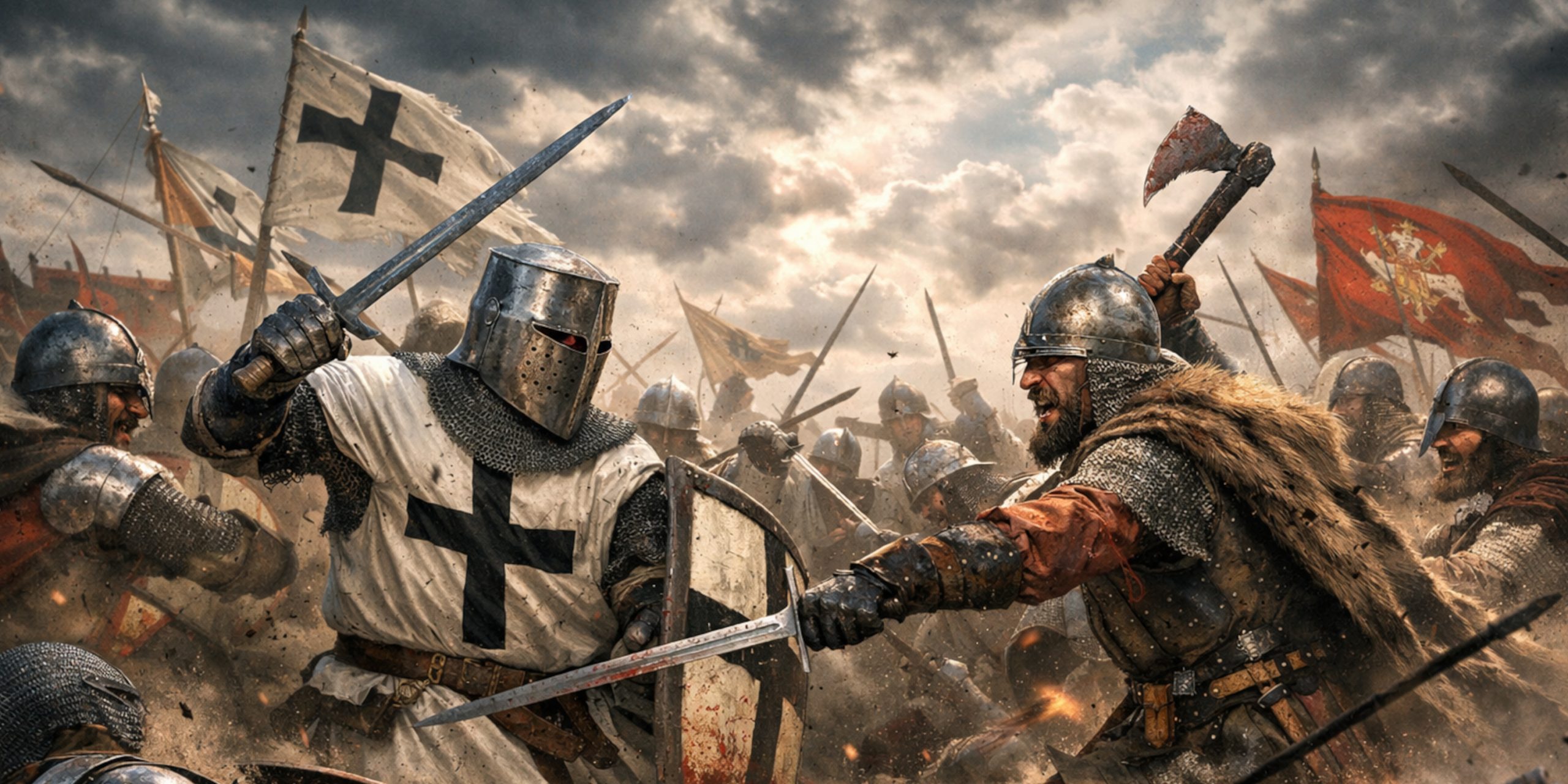
The Battle of Durbe, fought on 13 July 1260 near Lake Durbe in present-day Latvia, was one of the most important battles of the Northern Crusades. It was also one of the worst disasters ever suffered by the Teutonic Knights and their Livonian branch.
For the Samogitians and their allies, it was a remarkable victory. For the Teutonic Order, it was the sort of day that begins with confidence, banners and prayers, and ends with confusion, mud and a great many very expensive helmets lying abandoned in a marsh.
Durbe did not merely decide a battle. It triggered rebellions across the Baltic, shattered the aura of invincibility around the crusading orders and gave Lithuania and Samogitia the breathing room they desperately needed.
Background
By 1260 the Livonian Order and the Teutonic Knights had spent years attempting to conquer and convert the pagan peoples of the eastern Baltic. Their position, however, remained fragile.
The key issue was Samogitia. This region lay between the Teutonic Knights in Prussia and the Livonian Order further north. As long as Samogitia remained independent, the two branches of the order could not properly link their territories.
King Mindaugas of Lithuania had earlier granted parts of Samogitia to the order as part of his conversion to Christianity. The Samogitians had absolutely no intention of accepting this arrangement. They regarded it rather like a landlord announcing he had sold your house without consulting you.
In the years before Durbe, the Samogitians had already inflicted defeats on the crusaders at Skuodas and repeatedly raided their frontier lands. The Order responded by raising a large army and preparing a major campaign.
Foces
Samogitian and Curonian Forces
| Force | Estimated Strength | Notes |
|---|---|---|
| Samogitian warriors | 3,000 to 4,000 | Mainly infantry with some mounted nobles |
| Curonian allies | Several hundred | Some initially served with the crusaders before changing sides |
| Total | Around 4,000 | Flexible, mobile force used to fighting in forests and marshland |
Teutonic and Livonian Forces
| Force | Estimated Strength | Notes |
| Teutonic and Livonian knights | Around 190 knights | Heavy cavalry elite of the crusading orders |
| German, Danish and Swedish auxiliaries | Several thousand | Included infantry and mounted retainers |
| Christianised Baltic auxiliaries | Unknown | Curonians, Estonians and others attached to the order |
| Total | Around 8,000 | Larger army, but divided and poorly suited to the terrain |
The crusader army looked formidable on paper. Unfortunately for them, paper rarely accounts for marshes, divided command or allies who suddenly decide they have had enough.
Leaders and Troop Composition
| Side | Leader | Role |
| Samogitians | Possibly Alminas, perhaps Treniota | Commander of the Samogitian force |
| Curonians | Local chiefs | Allied support, later turned against the crusaders |
| Livonian Order | Burkhard von Hornhausen | Master of the Livonian Order |
| Teutonic Knights | Heinrich Botel | Marshal of Prussia |
There is still debate over who commanded the Samogitians. Later chroniclers claimed it was Treniota, nephew of Mindaugas. Modern historians often favour Alminas, a Samogitian noble elected by his people.
The crusader army was a coalition and, like many coalitions, it worked beautifully until the moment it actually had to fight.
Composition of the Samogitian Army
- Experienced infantry armed with spears, axes and javelins
- Small numbers of mounted nobles
- Archers and skirmishers familiar with woodland fighting
- Curonian allies with local knowledge of the terrain
Composition of the Crusader Army
- Heavy cavalry of the Teutonic and Livonian Orders
- Danish and German feudal contingents
- Infantry levies from conquered Baltic territories
- Christianised Curonians and Estonians serving under the order
Arms and Armour
The Battle of Durbe was fought at a moment when western European military equipment was meeting the lighter, more flexible style of Baltic warfare.
Samogitian and Curonian Arms
- Spears and long thrusting lances
- Throwing javelins
- Axes and war clubs
- Bows
- Round or oval wooden shields
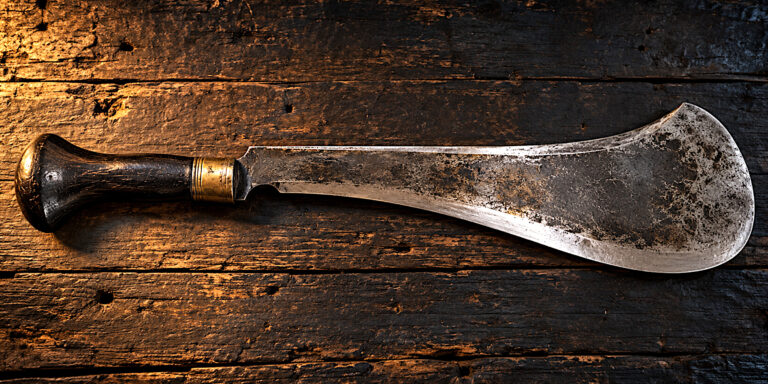
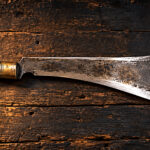
- Short swords and single-edged blades
Specific sword types probably included:
- Baltic single-edged war swords
- Early arming swords acquired through trade or plunder
- Curonian and Lithuanian blades influenced by Scandinavian forms
Samogitian warriors generally wore:
- Quilted tunics or leather jerkins
- Fur-lined clothing
- Simple helmets for wealthier fighters
- Little heavy armour, allowing them to move rapidly across difficult ground
Crusader Arms
The Teutonic and Livonian knights fought in the classic western European style.
- Long lances for cavalry charges
- Maces and war hammers
- Crossbows
- Large kite or heater shields
- Heavy cavalry swords
Specific sword types likely included:
- Knightly arming swords of Oakeshott Types X, XI and XII
- Longer cavalry swords suited to mounted combat
- Falchion-like sidearms carried by some infantry and sergeants
The crusader knights wore:
- Mail hauberks
- Conical or great helms
- Mail chausses protecting the legs
- Surcoats bearing the black cross of the order
All of this was very impressive in a tournament field. In marshland near Lake Durbe, it was rather like bringing a cathedral organ to a foot race.
The Battle
The crusader army originally intended to relieve the besieged fortress of Georgenburg. When news arrived that the Samogitians were raiding further north, the army changed direction and marched towards Durbe.
The battle took place near the southern shore of Lake Durbe, an area of boggy ground, woods and uneven terrain. This immediately favoured the Samogitians.
Before the battle even began, arguments broke out within the crusader camp. The Danish contingent reportedly refused to dismount from their horses. This was a serious problem because the ground was too soft for an effective cavalry charge.
The Christianised Curonians serving with the order asked that any Curonian prisoners captured by the Samogitians be released after the battle. The crusader leadership refused.
This turned out to be a catastrophic mistake.
When fighting began, the Curonians abandoned the crusader army. Some accounts even suggest they attacked it from the rear. Other Baltic auxiliaries then fled as well.
The Teutonic and Livonian knights suddenly found themselves isolated, hemmed in and unable to manoeuvre.
The Samogitians surrounded the crusader force and cut it apart. Burkhard von Hornhausen was killed, along with Heinrich Botel and around 150 knights.
For a medieval military order built upon the prestige of its mounted elite, this was devastating. Losing 150 knights in a single day was not simply a defeat. It was a catastrophe felt across the Baltic world.
Battle Timeline
| Time | Event |
| Early 1260 | The Teutonic and Livonian Orders prepare a major campaign against Samogitia |
| 25 January 1260 | Papal approval is granted for the crusade |
| Summer 1260 | Crusader army gathers near Memel |
| 13 July 1260, morning | Crusader force marches towards Lake Durbe |
| Midday | Arguments erupt within the crusader coalition over tactics and prisoners |
| Early afternoon | Battle begins in difficult marshy terrain |
| Shortly after | Curonian allies abandon the crusaders |
| Later afternoon | Estonians and other auxiliaries flee |
| Final stage | Samogitians surround and destroy the remaining crusader force |
| Evening | Burkhard von Hornhausen and Heinrich Botel are dead, the crusader army collapses |
Archaeology and the Battlefield
The exact location of the battlefield remains debated. Traditionally it has been placed near Lake Durbe in western Latvia, close to the modern town of Durbe.
Archaeologists and historians continue to argue over the precise site because medieval sources are frustratingly vague. Medieval chroniclers had a charming habit of describing battlefields as being near a river, a hill or a forest, which is not particularly helpful in a region containing all three every few miles.
Archaeological finds from the wider region include:
- Fragments of weapons and spearheads
- Horse equipment
- Belt fittings and personal items
- Remains associated with crusader fortifications
Modern studies of the landscape suggest the battle likely took place in marshy ground where heavy cavalry could not operate effectively. This matches the written accounts remarkably well.
Recent scholarship has also questioned whether the nearby fortress of Georgenburg was actually located where historians long assumed. If that proves correct, the entire campaign route of the crusader army may need to be reconsidered.
Aftermath
The defeat at Durbe sparked a chain reaction.
Across the Baltic, subject peoples rose in revolt. The Great Prussian Uprising began soon afterwards and would last for more than a decade. The Curonians, Semigallians and other groups also rebelled.
The Teutonic Order suddenly faced uprisings across nearly every territory it controlled.
Durbe also had profound consequences for Lithuania. The victory strengthened anti-Christian factions at the court of Mindaugas. Treniota, whether or not he had commanded at Durbe, used the triumph to persuade Mindaugas to abandon his alliance with the crusaders.
Within a few years, Lithuania returned to open war against the order.
The battle therefore bought Lithuania something precious: time.
Without Durbe, the Teutonic Order might have linked its Prussian and Livonian lands and crushed Lithuania while it was still young and vulnerable. Instead, Lithuania survived, expanded and eventually became one of the largest states in Europe.
Why the Battle of Durbe Matters
Durbe was more than a battlefield victory. It was a reminder that heavily armoured crusading armies were not invincible.
The Samogitians won because they understood the terrain, maintained cohesion and exploited the weaknesses of a divided enemy. The Teutonic Order lost because it relied too heavily on prestige, cavalry and allies whose loyalty was, at best, negotiable.
Historians sometimes describe Durbe as the Baltic equivalent of a great medieval upset. That is true, but it perhaps understates the matter. This was not a lucky ambush or a narrow escape. It was a complete military and political disaster for the crusading orders.
If the Teutonic Knights had nightmares, one suspects Lake Durbe featured rather prominently.
Contemporary Quotes
“So many brothers of the Order fell there that scarcely any greater loss had ever been suffered.”
From the Livonian Rhymed Chronicle.
“The Curonians abandoned the Christians and turned their weapons against them.”
Attributed to Peter of Dusburg.
“After this battle, all the lands of Prussia rose against the brothers.”
From later Prussian chronicles describing the aftermath.
Seven Swords Takeaway
The Battle of Durbe remains one of the defining moments of Baltic history. It halted the expansion of the Teutonic Order, inspired rebellion across the region and preserved the independence of Lithuania and Samogitia.
It was also a battle that perfectly demonstrated an old truth of medieval warfare: the largest army does not always win, especially if it marches into a swamp while arguing with itself.