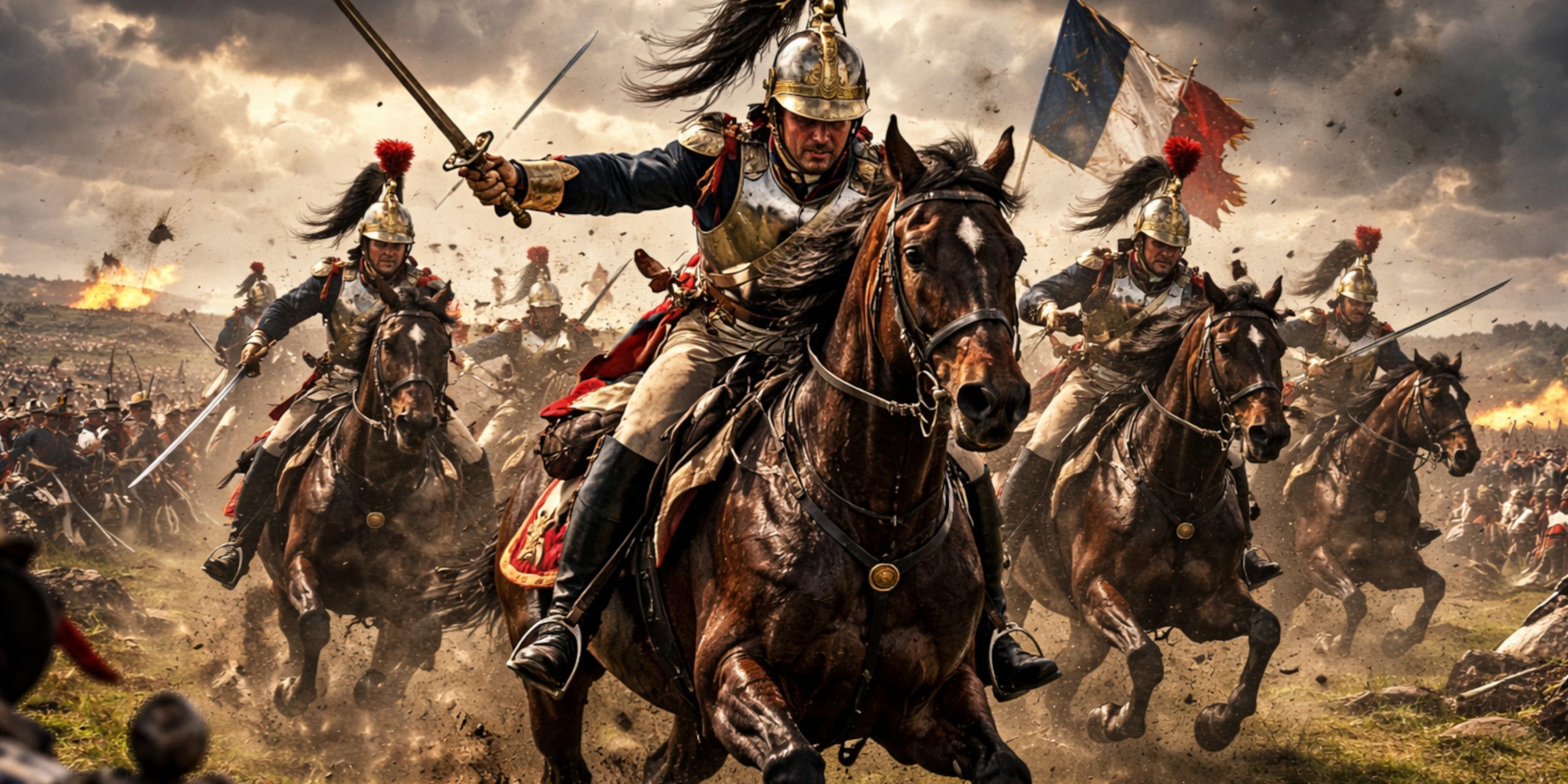
There is something faintly theatrical about the French cuirassiers. Polished steel breastplates, tall helmets crowned with horsehair, and the quiet confidence of men who knew they were meant to smash through whatever stood in front of them. If the infantry formed the spine of Napoleon’s army, then the cuirassiers were its clenched fist.
They were not subtle. They were not cheap. They were not always sensible. But when used properly, they could end a battle in minutes.
Origins and Evolution
The word cuirassier comes from cuirasse, meaning breastplate. Heavy cavalry wearing armour had existed for centuries, yet by the late eighteenth century most European armies had abandoned the practice. Firearms had improved, and armour seemed a relic.
France briefly agreed, then reversed course.
By the time of the French Revolutionary Wars, selected cavalry regiments were re-equipped with cuirasses. Under Napoleon Bonaparte, they became a defining element of battlefield shock tactics.
Key developments:
- Reintroduction of steel breastplates and backplates
- Standardisation of heavy cavalry regiments as cuirassiers
- Increased focus on massed charges rather than dispersed skirmishing
- Integration into decisive battlefield moments rather than routine use
By the early nineteenth century, cuirassiers had become a symbol of imperial power as much as a military tool. One suspects Napoleon understood the psychological value as well as the practical one.
Role on the Battlefield
Cuirassiers were designed for one purpose, decisive shock.
Their typical battlefield roles included:
- Breaking weakened infantry lines
- Exploiting gaps created by artillery or infantry assaults
- Countering enemy cavalry formations
- Delivering final blows in already unstable engagements
They were rarely used early. Napoleon preferred to hold them back, like a gambler keeping his best card hidden until the table grew tense.
At the Battle of Waterloo, their repeated charges under Michel Ney became both famous and infamous. Magnificent to watch, ruinously costly, and ultimately ineffective against disciplined infantry squares.
Arms and Armour
There is a tendency to romanticise cuirassiers, but their equipment was brutally functional.
Armour
- Steel cuirass consisting of breastplate and backplate
- Designed to deflect sword blows and, at times, pistol shots
- Weighed roughly 7 to 10 kilograms
- Often polished to a mirror finish, which did nothing for stealth but everything for morale
It did not make them bulletproof. It made them slightly less dead.
Helmet
- Brass helmet with a black horsehair crest
- Reinforced skullcap for protection
- Decorative elements varied by regiment
The helmet gave them a distinctive silhouette that could be recognised across a battlefield, which was both reassuring and, occasionally, unhelpful.
Primary Weapon, The Heavy Cavalry Sword
The standard weapon was the straight-bladed heavy cavalry sword, particularly the AN XI pattern.
- Long, straight blade optimised for thrusting
- Sturdy construction for powerful strikes from horseback
- Less curved than light cavalry sabres, reflecting its role in direct charges
This was not a duelling weapon. It was a tool for delivering force at speed.
Secondary Weapons
- Pistols carried in saddle holsters
- Occasionally carbines, though rarely central to their role
Firearms were useful, but the cuirassier’s true strength lay in momentum.
Organisation and Training
Cuirassiers were organised into regiments within heavy cavalry divisions. Each regiment maintained a strong emphasis on discipline, formation riding, and coordinated charges.
Training focused on:
- Maintaining tight formation at speed
- Timing charges precisely with infantry and artillery support
- Handling large, powerful horses under pressure
The horses themselves were carefully selected. Large, strong, and capable of carrying both rider and armour without collapsing halfway through a charge, which would have been awkward for everyone involved.
Archaeology and Material Evidence
Archaeological finds offer a less glamorous perspective.
Recovered cuirasses often show:
- Bullet dents that failed to penetrate
- Deformation from close-range impacts
- Signs of hurried repair
From sites such as Waterloo, artefacts reveal the reality behind the spectacle. Armour did save lives, sometimes. Other times, it simply recorded the moment before impact.
Museum collections across Europe preserve:
- Original AN XI swords
- Damaged cuirasses
- Helmets with battle wear
These objects carry a certain honesty. They do not care much for myth.
Contemporary Accounts
Writers of the period were rarely indifferent to cuirassiers. They either admired them or feared them.
A French officer recalled:
“They advanced like a wall of iron, and nothing seemed able to resist them.”
From the opposing side, a British infantryman wrote:
“The ground shook beneath them, and yet we stood, for we must.”
And from a more reflective perspective:
“The splendour of their charge was matched only by the cost.”
There is admiration in these lines, but also a quiet understanding of what such charges required in human terms.
Strengths and Weaknesses
Strengths
- Devastating shock impact in massed formation
- Strong morale effect on enemy troops
- Physical protection from armour
- Highly effective against disorganised or exposed infantry
Weaknesses
- Vulnerable to disciplined infantry squares
- Limited flexibility compared to light cavalry
- High logistical cost
- Dependent on terrain and timing
Used correctly, they could decide a battle. Used poorly, they became an expensive lesson.
Legacy
The age of cuirassiers faded with the rise of more effective firearms and changing tactics. Yet their image endured.
They influenced:
- Later European heavy cavalry traditions
- Ceremonial military uniforms
- Popular depictions of Napoleonic warfare
Even today, they remain shorthand for decisive force. When historians speak of shock cavalry, they often picture a cuirassier, whether they admit it or not.
Seven Swords Takeaway
There is always a temptation to see cuirassiers as relics of a fading age, men in polished armour charging into a future that had little patience for them. That view is not entirely wrong.
Still, for a brief moment, they represented the peak of cavalry warfare, disciplined, armoured, and terrifyingly direct.
And if one is being honest, there is something rather compelling about a soldier whose entire job description could be summarised as riding straight at the problem until it stopped being a problem.
History rarely offers solutions quite so blunt.