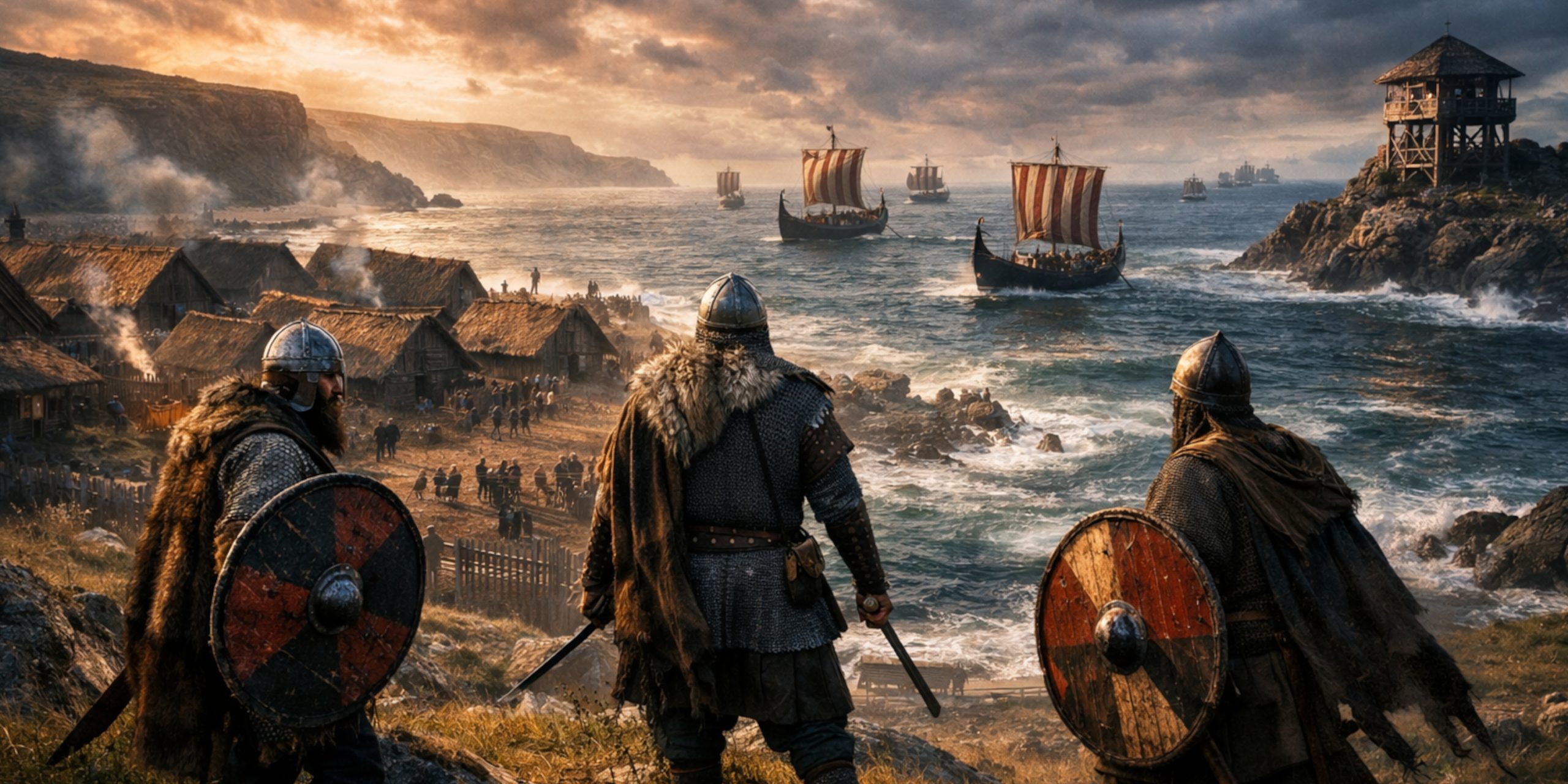
The Vikings did not just raid, burn and disappear into the mist like badly behaved ghosts with boats. At their height, they settled, traded, ruled, married locally, built towns, minted coins, raised halls, founded colonies and, in a few cases, pushed so far west that they reached North America. If we want to understand their real impact, not just the dramatic bit with axes and monasteries, we need to look at the places they made their own.
Some of these settlements began as overwintering camps. Some became power centres. Some turned into international trading hubs. A few helped reshape the political map of Europe and the North Atlantic. Together, they show that the Viking world was not confined to Norway, Denmark and Sweden. It spilled outward across the British Isles, the North Atlantic, Francia and beyond.
Below are the most important Viking settlements outside Scandinavia, and why they mattered.
Why Viking settlements mattered
Raiding brought wealth. Settlement brought permanence.
Once Scandinavians began staying through winter, controlling rivers, occupying coastal strongholds and building towns, they stopped being merely visitors with very sharp intentions. They became rulers, traders and colonists. Settlements let them control trade routes, exact tribute, project military power and absorb local cultures while preserving parts of their own identity.
This is where the story gets interesting. The Viking Age was never only about violence. It was also about movement, adaptation and opportunism on a frankly heroic scale.
Dublin, the great Norse power in Ireland
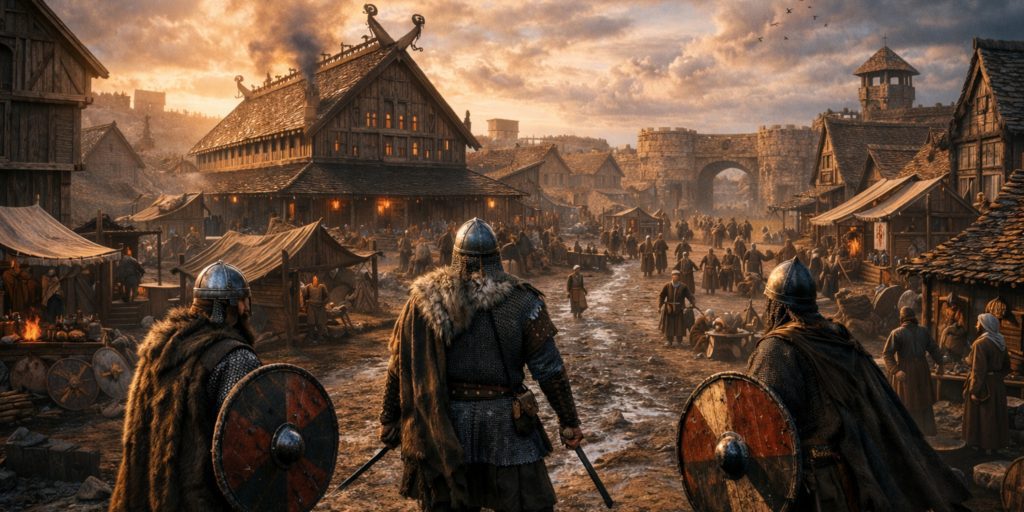
Dublin was one of the most important Viking settlements anywhere outside Scandinavia. Founded as a longphort, a fortified ship camp, in the ninth century, it grew into a major Norse town, slave-trading centre and political base in Ireland. Over time it became a hybrid Hiberno-Norse kingdom, Scandinavian in origin but deeply entangled with Irish politics and culture.
Dublin mattered because it linked the Irish Sea world. From here, Norse rulers could strike inland, trade across Britain and Ireland, and connect with wider Scandinavian networks.
Why Dublin mattered
- It became one of the leading Viking urban centres in the west
- It was a major trading hub for silver, slaves, textiles and imported goods
- It served as a base for Norse kings and war leaders in Ireland
- Its rulers influenced events far beyond the city itself
Battles and conflict
Dublin was repeatedly fought over by Irish kings, rival Viking factions and later Anglo-Norman forces. The Battle of Clontarf in 1014 is the famous example, though it is often simplified into a neat Irish versus Viking showdown. In truth, it was messier, full of shifting alliances, which is very medieval and therefore very on brand. Dublin’s Norse forces were central to that struggle.
Archaeology
Excavations at Wood Quay transformed our understanding of Viking Dublin. Archaeologists uncovered houses, streets, workshops, defences, tools, combs, gaming pieces and imported goods. The finds showed a dense, organised and commercially active settlement rather than a temporary pirate camp.
Contemporary voice
The Annals of Ulster refer to Viking activity in Ireland with grim regularity, and one early notice on the arrival of Norse forces captures the tone of the age well, describing “the heathens” as a devastating presence in Irish affairs. That language tells us as much about the chroniclers’ fear as it does about the newcomers.
Jórvík, Viking York and the making of a northern capital
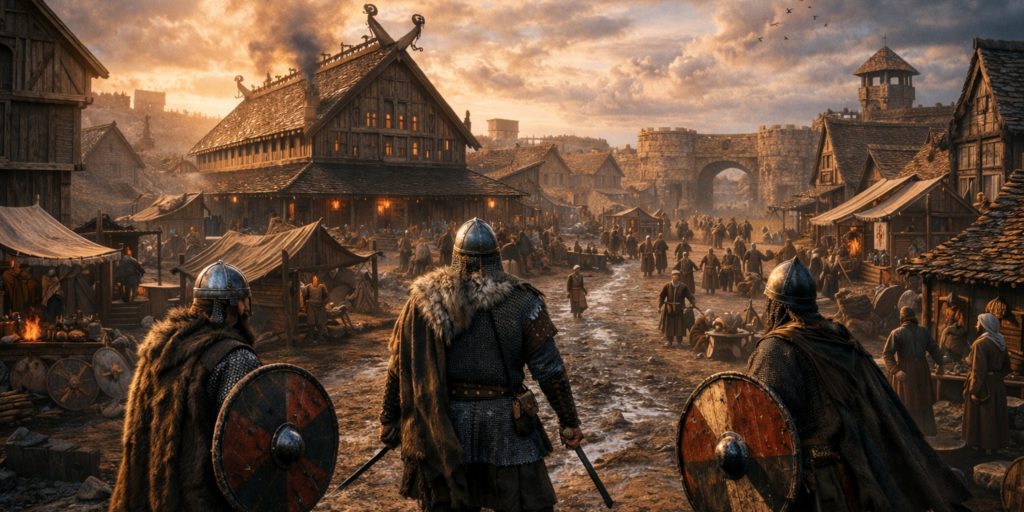
York, known to the Norse as Jórvík, was one of the most important Viking cities in England. Captured by the Great Heathen Army in 866, it became the capital of the Viking kingdom of Northumbria and one of the greatest urban centres in the Viking world outside Scandinavia.
Jórvík was valuable because of its Roman infrastructure, its strategic position and its trade links. This was not some muddy outpost with a few huts and a bad smell, though it probably did have the bad smell. It was a real city, and the Vikings knew the value of that.
Why Jórvík mattered
- It became the political centre of Viking power in northern England
- It was a major manufacturing and trading town
- It connected England to Scandinavia, Ireland and the wider North Sea economy
- It helped anchor long-term Scandinavian settlement in the Danelaw
Battles and conflict
The capture of York in 866 was a turning point. Control of the city became central to struggles between Viking rulers, Northumbrian factions and later English kings. In the tenth century, kings such as Eric Bloodaxe were tied to the city’s shifting fortunes as English rulers worked to bring the north back under tighter control.
Archaeology
The Coppergate excavations revealed one of the richest Viking urban sites ever found. Archaeologists uncovered timber buildings, craft workshops, metalworking evidence, leather goods, combs, textiles and imported materials. The sheer variety of finds showed Jórvík as a sophisticated commercial centre with strong Scandinavian cultural markers.
Contemporary voice
The Anglo-Saxon Chronicle records the seizure of York and later struggles for Northumbria in terse, hard little entries that feel almost colder than the events themselves. That matter-of-fact style can be chilling. People died, kingdoms shifted, and the chronicler simply moved to the next line.
The Danelaw towns, the Viking imprint across England
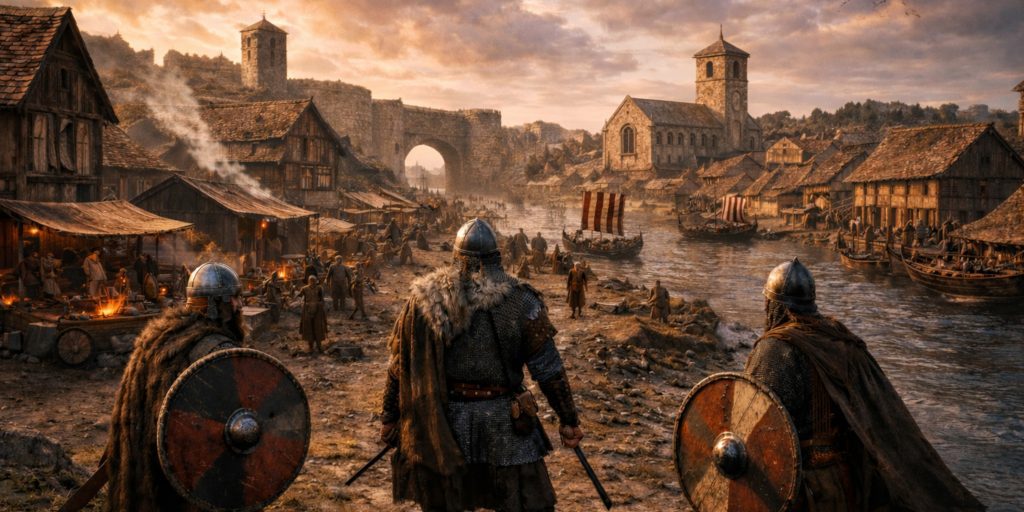
Not every important settlement was a royal capital. The wider Danelaw, especially towns such as Lincoln, Leicester, Nottingham, Derby and Stamford, mattered because they represented depth of settlement. This was not one city under Norse rule. It was a whole region reshaped by Scandinavian migration, military occupation and cultural fusion.
Why the Danelaw mattered
- It established long-term Scandinavian settlement across eastern and northern England
- It altered law, language, place-names and landholding
- It provided a durable base for Viking power after the great invasions
- It blended Scandinavian and Anglo-Saxon worlds rather than keeping them neatly apart
Battles and conflict
These towns sat within the military and political contest between Viking rulers and the kings of Wessex, especially Alfred the Great and his successors. The struggle for control of fortified towns and road networks was crucial to the reconquest of English territory in the late ninth and early tenth centuries.
Archaeology
Archaeology across the Danelaw has revealed Scandinavian burial practices, distinctive artefacts, metalwork, weights, coin hoards and settlement patterns. Place-name evidence is especially powerful here. Endings such as -by and -thorpe still mark landscapes shaped by Norse settlement.
Normandy, where Vikings became Normans
Normandy deserves a place near the top because it shows what happens when Viking settlement evolves into a full political transformation. Granted to the Viking leader Rollo in the early tenth century, the region became a durable Norse principality within western Francia. Over time its rulers adopted Christianity, the French language and Frankish customs, yet they remained marked by their Scandinavian roots.
Normandy mattered not because it stayed stubbornly Viking in every detail, but because it turned Viking settlement into state-building. A century and a half later, the descendants of these settlers conquered England in 1066. That is not a footnote. That is a historical earthquake.
Why Normandy mattered
- It turned a Viking enclave into a powerful duchy
- It stabilised part of the Frankish frontier through negotiated settlement
- It became one of the most dynamic military societies in Europe
- Its legacy reached England, Sicily and the eastern Mediterranean
Battles and conflict
The settlement itself followed years of Viking attacks on the Seine region. Later Norman expansion and military culture grew from this frontier background. Without Viking settlement in Normandy, the political map of medieval Europe looks very different.
Archaeology
Archaeological evidence for early Viking Normandy is less visually dramatic than Dublin or York, but material culture, burial evidence and settlement patterns support the picture of Scandinavian presence and assimilation.
Contemporary voice
Dudo of Saint-Quentin, writing about the early Norman rulers, depicts Rollo and his successors within a Christianised political framework, though his account must be handled carefully. Still, it captures a crucial truth. The settlers were no longer simply raiders. They were rulers.
Iceland, the great Viking colony of the North Atlantic
Iceland was one of the most extraordinary Norse settlement projects. From the late ninth century, settlers from Norway and the Norse world crossed the North Atlantic and established a new society on an uninhabited island. This was colonisation in the purest sense, and it created one of the most remarkable medieval literate cultures anywhere in Europe.
Why Iceland mattered
- It showed the Vikings’ capacity for large-scale migration and colonisation
- It became the centre of saga writing and memory
- It preserved law, genealogy and oral tradition on an unusual scale
- It acted as a stepping stone to Greenland and Vinland
Battles and conflict
Iceland lacked kings, but it was hardly peaceful. The sagas preserve a world of feuds, lawsuits, revenge killings and local power struggles. Not every historical detail can be taken at face value, but the settlement era clearly involved hard bargaining over land, resources and status.
Archaeology
Excavations of longhouses, farmsteads and assembly sites have given us a vivid picture of early Icelandic life. The site of Þingvellir, associated with the Alþing, speaks to the political sophistication of the colony. This was not a crude survival camp. It was a functioning settler society with legal institutions.
Contemporary voice
Ari Þorgilsson’s Íslendingabók presents the settlement of Iceland as an ordered process of colonisation and law-making. Even allowing for later shaping, it remains one of the key written windows into how Icelanders understood their origins.
Greenland, the edge of the Viking world
Greenland was more precarious than Iceland, but its importance is immense. Settled from Iceland in the late tenth century, it became the westernmost durable outpost of the Norse world. The Eastern and Western Settlements were never large, but they linked Europe to the far North Atlantic and served as the launching point for exploration farther west.
Why Greenland mattered
- It showed the outer limits of sustainable Viking colonisation
- It connected the Norse world to Arctic resources, especially walrus ivory
- It served as the base for voyages toward North America
- It tested how far Scandinavian farming culture could be transplanted
Battles and conflict
Greenland was less defined by warfare than by hardship. Its true enemy was environment, distance and long-term fragility. That sounds less cinematic than a shield wall, but it can be more decisive.
Archaeology
Ruined churches, farmsteads and animal remains have helped reconstruct daily life and eventual decline. Archaeology suggests a community that maintained European links while adapting, imperfectly, to a harsh environment. The settlements eventually vanished, and that disappearance remains one of the great historical puzzles of the North Atlantic.
L’Anse aux Meadows, the Viking foothold in North America
No list like this is complete without L’Anse aux Meadows in Newfoundland. This is the clearest archaeological evidence of Norse presence in North America, and that alone makes it one of the most important Viking sites outside Scandinavia.
It was not a vast colony. It was probably a small base, perhaps for repair, exploration or seasonal occupation. But its significance is colossal. It proves that Norse voyagers crossed the Atlantic and reached the Americas centuries before Columbus.
Why L’Anse aux Meadows mattered
- It is the first confirmed European site in North America before Columbus
- It proves the westward reach of Viking exploration
- It links archaeology with the Vinland sagas in a striking way
- It expands the geographic scale of the Viking world beyond what older historians once accepted
Battles and conflict
The Vinland sagas describe tensions and clashes with indigenous peoples, though the literary and historical details remain debated. Even so, the wider point stands. Norse expansion had reached a point where it encountered entirely new worlds and peoples.
Archaeology
Excavations revealed turf buildings, iron-working evidence and unmistakably Norse construction techniques. This is the hard evidence that shifted Vinland from saga curiosity to archaeological fact.
Orkney and the Northern Isles, the Norse hinge of the North Atlantic

Orkney, and more broadly the Northern Isles, were among the most strategically important Viking settlements outside Scandinavia. They sat between Norway, Scotland, Ireland, the Hebrides, Iceland and the Atlantic routes westward. Whoever held Orkney held a maritime crossroads.
Why Orkney mattered
- It became the seat of a Norse earldom
- It linked Scandinavian power to Scotland and the western seas
- It served as a base for raiding, trade and political expansion
- It remained culturally Norse for centuries
Battles and conflict
The earls of Orkney were deeply involved in Scottish, Irish and Norse politics. Power here was never static. Rivalries, sea warfare and overlapping claims made the islands central to wider struggles in the North Atlantic zone.
Archaeology
Norse farmsteads, burials and later monumental sites such as St Magnus Cathedral reflect a deep and lasting Scandinavian presence. The archaeology of the Northern Isles reveals settlement, not mere raiding.
Contemporary voice
The Orkneyinga Saga presents the earldom as a serious political world with its own rivalries, loyalties and ambitions. Like all saga material, it needs careful handling, but it preserves the memory of Norse rule in the isles with unusual richness.
The Hebrides and the Irish Sea world
The Hebrides, the Isle of Man and the wider Irish Sea zone formed another crucial Viking settlement sphere. These places mattered because they connected Dublin, western Scotland, northern England and routes into the Atlantic. Control here was fluid, often shared or contested between Norse-Gaelic rulers, local dynasties and Norwegian kings.
Why this region mattered
- It linked multiple Viking settlement zones into one maritime network
- It fostered mixed Norse-Gaelic political cultures
- It supported trade, war fleets and dynastic power
- It shaped the medieval history of Scotland, Ireland and Man
Battles and conflict
Sea power was everything here. Naval mobility, island bases and political marriages mattered as much as battlefield victories. The region’s history is a reminder that Viking expansion was as much about controlling seaways as conquering land.
Archaeology
Burials, hogback stones, sculpture, place-names and settlement remains reveal a deeply entangled Norse-Gaelic world. This was not simple replacement. It was fusion.
What archaeology tells us about Viking settlement
Archaeology has changed the story profoundly. Older popular images leaned too heavily on raids and sudden violence. Excavations at places such as York, Dublin, Icelandic farmsteads, Greenland and L’Anse aux Meadows show something broader and far more interesting.
They show traders, craftspeople, ship-repairers, settlers, law-makers and farmers. They show urban streets, workshops, imported goods, hybrid cultures and long-term adaptation. They also show that Viking expansion was uneven. Some settlements flourished for centuries. Others were fragile and short-lived.
That unevenness matters. The Vikings were bold, but not magical. Settlement succeeded where trade, geography and political conditions allowed it. It failed where distance, climate or local resistance made permanence too costly.
The most important battles linked to Viking settlements
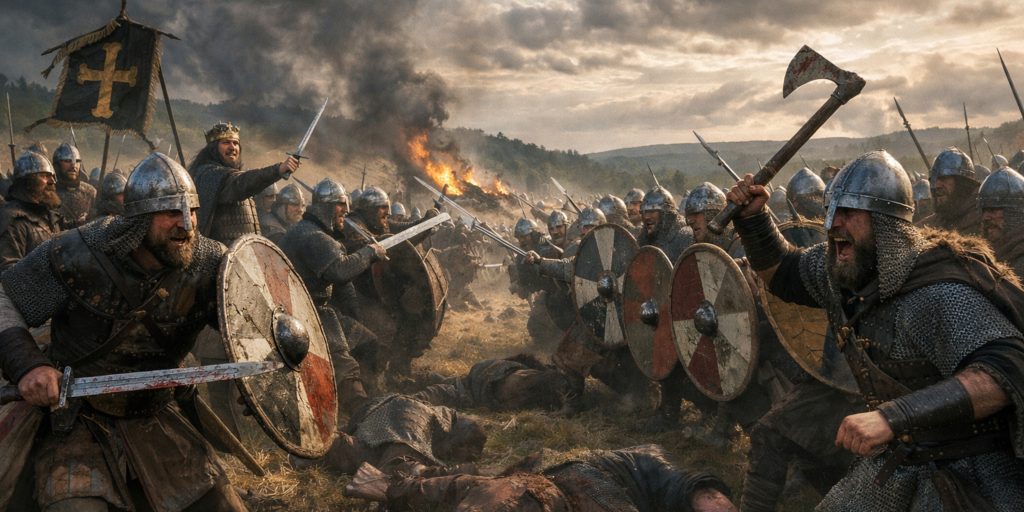
A settlement could not survive without force behind it, and many of the most important Viking centres were shaped by war.
Key examples
- York, 866: the seizure of York helped establish Jórvík as a Viking capital in England
- Clontarf, 1014: Dublin’s Norse rulers and allies were central to one of the most famous battles in Irish history
- The wars of Alfred and his successors: these campaigns determined whether the Danelaw would remain politically separate
- Frankish struggles on the Seine: these conflicts set the stage for the creation of Normandy
- Orkney and Irish Sea rivalries: control of island settlements shaped wider regional politics
The settlement map and the battle map often overlap. That is not an accident. Viking towns and colonies were valuable precisely because they gave military power something solid to stand on.
Contemporary quotes and how to read them
Contemporary and near-contemporary sources are indispensable, but they need careful handling. Monks usually wrote about Vikings when those Vikings were ruining their day, so the tone is rarely affectionate. English and Irish annals speak in the language of shock, punishment and catastrophe. Saga texts, written later, often preserve genuine traditions but also shape the past into memorable narrative.
That does not make them useless. Quite the opposite. It makes them human.
One of the strengths of the Anglo-Saxon Chronicle is its stark brevity. One of the strengths of the Irish annals is their immediacy. One of the strengths of the sagas is that they remember people as personalities rather than as statistics. Put together, they help us see Viking settlements not just as dots on a map, but as places where fear, ambition, commerce and adaptation collided.
Takeaway
The most important Viking settlements outside Scandinavia were not just places where Norse people happened to stop for a while. They were the engines of expansion. Dublin and Jórvík became urban powerhouses. The Danelaw remade much of England. Normandy turned settlers into state-builders. Iceland and Greenland pushed colonisation into the North Atlantic. L’Anse aux Meadows proved that the Viking world reached North America. Orkney, the Hebrides and the Irish Sea settlements tied the whole western network together.
That is the real scale of the Viking achievement. They were not simply raiders appearing from nowhere. They were settlers, rulers and organisers of remarkably wide horizons. Brutal, certainly. Adaptive, absolutely. And impossible to confine neatly to Scandinavia once they started moving.
History rarely rewards neatness anyway.