Xena carried a sword, whip and an impressive supply of concealed knives, but none of them defined her quite like the chakram. The circular weapon could disarm a soldier, cut through a rope, ricochet around a room and return neatly to her hand. Physics was invited to watch from a safe distance.
Across the six seasons of Xena: Warrior Princess, the chakram developed from a clever visual signature into an important part of Xena’s identity. It was connected to her violent past, her attempt at redemption and, eventually, the balance between the darker and lighter parts of her character.
Its appearance was loosely inspired by a genuine Indian weapon, although the television version cheerfully ignored most of the historical rules. Here is how Xena’s chakram worked, why its design changed and what separated it from the real weapon.
Xena’s Chakram at a Glance
| Feature | Xena’s chakram |
|---|---|
| Weapon type | Fictional bladed throwing ring |
| Main user | Xena |
| First appearance | Hercules: The Legendary Journeys |
| Primary design | Circular metal ring with a decorated crosspiece |
| Later design | Combined yin-yang chakram |
| Abilities | Cutting, ricocheting, disarming and returning to the thrower |
| Close-combat use | Blocking, striking and trapping weapons |
| Historical inspiration | The Indian chakram or chakar |
| Series | Xena: Warrior Princess |
| Original run | 1995 to 2001 |
What Is Xena’s Chakram?
Xena’s chakram is a circular bladed weapon carried at her hip. She normally throws it by gripping the crosspiece inside the ring, sending it spinning towards a target.
Once airborne, it behaves like a combination of throwing knife, boomerang, buzz saw and extremely obedient dog. It can strike several objects during one throw before returning to Xena, who catches it without losing any fingers. This final detail may be the least realistic part of the whole arrangement.
The chakram can be used to:
- Cut ropes, chains and wooden supports
- Knock weapons from an opponent’s hand
- Deflect arrows and other projectiles
- Strike several enemies in sequence
- Trigger switches or knock objects into position
- Disable opponents without killing them
- Attack at close range
- Block or trap swords during combat
Its accuracy depends heavily on Xena’s skill. Other characters can throw or wield it, but very few can reproduce her elaborate ricochets. The weapon therefore feels less like a magical automatic targeting system and more like a fantasy tool that rewards exceptional judgement.
That distinction matters. Xena is dangerous because she understands angles, timing and movement. The chakram simply allows the programme to exaggerate those talents until geometry starts looking nervous.
The Original Chakram
The original weapon is sometimes described by fans as the Dark Chakram, particularly after the series introduces its counterpart, the Chakram of Light.
It has a steel-coloured outer ring and an intricate gold-coloured crosspiece. The design is immediately readable on screen, even during fast action sequences. Its circular silhouette also distinguishes Xena from the many fantasy heroes carrying swords, axes or bows.
This first chakram is closely associated with Xena’s earlier life as a warlord. It is practical, severe and capable of lethal force, but Xena increasingly uses it with restraint. She might cut a belt, remove a weapon or drop a convenient object onto an attacker instead of slicing through the attacker directly.
That flexibility suits her redemption story. Xena remains exceptionally good at violence, but the interesting question is how she chooses to apply it.
How the Chakram Was Broken
The original chakram is shattered by Callisto during the fourth-season episode “The Ides of March.”
At this point, Callisto has become an angel and acts against Xena in a confrontation shaped by divine forces. The destruction of the weapon accompanies one of the bleakest moments in the series, when Xena and Gabrielle are captured and crucified.
Breaking the chakram works on more than a practical level. Xena’s familiar weapon, confidence and physical power are all stripped away at once. The series was never especially shy about symbolism. If it could add crucifixion, reincarnation and a shattered signature weapon to the same sequence, it absolutely would.
The Chakram of Light
The fifth-season episode “Chakram” introduces a second weapon known as the Chakram of Light.
After returning from death, Xena has lost her memories of being a warrior. Ares and another god of war, Kal, both want the new chakram, believing it can kill gods. Xena eventually retrieves the weapon from a temple.
The Chakram of Light represents purity and divine power, but it is incomplete as a reflection of Xena. A completely peaceful Xena is compassionate, yet she lacks the harder instincts needed to defend herself and Gabrielle.
The solution is not to discard her darkness. Instead, the two chakrams are joined.
The Yin-Yang Chakram Explained
When the Chakram of Light is placed beside the broken halves of Xena’s original weapon, they combine to create the yin-yang chakram.
The new version has two curved halves, one light and one dark, locked together in a circular design. Xena can use it as a single throwing weapon or separate it into two pieces for close combat.
Its abilities include:
- Splitting into two curved blades
- Reconnecting after being thrown
- Striking separate targets during the same attack
- Blocking swords in close combat
- Trapping or controlling an opponent’s weapon
- Retaining the ricochet abilities of the original chakram
The yin-yang design is hardly subtle, but subtlety was never the reason anyone watched Xena. It expresses one of the programme’s central ideas with admirable clarity: Xena cannot become whole by pretending her past never happened.
Her compassion and aggression exist together. The darker half gives her strength and survival instinct, while the lighter half guides what she does with them. It is character development rendered as a highly throwable piece of metal.
Was Xena’s Chakram Magical?
The series never treats the original chakram as an entirely conventional weapon, but its exact powers remain flexible.
Xena often appears to calculate its flight path through experience and remarkable spatial awareness. She can predict ricochets, adjust her throw and position herself for its return. Some scenes therefore present its performance as an extension of her training.
Other feats are harder to explain without magic. The chakram can maintain speed after multiple impacts, change direction at improbable angles and cut through materials that should stop it immediately. The later yin-yang version has a clearer supernatural origin and can separate and reform in ways no ordinary object could manage.
The fairest explanation is that Xena combines extraordinary skill with a weapon possessing supernatural qualities. Precisely where skill ends and magic begins depends on the needs of that week’s episode. This was 1990s fantasy television, not an engineering hearing.
How Xena Used the Chakram
The most memorable chakram scenes are often not the most destructive. They are the sequences in which Xena turns a chaotic environment into a puzzle.
She might bounce the weapon from a wall to a shield, sever a rope and bring part of the scenery crashing down. A single throw could release prisoners, disarm guards and return to her hand before anyone had properly processed what had happened.
This made the weapon useful for television storytelling. A sword fight generally requires Xena to reach an enemy. The chakram allowed her to influence several points within a scene almost instantly.
It also gave action sequences a playful quality. Viewers could follow the route of the weapon and anticipate what it might hit next. The throw became a miniature chain reaction, usually followed by a room full of defeated men reconsidering their career choices.
The Chakram in Close Combat
Although primarily a throwing weapon, the chakram was regularly used at close range.
Xena could grip its internal crosspiece and use the outer ring to block attacks. Its shape allowed her to catch blades, hook weapons and strike with either side. The yin-yang version expanded these possibilities by separating into two curved hand weapons.
As a real fighting system, this would present some rather immediate problems. A sharpened ring provides few safe gripping options, while catching a sword against it would transfer considerable force into the user’s hand and wrist.
On screen, however, its shape produces an unusual fighting style. Xena does not simply exchange sword blows. She redirects attacks, locks weapons and moves between defence and offence quickly. It feels precise and slightly theatrical, which is a fairly accurate description of the series itself.
Is Xena’s Chakram Based on a Real Weapon?
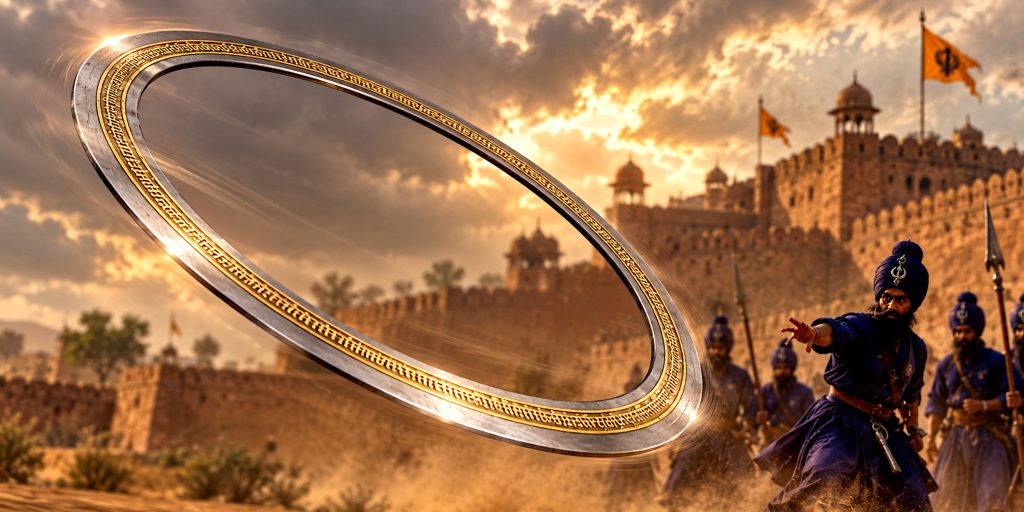
Yes, but only loosely.
The historical chakram, also called a chakar or war quoit, is a circular throwing weapon from the Indian subcontinent. It is particularly associated with Sikh warriors, including the Nihangs.
Historical examples are usually flat steel rings with sharpened outer edges. They were designed to be thrown with a spinning motion and could be carried on the arms, around the waist or attached to a tall turban.
The comparison is clear, but the television weapon differs substantially.
| Feature | Historical chakram | Xena’s chakram |
|---|---|---|
| Construction | Flat steel ring | Decorated ring with an internal crosspiece |
| Cultural association | Indian and Sikh martial traditions | Fictional ancient world |
| Method of use | Thrown with a spinning motion | Thrown by gripping the central handle |
| Return flight | Does not return | Regularly returns to Xena |
| Ricochets | Not a standard function | Central to its on-screen use |
| Close combat | Primarily a projectile | Frequently used for blocking and striking |
| Supernatural abilities | None | Present or strongly implied |
| Splitting mechanism | None | Later divides into two blades |
Calling Xena’s weapon a faithful historical chakram would be generous. It borrows the circular form and name, then adds a central grip, returning flight and enough impossible rebounds to upset a snooker table.
The real weapon deserves to be understood on its own terms rather than treated as a primitive version of the television prop. Historical chakrams were specialised projectiles connected to distinct martial traditions, not bladed boomerangs.
Could Xena’s Chakram Work in Real Life?
Not as depicted.
A real metal ring can be thrown effectively, but it will not rebound repeatedly while preserving a predictable flight path. Every collision alters its speed, spin and direction. Hard impacts can also damage or deform the weapon.
The returning flight creates further problems. A boomerang relies on an aerodynamic profile that generates lift as it rotates. A heavy sharpened ring is designed to travel towards a target, not curve safely back to the person who threw it.
Several aspects of Xena’s version are especially unlikely:
- Reliable rebounds from irregular surfaces
- Cutting through thick materials without losing momentum
- Returning after striking multiple targets
- Safe catches of a fast-moving sharpened edge
- Splitting and reconnecting during flight
- Consistent control inside crowded spaces
A foam replica can imitate the shape safely, but a functional sharpened version would be extremely dangerous. Trying to reproduce Xena’s catches would be an efficient way to become less good at counting to ten.
How the Chakram Effects Were Created
The chakram’s on-screen movement was produced through a combination of physical props, performance, editing, wire work and visual effects.
Different versions of a hero weapon are commonly required during television production. Detailed props can be used for close shots, while lighter stunt versions allow actors and performers to handle the object more safely during action scenes.
For Xena, the final illusion depended on several elements:
- Lightweight props for physical handling
- Detailed versions for close-up photography
- Carefully choreographed throwing and catching movements
- Off-screen assistance or wire work where required
- Sound effects that made every flight instantly recognisable
- Optical and digital effects to create impossible trajectories
- Editing that connected the throw, impact and return
The sound design deserves particular credit. Viewers often hear the chakram before fully seeing it. Its metallic whir announces that Xena has acted and someone’s weapon, belt or carefully arranged escape plan is about to suffer.
The existing article attributes specific quotations and construction details to members of the production team without providing reliable sourcing. Those claims are better omitted unless they can be traced to a published interview, commentary track or production archive.
Why the Chakram Suited Xena
A signature weapon works when it tells us something about the person carrying it. The chakram does this remarkably well.
It rewards control rather than brute strength. Xena must read the environment, anticipate movement and make decisions several steps ahead. The weapon can kill, but it can also rescue, interrupt or disarm. Its effect depends on her intent.
It also reflects her tendency to operate outside conventional heroic roles. Xena was neither a spotless champion nor a traditional fantasy princess. Giving her another sword would have worked, but it would not have said much. Giving her a weapon that no one else could properly use made her silhouette, combat style and personality immediately recognisable.
The later yin-yang form develops that connection further. Xena’s strength does not come from becoming purely good. It comes from accepting the whole of herself and choosing what to do next.
For a show that also featured musical episodes, body swaps and a suspicious number of lookalikes, that is a surprisingly thoughtful piece of weapon design.
The Chakram’s Best Episodes
Several episodes are particularly important to the history of the weapon.
“Sins of the Past”
The first episode of Xena: Warrior Princess establishes the chakram as part of Xena’s standard equipment and visual identity.
“Callisto”
Callisto’s ability to challenge Xena makes any exchange involving the chakram feel more dangerous. She is one of the few opponents capable of turning Xena’s own skills and symbols against her.
“A Solstice Carol”
The chakram is briefly taken and used as part of the episode’s decorations, showing that even Xena’s most dangerous possession could be recruited for seasonal cheer.
“The Ides of March”
Callisto shatters the original chakram during the confrontation that leads to Xena and Gabrielle’s crucifixion.
“Chakram”
This fifth-season episode introduces the Chakram of Light and combines it with the broken original to create the yin-yang weapon.
“Motherhood”
The enhanced chakram plays a role during Xena’s conflict with the Olympian gods, demonstrating that the later weapon operates on a distinctly supernatural level.
Replicas and Collecting Xena’s Chakram
Xena chakram replicas range from lightweight costume accessories to detailed display pieces and production-made props.
Collectors should distinguish between four broad categories:
| Type | What to expect |
|---|---|
| Costume replica | Lightweight plastic or foam intended for cosplay |
| Fan-made display piece | Custom resin, aluminium or metal construction |
| Licensed replica | Commercial product released under an official licence |
| Production-made prop | Item manufactured for or used during filming |
Prices vary considerably according to material, condition, maker, documentation and provenance. Production-connected props can command far more than ordinary replicas, but vague claims such as “screen used” should never be accepted without evidence.
Before buying, check:
- Whether the replica is officially licensed
- Its diameter, weight and construction material
- Whether the edges are sharp or safely blunted
- The quality of the central decoration
- Whether a stand or wall mount is included
- The seller’s photographs and returns policy
- Documentation supporting any production claim
- The chain of ownership for expensive props
Certificates of authenticity are useful, but only when issued by a credible studio, auction house or recognised production source. A certificate created by the seller proves mainly that the seller owns a printer.
Metal display replicas should never be thrown. Even a blunt ring can cause serious injury and damage.
Why Xena’s Chakram Remains So Memorable
Plenty of fantasy weapons are larger, more elaborate or covered in considerably more glowing runes. Few are as closely linked to one character.
The chakram gave Xena: Warrior Princess a visual idea that could be understood in seconds. Xena throws it, the weapon takes a wildly optimistic route through the scenery, several opponents lose their weapons and it returns to her hand. Job done.
Yet its appeal goes beyond spectacle. The weapon changes alongside Xena. Its destruction marks the collapse of her old identity, while its rebirth as a combination of light and darkness reflects a more complete understanding of who she is.
That is why the chakram still works as a symbol of the series. It is stylish, slightly ridiculous and much smarter than it first appears. Rather like Xena: Warrior Princess itself.
Frequently Asked Questions
What is Xena’s weapon called?
Xena’s circular throwing weapon is called a chakram. Its design was loosely inspired by historical Indian throwing rings, although the television version has numerous fictional abilities.
Does Xena’s chakram return like a boomerang?
Yes, the chakram usually returns to Xena after being thrown. This is a fictional ability and is not shared by historical chakrams.
Who broke Xena’s original chakram?
Callisto shattered the original weapon in the fourth-season episode “The Ides of March.”
Why did Xena’s chakram change?
The broken original was combined with the Chakram of Light in the fifth-season episode “Chakram.” The resulting yin-yang weapon represented the balance between Xena’s light and dark sides.
Can the yin-yang chakram split in two?
Yes. Xena can divide the later chakram into two curved weapons for close combat or separate attacks.
Is a chakram a real weapon?
Yes. Historical chakrams are steel throwing rings associated particularly with Indian and Sikh martial traditions. They do not return to the thrower or perform controlled ricochets.
Could you throw a Xena replica?
Foam cosplay versions may be suitable for carefully controlled prop use, depending on event rules. Metal, resin and hard plastic replicas should be treated as display pieces and never thrown.