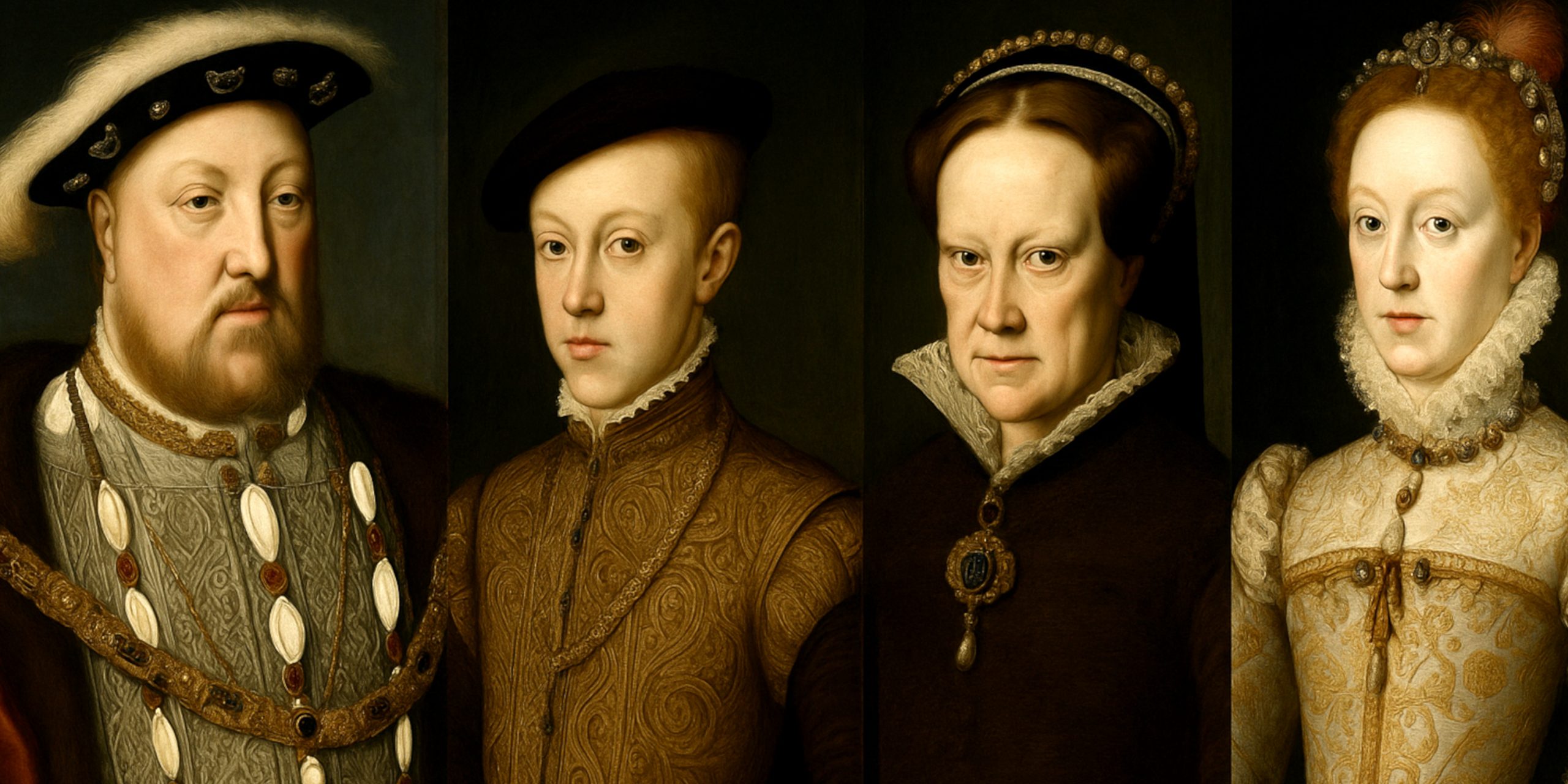
The Tudor dynasty remains one of the most recognisable royal houses in European history. Born in blood and ended in brilliance, it lasted just over a century, from 1485 to 1603. It was a dynasty forged by war, defined by reform, and obsessed with legitimacy. Each monarch left their own imprint on England’s identity, from Henry VII’s cautious pragmatism to Elizabeth I’s defiant majesty.
As a historian, I’ve always found the Tudors oddly human. Beneath the regal portraits and Latin mottos lie anxiety, fear, and an almost theatrical awareness of legacy. Their reigns were political chess games fought not only with swords and cannons but with marriages, manuscripts, and sermons.
1. Henry VII (1485–1509)
The Founder and Survivor
Henry Tudor seized the crown at Bosworth Field, ending the Wars of the Roses by defeating Richard III. His claim was shaky, but he understood that peace would depend on patience and propaganda.
Arms and Armour
Henry VII inherited a war-weary England. Armour of his time reflected transition, with the full Gothic plate of the 15th century giving way to the early Tudor style, influenced by Italian design. His personal armour, kept at the Royal Armouries, Leeds, shows a more slender silhouette, prioritising movement over bulk.
Battles and Military Acumen
Though he came to power through battle, Henry preferred treaties to swords. His major conflicts were internal uprisings, notably the Lambert Simnel and Perkin Warbeck rebellions. Both he crushed with precision and caution, ensuring his dynasty survived infancy.
Where to See Artefacts
- Henry VII Chapel, Westminster Abbey: His tomb, a masterpiece of Renaissance bronze and marble.
- Royal Armouries, Leeds: Features arms typical of his reign.
- National Portrait Gallery, London: The earliest surviving likeness of Henry, painted from memory.
Latest Archaeology
Recent studies of the Bosworth battlefield have shifted its location slightly southwest, revealing artillery fragments that illuminate how Tudor tactics evolved with gunpowder warfare.
2. Henry VIII (1509–1547)
The Warrior King Turned God’s Anointed Tyrant
Henry VIII’s reign began with charm and ended with tyranny. He broke with Rome, redefined monarchy, and left six wives and a fractured nation.
Arms and Armour
No Tudor king was more obsessed with martial display. His Greenwich Armoury produced some of the finest suits ever made in England. His tournament armour at the Tower of London, embossed with gold and engraved with Tudor roses, stands as testament to his vanity and strength.
Battles and Military Acumen
Henry dreamt of conquest. His campaigns in France, including the Battle of the Spurs (1513), were as much about glory as gain. He also oversaw the construction of England’s first standing navy, a legacy that would outlive him by centuries. His flagship, the Mary Rose, now restored in Portsmouth, is a haunting window into his ambitions and failures.
Where to See Artefacts
- The Mary Rose Museum, Portsmouth: Thousands of artefacts from Henry’s warship, from longbows to combs.
- Tower of London Armoury: Several of Henry’s personal armours.
- Hampton Court Palace: A living echo of Tudor power, filled with the king’s ghostly presence.
Latest Archaeology
Excavations of the Mary Rose have transformed our understanding of Tudor naval life. From skeletal remains to weapon stores, the finds tell of a diverse, disciplined crew and England’s maritime awakening.
3. Edward VI (1547–1553)
The Boy King and the Protestant Blueprint
Edward VI, Henry’s son by Jane Seymour, was only nine when he became king. His reign, though short, cemented Protestantism in England.
Arms and Armour
Edward’s court continued his father’s Greenwich tradition, though the boy himself was more scholar than soldier. Armour made for him survives at the Tower of London, ornate yet small, a symbol of power he would never wield.
Battles and Military Acumen
The wars of Edward’s time were fought by regents. The Battle of Pinkie Cleugh (1547) saw the English army use modern artillery and pike formations against Scotland, an early glimpse of Tudor firepower in full maturity.
Where to See Artefacts
- Tower of London: Armour and portraits of the young king.
- National Portrait Gallery: His coronation portrait, painted to project adult gravitas on a fragile child.
Latest Archaeology
Excavations in Somerset have revealed traces of military camps from the 1540s, offering insight into the musters raised for campaigns under the Duke of Somerset.
4. Mary I (1553–1558)
The Return to Rome
Mary’s reign is remembered for the fires of Smithfield and her attempt to undo her father’s Reformation. Yet she was not a caricature of cruelty but a deeply principled, tragic monarch.
Arms and Armour
The military aesthetic of her era leaned toward the Spanish style, reflecting her marriage to Philip II. Armour was richly etched, often bearing Catholic iconography, a clear expression of religious identity.
Battles and Military Acumen
Mary’s marriage alliance with Spain pulled England into continental conflict. The loss of Calais in 1558, England’s last possession in France, was a devastating symbolic blow. She was not a military strategist, but she understood the political power of armed loyalty, keeping the navy modernised for defence.
Where to See Artefacts
- Westminster Abbey: Her tomb lies beneath that of her half-sister Elizabeth, an irony of English history.
- British Museum: Coins and seals from her reign, showing her crowned beside Philip.
Latest Archaeology
Research into the Calais garrison has unearthed evidence of the city’s final siege. Artillery fragments and walls scorched by bombardment tell a story of desperation and imperial decline.
5. Elizabeth I (1558–1603)
The Virgin Queen and England’s Golden Age
Elizabeth I transformed insecurity into empire. Her reign blended diplomacy, spectacle, and steel, marking England’s entry into modernity.
Arms and Armour
The Elizabethan era prized ornate pageantry. Suits of armour from her court were less for battle and more for ceremony, gilded and etched with classical motifs. The Tilbury portrait shows her in armour-like dress, a symbol of female authority forged in a masculine world.
Battles and Military Acumen
Elizabeth’s greatest military test came with the Spanish Armada in 1588. Her rousing speech at Tilbury, delivered in armour, remains one of the most iconic moments in royal history. She understood strategy as theatre, using limited means to achieve maximum morale. Beyond that, her support for privateers like Francis Drake blurred the line between commerce and warfare.
Where to See Artefacts
- National Maritime Museum, Greenwich: Maps, navigational instruments, and relics from the Armada.
- Hatfield House: Personal letters and portraits of Elizabeth in her youth.
- Westminster Abbey: Her grand tomb, flanked by effigies of peace and plenty.
Latest Archaeology
Recent underwater finds off the coast of Ireland include fragments from Armada wrecks, offering new insight into the Spanish campaign’s logistics and failures. Elizabeth’s own palaces, like Greenwich and Richmond, continue to yield artefacts showing the opulent domestic world behind the iron crown.
The Tudor Legacy
The Tudors began as usurpers and ended as legends. Their century of rule transformed England from a medieval kingdom into a confident nation-state. They weaponised image, faith, and authority in ways that would echo for centuries.
As a historian, I find their story both cautionary and magnetic. Power, when wrapped in pageantry and paranoia, creates figures too human to forget. The Tudor monarchs were not gods, but mortals who wore divinity like armour, brilliant, flawed, and unforgettable.
Watch the documentary: