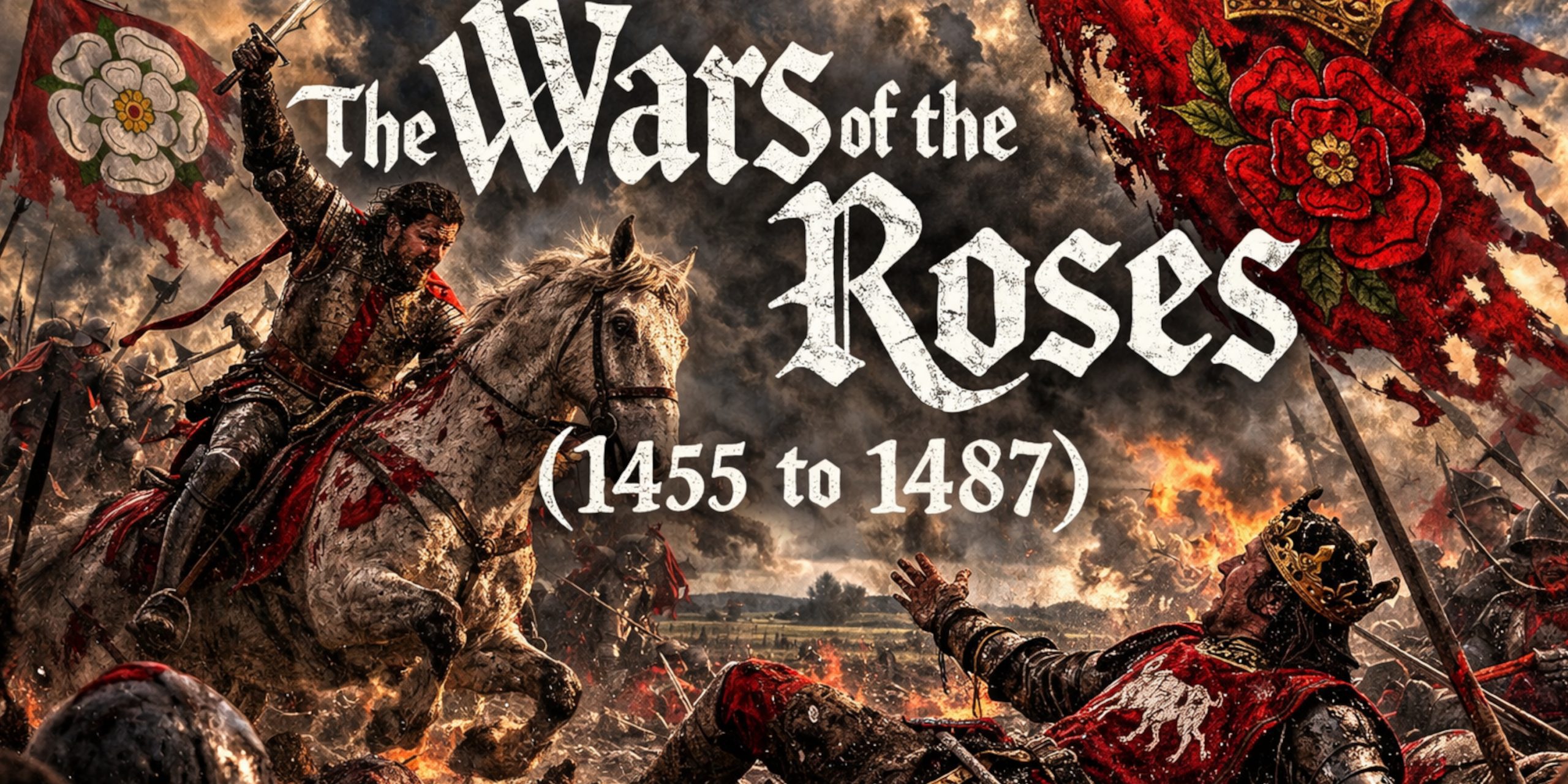
The Wars of the Roses were not one long, tidy war with neat edges and clear moral lessons. They were a vicious, stop-start dynastic struggle fought across England between rival branches of the Plantagenet royal house, the houses of Lancaster and York. The traditional dates, 1455 to 1487, are useful enough, though like most historical dates they behave rather like badly trained dogs and refuse to stay exactly where they are put.
At heart, this was a battle over kingship, legitimacy, noble power and political survival. That sounds lofty. In practice, it meant magnates raising private armies, kings being captured, heirs being declared illegitimate, and the realm being dragged through bouts of violence by men who insisted they were saving it.
For historians, the appeal is obvious. The period has everything: weak kings, ruthless queens, shifting loyalties, battlefield drama, legal sleight of hand, propaganda, and enough family bitterness to make any modern inheritance dispute look positively civilised.
Origins of the conflict
The roots of the Wars of the Roses lay deep in the instability of the late Plantagenet monarchy. Edward III had produced a large royal family, which in one sense was a blessing and in another a future national emergency. By the fifteenth century, rival lines descending from his sons could press claims to the throne, especially once royal authority weakened.
The immediate problem was the reign of Henry VI, a king whose piety was genuine but whose political effectiveness was painfully limited. He inherited the throne as an infant, lost most of England’s hard-won lands in France, and suffered bouts of mental collapse. A kingdom can survive a child king. It can survive military defeat. It struggles rather more when the adult monarch cannot consistently govern and rival elites begin circling each other like armed lawyers.
Henry’s inability to command consensus opened the door for Richard, Duke of York, who had a strong royal bloodline and an equally strong sense that other people were running the kingdom badly. He was not entirely wrong. Factional rivalry at court, resentment against royal favourites, financial strain, local feuds and the aftershocks of the Hundred Years’ War all combined to turn political tension into open conflict.
Why the crown became contested
The central issue was not simply who had the best blood claim, though that mattered. It was who could actually rule, command support, and survive.
Lancastrian kings descended from John of Gaunt, Edward III’s third surviving son. The Yorkist claim drew strength from descent through both Edmund of Langley, Edward III’s fourth surviving son, and the line of Lionel of Antwerp, the second surviving son, through the Mortimers. In strict hereditary terms, the Yorkist case could be presented as stronger. In practical politics, hereditary logic was only part of the story. The English crown was not awarded by a calm panel of constitutional referees. It was held by whoever could combine legitimacy, force, elite backing and luck.
That was the difficulty. Henry VI had title, but not strength. Richard of York had pedigree and ambition, but not a settled right. Once that balance broke, compromise became harder. After York’s death, his son would pursue the claim far more successfully as Edward IV.
The houses of Lancaster and York
The red rose of Lancaster and the white rose of York are famous symbols now, though the conflict was not always experienced in those simple heraldic terms by contemporaries. Modern memory likes clean branding. Medieval politics was messier.
Lancaster stood behind Henry VI, Queen Margaret of Anjou, and later Henry Tudor’s cause in a broader anti-Yorkist sense.
York was led first by Richard, Duke of York, then by his son Edward IV, and later by Richard III.
Many nobles changed sides at different moments, not always because they were cynics, though there were enough cynics to furnish several reigns. Survival, local interests, marriage ties, patronage and immediate military pressure often mattered more than abstract devotion to a coloured flower.
The first phase of war
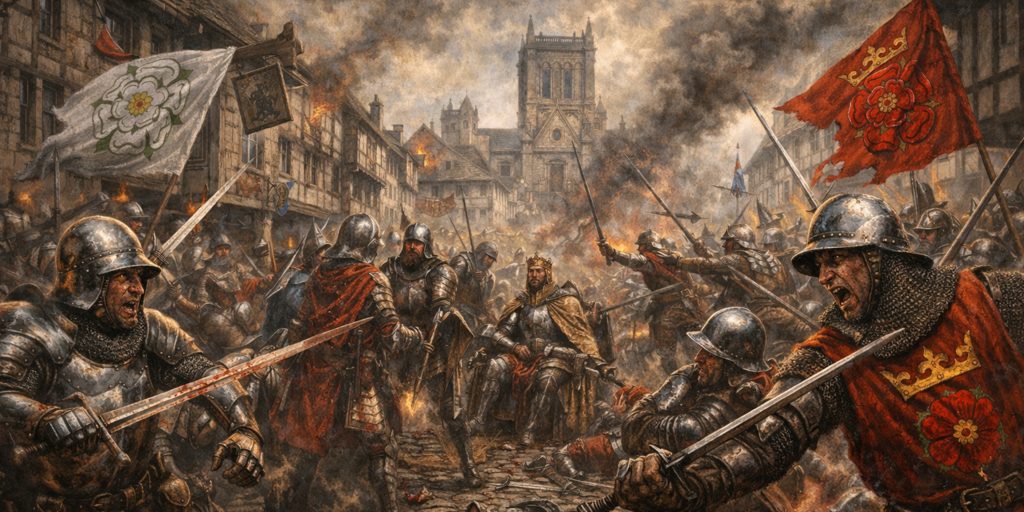
Open conflict began in 1455 at the First Battle of St Albans. Yorkist forces defeated the king’s party, and several leading Lancastrian nobles were killed. This was a sharp political shock. England had seen rebellion before, but now royal politics had become a matter for pitched battle.
The years that followed were unstable rather than continuously warlike. There were attempts at reconciliation, temporary settlements and recurring collapses into violence. One of the most significant developments came in 1460, when the Yorkists captured Henry VI at Northampton and forced the Act of Accord, which recognised Richard of York as Henry’s heir, disinheriting the king’s own son, Edward of Westminster. This was not likely to soothe Queen Margaret, and indeed it did not.
Later that year, Richard of York was killed at Wakefield. His death might have ended the movement, but instead it hardened it. His son Edward took up the cause with energy, military skill and, crucially, a much stronger instinct for kingship.
Edward IV and Yorkist triumph
Edward IV was one of the most formidable figures of the age. Tall, charismatic, politically flexible when necessary, and dangerous in battle, he was exactly the sort of king the Yorkist cause needed after the rather more austere Richard of York.
In 1461, after the bloody Yorkist victory at Towton, Edward seized the throne. Towton has often been described as the largest and bloodiest battle fought on English soil, and while figures are debated, there is no question that it was catastrophic in scale and ferocity.
Henry VI and Margaret of Anjou remained threats, but Edward’s kingship gradually strengthened. For a time, it looked as if the Yorkist settlement might hold. It did not, because this is the Wars of the Roses, and stability was apparently considered bad form.
The great internal rupture came from Edward’s relationship with Richard Neville, Earl of Warwick, the famous “Kingmaker.” Warwick had helped place Edward on the throne, but later fell out with him over policy, patronage and Edward’s marriage to Elizabeth Woodville. Warwick turned against Edward, restored Henry VI briefly in 1470 to 1471, and then was killed at Barnet in 1471. Shortly after, the Lancastrian heir Edward of Westminster died at Tewkesbury, and Henry VI also died in the Tower of London soon after, almost certainly murdered.
By 1471, the main Lancastrian line had effectively been broken.
Richard III and the last crisis
The final phase of the conflict centres on Richard III, one of the most argued-over kings in English history, which is saying something in a country that has produced no shortage of contentious monarchs.
When Edward IV died in 1483, his son became Edward V, still a boy. Richard, Duke of Gloucester, was appointed Protector. Within months, Edward IV’s children were declared illegitimate on the grounds of their father’s alleged precontract, and Richard took the crown as Richard III.
This remains one of the most controversial political seizures in English history. The disappearance of the Princes in the Tower, Edward V and his brother Richard, Duke of York, permanently darkened Richard’s reputation. Whether he ordered their deaths remains unproven beyond all doubt, but contemporaries were certainly capable of believing the worst, and that mattered politically.
Richard was a capable soldier and serious ruler in some respects, yet his hold on power was brittle. In 1485, Henry Tudor invaded, defeated Richard at Bosworth, and became Henry VII. Two years later, the Yorkist challenge was finally crushed at Stoke Field in 1487, often treated as the last battle of the Wars of the Roses.
The major battles
St Albans, 1455
The First Battle of St Albans marked the beginning of armed dynastic conflict. It was short, sharp and politically explosive. Yorkist forces attacked the royal army and killed several key Lancastrian leaders. Henry VI fell into Yorkist hands.
What matters here is not just the tactical result, but the precedent. Political disagreement at the centre of government had become organised military violence.
Blore Heath, 1459
Blore Heath showed that the conflict was becoming more entrenched. The Yorkists won, but it was part of a wider spiral in which neither side could settle matters decisively.
Northampton, 1460
This was a major Yorkist success. Henry VI was captured, and the Yorkists gained the political leverage to impose the Act of Accord. Military victory here had immediate constitutional consequences.
Wakefield, 1460
A Lancastrian victory, and a devastating one for York. Richard, Duke of York, was killed, along with his son Edmund, Earl of Rutland. The Yorkist cause was shaken, but not destroyed.
Wakefield is a reminder that this was not a smooth Yorkist march to power. It was a grim and uncertain contest.
Mortimer’s Cross, 1461
Edward, Earl of March, later Edward IV, won an important victory here. The battle also became famous for the atmospheric phenomenon of a parhelion, or mock sun, which Edward turned into a sign of divine favour. Medieval kings, much like modern politicians, were not above making energetic use of symbolism when it suited them.
Towton, 1461
Towton was the defining battle of the early war. Fought in snow and bitter conditions, it ended in overwhelming Yorkist victory and secured Edward IV’s crown.
Accounts describe appalling slaughter, especially during the Lancastrian rout. Precise numbers remain debated, but the scale of death was enormous by English standards. Towton fixed the brutality of the conflict in the historical imagination.
Barnet, 1471
Barnet was confused, foggy and decisive. Edward IV defeated Warwick, who was killed in the fighting. This ended the career of the Kingmaker and restored Edward’s authority.
Few periods illustrate the danger of overmighty subjects better than this one. Making kings looks glamorous in retrospect. Being on the receiving end of one’s own creation, less so.
Tewkesbury, 1471
Tewkesbury broke Lancastrian hopes. Edward IV’s forces won another decisive victory, and Prince Edward of Westminster died. With the Lancastrian heir gone, Henry VI’s restoration became politically hollow.
Bosworth, 1485
Bosworth was one of the great turning points in English history. Richard III was killed in battle, Henry Tudor became Henry VII, and the Tudor dynasty began.
The battle is remembered not only for its importance but for the drama of Richard’s final charge. Later tradition embroidered much around Bosworth, but the essential fact remains: a reigning English king died fighting for his crown on the field.
Stoke Field, 1487
Often overshadowed by Bosworth, Stoke was in some ways the true military end of the wars. Henry VII defeated a major Yorkist rising backed by supporters of Lambert Simnel. It showed that Bosworth had not magically settled everything. England still needed one more hard blow before the Tudor position looked secure.
Key figures
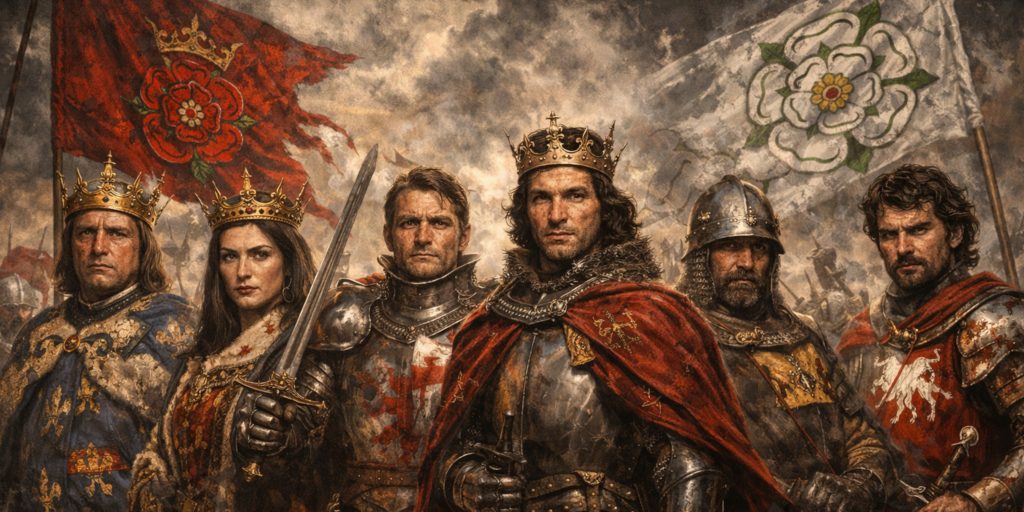
Henry VI
Pious, gentle and catastrophically unsuited to the demands of civil war. Henry’s weakness as a political ruler was one of the chief conditions that made the conflict possible.
Margaret of Anjou
One of the most formidable personalities of the age. She became the driving force of the Lancastrian cause, particularly when Henry could not rule effectively. Hostile chroniclers often painted her as unnatural or overbearing, which tells us at least as much about late medieval attitudes to female power as it does about Margaret herself.
Richard, Duke of York
The man whose challenge to Henry VI transformed crisis into dynastic struggle. He has sometimes been portrayed as either constitutional reformer or naked usurper. In truth, he was an aristocratic prince navigating a kingdom that had already become dangerously unstable.
Edward IV
Probably the ablest king produced by the conflict. Edward combined battlefield talent with political instinct and royal presence. His reign showed that Yorkist rule could be effective when held by a strong adult monarch.
Richard Neville, Earl of Warwick
The Kingmaker remains one of the most famous nobles in English history. His power was immense, but his shifting alliances also reveal the limits of magnate politics. Influence could place a king on the throne. It could not guarantee control over him.
Richard III
Still wrapped in controversy, Richard was neither the cartoon villain of Tudor propaganda nor the spotless martyr imagined by his more enthusiastic defenders. He was intelligent, militarily experienced and capable, but he took the throne in a way that damaged trust and invited rebellion. That tends to have consequences.
Henry VII
Less glamorous on the battlefield than Edward IV, perhaps, but in some ways the real winner of the age. Henry VII ended the cycle of dynastic warfare and built a more stable monarchy, though he did so with deep caution and not a little suspicion.
Warfare, armies and weapons

The Wars of the Roses were fought by retinues raised through noble affinity networks, supplemented by local levies and contracted service. This was not yet the age of massive standing armies. Much depended on personal loyalty, patronage and the ability of magnates to bring armed followers into the field.
English armies still relied heavily on the traditions honed during the Hundred Years’ War. Important features included:
- Men-at-arms fighting on foot
- Large numbers of archers using the longbow
- Bills, polearms and other staff weapons in close combat
- Command structures centred on noble households and banners
- Strong emphasis on dismounted battle lines in many engagements
Armour in this period was increasingly sophisticated. Elite men-at-arms wore high-quality plate harness, often supported by mail in vulnerable areas. Swords were sidearms rather than primary battlefield killers. In the crush of fighting, polearms, bills, axes and daggers were often more immediately useful. Still, swords carried enormous status, and late medieval arming swords and hand-and-a-half swords were common among the warrior elite.
Artillery existed and was increasingly significant in sieges, though field battles in the Wars of the Roses were still decided mainly by hand-to-hand fighting, missile fire and command cohesion.
Archaeology of the Wars of the Roses

Archaeology has added real weight to the study of the conflict, especially where written sources are partisan, vague or fond of dramatic invention.
The most famous discovery is the 2012 excavation and identification of Richard III’s remains in Leicester, under what had become a car park. History does occasionally have a sense of theatre. The skeleton confirmed severe scoliosis, multiple battle injuries and a violent death consistent with defeat at Bosworth. It did not support the old myth of a withered monster, which was always more propaganda than anatomy.
At Towton, mass graves have yielded some of the most striking evidence for the physical reality of late medieval warfare in England. Skeletons show terrible cranial injuries, blade wounds and trauma consistent with chaotic close combat and killing during pursuit. These remains remind us that battle narratives written by chroniclers can quickly drift into noble spectacle unless checked against the bones of the men who actually died.
There has also been important landscape archaeology on battlefields such as Bosworth, where revised interpretations of terrain and artefact distributions have reshaped debate about where the battle was actually fought. Battlefield archaeology rarely gives us perfect certainty, but it can expose older assumptions and force historians to rethink maps that once looked reassuringly settled.
Contemporary quotes
Contemporary voices do not speak with one mind, and that is precisely why they matter. They reveal fear, propaganda, grief and political argument in real time.
The Croyland Chronicle, reflecting on the instability of the period, gives a strong sense of a kingdom pulled apart by faction and uncertainty. Other chroniclers wrote of Towton with horror, emphasising the sheer bloodshed and the scale of aristocratic and common loss.
A famous line associated with Richard III at Bosworth comes from Shakespeare, not a contemporary battlefield witness, so it must be handled carefully. It is memorable, but not evidence. The real contemporary material is often less polished and far more useful.
One telling line from the Croyland Chronicle describes the realm as being shaken by divisions and sudden reversals in fortune, which is about as understated as one can be while watching a kingdom repeatedly batter itself over the head.
Another chronicler, writing of Towton, stressed that many men were slain and that the fighting was savage beyond measure. Chroniclers often inflated numbers, but they did not invent the horror from thin air.
The period also generated a rich body of letters, notably the Paston Letters, which reveal how national conflict touched local society. What makes them valuable is their texture. They show fear of disorder, concern over retaining property and office, and a very practical awareness that when great lords quarrel, lesser people can end up ruined.
Society and the wider impact
The Wars of the Roses did not produce constant devastation across every corner of England for thirty-two straight years. That point matters. Much of the kingdom continued to function between crises. Government did not vanish. Trade did not cease. Local life went on.
Yet the wars were still profoundly damaging. They destabilised kingship, intensified noble feuds, and encouraged a political culture in which armed intervention became thinkable at the very top of the realm. The aristocracy suffered repeated losses, and the crown’s authority was compromised again and again.
One of the lasting effects was psychological and political. By the time Henry VII took power, there was a deep appetite for order. Tudor rule benefited from that weariness. After decades of disputed titles, shifting loyalties and battle casualties among the elite, the promise of a firm dynasty had obvious appeal.
Myth, memory and Shakespeare
Modern understanding of the Wars of the Roses is shaped not only by chronicles and records, but by later retellings, especially Shakespeare and Tudor historiography. That matters because many popular assumptions about figures like Richard III derive less from fifteenth-century evidence than from sixteenth-century political storytelling.
Tudor writers had every reason to make the previous dynasty look bloody, unstable and morally bankrupt. Shakespeare then turned those traditions into brilliant theatre. The result was unforgettable, but not always fair.
A historian has to keep two thoughts in mind at once. First, these later portrayals are culturally important and cannot be ignored. Second, they are not neutral windows into events. They are interpretations, often sharp, partisan ones.
Why the wars ended
The wars ended because Henry VII proved more successful than his predecessors at combining victory, legitimacy and control. His marriage to Elizabeth of York symbolically united the rival houses, though symbolic union alone would never have been enough. He also neutralised opponents, strengthened royal finances, curbed the military independence of the nobility, and ruled with the wary discipline of a man who knew exactly how fragile dynasties could be.
Bosworth began the Tudor settlement. Stoke confirmed it. After that, the political conditions that had fed the wars were not fully gone, but they were much harder to reproduce.
Legacy
The Wars of the Roses helped to bring the medieval English monarchy to an end and the early modern Tudor state into view. They exposed the dangers of weak kingship, overmighty nobles and uncertain succession. They also left a cultural legacy far beyond their actual chronology, shaping fiction, drama, national mythology and modern fascination with royal conflict.
They remain compelling because they were not merely a sequence of battles. They were an argument, fought with swords, bills, arrows, law, marriage, rumour and murder, over what made a king legitimate and what happened when too many powerful men decided they knew the answer.
That argument did not always produce noble behaviour. In fact, it rarely did. But it produced one of the most gripping and revealing crises in English history.
Seven Swords Takeaway
The Wars of the Roses are often romanticised because they offer banners, crowns, armour and family drama on a grand scale. All of that is there. So too are political breakdown, legal manipulation, fear, opportunism and a deeply unsettling level of elite bloodletting.
What I find most striking is how often contemporaries were forced to live with uncertainty. Who was the rightful king? Which oath still held? Which alliance would survive the month? Historians, with the comfort of hindsight, can impose patterns. The people living through it had no such luxury.
And that, more than the roses, is what gives the period its bite. It was not a pageant. It was a crisis.
Further reading
Primary sources
- The Croyland Chronicle
- The Paston Letters
- The Arrivall of Edward IV
Modern works
- Michael Hicks, The Wars of the Roses
- A.J. Pollard, The Wars of the Roses
- Charles Ross, Edward IV
- Anne Sutton and Livia Visser-Fuchs, works on Richard III and late medieval politics
- Christine Carpenter, studies on fifteenth-century English political culture