The strongest witches in legends and lore include Hecate, Circe, Medea, Morgan le Fay and Baba Yaga. Their powers range from transforming human bodies to healing wounded kings, defeating supernatural guardians and controlling access to dangerous worlds.
Yet the word witch hides some awkward distinctions. Hecate was a worshipped goddess. Morgan belongs to medieval literature. Baba Yaga inhabits folktales. Tituba was a real, enslaved woman questioned by magistrates who had already decided that something supernatural was happening.
I find these differences more revealing than a simple ranking. Stories can give women extraordinary power; historical accusations could leave them with almost none.
This guide considers the most formidable figures in the original article, what their sources actually say, and where later storytelling has overtaken the evidence.
Who Were the Strongest Witches in Myth and Folklore?
There is no universal hierarchy of magical power across these traditions. Greek epic, Arthurian romance and Russian folktales were written for different audiences, with different ideas about what magic could accomplish.
The following comparison is an editorial judgement based on their surviving stories, rather than an ancient league table.
| Figure | Tradition | Nature of the figure | Principal powers or reputation |
|---|---|---|---|
| Hecate | Ancient Greek religion | Goddess | Divine authority, protection and later associations with ghosts, crossroads and magic |
| Circe | Greek epic | Goddess and enchantress | Transformation, enchanted drugs and knowledge of dangerous journeys |
| Medea | Greek myth and tragedy | Princess and sorceress | Protective preparations, destructive magic and knowledge that enables heroic exploits |
| Morgan le Fay | Arthurian literature | Healer, enchantress and sometimes antagonist | Healing, enchantment and, in some texts, changing shape |
| Baba Yaga | Slavic folklore | Supernatural forest figure | Magical transport, dangerous tests and supernatural assistance |
| Mother Shipton | English legend | Supposed prophetess | Predictions attributed to her by later publications |
| Tituba | Colonial Massachusetts | Historical woman accused of witchcraft | Powers alleged in testimony, with no evidence that they existed |
| La Voisin | Seventeenth-century France | Fortune-teller implicated in a criminal scandal | Divination, charms and alleged involvement in poisoning and illicit rituals |
Hecate has the strongest claim to divine scope. Circe provides one of the clearest demonstrations of transformation. Medea’s knowledge repeatedly achieves what armed heroes cannot. Baba Yaga is perhaps the most unsettling because her help and her hostility can be equally dangerous.
Hecate: A Goddess Before She Became a Witchcraft Icon
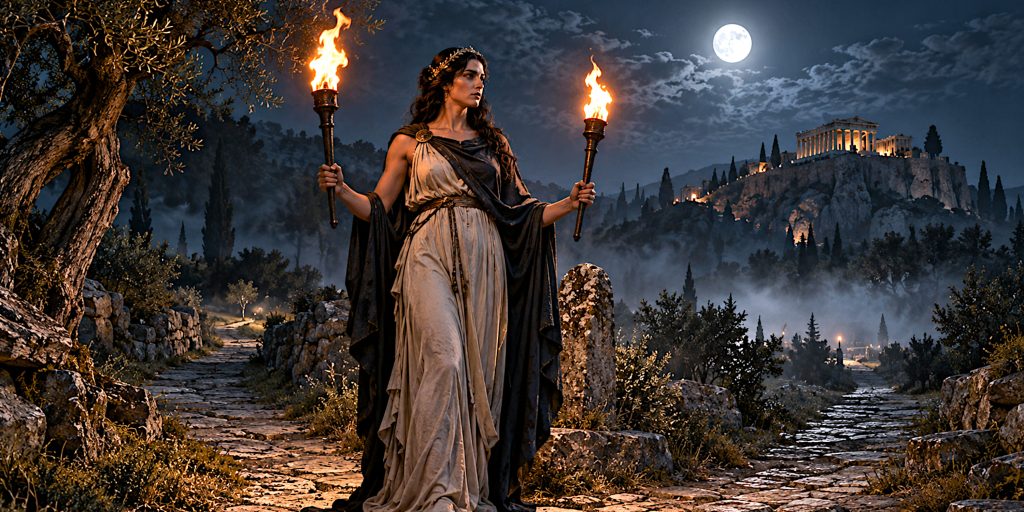
Hecate is frequently described as an ancient witch, but that description reduces a deity to one part of her much longer history.
In Hesiod’s Theogony, composed around the late eighth or early seventh century BCE, she receives honours extending across earth, sea and heaven. She can assist people in judgement, competition, warfare and prosperity. This is a broader figure than the torch-bearing mistress of ghosts familiar from later imagery.
Hesiod describes her as:
“Hecate whom Zeus the son of Cronos honoured above all.”
Translation by Hugh G. Evelyn-White, from Hesiod’s Theogony. This is ancient literary testimony to her status, rather than evidence of supernatural events.
Her associations with crossroads, night, spirits and sorcery become especially prominent in later sources. Torches and representations with three bodies or faces express aspects of her relationship with passageways and intersecting routes. They should not be treated as a single, unchanging image used throughout antiquity.
What makes her formidable: Hecate’s authority is divine and extends beyond individual spells.
What needs qualification: Calling her the “mother of all witches” is a modern simplification. Witch traditions developed in many societies, and they do not all descend from Greek religion.
Circe: Transformation, Knowledge and the Limits of Heroic Confidence
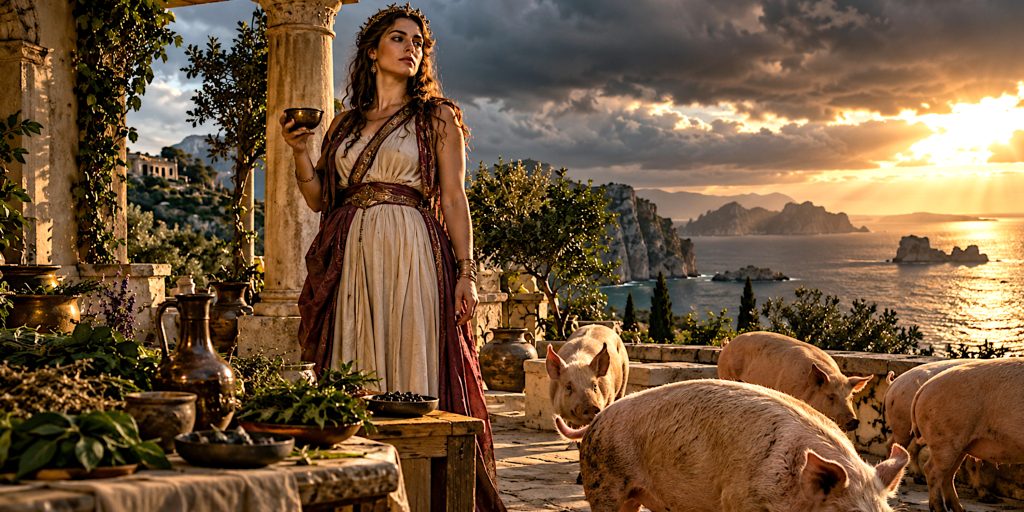
Circe appears in Book 10 of Homer’s Odyssey, an epic conventionally dated to the late eighth or early seventh century BCE. She lives on Aeaea and is identified as a daughter of Helios.
Her most famous act is to turn members of Odysseus’s crew into pigs. Homer makes the transformation particularly disturbing by leaving their human understanding intact. They know what has happened to them, even though they can no longer act as men.
Circe’s magic involves prepared food, drugs and a wand. Odysseus avoids their effects with help from Hermes, who supplies the protective plant moly. His success therefore depends on divine assistance, rather than swordsmanship alone. The epic gives martial confidence a fairly firm correction.
Circe subsequently restores the crew and advises Odysseus about the journey ahead, including his consultation with the dead. She is a threat, but also an indispensable source of knowledge.
What makes her formidable: She can alter human bodies and reverse that transformation.
What needs qualification: Circe is a divine enchantress within Greek epic. Her use of drugs does not establish a direct historical connection between ancient herbal knowledge and later European witch trials.
Medea: The Sorceress Who Makes the Hero’s Success Possible
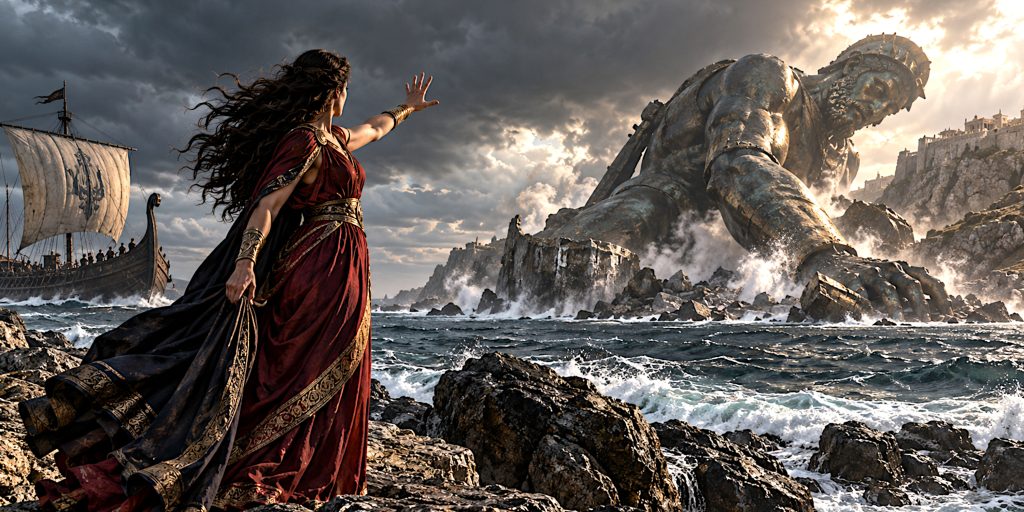
Medea belongs to several overlapping Greek traditions. There is no single account that contains every familiar episode of her life.
A princess of Colchis, she helps Jason obtain the Golden Fleece. Her knowledge supplies protection and solutions that the expedition’s strength cannot provide. The hero receives much of the fame, although the practical work is rather unevenly distributed.
In Apollonius of Rhodes’s Argonautica, written in the third century BCE, Medea also helps overcome Talos, the bronze guardian of Crete. His destruction gives a striking example of magical knowledge defeating an apparently invulnerable body. Other ancient versions explain his defeat differently.
Her reputation is also inseparable from Euripides’s Medea, first performed in 431 BCE. In that tragedy, she kills the children she has had with Jason after his betrayal. This is the most influential version for later audiences, but should not be presented as the uniform account of every Greek storyteller.
What makes her formidable: Medea combines specialised knowledge with the ability to protect, deceive and destroy.
What needs qualification: Mythical Medea is neither a straightforward heroine nor a convenient symbol of misunderstood independence. Her suffering matters, and so do the people she harms.
Morgan le Fay: Healer of Avalon and Adversary of Arthur
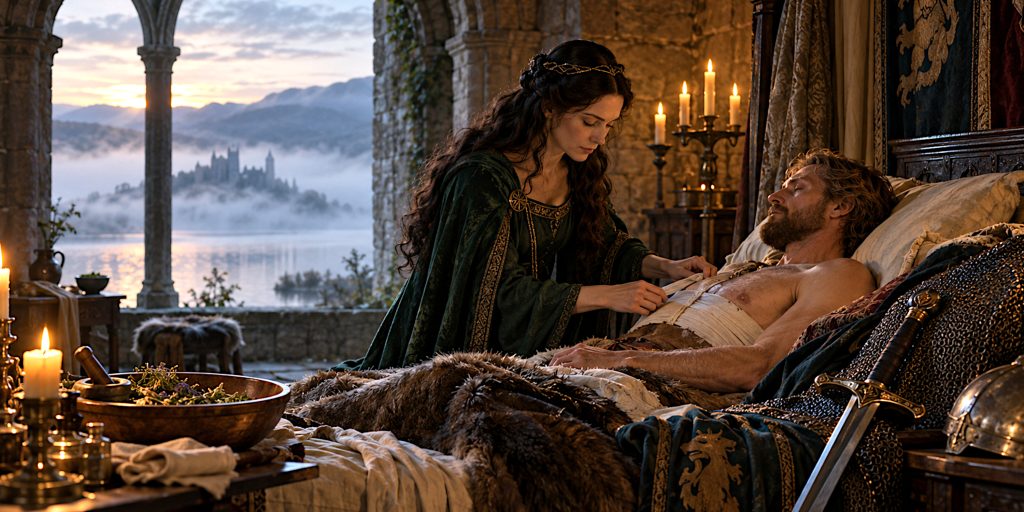
Morgan le Fay changes substantially across Arthurian literature. Treating her as a consistently wicked witch misses much of her appeal.
An early surviving version appears as Morgen in Geoffrey of Monmouth’s Vita Merlini, written around 1150. She is the leading figure among nine sisters on the island associated with Avalon, possessing exceptional healing knowledge.
Geoffrey describes her as:
“more skilled in the healing art”
In this account, the wounded Arthur is brought to her care. Her role is restorative rather than hostile. The passage can be read in the translated Vita Merlini.
Later romances develop Morgan as Arthur’s sister or half-sister and give her more antagonistic roles. She may manipulate relationships, threaten knights or challenge the court. Yet her connection with Arthur’s final journey to Avalon survives alongside these darker portrayals.
I would be cautious about explaining this development solely as Christian writers demonising an independent woman. Gender and moral judgement matter, but so do the needs of romance: a learned healer and a dangerous court adversary perform different jobs in a story.
What makes her formidable: Her magic combines healing, knowledge and influence within Arthur’s own world.
What needs qualification: Morgan’s family relationships, motives and abilities depend on the particular text.
Baba Yaga: The Forest Witch Who Might Help You

Baba Yaga is among the most recognisable supernatural figures in Slavic folklore, particularly Russian tales. Her familiar attributes include a hut on chicken legs, a mortar used as transport, a pestle and a broom for removing her tracks.
Those details vary between stories. So does her behaviour.
She can threaten to eat visitors, set punishing tasks or provide the assistance needed to complete a quest. Some tales contain more than one Baba Yaga, which complicates the idea that every appearance describes a single character with a fixed biography.
In Vasilisa the Beautiful, preserved in Alexander Afanasyev’s nineteenth-century collection, the heroine survives Baba Yaga’s demands with help from a magical doll. She leaves with a burning skull whose light destroys her cruel stepmother and stepsisters. Assistance from Baba Yaga comes with consequences that would make most people reconsider asking a neighbour for a light.
What makes her formidable: Baba Yaga controls the encounter. Visitors enter her territory, face her rules and may depend on her gifts.
What needs qualification: Interpretations identifying her as a surviving prehistoric goddess are theories, rather than a securely documented origin. Nineteenth-century collections preserve older storytelling, but cannot establish the age of every detail.
Mother Shipton: Prophecy, Print and Retrospective Accuracy
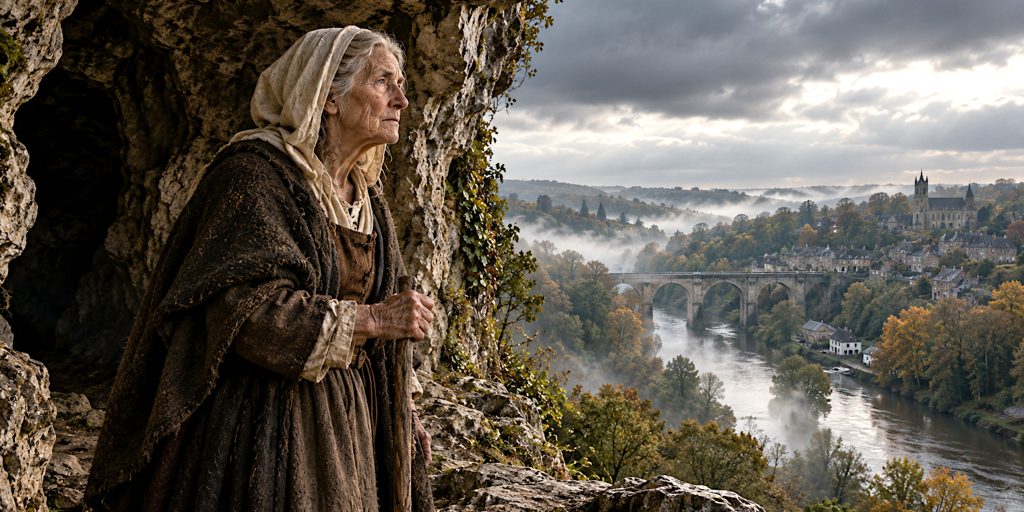
Mother Shipton is traditionally identified as Ursula Southill or Southeil, a Yorkshire prophetess supposedly born near Knaresborough around 1488. Much of the familiar biography is late and difficult to verify.
The first known printed collection of prophecies attributed to her appeared in 1641, well after her supposed lifetime. Later publications expanded both her life story and her predictions.
This matters because a prophecy published after an event has already occurred offers very little evidence of foresight. It offers much better evidence of publishing ingenuity.
The famous verses predicting technological developments and the end of the world in 1881 were introduced by Charles Hindley in an 1862 publication. He later acknowledged fabricating them. The older Dictionary of National Biography entry records this publication history and the problems surrounding her supposed life.
What makes her significant: Her reputation shows how printed material can turn an uncertain local figure into a national prophetess.
What needs qualification: Predictions attributed to Mother Shipton require evidence that their wording existed before the events they supposedly foretold.
Tituba: An Accused Woman, Not a Proven Witch
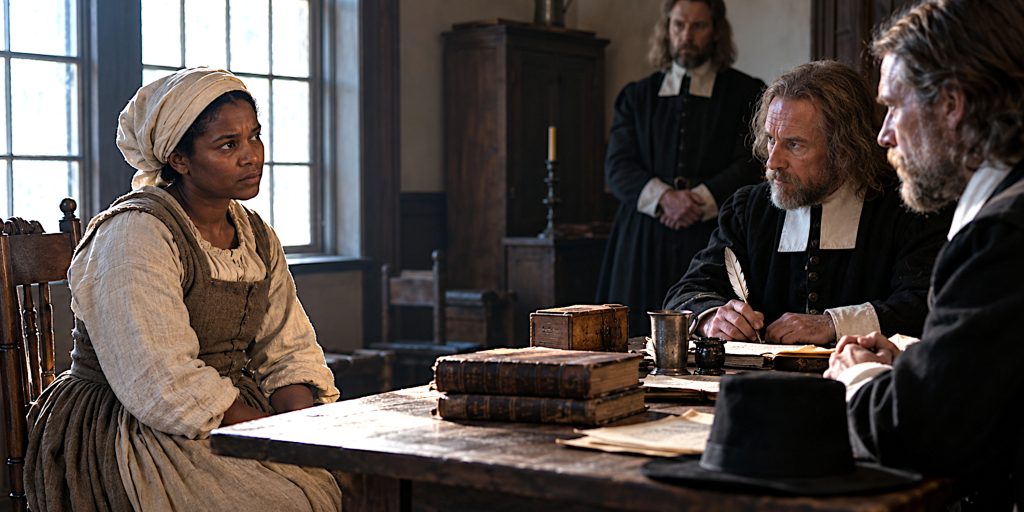
Tituba was an enslaved woman in the household of Samuel Parris at Salem Village. Surviving records describe her as an Indigenous woman, although her precise origins remain uncertain. Later portrayals often add identities and magical practices that the documents do not establish.
She was among the first people examined during the Salem witchcraft crisis of 1692.
The record of her examination on 1 March preserves this exchange:
“why doe you hurt these children,”
“I doe not hurt them”
The original spelling is retained from the Salem trial records held in the University of Virginia’s documentary archive. The question assumes guilt before the answer is given.
Her testimony subsequently includes the Devil, threatening figures and supernatural animals. Given her enslavement, the interrogation and the leading questions preserved in the record, this material cannot responsibly be read as proof of magical practice.
Her confession helped make the authorities’ fear of a wider conspiracy seem credible. That does not make her responsible for the prosecutions that followed. She survived the crisis; her later fate is poorly documented.
What makes her significant: Her case exposes the imbalance between an accused person and the people recording, interpreting and judging her words.
What needs qualification: Tituba has no place in a factual ranking of supernatural strength. Her supposed powers were accusations.
La Voisin: Fortune-Telling and the Affair of the Poisons
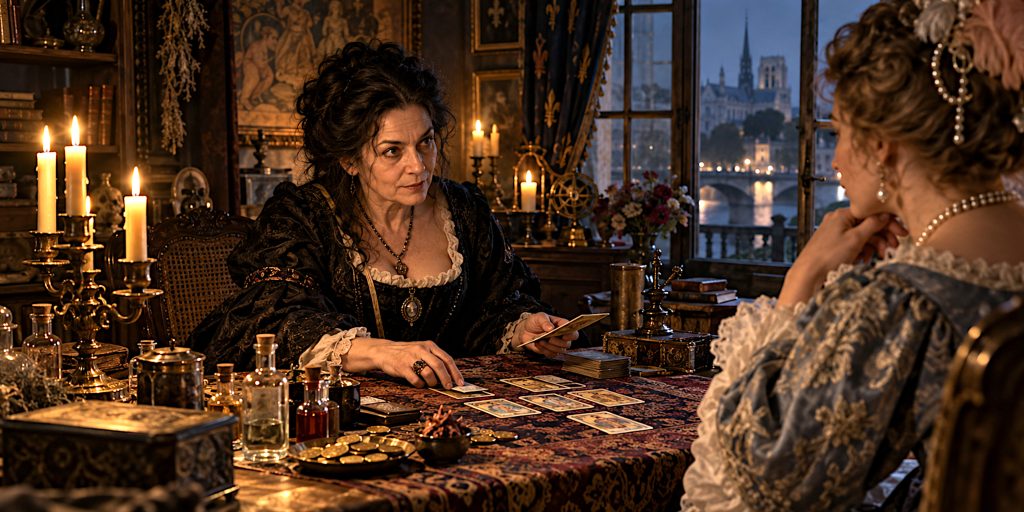
Catherine Deshayes, known after marriage as Catherine Monvoisin or La Voisin, occupied a very different historical setting: Paris under Louis XIV.
She worked as a fortune-teller and became a central figure in the Affair of the Poisons, an investigation involving allegations of poisoning, charms and illicit religious ceremonies. Her case drew attention to customers and intermediaries connected with elite society.
She was executed by burning in February 1680.
The difficulty lies in separating criminal activity from the investigation’s most sensational claims. Allegations about black masses and the involvement of prominent courtiers require careful assessment of individual testimony. A charge appearing in an interrogation record does not automatically make it established fact.
Historical research on the scandal examines how gender, crime and reputation shaped the treatment of La Voisin and other women implicated in the affair.
What makes her significant: Her influence depended on customers, connections and a market for forbidden services.
What needs qualification: Neither her conviction nor her occult reputation demonstrates supernatural ability. Her case also cannot safely be reduced to the persecution of an entirely innocent healer.
Why “Agrippa’s Sorceress” Does Not Belong on the List

Heinrich Cornelius Agrippa was a Renaissance scholar and author associated with occult philosophy. Stories about his black dog being a demonic familiar became part of his reputation.
That tradition does not establish a separate witch called “Agrippa’s Sorceress”, or a female spirit bound to him.
Johann Weyer, who knew Agrippa, rejected the supernatural interpretation of the animal. Later scholarship examines the dog story as part of the hostile reputation surrounding Agrippa’s learning and writings.
The entry should therefore be removed from a list of identifiable witches. It belongs in a discussion of familiar spirits and legends about magicians.
What Historical Witchcraft Records Can Tell Us
Historical records reveal beliefs, accusations, legal procedures and sometimes the services people actually offered. They do not prove that an accused person could summon storms, travel invisibly or harm a neighbour through magic.
Several distinctions help keep the evidence in focus:
- An accusation establishes suspicion, rather than the truth of the charge.
- A confession requires scrutiny of questioning, threats and the circumstances in which it was recorded.
- Healing, divination and harmful magic were overlapping but distinct categories.
- Women formed a large proportion of those accused in many regions, but men also faced prosecution.
The National Archives’ collections show how disputes, illness, religious beliefs and legal processes shaped English accusations. Some cases involved healers; that does not support the popular claim that witch trials were simply a campaign against women practising medicine.
Nor did everyone in these societies agree. Doubt, resistance and concern about unreliable evidence existed alongside persecution.
Why These Witches Still Matter
These figures endure for different reasons.
Circe makes bodily identity frighteningly unstable. Medea exposes how dependent heroic achievement can be on someone whose knowledge receives less credit. Morgan can preserve the king’s life while also challenging his court. Baba Yaga turns a request for help into a test of judgement.
Tituba’s story asks a harder historical question: who gets to define what another person is? Mother Shipton shows how a reputation can grow through repetition and fabrication. La Voisin reveals that money, status and dangerous belief could meet far above the village doorstep.
I find the surviving differences more compelling than the familiar claim that every witch represents the same struggle for independence. Some are gods, some are monsters, some are helpers, and some were people trying to survive an accusation. Their histories deserve that precision.
Frequently Asked Questions About Legendary Witches
Who is the strongest witch in mythology?
Hecate has the strongest claim to broad divine authority among the figures discussed here. Circe and Medea demonstrate more specific magical feats in their stories. Comparing them remains an interpretation, rather than an ancient consensus.
Was Morgan le Fay evil?
Her character varies between Arthurian texts. She appears as a healer, an antagonist and a figure connected with Arthur’s passage to Avalon.
Is Baba Yaga always a villain?
No. She can threaten, test or assist a visitor. Her role depends on the tale.
Were Tituba and La Voisin real people?
Yes. Both are documented historical women. Their existence does not establish the supernatural powers attributed to them.
Did Mother Shipton predict modern technology?
The best-known verses making those predictions were nineteenth-century fabrications. Other prophecies attributed to her also need to be checked against their earliest surviving publication.