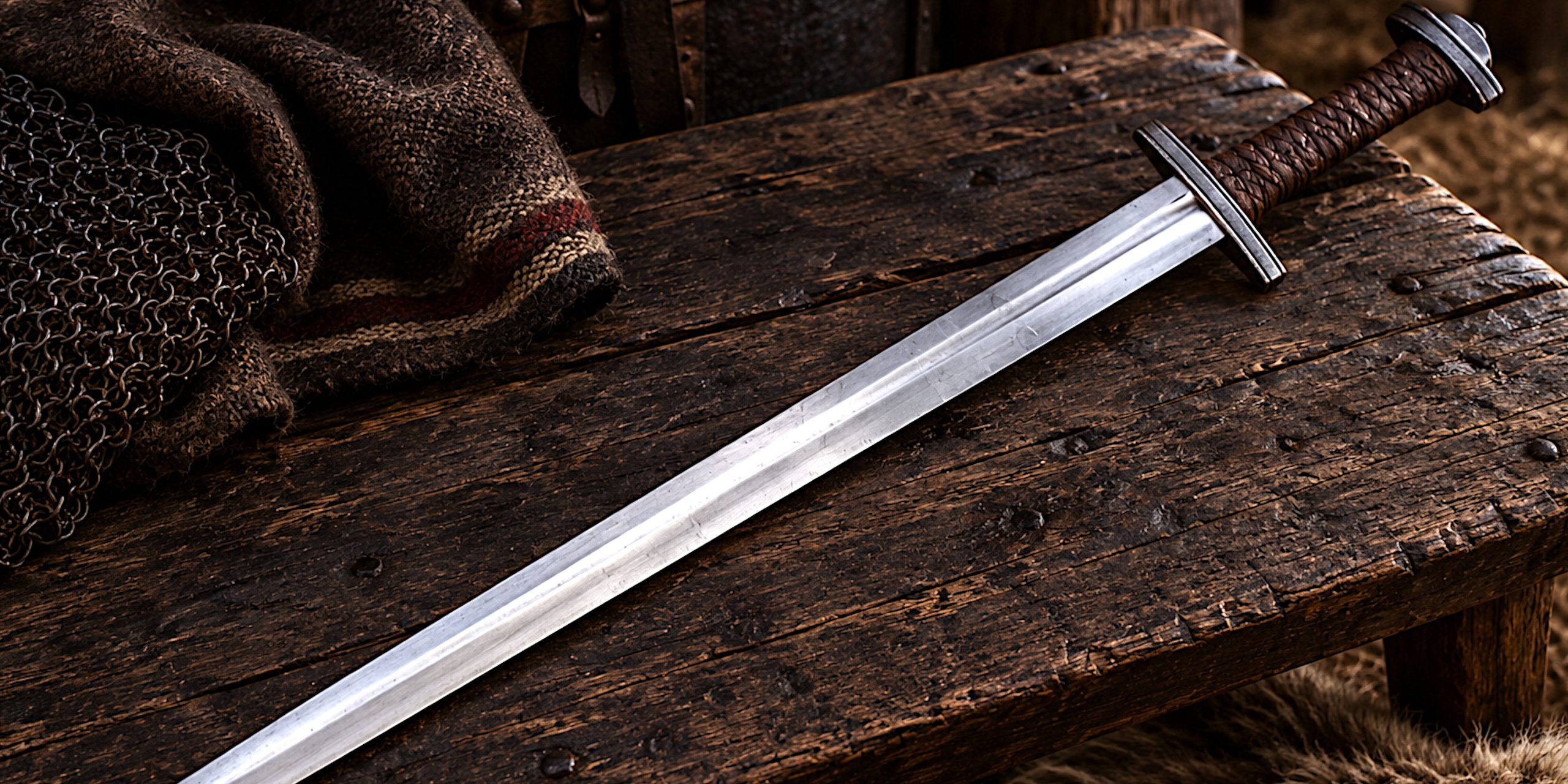
The Frankish spatha was a long, double-edged sword used across the early medieval Frankish world. It belonged to a much older family of swords, with roots in the Roman spatha, but Merovingian-era blades and fittings developed their own styles. Some were practical weapons; the finest were also costly displays of rank.
There was no single standard Frankish model. Blades, hilts and fittings varied across time and place, so “Frankish spatha” is best understood as a useful label for a broad group of early medieval swords, rather than a precise pattern with fixed measurements.
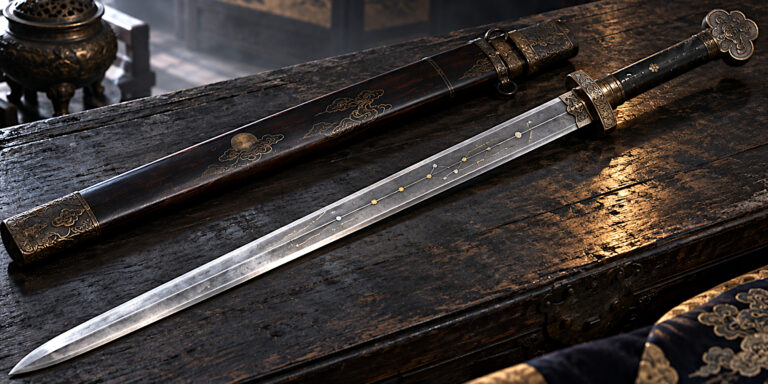
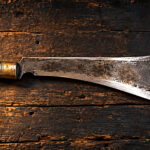
The reference image shows a simple modern interpretation: a long, straight blade, shallow fuller and modest crossguard. The dark brown grip binding in the accompanying illustration gives it a more historically grounded finish. It should still be treated as a reconstruction, since original organic grip materials rarely survive intact.
Frankish Spatha Specifications
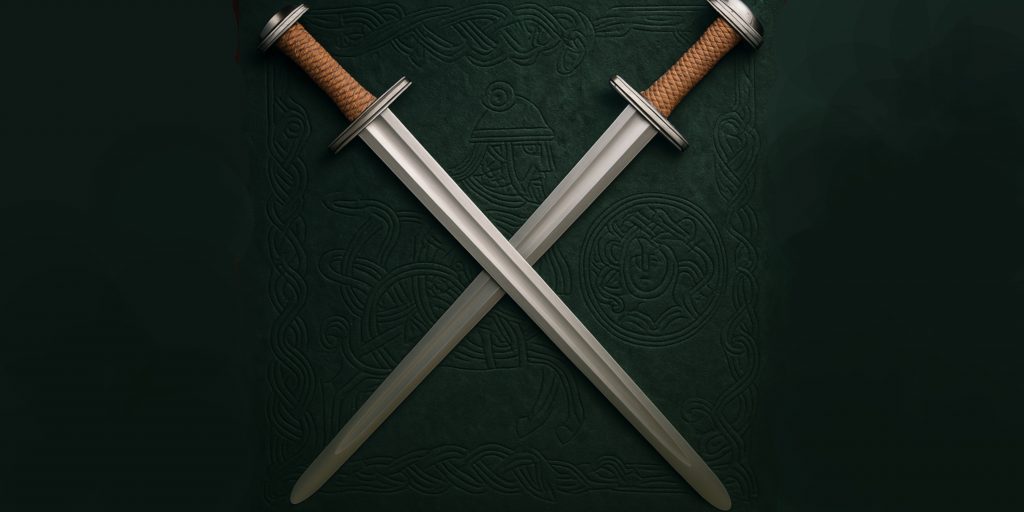
Measurements varied between surviving examples. The figures below describe a broad type, alongside one documented Merovingian sword that went to auction in 2026.
| Feature | Typical description |
|---|---|
| Type | Single-handed, double-edged sword |
| Blade | Straight, broad and generally parallel-sided, often tapering towards the point |
| Blade length | Commonly around 70–80 cm, though examples differ |
| Overall length | Often around 85–95 cm |
| Weight | Many examples fall roughly between 700 g and 1 kg |
| Fuller | Sometimes present; its shape and length vary |
| Hilt | Short grip, with a compact guard and pommel; materials and decoration varied |
| Construction | Iron and steel components; some blades used pattern-welding |
| Scabbard | Usually a wooden core with organic covering and metal fittings, though preservation varies |
One sixth-century sword described by TimeLine Auctions measured 86.5 cm overall and weighed 694 g. That is a useful real-world reference, not a template for every spatha. Museum descriptions also note that some examples were around one kilogram.
Pattern-welding is often associated with early medieval swords, but it was not universal. Nor should it be treated as a guarantee of superior performance: it was a demanding way to build a blade, and the visible patterns could also make the weapon striking to look at.
History and Evolution
Roman roots
The word spatha refers to a long sword used in the Roman world. Roman examples were associated with cavalry, but the weapon’s use broadened over time. By the later Roman period, long swords were also carried by infantry. The spatha therefore did not begin as a uniquely Frankish weapon, or as a sword reserved exclusively for mounted fighters.
As Roman political authority weakened in western Europe, sword forms and sword-making traditions continued across communities that included the Franks. Weapons, craftsmen and styles crossed political and cultural boundaries. The result was adaptation, not a clean handover from one people to another.
Merovingian swords and status
During the Merovingian period, roughly the fifth to eighth centuries, swords could signal social standing as well as provide a weapon for combat. Many graves contain spears or single-edged knives, while swords appear more selectively. Some high-status examples had elaborate hilts, scabbard fittings or pattern-welded blades.
That distinction matters. A richly decorated sword tells us about its owner’s wealth and social world, but decoration alone cannot tell us how often it was used in battle. Some swords may have been heirlooms, prestige objects or both.
From Merovingian to Carolingian forms
Sword designs changed gradually as the Frankish kingdoms gave way to Carolingian rule. Hilt shapes and fittings evolved, while long, double-edged blades remained in use across western and northern Europe. Later Viking-age swords share some of this wider tradition, but it is misleading to imagine one standard Frankish sword transforming in a straight line into one standard Viking sword. Regional styles overlapped, and makers borrowed and adapted techniques.
Pattern-welding is one of the most visually memorable parts of the story. Smiths forged together iron and steel rods, sometimes twisting or arranging them to create patterns in the blade. The process demanded considerable skill. A patterned blade was not simply “Damascus steel” in the modern sense, even though older descriptions sometimes use related terminology. The technique and the structure of individual blades could differ.
Advantages and Disadvantages
Advantages
- Useful reach: A long blade could deliver effective cuts while keeping an opponent at a greater distance than a shorter sword.
- Versatility: A double-edged blade could cut with either edge and could also thrust, depending on its point and handling.
- Manageable weight: Many examples were relatively light for their length, making them practical to carry and wield.
- Adaptable design: The broad blade and varied hilt forms could suit different users and traditions.
- Prestige: Elaborate fittings and skilled blade-work made some swords visible markers of status.
Disadvantages
- Limited hand protection: Many early examples had a modest guard, offering less protection than the larger crossguards of later medieval swords.
- Cost: A well-made sword required specialist labour and materials. It was beyond the means of many people.
- Dependence on other equipment: A sword was valuable, but it did not replace the spear, shield or other weapons that mattered in combat.
- Variation complicates comparison: “Frankish spatha” covers a range of forms. Claims about one exact weight, balance or battlefield role can be too neat.
- Fragile archaeological evidence: Organic parts such as grips, scabbards and bindings often decay, leaving only fragments or traces.
Frankish Spatha Compared with Similar Weapons
| Weapon | Main distinction | How it compares |
|---|---|---|
| Late Roman spatha | Earlier long-sword tradition | The Frankish examples belong to a continuing and changing tradition, not a wholly separate invention. |
| Viking-age sword | Later regional forms with varied hilts and pommels | Shares broad features with earlier long swords, but its fittings and blade details can differ. |
| Seax | Single-edged knife or short sword | More compact and single-edged, often serving practical as well as combat roles. |
| Roman gladius | Shorter sword associated with close-order fighting | Shorter and more compact than the spatha, with a different balance of reach and handling. |
| Later arming sword | More developed crossguard and later medieval context | Often offers greater hand protection, but belongs to a later design tradition. |
The comparisons are helpful so long as they do not turn into a tidy ladder of “primitive” to “advanced”. A short gladius, long spatha and later arming sword answered different needs in different settings.
Legacy
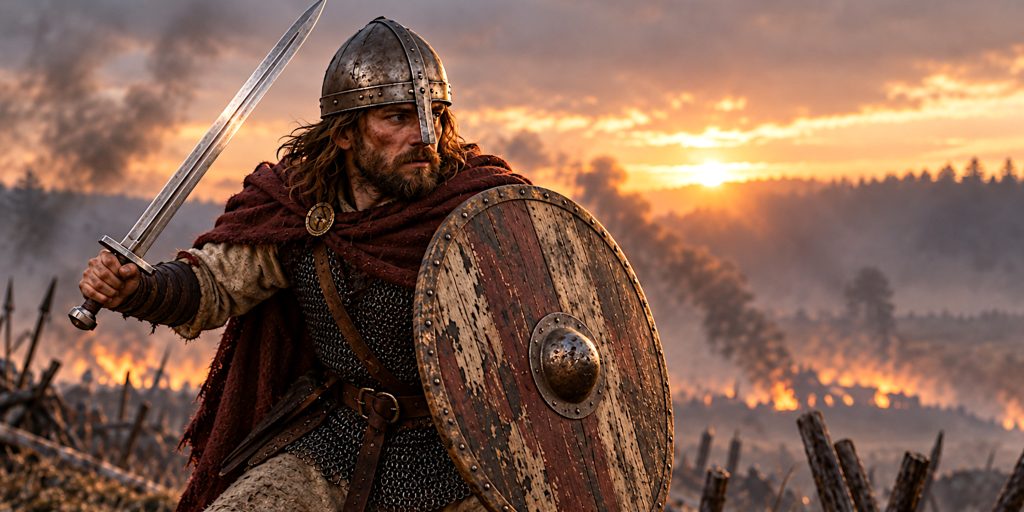
The Frankish spatha sits at an important crossroads in European arms history. It connects Roman military traditions with the weapon cultures of early medieval kingdoms, while its surviving forms show how much variation existed within that broad inheritance.
Its legacy is visible in:
- The continued use of long, double-edged swords across early medieval Europe.
- The high status attached to swords in some burial contexts.
- The technical and artistic ambition of pattern-welded blades and decorated hilts.
- The close relationship between weapon design, trade, skilled labour and political authority.
The spatha is compelling partly because it refuses to be only one thing. It was a weapon, an expensive object and, in some cases, a statement about who carried it.
Where to See Frankish and Related Spathae
- The Metropolitan Museum of Art, New York: Its collection includes an iron sword identified as Frankish and dated to 500–700 CE. The museum currently lists it as not on view, but its online record includes dimensions and collection details. View the Met’s Frankish sword record.
- Museum für Vor- und Frühgeschichte, Berlin: The museum has published research on a gold-hilt spatha and associated grave goods dating to the first half of the fifth century. The find’s exact discovery location is not documented, so its context has limits. Read the museum’s research page.
- State Museum of Prehistory, Halle: Its exhibition page describes a reconstruction based on a sword from the Theißen grave. This is a replica, but it offers a useful view of the weapon’s proportions and construction.
Check current displays before travelling. Museum objects can be moved for conservation, loans or exhibition changes.
Collector’s Guide and Auction Prices
Original early medieval swords are scarce, and an attractive description is not proof of authenticity. Provenance, conservation history and specialist assessment matter more than a dramatic sales photograph.
Two recent TimeLine Auctions results give a sense of the market, while also showing why a single price cannot serve as a valuation guide:
| Lot | Description | Recorded result |
|---|---|---|
| Merovingian iron pattern-welded sword, circa sixth century | 86.5 cm long, 694 g; described with a lentoid blade, battle nicks and traces of scabbard material | £975, including buyer’s premium |
| Saxon iron spatha with bronze chape, fifth to sixth century | Described as a sacrificed sword, broken into two parts | £1,300, including buyer’s premium |
These are specific sale results, not reliable price bands for all early medieval swords. Condition, completeness, provenance, fittings, documentation and buyer competition can change a result sharply. The auction record for the Merovingian sword gives its measurements and catalogue description; the auction’s results page records the sale prices.
Before considering an authentic artefact:
- Ask for a documented ownership history and any export or import paperwork.
- Check whether the sword is complete, restored, composite or heavily conserved.
- Look for an independent specialist report, and confirm what that report actually establishes.
- Compare the dimensions and construction with published museum examples.
- Check the laws that apply where the object is being sold, exported and purchased.
- Budget for buyer’s premiums, taxes, transport and conservation advice.
For most collectors, a well-researched replica is the sensible option. Replicas also make it easier to handle and study the design without the legal and conservation responsibilities attached to an archaeological object.