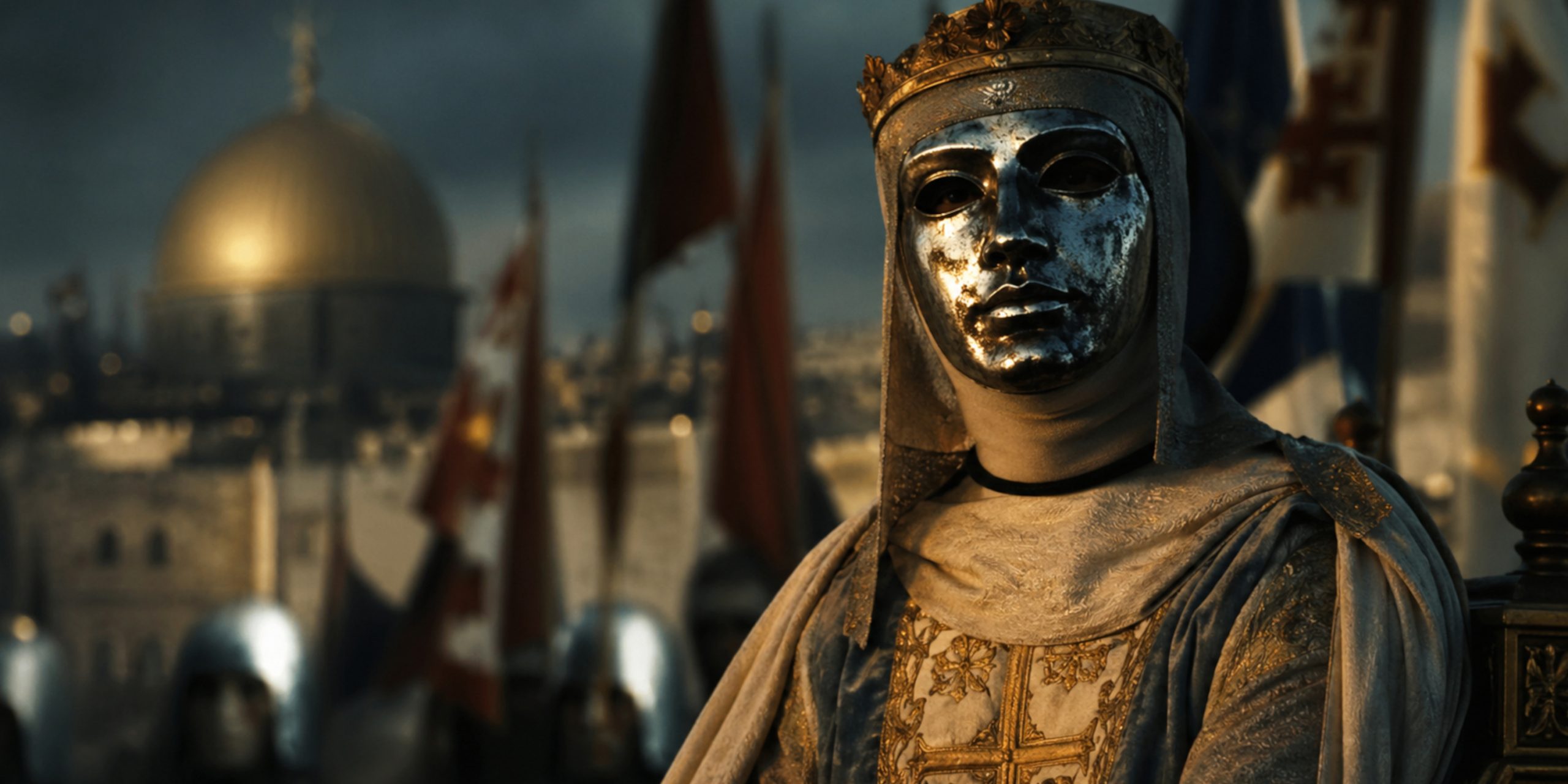
There is something quietly fascinating about a king who believes deeply, yet refuses to let belief turn into chaos. In Kingdom of Heaven, Baldwin IV sits at the centre of that tension. He is young, terminally ill, and somehow the most level-headed person in a room full of men who think God is on their side with a sword in hand.
Watching him, you start to realise the film is not really about battles. It is about restraint. It is about what happens when faith meets power and chooses not to explode.
Baldwin IV: A King Who Refuses Extremes
Played with eerie calm by Edward Norton, Baldwin is not written as a typical crusader king. He does not rant about divine destiny. He does not chase glory. Instead, he seems tired in a way that has nothing to do with illness.
His Christianity is present but controlled. He believes, clearly, but he also understands something many of his peers do not: faith can stabilise a kingdom or tear it apart.
That distinction matters more than any battlefield victory.
The Political Reality Behind the Faith
Baldwin’s Jerusalem is not a clean, unified Christian state. It is a fragile mix of religions, cultures, and uneasy agreements. Muslims, Christians, and others live within the same walls, often peacefully, sometimes not.
The king’s approach is simple in theory and incredibly difficult in practice:
- Maintain peace with Saladin
- Keep extremist nobles in check
- Prevent religious conflict from becoming open war
He knows that one reckless act, one raid, one insult dressed up as devotion, could collapse everything.
The uncomfortable truth sits right under the surface. Peace is not being maintained because everyone agrees. It is being maintained because Baldwin forces it to hold.
Religion as Responsibility, Not Weapon
What stands out is how Baldwin treats religion less like a banner and more like a responsibility. He does not deny its importance. He just refuses to let it justify stupidity.
This puts him in direct contrast with characters like Guy de Lusignan, who sees faith as something to prove through violence, and Raynald of Châtillon, who treats it as permission to provoke war.
Baldwin’s version of belief feels almost modern. It asks a quiet question: what if devotion meant holding back rather than charging forward?
It is not flashy. It does not win applause. But it keeps people alive.
The Mask and the Message
The silver mask is not just a visual choice. It becomes a kind of symbol for the entire dilemma.
Baldwin hides his disease, but he also hides emotion. There is no visible anger, no visible fear. Just control. It creates distance between him and everyone else, which feels intentional.
In a way, the mask mirrors his leadership style. He absorbs pressure without showing it. He contains conflict without letting it spill over.
There is something almost tragic in that. He is holding together a system that depends entirely on him, knowing full well he will not be there long enough to secure it.
The Fragility of Moderation
Moderation sounds reasonable until you realise how unstable it actually is. It requires constant effort. It relies on people not pushing too far.
Baldwin manages it through authority and presence. Once that weakens, the system starts to crack.
You can see it coming. The moment he is no longer able to intervene, figures like Guy and Raynald step forward, eager to turn belief into action. Not thoughtful action. Loud, destructive action.
The film does not need to spell out the consequences. History, and the narrative, take care of that.
Baldwin and Saladin: Mutual Respect in a Divided World
The relationship between Baldwin and Saladin is one of the film’s quieter strengths. There is no friendship in the usual sense, but there is respect.
Both men understand the cost of war. Both recognise that religion, while central, cannot be allowed to dictate every decision.
That shared understanding creates a fragile balance. It is less about trust and more about recognising that the alternative is far worse.
It is one of those rare portrayals where opposing sides are not reduced to simple enemies. They are leaders trying to avoid disaster with limited room to manoeuvre.
Why Baldwin Still Feels Relevant
It is tempting to see Baldwin as a historical curiosity or a cinematic invention, but his dilemma feels uncomfortably current.
The idea of belief being used to justify conflict has not gone anywhere. If anything, it has become louder. Baldwin’s approach, measured, restrained, almost stubbornly calm, feels like something that rarely gets attention.
There is also a slightly frustrating truth here. His way works, but only under specific conditions. It requires authority, intelligence, and a willingness to disappoint people who want something more dramatic.
Not exactly a recipe for popularity.
Takeaway
Baldwin IV stands out because he refuses to turn religion into a performance. He believes, but he does not weaponise that belief for personal gain or political theatre.
That choice defines his rule. It also limits it.
There is a quiet irony in how compelling that makes him. In a film filled with speeches, battles, and big personalities, the most interesting figure is the one trying to keep everything from spiralling out of control.
It leaves you with a question that lingers longer than any fight scene. What actually holds a kingdom together, conviction or restraint?
Baldwin’s answer is clear. Whether it is sustainable is another matter entirely.