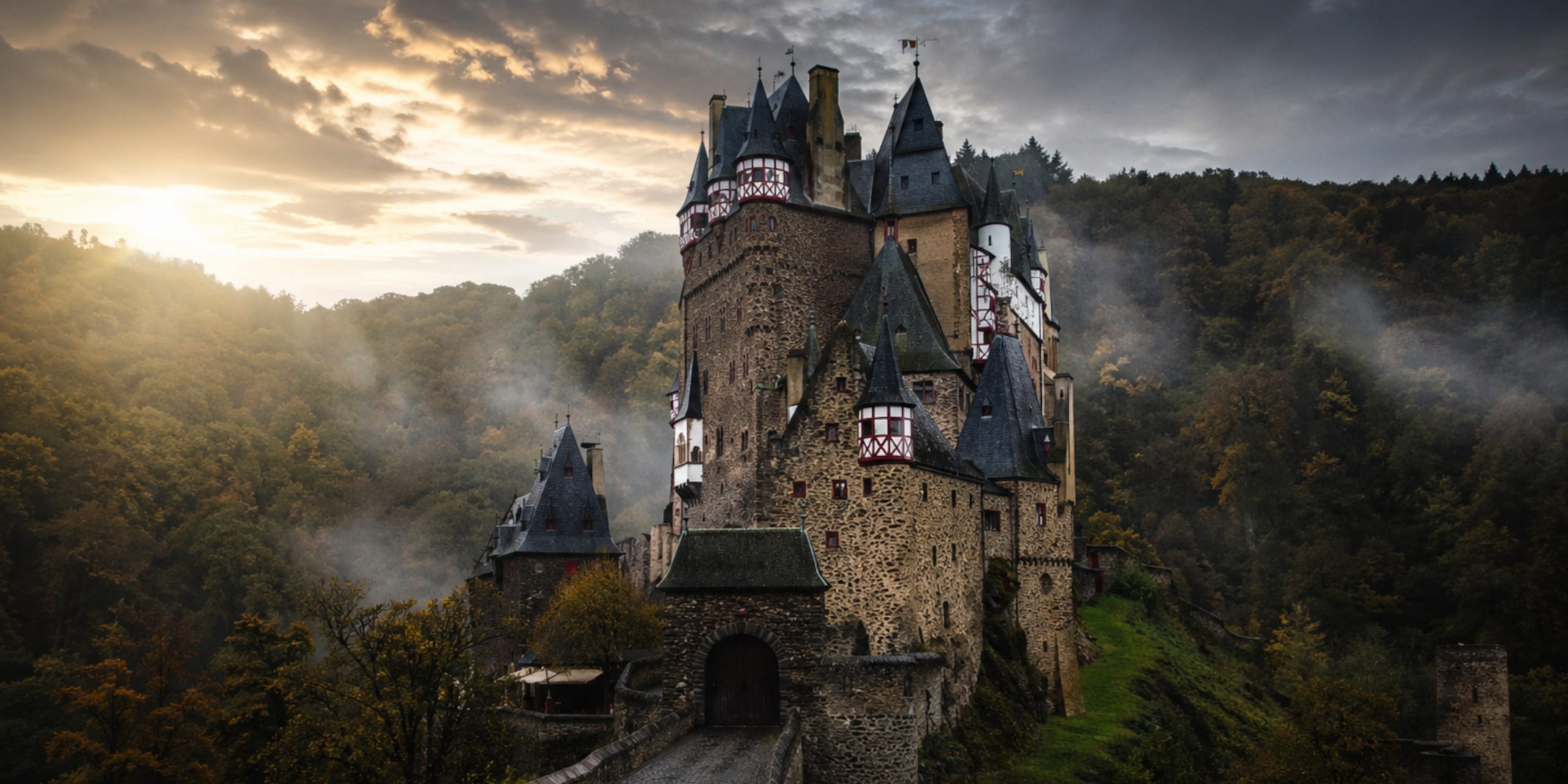
Hidden deep within a wooded valley above the Elzbach river, Burg Eltz has the rare distinction of feeling untouched without actually being forgotten. Many castles survived because they were rebuilt. Eltz survived because no one ever quite managed to destroy it.
It has remained in the same family for over eight centuries. That alone would make it notable. The fact that it still stands in near original condition, complete with layered medieval architecture, makes it something closer to a quiet anomaly in European history.
Setting and Strategic Position
Burg Eltz occupies a natural defensive position, perched on a rocky spur surrounded on three sides by the looping Elzbach. It sits between Koblenz and Trier, near the Moselle, a region that was once dense with trade routes and rival lordships.
Unlike castles built to dominate open plains, Eltz feels deliberately tucked away. This was not a seat of grand conquest. It was a fortress of endurance, built to withstand pressure rather than project power.
The dense forest that now gives it a fairy tale reputation once served a more practical purpose. It made the castle difficult to approach, harder to besiege, and easier to defend.
Architectural Evolution
Construction began in the 12th century, and rather than following a single unified plan, the castle grew organically. Different branches of the Eltz family expanded it over generations, resulting in a cluster of interconnected buildings rather than a singular keep.
Three main family lines shaped its layout:
- The Rübenach House
- The Rodendorf House
- The Kempenich House
Each section reflects its own period and priorities. Some areas favour defence, with thick walls and narrow windows. Others lean toward comfort, with larger chambers and decorative elements that hint at rising wealth.
The result is a castle that feels almost improvised, though in truth it is the product of centuries of careful adaptation. One suspects the original builders would be surprised to see how tall and intricate it eventually became.
Sieges and Conflict
Despite its longevity, Burg Eltz has faced remarkably few direct assaults. The most notable conflict came during the 14th century Eltz Feud.
Archbishop Baldwin of Trier sought to assert authority over independent nobles in the region. The Eltz family resisted, prompting Baldwin to construct a siege castle, Trutzeltz, nearby.
From this vantage point, he bombarded Burg Eltz with early gunpowder artillery.
A contemporary account attributed to Baldwin’s circle notes:
“The walls of Eltz stand stubborn, though the thunder of stone and fire is brought against them.”
The siege lasted several years, yet the castle was not destroyed. Eventually, the Eltz lords submitted, becoming vassals rather than casualties.
It is telling that even under sustained pressure, the castle endured. Many others did not enjoy the same outcome.
Occupants Timeline
The Eltz family story is less about dramatic turnover and more about continuity, which is unusual enough to deserve attention.
12th Century
- First recorded mention of the Eltz family
- Initial construction begins
13th–15th Centuries
- Expansion into multiple family residences
- Participation in regional politics and feuds
16th–17th Centuries
- Gradual shift toward more comfortable living spaces
- Influence of Renaissance styles in interiors
18th Century
- Castle begins to fall out of primary use
- Preservation becomes more passive than active
19th Century
- Count Karl zu Eltz undertakes restoration
- Efforts focus on preserving medieval character rather than modernising
20th–21st Centuries
- Continued ownership by the Eltz family
- Opening to the public as a historical site
Unlike many castles that passed through conquest or sale, Burg Eltz has remained remarkably stable. It has had fewer identity crises than most European noble houses.
Daily Life and Interiors
Inside, the castle reflects layers of medieval and early modern life.
- Great halls used for gatherings and administration
- Private chambers that reveal a gradual move toward comfort
- Chapels that underline the centrality of faith
The treasury is particularly notable, housing artefacts such as goldwork, weapons and ceremonial objects. These items provide insight into both wealth and status, though one suspects they were also displayed with a certain amount of quiet boasting.
Archaeology and Preservation
Archaeological work at Burg Eltz has been less about discovery and more about careful preservation.
Findings include:
- Original timber structures dating back several centuries
- Medieval ceramics and domestic objects
- Armour and weapon fragments tied to the castle’s defensive history
What makes Eltz unusual is not the scale of its finds but the continuity of its structure. Much of what would be considered archaeological elsewhere is still part of the standing building.
Restoration efforts in the 19th century were notably restrained. Count Karl zu Eltz avoided the temptation to romanticise the castle, choosing instead to maintain its historical integrity. This decision has paid off, even if it denies modern visitors the kind of theatrical embellishment found elsewhere.
Cultural and Historical Significance
Burg Eltz occupies an interesting place in German heritage. It is not the largest castle, nor the most politically significant. Yet it is often cited as one of the most authentic.
Its survival offers a rare continuity from medieval feudal life to the present. While other castles tell stories through ruins, Eltz tells its story through presence.
It has also become something of a cultural icon, frequently appearing in media and travel literature. One might argue it benefits from its picturesque setting, though the builders were likely thinking more about defence than postcard appeal.
Legacy
The legacy of Burg Eltz lies in its refusal to follow the usual pattern.
It was not destroyed in major wars. It was not abandoned and left to decay. It was not heavily rebuilt in later centuries to suit changing tastes.
Instead, it endured with a quiet consistency.
In a landscape where history often arrives in fragments, Burg Eltz offers something closer to a continuous thread. That alone makes it worth attention, even if it never once claimed to be the most important castle in the region.
And perhaps that is the point. It survived precisely because it did not try too hard to dominate its world. It simply held its ground, quite literally, for over eight hundred years.