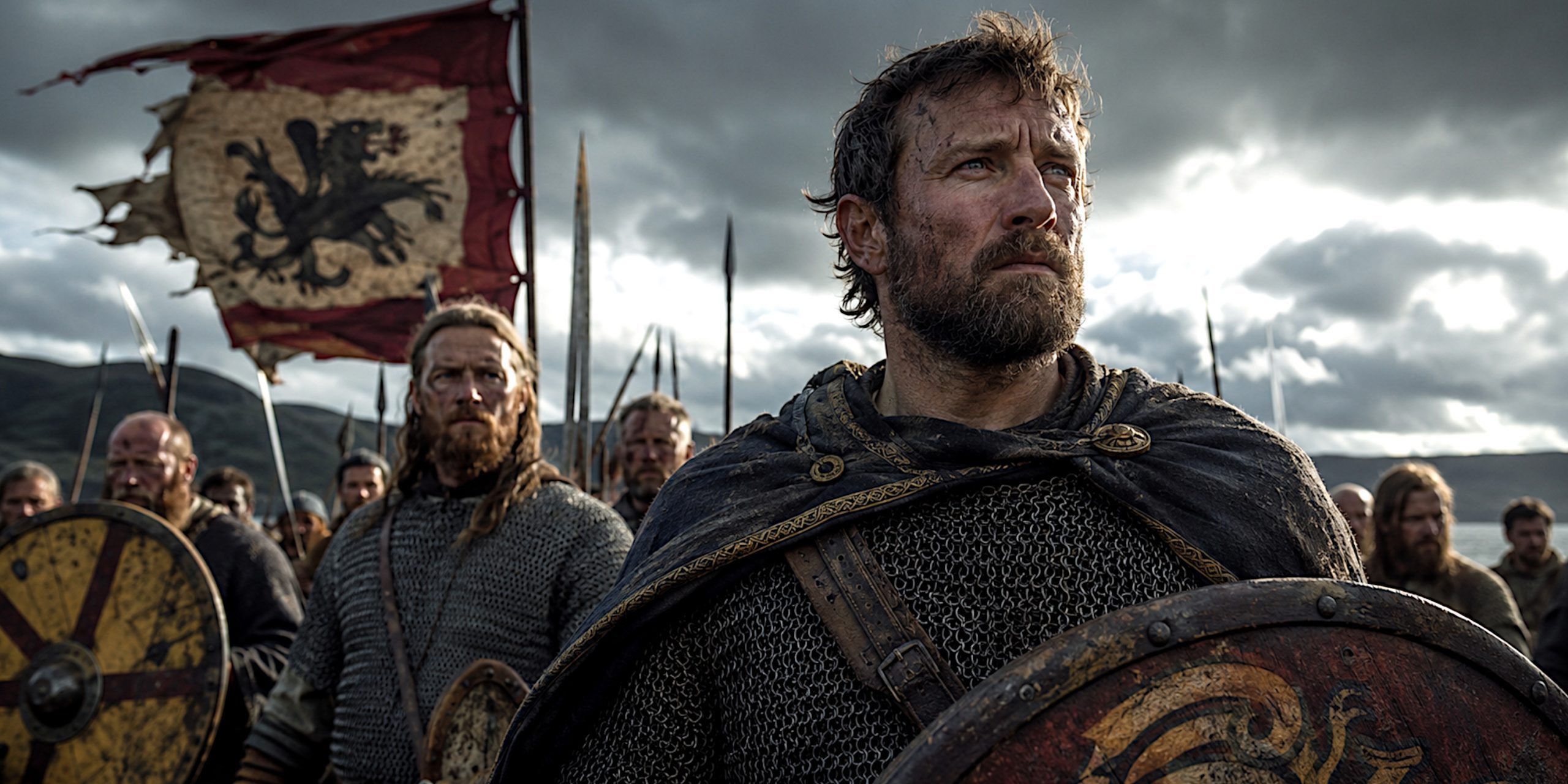
The story of Anglo-Saxon England is often told through its kings. Alfred the Great, Æthelstan, Edmund Ironside and Harold Godwinson naturally attract the headlines. Yet none of them ruled alone. Behind every successful king stood a class of professional warriors, landowners and administrators who formed the backbone of the kingdom. These were the thegns.
A Saxon thegn was far more than a soldier. He collected taxes, dispensed justice, managed estates, advised kings and fought when war called. In many ways he was the medieval equivalent of a knight, although the institution of knighthood had not yet developed in England.
Without the loyalty of the thegns, Anglo-Saxon England simply could not function. Without their courage, it might not have survived as long as it did against Vikings, Welsh princes and eventually the Normans.
Their world was harsh, ambitious and often surprisingly practical. Loyalty was expected. Bravery was admired. Cowardice was remembered for generations, usually by somebody with a very sharp memory and an even sharper sword.
Who Were the Saxon Thegns?
The word thegn (Old English: þegn) originally meant a servant or attendant. By the ninth and tenth centuries it had evolved into one of the highest social ranks below an earl.
Thegns formed the military and political elite of Anglo-Saxon England. They were wealthy landowners who owed military service directly to a king or powerful lord.
A successful thegn typically possessed:
- A substantial estate
- Professional military experience
- Household warriors
- Political influence
- Legal responsibilities
- Access to the royal court
The office combined military command with local government. A king relied upon trusted thegns to enforce royal authority across increasingly large kingdoms.
Origins of the Thegn
The position developed gradually during the seventh and eighth centuries.
Early Anglo-Saxon kingdoms depended upon warbands led by kings. Warriors earned rewards through personal loyalty and battlefield service. As kingdoms expanded, permanent administration became necessary.
Kings began rewarding loyal followers with estates rather than temporary gifts.
Land ownership became tied directly to military obligation.
By the reign of Alfred the Great in the late ninth century, the thegn had become an established institution. Under his successors the role expanded further as England became politically unified.
By the reign of King Cnut in the eleventh century, thegns governed much of local England on behalf of the Crown.
The Different Ranks of Thegn
Not every thegn enjoyed equal prestige.
King’s Thegn
These served the king directly.
Royal thegns attended court, advised the monarch and often commanded armies.
Many became sheriffs or royal officials.
Ordinary Thegn
Most belonged to local society.
They managed estates, supplied soldiers and fulfilled military obligations whenever summoned.
High Thegns
Some accumulated enormous wealth.
Families such as the Godwins effectively ruled vast regions while technically remaining subjects of the king.
By 1066 several leading thegns possessed influence comparable to continental princes.
How Did Someone Become a Thegn?
Birth certainly helped.
Many thegns inherited estates from their fathers.
However, Anglo-Saxon society remained more flexible than Norman England would become.
A successful warrior could rise through service.
The legal text Geþyncðo famously states:
“If a ceorl prospered, so that he had fully five hides of land, church and kitchen, bell-house and burh-gate seat, and special service in the king’s hall, then he was thereafter worthy of the rights of a thegn.”
Social mobility certainly existed, although achieving such wealth was considerably easier on parchment than in everyday life.
The Responsibilities of a Thegn
The role extended well beyond warfare.
Responsibilities included:
- Leading troops during military campaigns
- Defending local territory
- Collecting taxes
- Attending royal councils
- Enforcing law
- Managing estates
- Supervising agricultural production
- Supporting church foundations
- Maintaining bridges and fortifications
A successful kingdom depended upon capable local leadership.
Thegns provided exactly that.
Military Role
Military service remained their defining responsibility.
When the king called the fyrd, the national levy, thegns arrived with armed retainers drawn from their own estates.
Unlike ordinary farmers, thegns trained continuously.
Many had decades of battlefield experience.
They fought Vikings throughout the ninth and tenth centuries before facing Danish invasions and finally William of Normandy.
At battles including Maldon, Stamford Bridge and Hastings, thegns formed the professional core of Anglo-Saxon armies.
Arms and Armour
Equipment reflected both wealth and status.
Archaeological discoveries and manuscript illustrations reveal increasingly sophisticated equipment throughout the Anglo-Saxon period.
Swords
The sword remained the ultimate symbol of noble status.
Common sword types included:
| Sword Type | Period | Characteristics |
|---|---|---|
| Migration Era Sword | 6th to 7th century | Pattern-welded blades with ornate hilts |
| Ring-Hilt Sword | 6th to 8th century | Distinguished by decorative rings on the pommel |
| Carolingian Sword | 8th to 11th century | Broad double-edged blade with improved steel quality |
| Petersen Type X | Late 10th to 11th century | Popular among Anglo-Saxon and Scandinavian warriors |
| Petersen Type S | 10th century | High-quality imported Scandinavian design |
Many elite swords carried pattern-welded blades that combined beauty with practical strength.
Decorated hilts featured silver, gold and garnet inlays.
Several swords were treasured family heirlooms passed through generations.
Spears
The spear remained the most common battlefield weapon.
Thegns carried:
- Heavy thrusting spears
- Throwing spears
- Winged spears
- Broad-bladed fighting spears
A spear often proved more practical than a sword.
It was also considerably cheaper.
Kings rarely complained when a thegn carried both.
Seaxes
The distinctive single-edged seax remained an important sidearm.
Long seaxes sometimes approached sword length.
Shorter versions served as practical utility knives alongside combat weapons.
Shields
Round wooden shields dominated the battlefield.
Most featured:
- Linden or poplar construction
- Iron boss
- Leather facing
- Painted designs
- Iron rim fittings on wealthier examples
Shield walls relied upon disciplined cooperation rather than individual heroics.
Helmets
Helmets remained expensive.
Only wealthier thegns could reliably afford them.
Common styles included:
- Spangenhelm construction
- Nasal guards
- Iron framework with metal plates
The famous Coppergate Helmet demonstrates the exceptional craftsmanship available in late Anglo-Saxon England.
Mail Armour
Mail shirts represented enormous investments.
Constructed from thousands of riveted iron rings, a quality byrnie required months of skilled labour.
Only affluent warriors possessed complete mail.
Many lesser thegns supplemented mail with padded garments and leather equipment.
Training and Combat
Thegns trained from childhood.
Skills included:
- Swordsmanship
- Spear fighting
- Riding
- Hunting
- Wrestling
- Shield wall discipline
The shield wall required immense trust.
Individual bravery mattered less than maintaining formation.
Breaking ranks usually proved fatal.
This simple fact explains why medieval chroniclers praised discipline almost as much as courage.
Life on a Saxon Estate
Military service occupied only part of the year.
Most thegns spent their lives managing estates.
Their responsibilities included:
- Agricultural production
- Legal disputes
- Church patronage
- Estate finances
- Hospitality
- Hunting
- Maintaining roads and bridges
The estate generated wealth that funded military obligations.
Without successful farming, impressive swords quickly became expensive ornaments.
Thegns and the Church
Many thegns became major patrons of monasteries.
They donated:
- Land
- Livestock
- Precious metalwork
- Books
- Churches
Religious patronage reinforced political legitimacy while also addressing understandable concerns regarding the afterlife.
After a career involving swords, warfare and occasionally enthusiastic property disputes, many nobles appreciated a few extra prayers.
Famous Saxon Thegns
Byrhtnoth
Leader of the English army at the Battle of Maldon in 991.
The anonymous poem The Battle of Maldon immortalised both his courage and the loyalty of his household warriors.
Godwin of Wessex
One of the richest and most powerful thegns ever to live.
His family dominated English politics during the reign of Edward the Confessor.
Harold Godwinson
Before becoming king, Harold served as the most influential thegn in England.
His military reputation helped secure his election as king following Edward’s death.
Archaeology
Archaeology has transformed our understanding of thegns.
Several discoveries illuminate their lives.
Sutton Hoo
Although predating the mature thegn system, Sutton Hoo reveals the aristocratic warrior culture from which later thegns emerged.
The famous sword, helmet, shield and mail display extraordinary craftsmanship.
Staffordshire Hoard
Discovered in 2009, the Staffordshire Hoard contains over 4,000 Anglo-Saxon gold and silver objects.
Many sword fittings almost certainly belonged to elite warriors including thegns.
The quantity of martial decoration suggests a society where military prestige remained central.
Coppergate Helmet
Found in York, this exceptionally preserved helmet demonstrates the sophistication of Anglo-Saxon armourers.
Its famous inscription combines Christian belief with military identity.
Winchester and Bamburgh
Excavations have uncovered elite residences, imported goods, weapon fragments and administrative centres connected with noble households.
These sites reveal that thegns lived within extensive political and economic networks reaching across northern Europe.
Contemporary Sources
Our knowledge comes from remarkable written evidence.
The Anglo-Saxon Chronicle regularly records the activities of leading thegns.
The Battle of Maldon celebrates loyal retainers with stirring words.
One famous declaration reads:
“Thought shall be the harder, heart the keener, courage the greater as our strength grows less.”
The Chronicle also reflects the central importance of noble loyalty during times of crisis.
Following the Norman victory in 1066, it lamented:
“There was great slaughter made there.”
Its restrained language somehow makes the loss feel even greater.
The Norman Conquest and the End of the Thegns
The Battle of Hastings changed everything.
Many leading thegns died defending Harold.
Others lost their estates during William’s redistribution of land.
Norman barons replaced much of the Anglo-Saxon aristocracy.
The office of thegn gradually disappeared during the late eleventh century.
Its military functions evolved into feudal knighthood.
Its administrative duties became absorbed within Norman government.
England changed remarkably quickly after 1066, but traces of the old system survived in law, place names and local administration.
Legacy
The Saxon thegn occupies an important place in English history.
He represented the link between king and people, between local government and royal authority, between peace and war.
Without thegns there would have been no organised resistance against Viking invasions, no unified kingdom under Alfred’s descendants and arguably no England in the form that emerged before the Norman Conquest.
Modern archaeology continues to refine our understanding of these remarkable figures. Every sword hilt recovered from a river, every estate excavated and every manuscript re-examined adds another piece to the puzzle.
The image of the Saxon warrior standing shoulder to shoulder behind a shield wall remains one of the defining scenes of early medieval Europe. Yet the real achievement of the thegn was not simply fighting well. It was governing, organising and sustaining a kingdom that endured through centuries of invasion, political upheaval and remarkable transformation.
For historians, they are endlessly fascinating because they reveal how power truly worked in Anglo-Saxon England. Kings may have worn the crowns, but thegns carried much of the weight.
Frequently Asked Questions
What was a Saxon thegn?
A Saxon thegn was a noble landowner and professional warrior who served an Anglo-Saxon king or lord through military, administrative and judicial duties.
Were thegns the same as knights?
No. Thegns predated Norman knighthood. After the Norman Conquest, many of their military and social functions evolved into the institution of the knight.
What weapons did Saxon thegns use?
They commonly carried Carolingian swords, Migration Era swords, Petersen Type X swords, spears, seaxes and round shields. Wealthier thegns also wore mail armour and iron helmets.
Could ordinary people become thegns?
Yes, although it was uncommon. Wealth, land ownership and royal service could elevate a successful freeman to the rank of thegn.
What happened to the thegns after 1066?
Many died at Hastings or lost their lands to Norman nobles. The office gradually disappeared as Norman feudal society replaced the Anglo-Saxon system.