Corinth occupied one of the most valuable positions in Greece. Its harbours faced east and west, while the city commanded the narrow isthmus joining the Peloponnese to the mainland. In 146 BCE, that position placed it at the centre of the Achaean League’s final war with Rome.
The battle was fought outside Corinth. The sack came afterwards. Keeping those events separate matters: the Achaean army was defeated in the field, but its commander did not attempt a sustained defence of the city. Rome then made Corinth pay for the League’s resistance.
Background: how Corinth became the battlefield
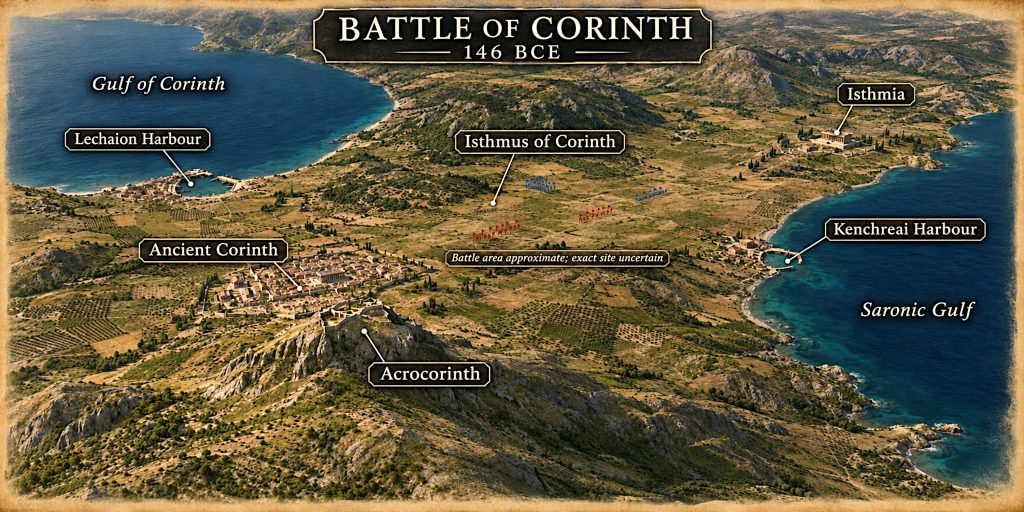
The Achaean League was a federation of Greek cities whose relationship with Rome had grown increasingly strained. A dispute involving Sparta and other League members brought Roman intervention into Greek politics. In 146 BCE, the confrontation became a war.
The League’s commander Critolaus was defeated by the Roman general Quintus Caecilius Metellus near Scarpheia. Critolaus disappeared, and Diaeus took command. He called up men of military age and ordered cities to provide armed, formerly enslaved men. Corinth became the gathering point for a force assembled under considerable pressure. Rome’s consul Lucius Mummius subsequently took command of the Roman campaign on the isthmus
Forces
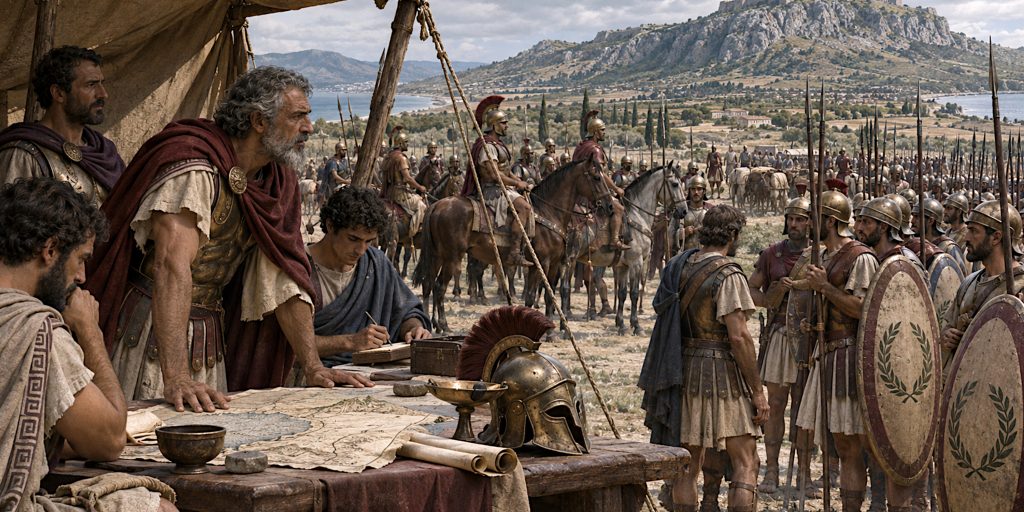
The surviving accounts give a figure for Mummius’ assembled army, but no equally secure total for the Achaeans. The Roman figures below come from Pausanias, who wrote centuries after the battle; they are ancient reported numbers, not a modern headcount.
| Side | Commander at Corinth | Reported strength | Troop composition |
|---|---|---|---|
| Roman Republic and allies | Lucius Mummius | 23,000 infantry and 3,500 cavalry, according to Pausanias | Roman and Italian troops, cavalry, Cretan archers and troops sent from Pergamon |
| Achaean League | Diaeus | Unknown | League infantry and cavalry, local levies and men armed through Diaeus’ emergency mobilisation |
Leaders and troop composition
- Lucius Mummius commanded the Roman force at the decisive battle. His army included allied troops and reinforcements; it should not be pictured as two isolated legions acting alone.
- Diaeus had inherited command after Critolaus’ defeat. Polybius describes his urgent demands for men, arms and money, which tell us more about the League’s predicament than any tidy estimate of its strength could.
- Critolaus led the earlier phase of the war but did not command the Achaeans at Corinth.
Arms and armour
No surviving inventory identifies the equipment of each soldier at Corinth. These are weapon types appropriate to the opposing forces in the mid-second century BCE, rather than finds proven to come from this battlefield.
| Force | Principal weapons | Swords and sidearms | Likely protection |
|---|---|---|---|
| Roman and Italian infantry | Javelins and thrusting spears, depending on troop type | Gladius Hispaniensis, a Roman sword suited to both cutting and thrusting | Shields, helmets and, for some soldiers, mail |
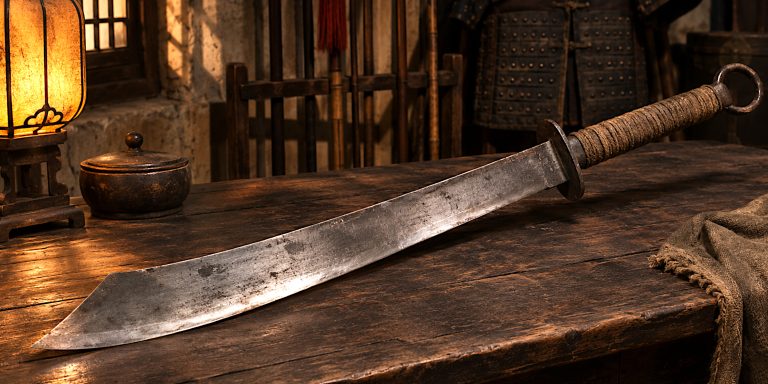
| Achaean infantry | Spears and other equipment that varied across the League’s contingents | Xiphos, a straight, double-edged sword; kopis, a forward-curved cutting sword that may also have been carried by some Greek fighters | Shields, helmets and armour of varying kinds and quality |
| Cavalry and supporting troops | Spears, javelins or bows according to role | Sidearms varied | Equipment varied |
A sword was useful when the fighting closed, but the sources do not describe a duel between Roman gladii and Greek xiphoi. Nor is there evidence for Roman lorica segmentata at this battle. The more revealing details in the account are the Achaean cavalry’s flight and the Roman attack on the infantry’s flank.
The battle outside Corinth
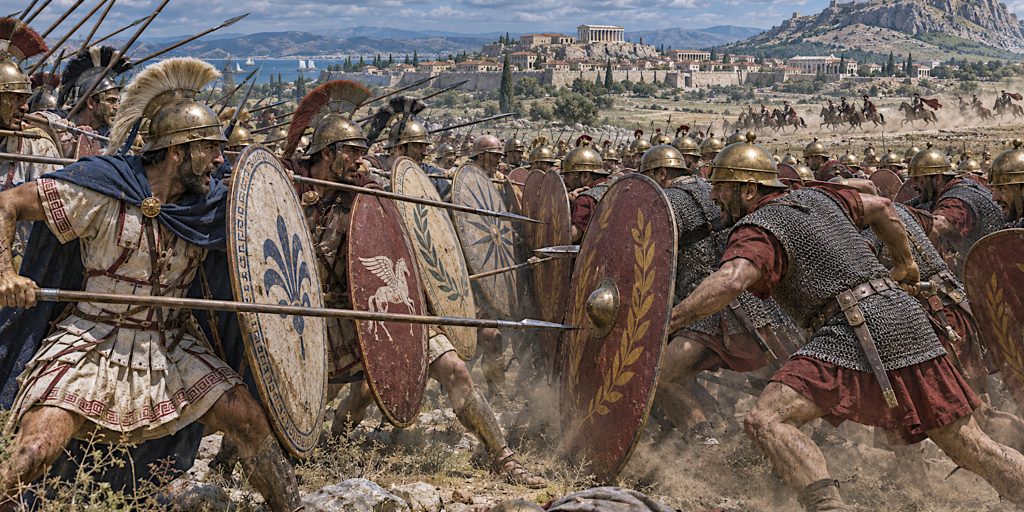
Pausanias says that the Achaeans first attacked a Roman outpost whose guards had grown careless. They killed or drove back some of its defenders and captured about 500 shields. It was a real success, though a dangerous one to mistake for a forecast. Encouraged, the Achaeans marched out to offer battle.
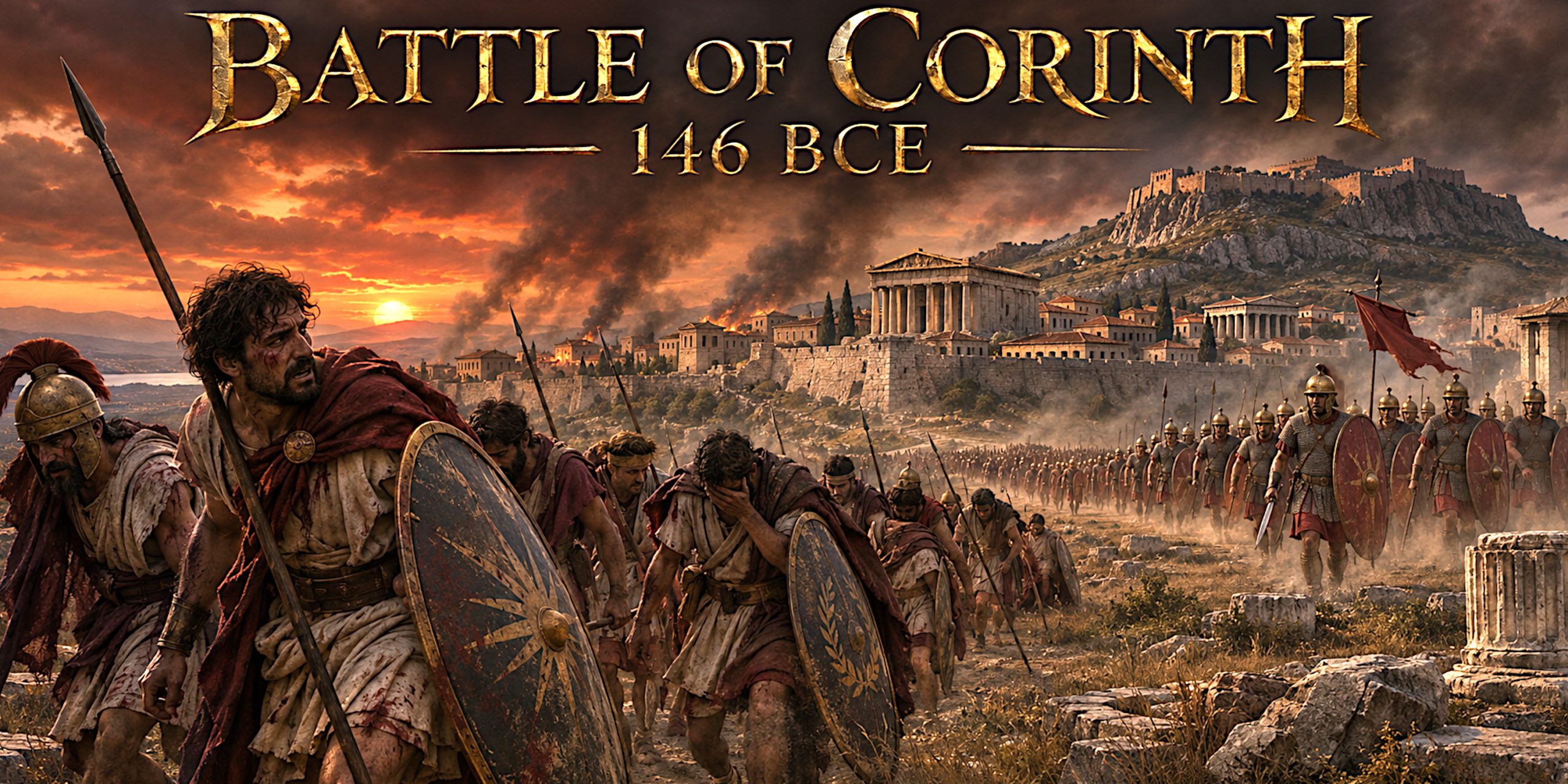
When Mummius advanced, the Achaean cavalry fled before meeting the Roman charge. Their infantry stood and fought, despite seeing the horsemen disappear. Pausanias credits them with determined resistance, then says that 1,000 selected Roman troops struck their flank and broke the line. Diaeus fled towards Megalopolis.
This was no account of a Greek army simply forgetting how to fight. Its infantry held for a time. The collapse of its cavalry, Roman numerical strength as reported by Pausanias, and the flank attack together explain the defeat more convincingly than a familiar claim that the phalanx had suddenly become obsolete.
The sack of Corinth
Some Achaean survivors reached Corinth, but Pausanias says they left during the night, along with many of the city’s inhabitants. Mummius initially hesitated to enter through the open gates because he feared an ambush. On the third day after the battle, Roman troops entered and set the city on fire.
Pausanias reports that many of those who remained were killed, while women and children were sold into slavery. Valuable artworks and offerings were taken away. Polybius, who lived through these events, gives a painfully concrete account of soldiers throwing paintings to the ground and playing dice on them. The fate of a city is often described in terms of policy; here, for a moment, we can see what the looting looked like.
Battle timeline
The ancient accounts establish the sequence more securely than they establish exact calendar dates.
| Date | Event |
|---|---|
| 146 BCE | Roman forces under Metellus defeat Critolaus near Scarpheia. |
| 146 BCE | Diaeus assumes command and gathers Achaean forces at Corinth. |
| Shortly before the main battle | Achaeans attack a Roman outpost and capture shields. |
| Battle outside Corinth | The Achaean cavalry flees; the infantry resists until a Roman flank attack breaks it. |
| Following night | Achaean survivors and many Corinthians leave the city. |
| Third day after the battle | Mummius’ troops enter Corinth; the city is sacked and partly burned. |
| 44 BCE | A Roman colony is founded on the site. |
Archaeology: how much of Corinth was destroyed?
The human and political consequences of 146 BCE were severe. The physical evidence, however, does not support a picture of every building reduced to ash. Archaeological study points to damage and the loss of Corinth’s civic life, while also finding that important structures survived. People and activity remained on the site before the Roman colony was founded in 44 BCE.
Evidence discussed by excavators and historians includes damage to some public buildings and inscriptions, alongside surviving structures and signs of later occupation. A destruction layer, weapon hoard or collection of bent Roman swords cannot simply be assigned to this battle without a securely documented find context. Corinth’s archaeological story is less cinematic than a single blanket of ash, and considerably more useful.
What the ancient writers said
Polybius provides an eyewitness observation from the sack, in the translation reproduced by Fordham’s Ancient History Sourcebook:
“I saw with my own eyes pictures thrown on the ground and soldiers playing dice on them.” sourcebooks.fordham.edu
Pausanias, writing much later, describes the moment the infantry’s defence failed:
“A thousand picked Romans fell upon their flank and utterly routed them.” Pausanias´ Description of Greece
These voices have different strengths. Polybius brings us close to the plunder; Pausanias supplies the fullest surviving account of the battle’s sequence. Neither gives us licence to invent a speech by Mummius or a precise modern casualty total.
Aftermath and legacy
The defeat ended the Achaean League’s attempt to resist Rome by force. Corinth lost its political standing, its people suffered killing and enslavement, and its art was dispersed. Yet the city’s later history also matters: activity continued among its surviving structures, and a Roman colony rose there in 44 BCE.
Corinth’s fall is sometimes made to stand for the instant death of Greek civilisation. That gives Rome rather too much credit. Greek cities, people and culture continued under Roman power. What ended at Corinth was the Achaean League’s capacity to make its own military choices, and for those caught in the sack, that distinction offered little comfort.
Sources
- Pausanias, Description of Greece, 7.16, for the battle, the entry into Corinth and its aftermath.
- Polybius, fragments on the Achaean War and sack of Corinth, for mobilisation and the account of looting.
- Corinth Computer Project, timeline of Corinth, for the city’s political and archaeological history.
- Corinth VII.7: Hellenistic Pottery: The Fine Wares, discussion of Corinth between 146 and 44 BCE, for the archaeological limits of the traditional account of total destruction.