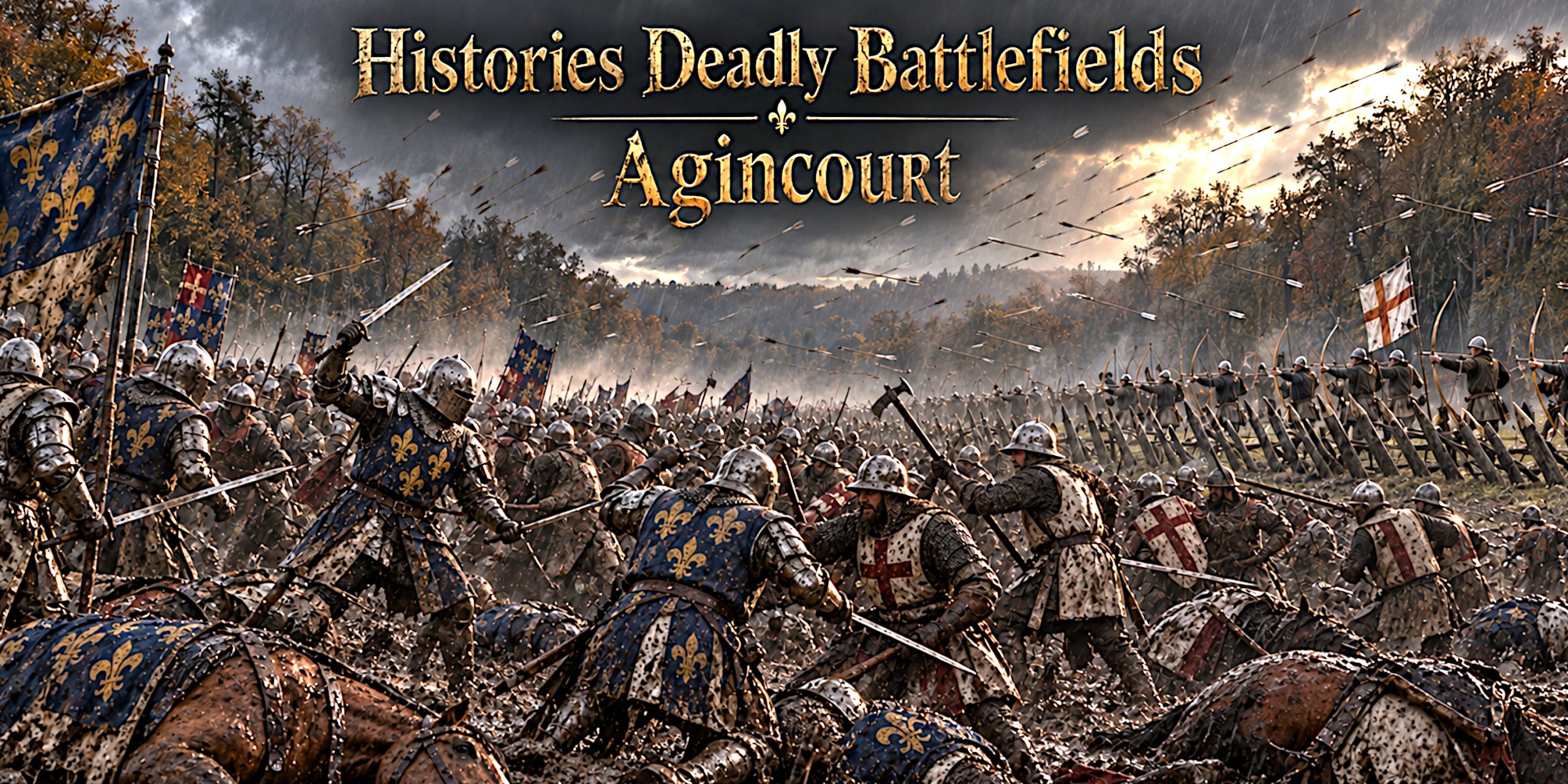
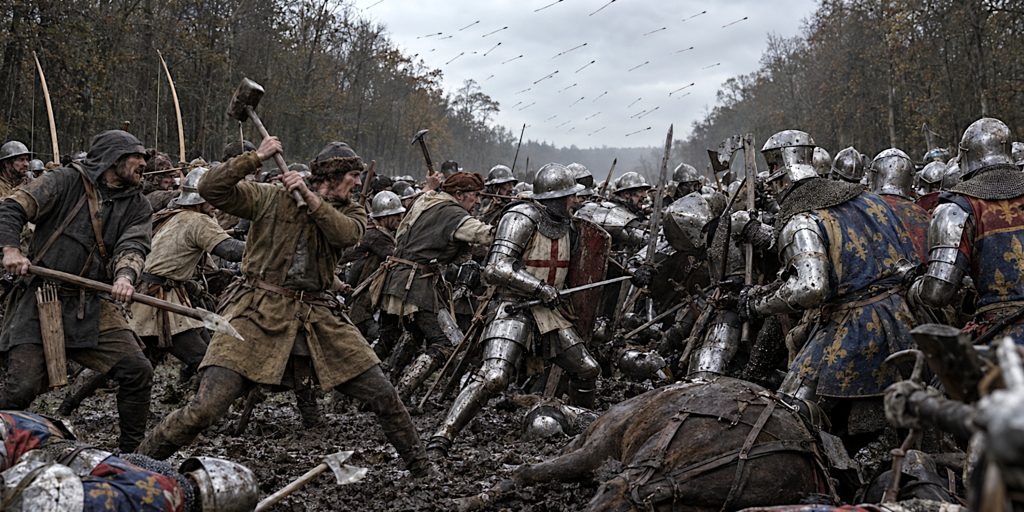
On 25 October 1415, a large French army advanced across a wet field towards an exhausted English force near Agincourt. It should have been the final, miserable chapter of Henry V’s campaign in France. Instead, the French attack collapsed into a congested struggle in which thousands of armoured men were pushed together, knocked down and killed.
The English longbow deserves its formidable reputation, but Agincourt was not won by archery alone. Geography restricted the French deployment. Rain softened the cultivated ground. Horses churned the surface into deeper mud. Dense French formations continued advancing into an area that became narrower with every step.
The battlefield did not swallow the French army by itself. It created the conditions in which weaknesses in the French battle plan became lethal.
Battle of Agincourt at a Glance
| Detail | Information |
|---|---|
| Date | 25 October 1415 |
| Location | Near Azincourt, northern France |
| War | Hundred Years’ War |
| English commander | Henry V |
| French commanders | Charles d’Albret and Marshal Boucicaut |
| English strength | Probably around 6,000 to 9,000 |
| French strength | Probably around 12,000 to 20,000 |
| Result | Decisive English victory |
| Main factors | Restricted ground, wet soil, longbow fire, formation density and close-quarter fighting |
The figures remain disputed. Medieval chroniclers were fond of enormous numbers, particularly when those numbers made victory look miraculous. Modern estimates are lower, although the French still held a substantial numerical advantage.
Where Was the Battle Fought?
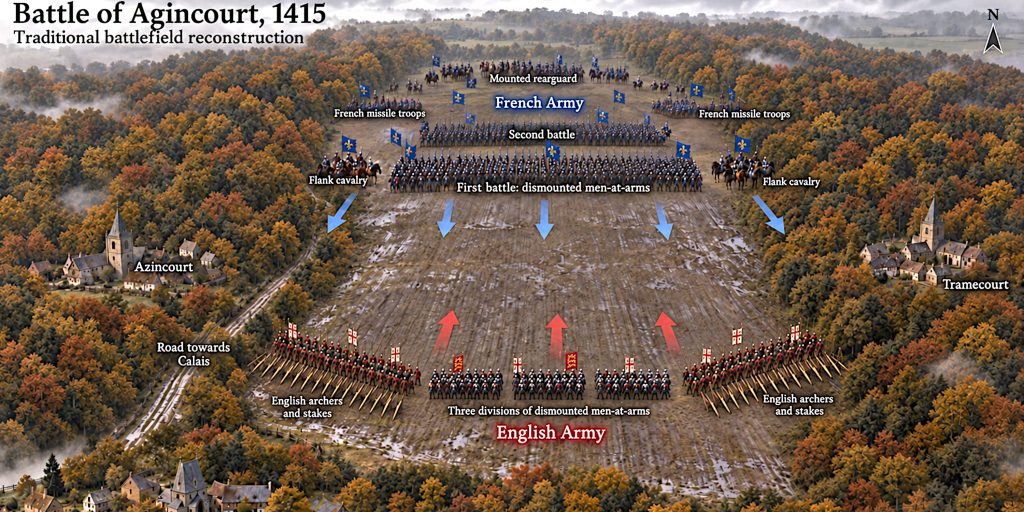
The traditional battlefield lies between the villages of Azincourt and Tramecourt in the Pas-de-Calais region of northern France. Henry’s army occupied the southern end of a cultivated corridor, with woods and settlements limiting movement on either side.
The English position was not an impregnable fortress. There was no great ridge, deep river or wall protecting Henry’s men. Its strength came from something less dramatic: limited space.
The French army had the numbers to surround or overwhelm the English, but the battlefield prevented it from using those numbers efficiently. As the French advanced, the available ground appears to have narrowed. Men approaching from a broad starting position were gradually compressed towards the English line.
This mattered enormously. A numerical advantage is useful when soldiers can deploy, manoeuvre and reinforce one another. Packed shoulder to shoulder in mud, it becomes a crowd-management problem involving swords.
The precise position and dimensions of the battlefield continue to be debated because archaeological evidence is limited. The traditional location remains widely accepted, but historians have proposed alternative alignments, including a battlefield farther west. The general tactical problem described in contemporary accounts remains consistent: the French advanced across restricted and difficult ground.
Why the Geography Favoured Henry V
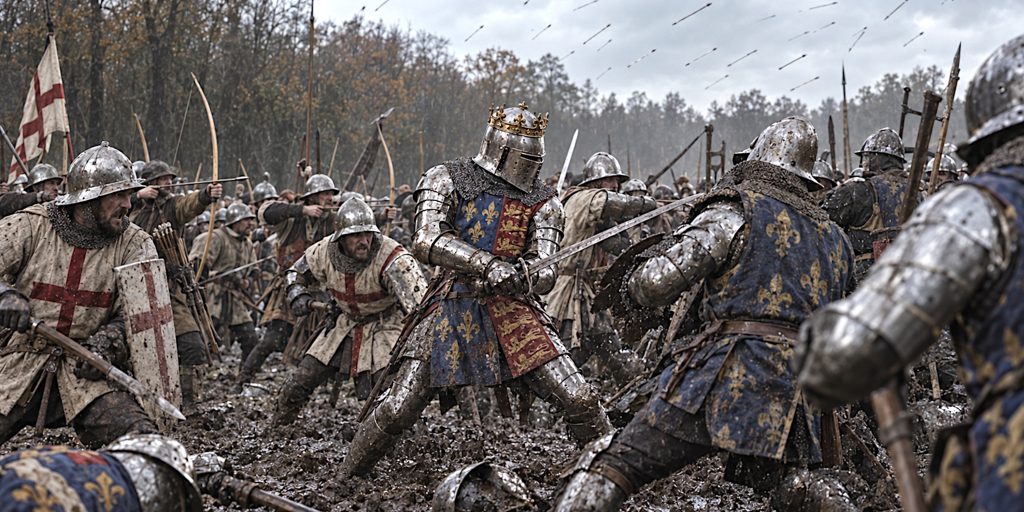
Henry needed a position that protected his flanks and forced the French to attack from the front. The ground near Agincourt offered exactly that.
The English army was too small to maintain a long battle line across open country. On a narrow frontage, however, Henry could place his men-at-arms in the centre and distribute groups of archers along the front and flanks.
The surrounding woods also made a wide cavalry sweep difficult. French mounted troops could not simply ride around the English position in large numbers and attack from behind. Their most obvious route was directly towards Henry’s line, across ground already covered by English archers.
The French had space behind their army, but comparatively little useful space at the point of contact. This allowed pressure to build from the rear while the leading ranks struggled to move or fight.
French numbers had become physically inconvenient before they became tactically disastrous.
How the Weather Changed the Ground
Heavy rain fell before the battle. The armies had spent the night outdoors, and the field between them consisted largely of recently worked agricultural soil.
The important point is not that the battlefield became a bottomless swamp. It did not. The danger came from wet, disturbed earth that grew progressively worse as thousands of men and horses crossed it.
The sequence was brutal:
- Rain softened the soil.
- Mounted troops broke and churned the surface.
- Advancing men-at-arms pushed through the damaged ground.
- Later ranks entered mud already disturbed by horses and earlier formations.
- Fallen men obstructed those still advancing.
- Pressure from behind restricted movement and made recovery difficult.
Mud increased the effort required for every step. Even a modest loss of footing was dangerous in a formation where men had little room to regain their balance.
The chronicler known as the Monk of Saint-Denis described the French as marching through mud in which they sank deeply, claiming that they were fatigued before reaching the enemy. The precise depth was probably not uniform across the field, but the underlying observation is credible: the advance exhausted and disordered the French formation.
Did French Armour Make the Mud Deadly?
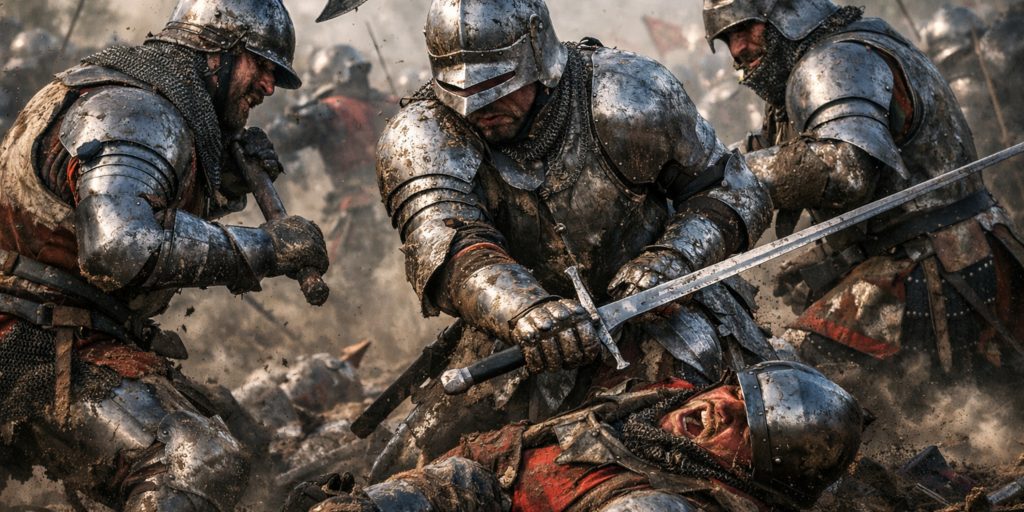
Plate armour did not usually render a man helpless. A properly fitted harness distributed weight across the body, and trained men-at-arms could run, climb and mount horses while wearing it. The popular image of a knight toppling over and waiting to be collected like an overturned tortoise is nonsense.
Agincourt was different because several problems arrived together.
French men-at-arms had to cross wet soil while being struck by arrows. They were advancing in a dense formation, sometimes with visors lowered and heads inclined. Men behind continued pressing forward while those ahead slowed down. Once the front ranks reached the English line, there was little room to use weapons effectively.
The armour protected many men from immediately fatal arrow wounds, but it could not prevent exhaustion, loss of balance or suffocation beneath other bodies. A man knocked down in open ground had a fair chance of rising. A man knocked down in mud while several ranks pushed over him had a very different afternoon ahead.
The anonymous English author of the Gesta Henrici Quinti described the effect:
“The living fell on top of the dead, and others falling on top of the living were killed as well.”
Translations differ, but the image is repeated across the narrative sources. The battlefield became crowded with bodies, and that obstruction made each subsequent French rank less effective.
The Armies and Their Troop Types
The English Army
| Troop type | Battlefield role |
|---|---|
| Longbowmen | Missile fire, flank protection and close combat |
| Men-at-arms | Held the centre and fought the French attack |
| Knights and nobles | Fought mainly on foot beside Henry |
| Servants and support troops | Guarded baggage and assisted the army |
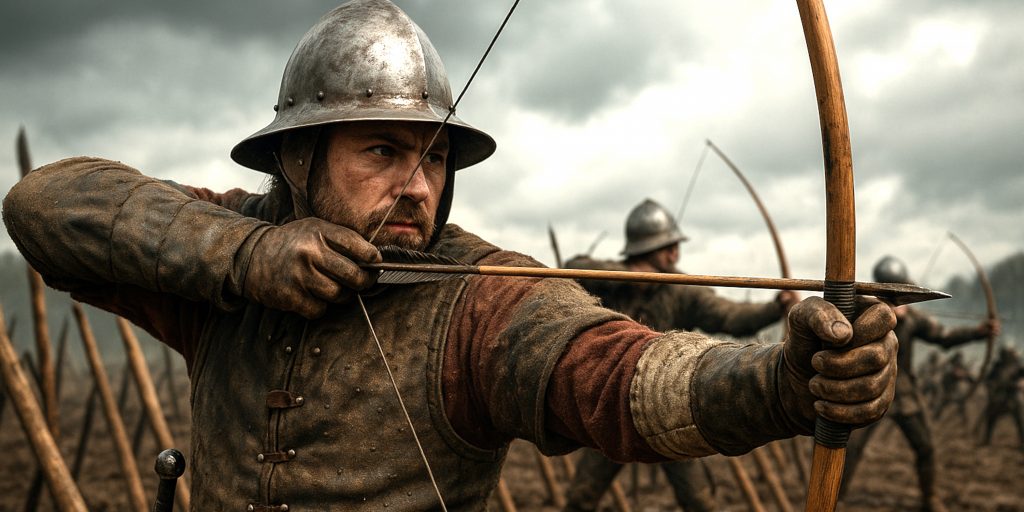
Archers probably formed the majority of Henry’s army. Many carried swords, daggers, mallets or axes in addition to their bows. Their wooden stakes provided protection against cavalry and helped define the English position.
English men-at-arms fought dismounted. This kept the centre compact and prevented valuable horses from becoming liabilities in the wet ground.
The French Army
| Troop type | Battlefield role |
|---|---|
| Dismounted men-at-arms | Main frontal assault |
| Mounted men-at-arms | Intended to attack and disrupt the archers |
| Crossbowmen | Missile troops, but used ineffectively |
| Archers | Present, though not given a decisive role |
| Later battles and retainers | Reinforcement and reserve |
The French plan relied heavily on their men-at-arms. Their own missile troops were poorly positioned to soften the English line, while the cavalry attacks on the English archers lacked the weight and coordination required.
France did not lose because it possessed the wrong kinds of soldiers. It lost because those soldiers were used in a way that magnified the battlefield’s limitations.
How the Longbow Shaped the French Advance
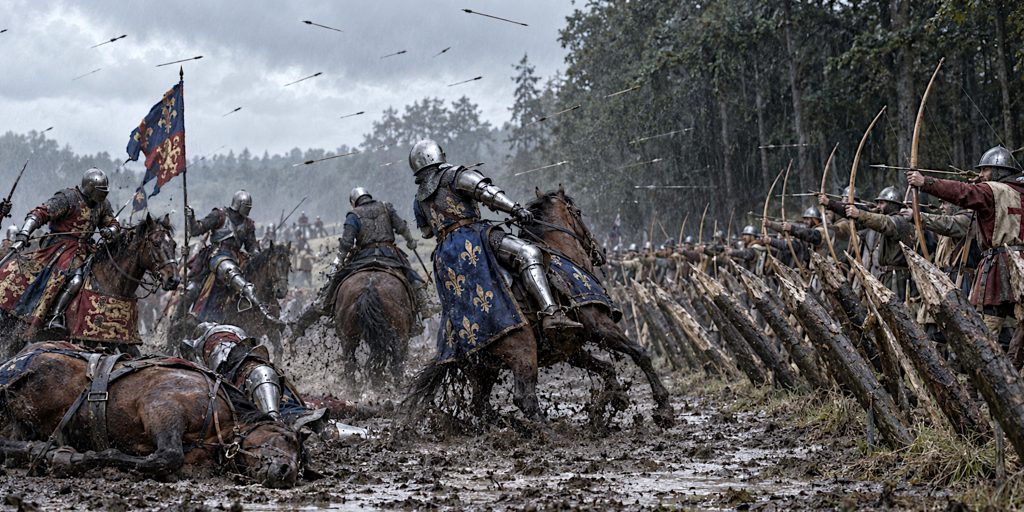
The longbow’s importance at Agincourt went beyond the number of men it killed at range.
An arrow might penetrate weaker parts of armour or injure an unprotected face, but good plate could resist many direct impacts. Horses were far more vulnerable. When the French mounted attack moved against the English archers, arrow fire wounded animals, disrupted formations and drove some horses back towards their own troops.
The retreating and uncontrolled horses further damaged the wet ground. They may also have collided with advancing French infantry.
English arrows forced the French men-at-arms to keep moving. Standing still beneath repeated volleys was not an attractive option. Many lowered their heads or closed their visors, reducing visibility and airflow as they crossed the field.
The longbow therefore acted as a weapon of disruption:
- It broke up the cavalry attack.
- It channelled the French towards the English centre.
- It forced armoured men to advance under pressure.
- It injured horses and disturbed the ground.
- It exhausted and disorganised the attacking formations.
- It allowed English archers to join the melee once their arrows were spent.
The arrows did not need to cut down every knight. They needed to deliver a tired and compressed enemy to Henry’s men-at-arms.
Why the French Formation Became So Crowded
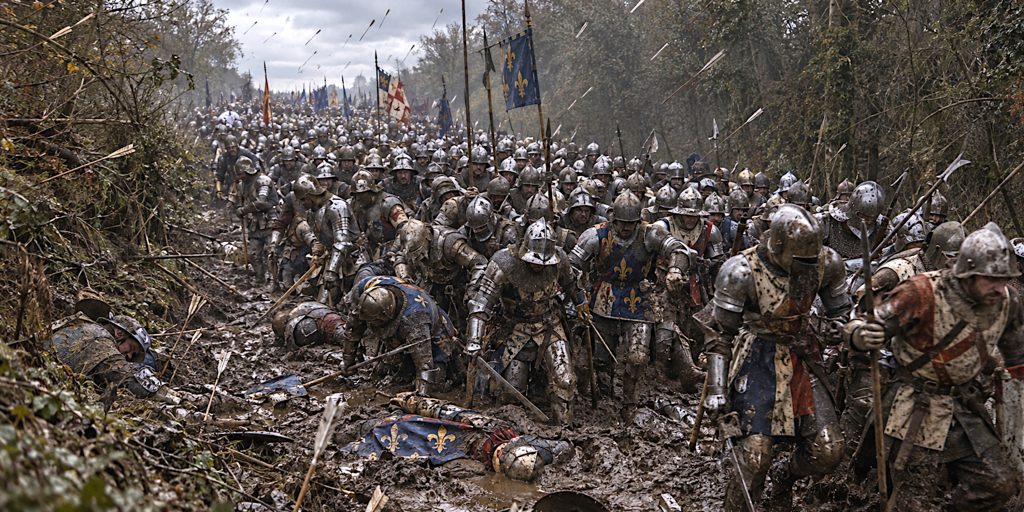
French nobles expected to occupy prestigious positions near the front. The desire to participate in the main assault appears to have increased the depth and density of the forward formations.
As the first French battle advanced, its ranks compressed. Men naturally moved away from arrow fire at the sides and towards the relative shelter of the centre. The narrowing ground made that instinct dangerous.
The Monk of Saint-Denis wrote that the men were packed so closely that those in the third rank could scarcely use their swords. Whether taken literally or as a chronicler’s exaggeration, the passage captures the central tactical failure.
A sword, pollaxe or lance requires space. At Agincourt, many French men-at-arms reached the enemy without enough room to strike properly. Those behind continued pushing, while wounded or fallen men accumulated beneath them.
The English line may have been driven back during the initial impact, but its men could fight with greater freedom. English archers then abandoned their bows and attacked from the sides using swords, axes, mallets and heavy wooden weapons.
At that point, the French numerical advantage was trapped behind its own front ranks.
Was Agincourt Really a Death Trap?
The phrase is fair, provided it is understood correctly. Henry did not carefully construct the battlefield as one might build a fortified killing ground. He recognised favourable terrain and used it well.
The French were not doomed from the moment they arrived. They had other options:
- Refuse battle and continue blocking Henry’s route.
- Deploy fewer men in the first assault.
- Give their crossbowmen and archers a greater role.
- Avoid a premature cavalry attack.
- Force the weakened English army to manoeuvre.
- Wait for hunger, sickness and exhaustion to worsen Henry’s position.
Instead, the French attacked under conditions that neutralised much of their superiority.
The death trap was therefore a combination of landscape and decision-making. Wet ground slowed the assault. Woods restricted movement. English archery increased disorder. Deep formations caused compression. Close combat completed the destruction.
Mud was the accomplice, not the mastermind.
Battle Timeline
| Approximate time | Event |
|---|---|
| Night of 24 October | Heavy rain worsens the cultivated ground. Both armies spend the night facing one another. |
| Early morning | Henry deploys his army between the woods, with men-at-arms in the centre and archers protected by stakes. |
| Morning | The armies wait. The French do not immediately attack, hoping the English will move first. |
| Late morning | Henry advances his line to within effective longbow range and orders the stakes replanted. |
| Shortly afterwards | English archers begin shooting, provoking the French response. |
| Opening attack | French cavalry attempts to attack the archers but is disrupted by arrows, stakes and difficult ground. |
| Main advance | The first French battle of dismounted men-at-arms crosses the muddy field under arrow fire. |
| First contact | French men-at-arms strike the English centre and initially force it backwards. |
| Melee | French ranks compress. Fallen men create obstacles while pressure builds from behind. |
| English counterattack | English archers enter the fight with swords, axes, mallets and other hand weapons. |
| Collapse | The French first and second formations become entangled. Many nobles are killed or captured. |
| Later phase | Reports of an attack on the English baggage and fears of renewed French action lead Henry to order many prisoners killed. |
| Afternoon | Organised French resistance ends. Henry retains control of the battlefield. |
Exact times cannot be securely reconstructed. Medieval chroniclers were witnesses and storytellers, not men checking wristwatches in a field full of arrows.
Contemporary Accounts of the Battlefield
Jean Le Fèvre de Saint-Remy, who was present with the English army, described French horses being thrown into confusion by the arrow storm. His account also records the English archers rushing into close combat once the French formation had stalled.
Enguerrand de Monstrelet similarly described the French advance becoming disordered and the English archers entering the melee. He noted the great shout raised by the English as the battle began, which caused astonishment among the French.
The Gesta Henrici Quinti, written by an author attached to Henry’s campaign, placed particular emphasis on the crushing density of the French formation:
“So great was the pressure of the mass of men behind them that the living fell on top of the dead.”
These accounts were not neutral reports. The Gesta presented Henry’s victory as evidence of divine favour, while Burgundian writers brought their own political sympathies. Their casualty estimates and dramatic language must be treated cautiously.
Yet they broadly agree on several physical features of the fighting: wet ground, a constricted advance, disrupted cavalry, tightly packed men-at-arms and an English counterattack once the French formation lost cohesion.
How Much Did the Mud Really Matter?
The mud mattered greatly, but it should not be allowed to explain everything.
It did not make plate armour useless. It did not prevent all Frenchmen from reaching the English line. It did not win the battle before the fighting began.
Its effect was cumulative. The wet soil consumed energy, slowed movement and made formations less stable. Horses worsened the surface. Arrows forced the attackers to keep moving and seek protection. Narrow ground concentrated the French ranks. Bodies and wounded men created further obstacles.
If the same armies had fought on dry, open ground, French cavalry and larger numbers would have been much harder to contain. If the English had lacked longbows, the French could have crossed the field with less disruption. If the French had attacked in better-controlled waves, the congestion might have been reduced.
Agincourt was decided by interaction rather than one magical weapon or one especially vindictive patch of mud.
Why Agincourt Became a French Catastrophe
The French army entered the battle with more men, more nobles and considerable fighting experience. What it lacked was a plan suited to the ground in front of it.
The battlefield narrowed its front. The weather damaged its footing. Its cavalry churned the approach. English arrows disrupted movement. The leading men-at-arms arrived exhausted, crowded and unable to use their weapons freely.
Once those men fell, the battlefield became an obstacle made from armour, bodies and frightened soldiers.
Henry V’s achievement was not simply surviving the French assault. He placed a missile-heavy army in terrain that made a direct attack costly, then allowed the French command to choose exactly that attack.
Agincourt was not proof that Englishmen were naturally superior, that knights were helpless in armour or that the longbow could punch through anything placed before it. It was an example of terrain, weather and troop deployment combining with unusually savage efficiency.
The French had the larger army. The battlefield ensured that only part of it could fight, and even that part could barely move.
Sources and Further Reading
- De Re Militari: Enguerrand de Monstrelet’s account of Agincourt
- Anne Curry, Agincourt: A New History
- Juliet Barker, Agincourt: The King, the Campaign, the Battle
- Christopher Hibbert, Agincourt
- Michael Livingston, Agincourt: Battle of the Scarred King
- Gesta Henrici Quinti, translated in collections of contemporary Agincourt sources
- Chronique du Religieux de Saint-Denys, commonly known as the Chronicle of the Monk of Saint-Denis