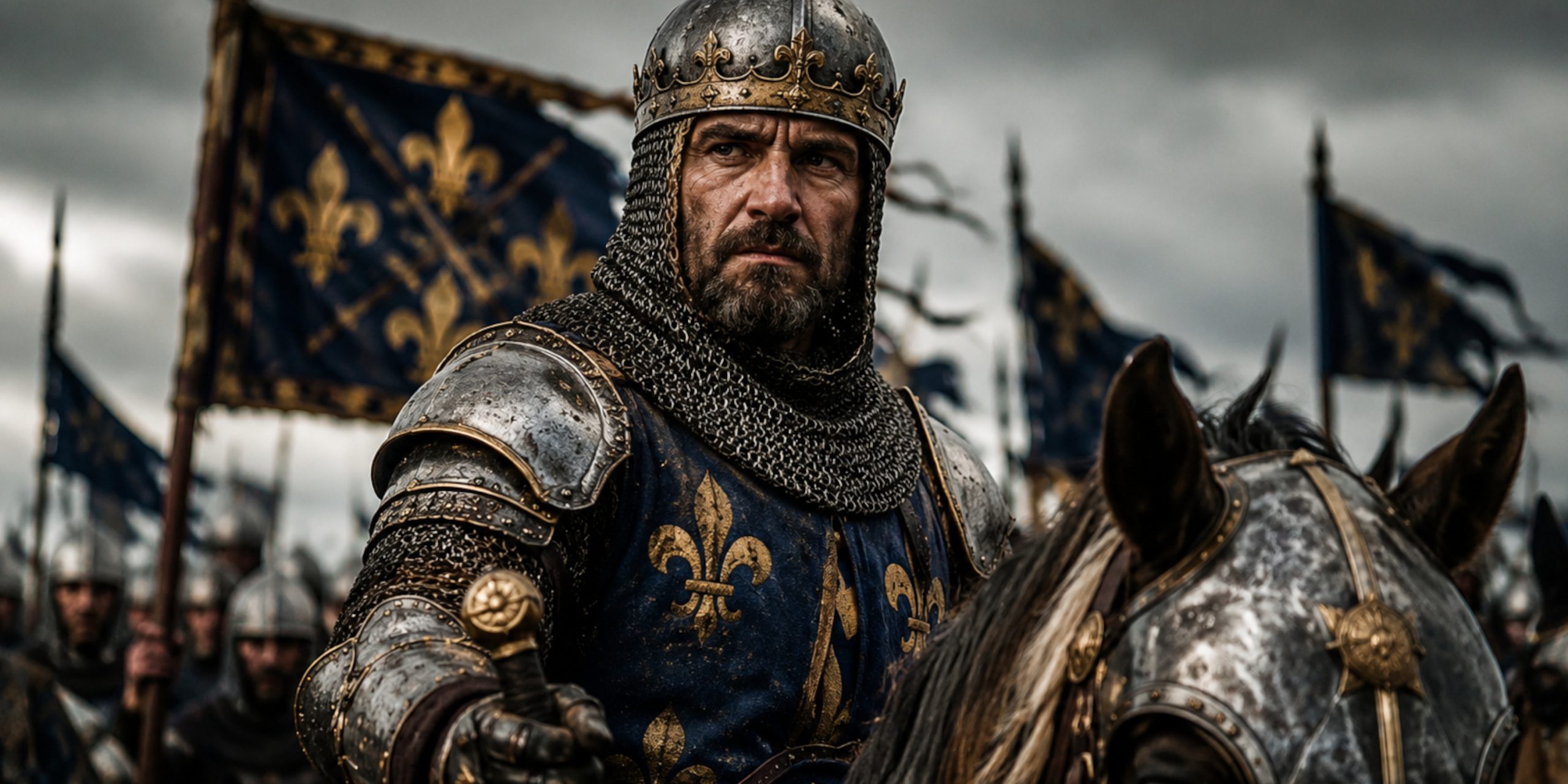
Jean II Le Maingre, better known as Boucicaut, was one of the most celebrated knights of the late medieval world. Born around 1366, he became Marshal of France, fought across Europe and the Mediterranean, and built a reputation as the living image of chivalry.
The fascinating thing about Boucicaut is the contrast. Medieval writers presented him almost as a knight from a romance: fearless, honourable, devout and impossibly skilled with weapons. Yet behind the heroic image was a practical soldier operating in one of the most brutal and politically unstable periods of the Middle Ages.
He fought crusaders, Ottomans, Italians and English armies. He defended cities, commanded fleets and survived disasters that destroyed the reputations of others. His story feels like the final chapter of an older knightly tradition before gunpowder, professional armies and changing tactics reshaped warfare forever.
Early Life and Rise
Jean II Le Maingre was the son of Jean I Le Maingre, who had also served as Marshal of France. The nickname “Boucicaut” came from his family and was passed from father to son.
From a young age he was immersed in the martial culture of the French nobility. He entered royal service as a page and developed a reputation for physical training and discipline.
According to the famous biography Le Livre des faits du bon messire Jean le Maingre, dit Bouciquaut, he followed an intense training routine:
- Running long distances in armour
- Vaulting onto horses without using stirrups
- Climbing walls using only his hands
- Practising swordplay and wrestling
- Repeated exercises to improve endurance
Some medieval biographies were written to flatter their subjects, so we should treat the details carefully. Even so, Boucicaut’s reputation as an unusually athletic knight appears well deserved.
Anyone who has tried moving in full plate armour for five minutes will appreciate the commitment. Medieval knights were not slow metal statues, and Boucicaut seems to have spent his life proving that point.
Becoming Marshal of France
Boucicaut was knighted in 1384 and quickly became one of the most respected warriors in France.
His career included campaigns in:
- Prussia with the Teutonic Knights
- Spain during the later stages of the Hundred Years’ War
- The Balkans against the Ottoman Empire
- Italy during French involvement in Mediterranean politics
In 1391, aged around 25, he was appointed Marshal of France by Charles VI. This was an extraordinary achievement, placing him among the highest military officers in the kingdom.
Battles and Military Acumen
Boucicaut’s military career was dramatic. He experienced moments of brilliance but also became associated with some of the greatest French defeats of his generation.
Battle of Nicopolis (1396)
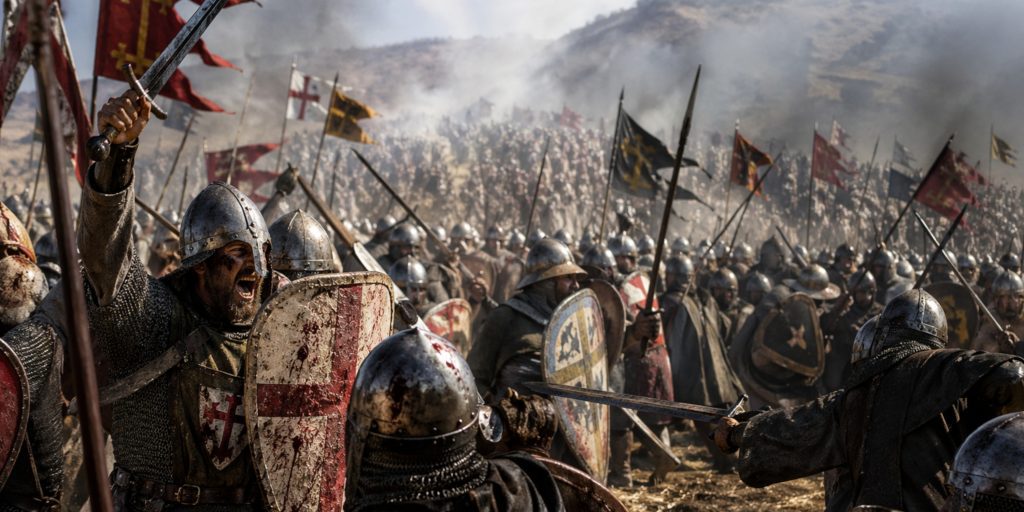
Conflict: Crusade of Nicopolis
Opponents: European crusader coalition vs Ottoman Empire
Main Ottoman commander: Sultan Bayezid I
Nicopolis was intended to halt Ottoman expansion into Europe. Boucicaut joined a large crusading force made up of French, Burgundian, Hungarian and allied troops.
The French knights launched a fierce cavalry attack and initially overwhelmed Ottoman infantry positions. The problem came afterwards. Exhausted and disorganised, they encountered Bayezid’s main forces.
The result was a disaster.
Boucicaut fought bravely but was captured. Many prisoners were executed, but his noble status and value as a ransom saved his life.
Nicopolis showed both the strength and weakness of late medieval chivalry: extraordinary courage, but sometimes too much faith in a direct charge.
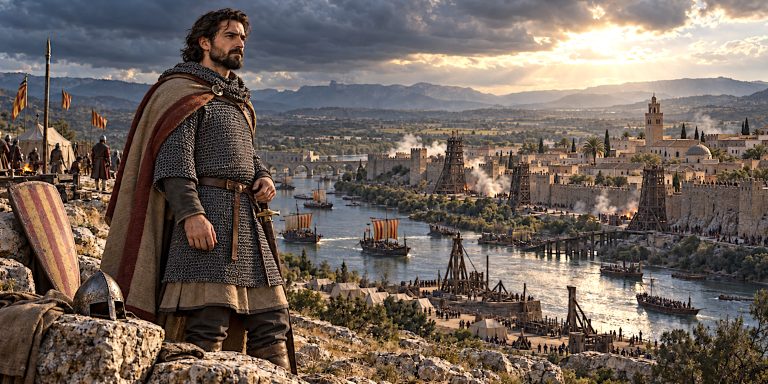
Defence of Constantinople (1399 to 1402)
After his release, Boucicaut led French forces to support the Byzantine Empire against Ottoman pressure.
His expedition helped defend Constantinople during a critical period, improving fortifications and launching aggressive raids.
Although he could not permanently solve Byzantium’s problems, his actions helped buy valuable time. The city would survive until 1453.
Governor of Genoa
In 1401, Boucicaut became French governor of Genoa. This was not simply a military appointment. Genoa was wealthy, politically unstable and extremely difficult to control.
He strengthened French influence, commanded naval operations and attempted to impose order among rival factions.
His time there revealed another side of his career. Boucicaut was not only a battlefield knight. He understood administration, diplomacy and maritime warfare.
Battle of Agincourt (1415)
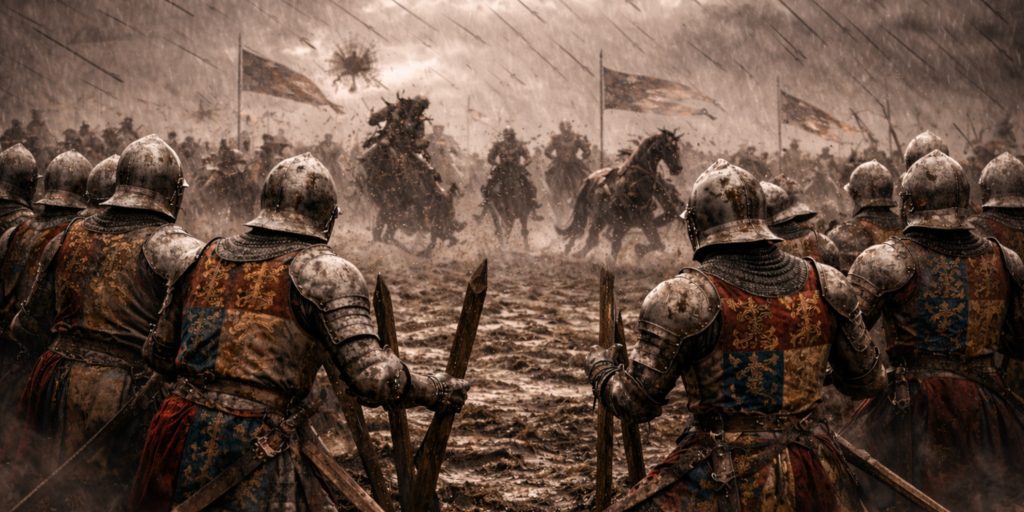
Conflict: Hundred Years’ War
Opponents: France vs England
English commander: Henry V
Agincourt became the defining tragedy of Boucicaut’s later life.
By this stage he was one of France’s senior commanders. The French army had enormous confidence, but poor battlefield conditions, command disagreements and English defensive tactics created a catastrophe.
French men-at-arms advanced through deep mud under heavy English longbow fire. The compressed battlefield prevented them from fighting effectively.
Boucicaut survived but was captured.
He spent his final years as a prisoner in England, dying in Yorkshire in 1421.
Arms and Armour of Jean II Le Maingre
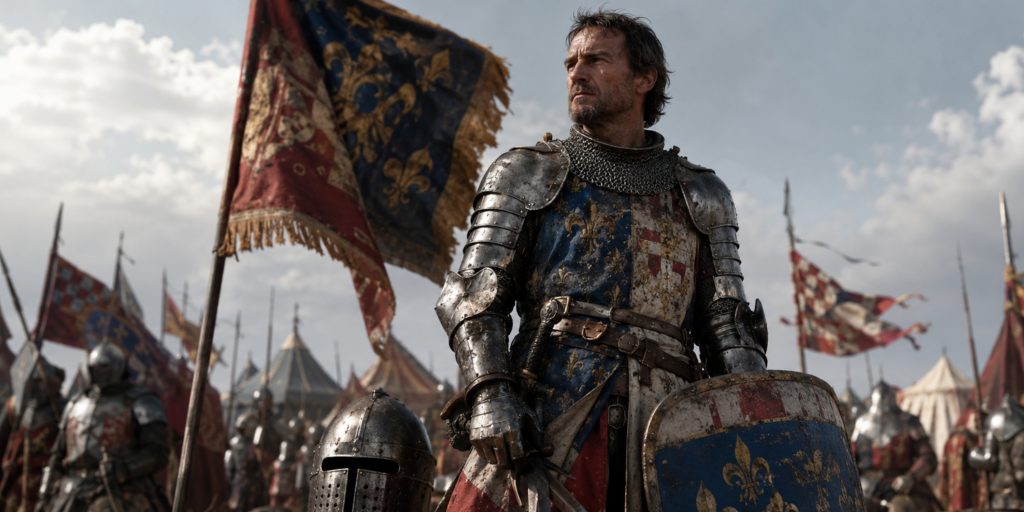
Boucicaut lived during one of the most important transitional periods in medieval armour development. By his lifetime, elite knights were moving from mail-dominated protection towards advanced plate armour.
Armour
A knight of Boucicaut’s status would likely have worn:
Bascinet helmet
- Popular among knights of the late 14th century
- Often fitted with a pointed hounskull visor
- Protected by a mail aventail around the neck
Plate harness
- Steel breastplate
- Backplate
- Arm harness with couters and vambraces
- Plate gauntlets
- Leg armour including poleyns and greaves
Mail protection
- Used beneath plate
- Protected gaps around joints
By Agincourt, French nobles were wearing some of the finest armour ever produced in medieval Europe.
Weapons Used by Boucicaut
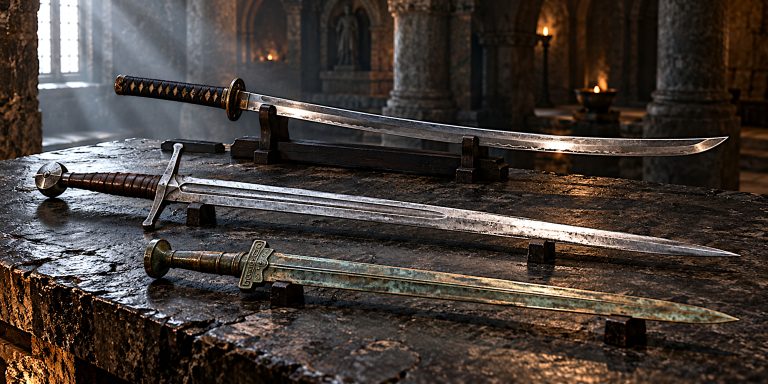
Arming Sword
The classic knightly sidearm.
Likely examples:
Features:
- Straight double edged blade
- Effective cuts and thrusts
- Designed for use against increasingly armoured opponents
Longsword
The longsword became increasingly important during Boucicaut’s lifetime.
Advantages:
- Two handed control
- Strong thrusting ability
- Useful in armoured combat techniques
Against plate armour, knights often used half swording, gripping the blade with one hand to drive the point into armour gaps.
Lance
The weapon that defined heavy cavalry.
Used for:
- Shock charges
- Breaking enemy formations
- Tournament combat
Dagger
Common types:
- Rondel dagger
- Ballock dagger
The rondel dagger was especially associated with armoured fighting, where close combat often ended with attempts to penetrate weak points.
Boucicaut’s Chivalric Reputation
Boucicaut founded the Order of the White Lady of the Green Shield, a knightly order supposedly dedicated to defending noblewomen.
Modern historians debate how much this reflected genuine ideals versus aristocratic image building. Medieval nobles were very aware of reputation, and Boucicaut’s biography was designed to preserve his fame.
Still, there is evidence he took knightly values seriously. He was praised for:
- Courage
- Religious devotion
- Discipline
- Loyalty
- Protection of prisoners and civilians
The complicated truth is that chivalry existed alongside the violence of medieval warfare. Knights could genuinely believe in honour while participating in conflicts that were anything but gentle.
Artefacts Connected to Boucicaut and His Era
No complete surviving armour set can confidently be identified as belonging personally to Boucicaut. However, several collections preserve objects that show the military world he inhabited.
Musée de l’Armée, Paris
Where to see:
- Late medieval French armour
- Knightly weapons
- Hundred Years’ War material
Highlights:
- 14th and 15th century swords
- Bascinets
- Plate armour developments
Royal Armouries, Leeds
Important collection containing:
- Medieval European swords
- Plate armour
- Polearms
- Examples of knightly battlefield equipment
These pieces help illustrate what a noble commander like Boucicaut would have carried.
Metropolitan Museum of Art, New York
The Arms and Armor collection includes:
- European harnesses
- Medieval swords
- Tournament equipment
Many examples date slightly later but show the evolution of the technology that began during Boucicaut’s lifetime.
Archaeology and Recent Historical Research
Recent studies of late medieval warfare have changed how historians view knights like Boucicaut.
Key areas include:
Battlefield Archaeology
Research around Agincourt has focused on:
- Terrain reconstruction
- Movement of armoured soldiers
- Effects of mud and battlefield compression
- Longbow effectiveness
The older image of helpless knights unable to move has largely been rejected. The real problem was tactical: exhaustion, crowding and lack of space.
Armour Research
Modern experiments with replica armour have shown:
- Full harness allowed running and climbing
- Weight was distributed efficiently
- Elite knights trained like professional athletes
This supports some descriptions of Boucicaut’s physical abilities, even if medieval writers exaggerated the details.
Manuscript Studies
Boucicaut is also associated with the famous Boucicaut Master, an anonymous illuminator responsible for some of the finest manuscript artwork of the early 15th century.
The connection reflects his world: a place where warfare, religion, politics and art were deeply connected.
Death and Legacy
Jean II Le Maingre died in English captivity in 1421.
His life represents the peak and decline of medieval chivalric warfare. He was not a relic who failed to understand changing times. He adapted to siege warfare, naval campaigns and international politics.
Yet he belonged to a generation caught between two military ages. The knight remained powerful, but discipline, combined arms tactics and professional infantry were becoming increasingly important.
Boucicaut may not have won every battle, but few medieval warriors experienced such a wide range of conflicts or left behind such a vivid picture of what a knight aspired to be.
He was brave, flawed, ambitious and probably exhausting to compete against. In many ways, that makes him far more interesting than the perfect knight imagined by medieval romance.