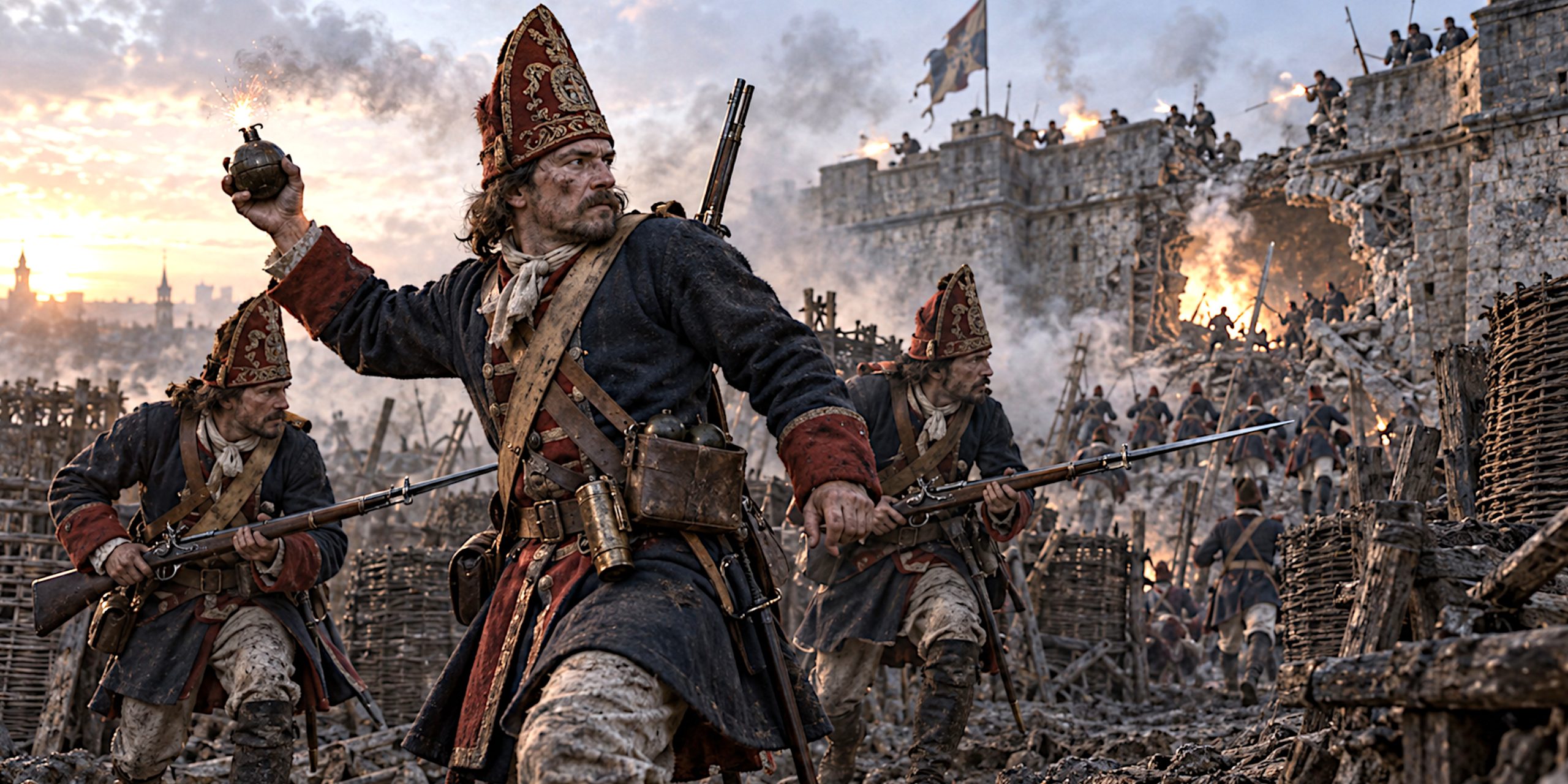
Grenadiers began as specialist soldiers trusted with one of the most temperamental weapons on the early modern battlefield: a hollow bomb filled with gunpowder and fitted with a burning fuse. By the eighteenth century, many grenadiers rarely threw grenades at all. The title survived because it had acquired a second meaning. A grenadier was now a large, experienced and conspicuous infantryman expected to lead assaults, steady a line and look suitably alarming on parade.
That transformation is the heart of their history. Grenadiers were never simply human artillery. They belonged to a changing culture of siegecraft, disciplined infantry and military display. Their tall caps, moustaches and proud position on the right of the line became more durable than the weapon that had created them.
I find them fascinating partly because they expose an old military habit: once an elite identity has been invented, armies are very reluctant to surrender it. The grenade might vanish from routine service, but the splendid cap and superior status were apparently non-negotiable.
Grenadiers at a Glance
| Feature | Typical early modern form |
|---|---|
| Main period | Late seventeenth to early nineteenth century |
| Original role | Throwing hand grenades during assaults and sieges |
| Later role | Elite or senior line infantry, assault troops and guards |
| Principal weapon | Flintlock musket with bayonet |
| Specialist weapon | Black-powder hand grenade |
| Sidearms | Hanger, infantry sabre, briquet or officer’s smallsword |
| Distinctive equipment | Grenade pouch, match case and tall brimless cap |
| Typical recruitment | Strong, experienced and often taller soldiers |
| Common deployment | Grenadier company on the right of a battalion, or combined grenadier battalions |
What Was a Grenadier?
In its earliest formal sense, a grenadier was an infantryman selected and trained to throw hand grenades. The weapon was most useful in confined fighting: trenches, breaches, covered ways, fortified buildings and the decks of ships. A grenade could be thrown over a parapet or through an opening where a musket ball could not readily reach.
The soldier required strength, nerve and judgement. He had to manage a musket, a grenade pouch and a length of burning match while advancing close enough to make a short-ranged explosive worthwhile. A badly judged fuse could achieve the opposite of the intended effect with distressing efficiency.
Grenadiers gradually became permanent companies within infantry regiments. In British practice, the grenadier company held the place of honour on the right of the battalion. Other European armies developed comparable organisations, though their names, uniforms and administrative arrangements varied.
By the middle of the eighteenth century, grenades were no longer the normal working weapon of most grenadier companies. Yet the men retained their senior status. The grenadier had evolved from a technical specialist into a category of elite infantry.
The Origins of the Grenadier
Gunpowder-filled vessels existed long before the formal grenadier. Ceramic, glass and metal incendiaries or explosive containers had been used in siege warfare in Europe, Asia and the Islamic world. What changed during the seventeenth century was the integration of selected grenade throwers into increasingly regular European armies.
The exact claim to the first grenadier company is disputed. Specialist grenade throwers appear in several armies around the middle decades of the seventeenth century. France formalised grenadier units under Louis XIV, while English evidence places recognised grenadiers in service by the 1670s. Austrian, Spanish, Dutch and other forces developed similar troops.
John Evelyn recorded their arrival in English service in 1678:
“Now were brought into service a new sort of soldier called grenadiers, who were dexterous to fling hand grenades.”
He also noted their pouches and furred caps, adding that the latter made them look fierce. The remark captures both halves of the grenadier identity: practical equipment and calculated intimidation.
The rise of grenadiers belonged to a wider military transformation. Standing armies expanded, drill grew more standardised and infantry units acquired specialised companies. Grenadiers fitted this system neatly. They were selected men with a defined place in battle, a distinctive appearance and duties that could be rehearsed.
How the Hand Grenade Worked
An early modern hand grenade was usually a hollow sphere with an opening for a fuse. Its shell might be made from cast iron, ceramic, glass or another material. It was filled with gunpowder and sealed around a slow-burning fuse.
The basic sequence was simple on paper:
- Prepare the grenade and fuse.
- Light the match or apply a burning match to the fuse.
- Allow enough time for ignition.
- Throw the grenade towards the enemy.
- Take cover, assuming cover was available and the fuse had behaved itself.
In practice, almost every stage introduced uncertainty. Powder quality varied. Fuses did not burn with modern consistency. A grenade might fail to burst, fragment unpredictably or be thrown back. Thick iron shells could produce dangerous fragments, but weak casings might split poorly. Ceramic and glass bodies behaved differently and were easier to manufacture in some circumstances.
Grenades were carried in a pouch or budget slung from the shoulder. Grenadiers also carried a match case, often attached to their equipment, so that a smouldering match could be protected until required. Surviving drill images show the grenade exercise broken into deliberate movements. Commands such as “Handle your Match”, “Handle your Granade” and “Throw your Granade” make the procedure sound reassuringly controlled. Live gunpowder presumably restored the missing sense of urgency.
Recruitment and Training
Grenadiers were generally chosen from experienced, physically capable soldiers. Height became a particularly visible qualification during the eighteenth century, although standards differed between states, regiments and periods. Tall men looked impressive in formation and reinforced the status of the company.
Strength mattered, but the popular image of a grenadier hurling an iron ball an enormous distance is misleading. The operational range was short. Courage and steadiness were at least as important as throwing power. The grenadier needed to approach defensive works, keep his match alight and release the weapon at the right moment.
Training included ordinary infantry drill as well as the specialist grenade exercise. A grenadier still had to load and fire a musket, march in formation, use the bayonet and obey rapidly transmitted commands. Once grenade throwing declined, these conventional infantry skills became the substance of his battlefield work.
Selection also created a regimental hierarchy. Grenadier companies accumulated veterans and imposing men who could be used for difficult tasks. Their elite reputation therefore became partly self-sustaining. Give one company the best recruits, the place of honour and the most splendid headgear, and it will soon acquire a formidable opinion of itself.
Arms and Armour
Hand grenades
The earliest defining weapon was the black-powder grenade. Surviving examples vary considerably in size, material and wall thickness. There was no universal European pattern. Some were compact enough for hand throwing, while larger explosive shells belonged to mortars rather than grenadiers.
Muskets and bayonets
Grenadiers carried the standard infantry firearm of their army. Matchlocks remained present in the seventeenth century, but flintlock muskets became dominant. British grenadiers of the eighteenth century used weapons such as the Long Land and Short Land Pattern muskets, commonly gathered under the later nickname “Brown Bess”.
The socket bayonet allowed a musket to remain loaded and fired while the blade was fixed. This made it especially useful for assault infantry. By the eighteenth century, the musket and bayonet were far more important to the grenadier’s daily battlefield role than the grenade itself.
Swords and sidearms
The swords associated with grenadiers depended on rank, nationality and date:
- Infantry hanger: A short, single-edged or slightly curved sword carried by some enlisted infantry during the late seventeenth and eighteenth centuries. It was practical in close quarters and less cumbersome than a cavalry sword.
- Grenadier sabre or briquet: Continental grenadiers, particularly in French and allied traditions, could carry a short sabre with a compact brass hilt. The later term briquet is commonly applied to this family of infantry sidearms.
- Faschinenmesser: German-speaking armies used robust, short-bladed sidearms that could serve as weapons and tools, particularly when working around field defences.
- Smallsword: Grenadier officers in the late seventeenth and eighteenth centuries often carried the gentlemanly smallsword as a badge of rank and personal sidearm.
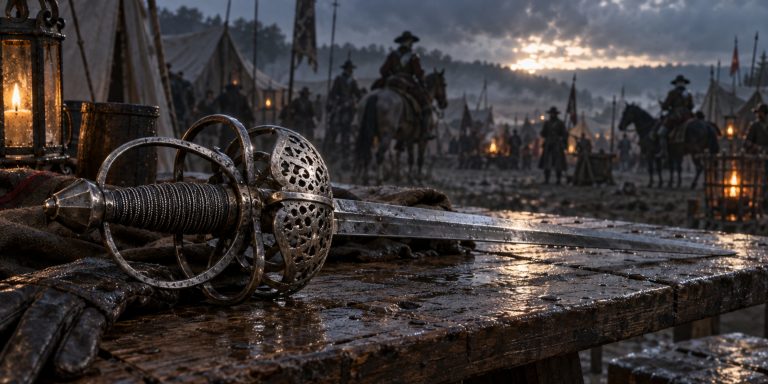
- Infantry officer’s sabre: Curved officer’s swords became increasingly common in the later eighteenth and early nineteenth centuries. British grenadier and light-company officers were associated with the Pattern 1803 flank officer’s sword at the end of the period.
Grenadier officers might also carry a spontoon or fusil according to army and date. Uniform regulations were ideals rather than magical spells. Campaign losses, private purchase and local supply ensured that real companies were often less tidy than the plates suggest.
Armour
Grenadiers did not normally wear body armour. The seventeenth-century decline of armour among ordinary infantry affected them as it did musketeers. A buff coat or older protective equipment might occasionally appear during the earlier period, but by the mature age of the grenadier company, cloth uniform and courage were the usual defences. The latter was not notably good at stopping musket balls.
Uniforms and the Famous Grenadier Cap
The grenadier’s most recognisable feature was his tall, brimless headgear. Early forms included cloth mitre caps and fur caps. Designs varied widely across Europe and evolved over time.
British grenadiers became known for mitre-shaped caps with embroidered fronts. French grenadiers often retained tricornes for much of the eighteenth century, while some wore bearskin caps. Prussian, Russian, Austrian and other armies developed their own mitres, metal-fronted caps or fur styles. By the Napoleonic period, bearskins had become strongly associated with elite grenadiers in several armies.
It is often claimed that the brimless cap existed so a grenadier could throw without knocking off a broad-brimmed hat. There is some practical sense in avoiding an obstructive brim, but the familiar explanation is too neat. Grenades could be thrown underarm, and ceremonial display became at least as important as function. Height, decoration and fur made the wearer appear larger. That mattered in an age when uniform was meant to communicate status before anyone had fired a shot.
Grenade badges, flaming ornaments, lace and distinctive shoulder decorations continued long after grenades ceased to be routinely carried. The symbol had become institutional property.
Grenadiers in Battle
Siege assaults
Grenadiers were at their most historically appropriate during siege warfare. They could support attacks on trenches, outworks, gates and breaches, where short-range explosives might drive defenders away from cover. They also joined storming parties and other dangerous detachments.
Open battle
In line battles, grenadiers fought chiefly as musket-armed infantry. Their company occupied an honoured flank position, while commanders could detach grenadier companies from several regiments and combine them into temporary battalions. These formations concentrated experienced troops for assaults or reserve duties.
Grenadiers served in the major European wars of the period, including:
- The Nine Years’ War
- The War of the Spanish Succession
- The Great Northern War
- The War of the Austrian Succession
- The Seven Years’ War
- The American War of Independence
- The French Revolutionary and Napoleonic Wars
At Blenheim in 1704, grenadiers fought as part of the hard struggle for villages and river crossings. During the Seven Years’ War, Frederick the Great’s army used grenadier battalions assembled from companies belonging to different regiments. In the American War of Independence, British grenadier companies were grouped with light infantry into converged battalions and used as hard-hitting field troops.
Napoleonic grenadiers were often elite infantry in name, selection and appearance rather than regular bomb throwers. France fielded grenadiers in line regiments and in the Imperial Guard. Russia, Austria, Prussia and other states likewise retained grenadier formations. The role had travelled a long way from the man nursing a burning match beside a siege trench.
Why Grenades Declined but Grenadiers Survived
Hand grenades were awkward weapons for close-order field warfare. Their short range exposed the thrower, their fuses were unreliable and their effects could be inconsistent. Improvements in muskets, bayonets, artillery and siege methods reduced the need for a dedicated grenade thrower in every battalion.
The title survived because grenadier companies had acquired other uses:
- They concentrated strong and experienced soldiers.
- They provided assault troops for difficult objectives.
- They occupied a prestigious place in the battalion.
- They helped regiments reward and display veteran service.
- Their appearance supported morale, ceremony and intimidation.
Military institutions preserve names long after functions change. Hussars stopped being exclusively Hungarian. Dragoons ceased to be merely mounted infantry. Grenadiers kept the bomb on their badges even when their principal explosive activity was confined to alarming the enemy with their hats.
Grenadiers Across Europe
| Army | Broad character of its grenadiers |
|---|---|
| British | One grenadier company per infantry battalion, often combined for campaigns; mitre caps, later fur caps in Guards traditions |
| French | Elite companies in line battalions; grenadiers also prominent in the Imperial Guard |
| Prussian | Grenadier companies frequently combined into separate battalions; highly formalised elite status |
| Russian | Grenadier regiments and battalions developed into substantial elite formations |
| Austrian | Grenadier companies could be detached and grouped into composite battalions |
| Spanish | Early adoption of grenade specialists, followed by elite company traditions |
These categories conceal considerable change. A British grenadier of 1690, a Prussian grenadier of 1757 and a French Imperial Guard grenadier of 1812 shared a title, but not an identical tactical job.
Contemporary Voices and Evidence
Period sources show the grenadier shifting from new specialist to established military type.
John Evelyn’s 1678 description called grenadiers “a new sort of soldier” and praised their dexterity in throwing. His account is especially valuable because it records the combination of grenade pouch, unusual cap and deliberate ferocity at an early date.
The illustrated Granadiers Exercise of the Granado, produced in the eighteenth century for the First Regiment of Foot Guards, preserved commands including:
“Handle your Match.”
“Handle your Granade.”
“Throw your Granade.”
These terse instructions are not colourful memoir writing, but they are excellent evidence. They show that grenade use was formalised into a drill rather than left to individual improvisation.
The traditional song The British Grenadiers also remembered the old equipment:
“With a tow, row, row, row, row, row, for the British Grenadiers.”
Its surviving lyrics refer to caps, pouches and throwing from a glacis, preserving the grenadier’s siege origins in regimental culture. Songs are not equipment returns, naturally, but they reveal what soldiers and institutions chose to remember.
Archaeology and Surviving Material
Archaeology complicates the familiar iron-ball image. Early modern grenade bodies were produced in several materials, and excavated examples can be difficult to classify. An iron sphere might be a hand grenade, a mortar shell or another form of ordnance depending on its dimensions and context. Responsible identification requires rather more than declaring that anything round and rusty must have been thrown by a heroic fellow in a tall hat.
Important evidence includes:
- London stoneware grenade: The London Museum holds a heavy, salt-glazed stoneware grenade recovered through excavation. It is a rare material survival of the use of ceramic grenade bodies in the seventeenth century.
- Queen Anne’s Revenge wreck: Grenades recovered from the wreck associated with Blackbeard demonstrate their maritime use in the early eighteenth century. Conservation revealed fabric and tar around the fuse area of one example, suggesting it had been prepared for action.
- Ingolstadt finds: Large numbers of ceramic grenade bodies discovered near the Bavarian fortress city show that grenades could be stored in quantity and were not exclusively made from iron.
- Baba Vida Fortress: Seventeenth-century glass grenade fragments from conflict layers at this Bulgarian fortress broaden the geographical and material record.
- Battle and siege deposits: Iron grenade bodies occur at fortified sites, wrecks and places associated with seventeenth- and eighteenth-century warfare. Context is vital because larger mortar bombs can resemble oversized hand grenades.
Experimental archaeology has also tested reconstructed black-powder grenades. Such work highlights the great variation in fragment patterns and explosive performance. It warns against assuming a standard lethal radius for weapons whose shells, charges and fuses were anything but standard.
Surviving uniforms and equipment add another kind of evidence. Captain Robert Parker’s grenadier cap, held by the National Army Museum and dated to about 1710, demonstrates how elaborate and costly the headgear could be. Drill prints show how the pouch, sling, match and musket were managed together. Material culture gives the grenadier back his awkward bulk, something elegant battle paintings tend to edit out.
Myths and Misconceptions
Every grenadier regularly threw grenades
No. Grenade throwing defined the original role, but it declined during the eighteenth century. Later grenadiers usually fought with musket and bayonet.
Grenadiers were always the tallest men
Height became a common selection principle and visual ideal, but it was not uniform across every army and decade. Experience, strength and reliability also mattered.
The tall cap was purely practical
The brimless design may have reduced interference, but display and unit identity were major considerations. The cap grew more impressive as the grenade itself became less relevant, which rather gives the game away.
All early grenades were cast-iron balls
Archaeological and documentary evidence records ceramic, glass and various metal bodies. The neat black sphere belongs to the history, but not to the exclusion of everything else.
Grenadiers were a separate type of soldier in every army
Organisation differed. Some armies maintained grenadier companies within regiments, some combined them for campaigns and others created permanent grenadier regiments or guard formations.
The Grenadier’s Legacy
Grenadiers left an unusually persistent military inheritance. Modern regiments still carry grenades as badges, preserve grenadier titles and wear forms of ceremonial headgear associated with their predecessors. Britain’s Grenadier Guards received that title after Waterloo in 1815, linking the older grenadier tradition with victory over Napoleon’s Imperial Guard.
Their deeper legacy lies in the idea of elite infantry selected from within the line. Grenadier companies helped armies identify troops for assault, reward veterans and concentrate prestige. The weapon that gave them their name became secondary, but the social and tactical category endured.
This is why the grenadier should not be reduced to either a bomb thrower or a parade-ground giant. He began as a specialist in dangerous close-range explosives, matured into an assault infantryman and ended the early modern period as one of the most recognisable symbols of military seniority. Few job titles have survived such a complete change in the job.
Frequently Asked Questions
When did grenadiers first appear?
Specialist grenade throwers appeared in European armies during the mid-seventeenth century. Permanent grenadier companies became increasingly common from the 1660s and 1670s.
How heavy was an early hand grenade?
There was no single standard. Surviving grenade bodies vary by material, size and intended use. A genuine hand grenade needed to be portable and throwable, while much larger spherical shells were designed for mortars.
Why did grenadiers wear tall caps?
Brimless caps avoided some of the inconvenience of broad hats, but their height and decoration also marked elite status and made the soldiers look more imposing.
Did grenadiers carry swords?
Some did. Enlisted grenadiers could carry hangers, short sabres, briquets or related sidearms depending on their army and period. Officers commonly carried smallswords and later infantry sabres.
Were grenadiers still using grenades in the Napoleonic Wars?
Not as their normal battlefield weapon. Napoleonic grenadiers were predominantly elite musket-and-bayonet infantry. Their title and grenade insignia preserved the older specialist tradition.
Suggested Further Reading and Collections
- National Army Museum, Captain Robert Parker and the eighteenth-century Grenadier’s Exercise
- National Army Museum, grenade dated to about 1700
- Royal Armouries, infantry and flank-company weapons from the eighteenth and early nineteenth centuries
- London Museum, seventeenth-century stoneware grenade
- Queen Anne’s Revenge Conservation Laboratory, recovered early eighteenth-century grenades
- Wellcome Collection, The Granadiers Exercise of the Granado