Roman gladiators are often remembered as a blur of helmets, shouting crowds and Russell Crowe looking understandably irritated. The real thing was far stranger, more theatrical and, in its own way, far more interesting.
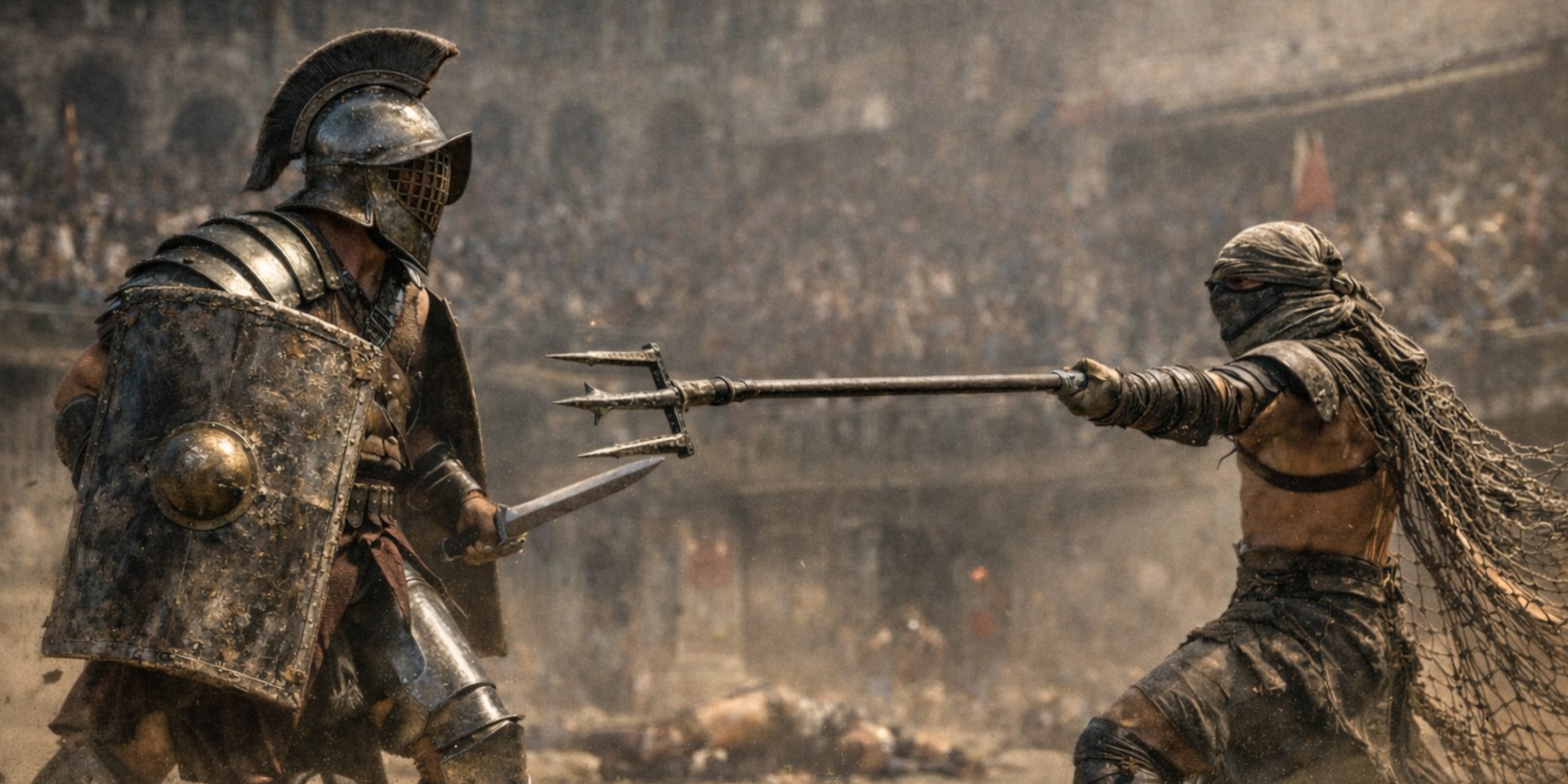
Gladiators were not simply armed men pushed into an arena and told to get on with it. Roman organisers paired fighters carefully. Their weapons, armour and fighting styles were designed to create a contest that was dramatic, recognisable and occasionally absurd. One man might arrive carrying a heavy shield and short sword, while his opponent wandered in with a fishing net and trident. It sounds like the result of a particularly unhinged tavern bet, but to the Romans it made perfect sense.
Why Gladiators Used Different Weapons and Styles
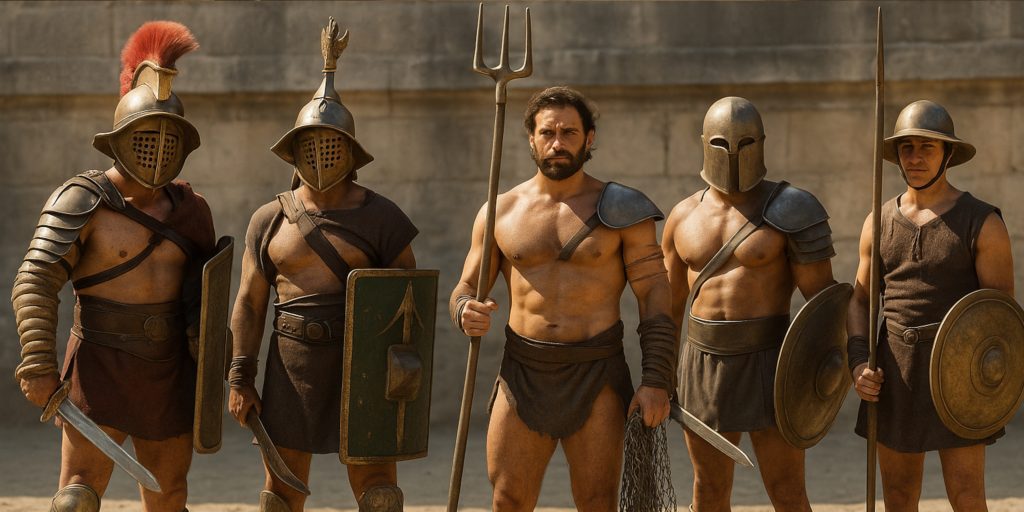
Roman gladiatorial combat was built around contrast. Promoters wanted two fighters whose equipment and methods balanced each other.
A heavily armoured gladiator with a large shield might face a lighter opponent with speed and reach. A man with a net and trident would be matched against someone with a helmet that restricted his vision. The aim was not fairness in the modern sense. The aim was spectacle.
Most gladiators trained in specialist schools called ludi. Within these schools they learned one specific fighting style and rarely changed it. A murmillo trained as a murmillo. A retiarius trained as a retiarius. Switching styles would have been rather like asking a heavyweight boxer to suddenly compete as a fencer.
The different gladiator classes also reflected Rome’s fascination with conquered peoples. Some types borrowed the names, weapons and supposed appearance of enemies Rome had defeated. Thracians, Gauls and Samnites all ended up transformed into arena caricatures. It was Rome’s way of turning military victory into entertainment, which says quite a lot about Roman society and perhaps rather less than flattering things about its hobbies.
Gladiator Timeline
| Period | Development |
|---|---|
| 3rd century BC | Earliest gladiatorial combats appear in Italy, probably influenced by funerary rites in Campania and Etruria. |
| 264 BC | First recorded gladiatorial games held in Rome at the funeral of Junius Brutus Pera. |
| 2nd century BC | Formal gladiator schools begin to appear and combat styles become more specialised. |
| 1st century BC | Classic gladiator types such as the murmillo, Thraex and retiarius become common. |
| AD 73-71 | Spartacus leads the most famous gladiator revolt. |
| 1st-2nd century AD | Gladiatorial combat reaches its height across the Roman Empire. |
| 3rd century AD | Fewer games are held as the empire faces economic and political crises. |
| AD 404 | Traditional story claims the monk Telemachus is killed trying to stop a gladiatorial fight. |
| 5th century AD | Gladiatorial combat largely disappears in the Western Roman Empire. |
Murmillo
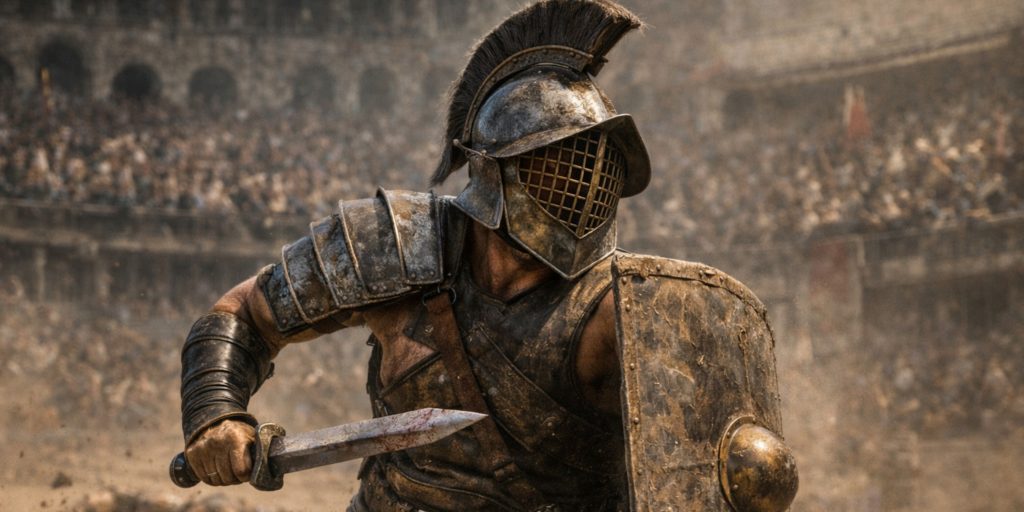
The murmillo was one of the most common and recognisable gladiator types.
He carried:
- A large rectangular shield (scutum)
- A short sword (gladius)
- A heavy helmet with a broad brim and fish-shaped crest
- A padded sleeve and greave on one leg
The murmillo fought as a slow, heavily protected warrior. He relied on advancing steadily behind his shield and waiting for the right moment to strike with the gladius.
His most common opponents were the Thraex and the hoplomachus. Both were faster and more lightly equipped, which made the match far more interesting than two men spending ten minutes hiding behind identical shields.
Murmillo Tactics
- Stay protected behind the shield
- Force the opponent backwards
- Tire out lighter gladiators
- Use short, controlled thrusts rather than wild swings
Contemporary writers often described the murmillo as powerful but rather predictable. One can imagine the crowd appreciating him in the same way modern fans admire a dependable centre-back. Effective, intimidating and not especially graceful.
Thraex
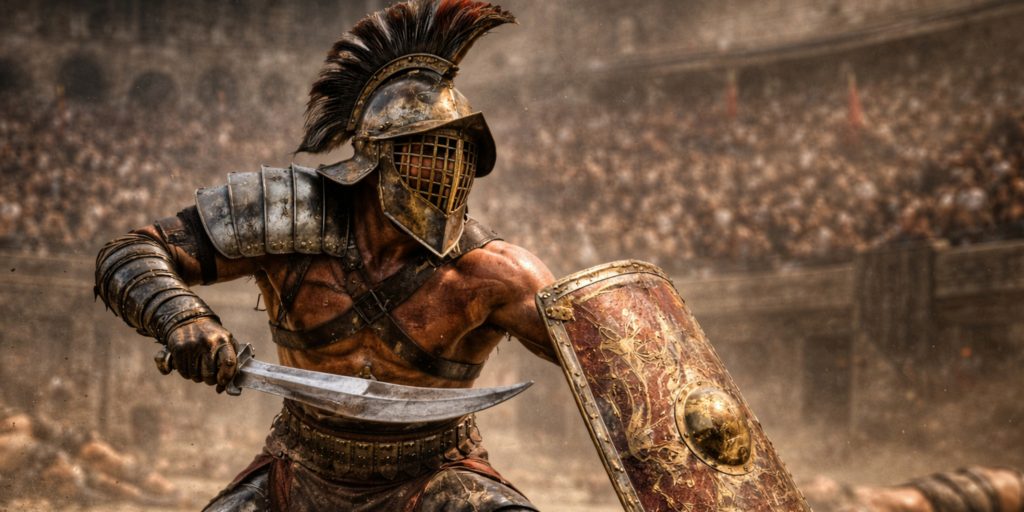
The Thraex, or Thracian gladiator, was based loosely on Rome’s old enemies from Thrace.
He carried:
- A small square or circular shield
- A curved sword called a sica
- High greaves on both legs
- A decorated helmet with a griffin crest
The sica was the Thraex’s most distinctive weapon. Its curved blade allowed him to reach around the edge of an opponent’s shield. Against a murmillo with a large scutum, this could be extremely useful.
Thraex Tactics
- Attack quickly from the side
- Use footwork to avoid direct clashes
- Hook strikes around the shield with the sica
- Aim for exposed legs and arms
The Thraex often appeared more agile and theatrical than the murmillo. Ancient mosaics and reliefs regularly show Thracian gladiators in dramatic poses, perhaps because the Romans appreciated a little style with their attempted homicide.
Hoplomachus
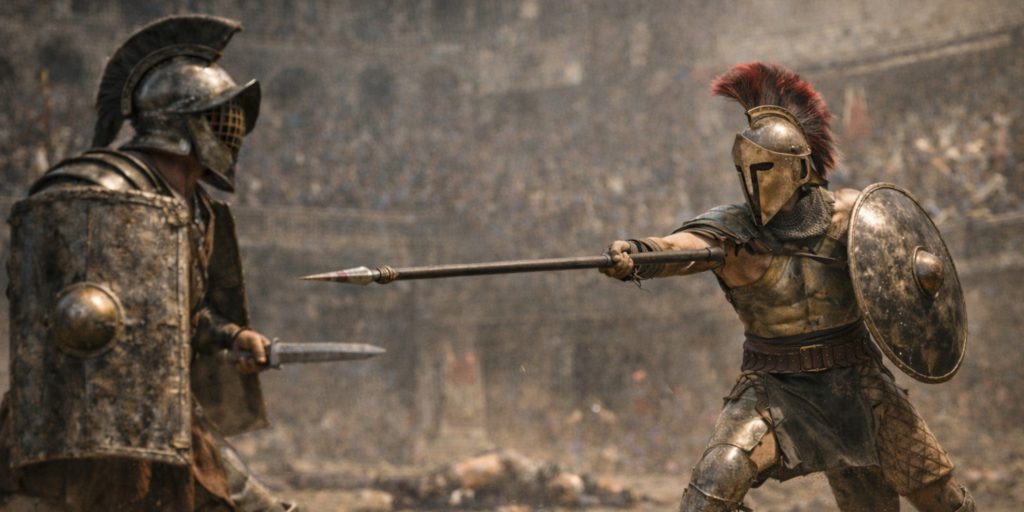
The hoplomachus was designed to resemble a Greek hoplite.
He carried:
- A spear
- A short sword as a backup weapon
- A small round shield
- Heavy greaves and helmet
The spear gave the hoplomachus greater reach than most gladiators. He tried to keep his opponent at a distance and use the point of the spear to control the fight.
If the spear was broken or lost, he switched to his sword. At that point he often found himself in a much less comfortable situation.
Hoplomachus Tactics
- Use reach to keep the opponent away
- Strike quickly with the spear
- Retreat and reposition constantly
- Switch to sword only if necessary
Retiarius
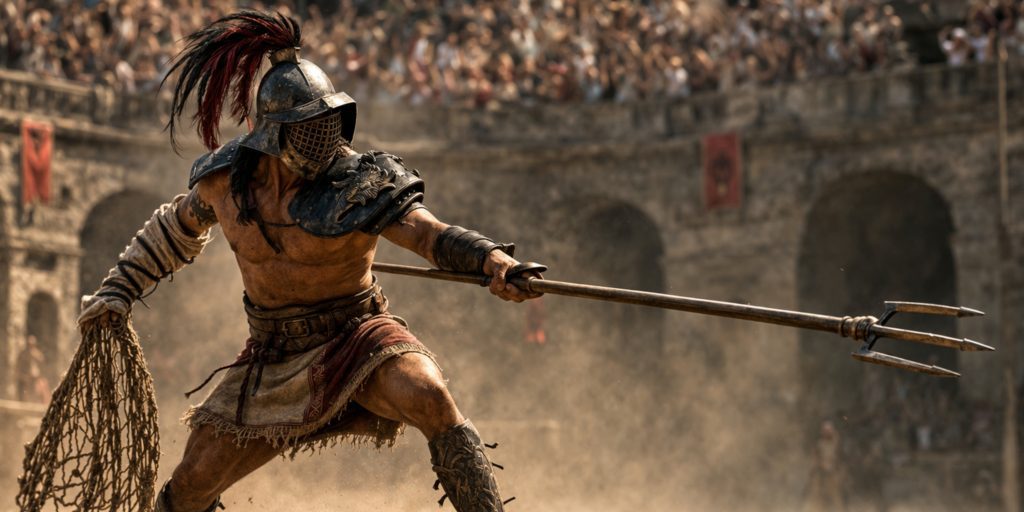
The retiarius is perhaps the strangest gladiator type and certainly the easiest to recognise.
He carried:
- A weighted net
- A trident
- A dagger
- Minimal armour, usually only a shoulder guard called a galerus
Unlike most gladiators, the retiarius wore no helmet. He relied on speed and visibility rather than protection.
The retiarius usually fought a secutor. This was one of the most famous pairings in the arena. The retiarius tried to entangle his opponent with the net, stab from a distance with the trident and stay out of reach.
Retiarius Tactics
- Circle constantly
- Throw the net at the right moment
- Keep distance with the trident
- Use speed rather than strength
A good retiarius could make a secutor look clumsy and exhausted. A bad retiarius probably spent the afternoon wondering why he had chosen a career involving a fishing net and an angry man with a sword.
Secutor
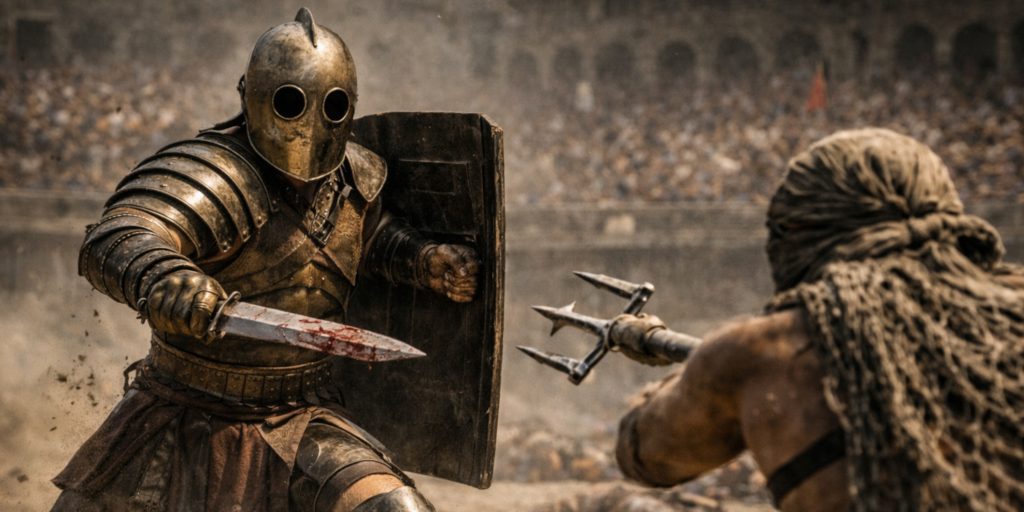
The secutor existed almost entirely to fight the retiarius.
He carried:
- A large shield
- A gladius
- A smooth, rounded helmet with very small eye holes
The helmet was specifically designed so that the retiarius could not easily catch it in his net. Unfortunately, the tiny eye holes also made it difficult to see and rather warm to wear. One suspects secutors developed strong opinions about ventilation.
Secutor Tactics
- Close the distance quickly
- Corner the retiarius
- Avoid becoming tangled in the net
- Finish the fight at close range
The secutor versus retiarius match was one of the most popular in Roman arenas because it created a very clear contrast between strength and speed.
Provocator
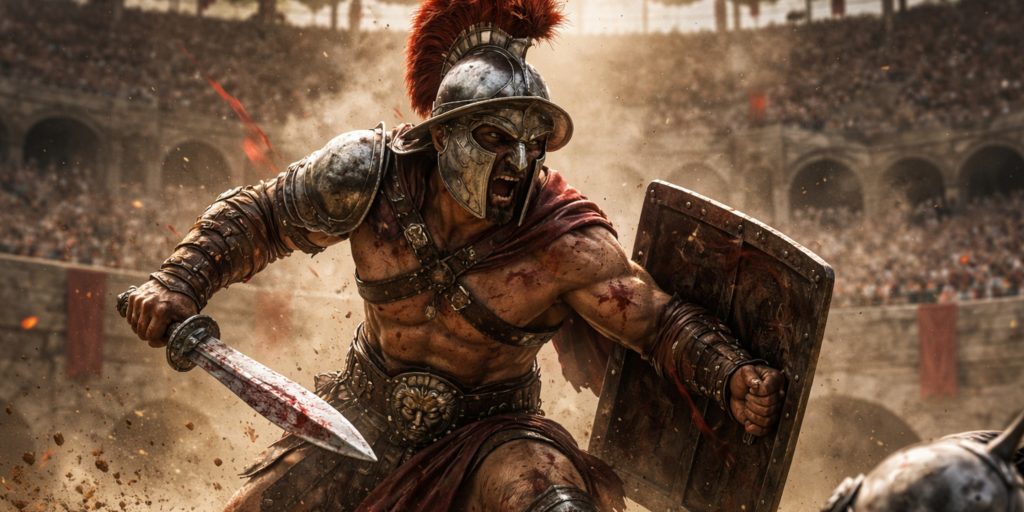
The provocator was unusual because he often fought another provocator.
He carried:
- A rectangular shield
- A gladius
- A breastplate
- A plain helmet
This style looked closer to an actual Roman soldier than many other gladiator types.
Because both fighters were armed in the same way, provocator contests relied on endurance, discipline and skill rather than exotic equipment.
Dimachaerus
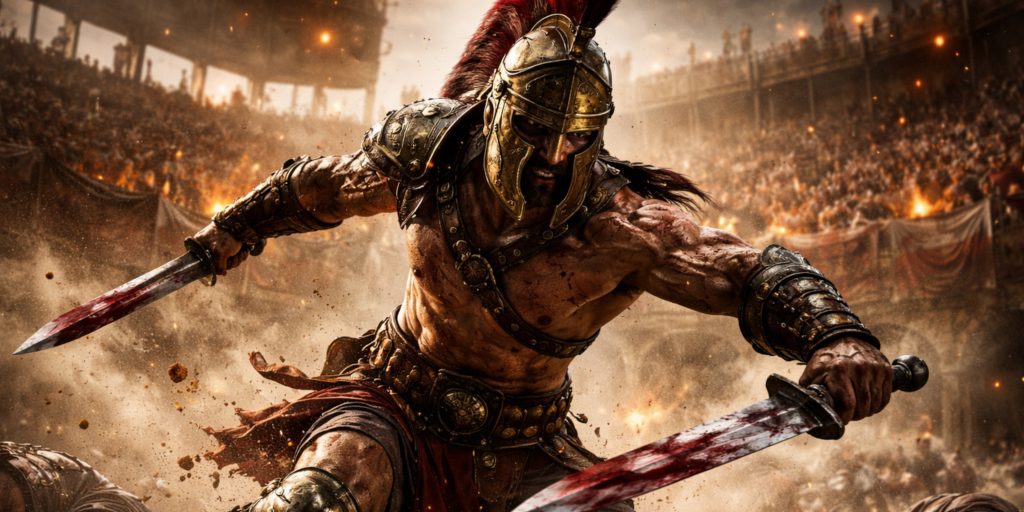
The dimachaerus fought with two swords and no shield.
This gladiator type remains rather mysterious because ancient sources are limited. Reliefs suggest that he used a pair of short swords or curved blades.
Dimachaerus Tactics
- Attack rapidly from both sides
- Keep the opponent under pressure
- Avoid being trapped against a shield
The style must have looked impressive, although one imagines it also carried a slightly higher chance of accidentally hitting oneself. Roman audiences probably appreciated the risk.
Bestiary and Animal Fighters
Not every arena fighter battled another gladiator. Some fought wild animals.
Bestiarii faced:
- Lions
- Leopards
- Bears
- Wild boars
- Occasionally more exotic creatures such as crocodiles or ostriches
Their weapons varied enormously and could include spears, javelins, whips and short swords.
Animal hunts, known as venationes, were often held before the main gladiatorial combats. They were hugely popular and brutally expensive.
Gladiator Weapons Explained
Gladius
The gladius was the most common gladiator weapon.
- Blade length usually between 45 and 60 cm
- Designed primarily for thrusting
- Used by murmillos, secutors and provocators
The gladius was brutally efficient in close combat. Roman writers repeatedly emphasised that a thrust was deadlier than a slash.
Sica
The sica was a short curved blade used by the Thraex.
- Curved inward near the point
- Excellent for striking around shields
- Usually between 30 and 45 cm long
Trident
The trident was used by the retiarius.
- Long reach
- Could stab or trap an opponent
- Often paired with the net
Net
The retiarius’ net was weighted and designed to entangle an opponent’s legs, shield or weapon.
Contrary to popular belief, it was not usually thrown wildly in the opening seconds. A skilled retiarius waited for the perfect moment.
Spear
The hoplomachus used a spear as his main weapon.
- Longer range than a sword
- Useful for keeping enemies back
- Could be broken or dropped during combat
Gladiator Armour and Protective Equipment
Gladiators wore armour that was deliberately uneven. One fighter might have extensive protection while the other had almost none.
Common pieces included:
- Helmets with decorative crests
- Large or small shields
- Greaves to protect the legs
- Arm guards called manicae
- Thick padding beneath metal armour
The imbalance was deliberate. Roman organisers wanted each type to have strengths and weaknesses.
For example:
| Gladiator | Main Strength | Main Weakness |
| Murmillo | Heavy protection | Slow movement |
| Thraex | Speed and agility | Small shield |
| Retiarius | Reach and mobility | Little armour |
| Secutor | Strong at close range | Limited visibility |
| Hoplomachus | Long reach | Vulnerable if spear lost |
Famous Gladiators
Spartacus
The most famous gladiator of all was Spartacus, a Thracian who escaped from a gladiator school in Capua in 73 BC.
He led a massive slave revolt that terrified Rome for two years. Ancient writers disagree about his exact gladiator type, although many believe he trained as a Thraex.
Flamma
Flamma was a Syrian gladiator who fought 34 times.
According to his tombstone:
- Won 21 fights
- Drew 9 fights
- Lost 4 fights
- Refused freedom four times
Either he loved the arena, disliked paperwork, or realised that retirement in Roman society was perhaps not especially glamorous.
Spiculus
Spiculus became one of the favourites of Emperor Nero. Ancient sources claim Nero rewarded him with property and wealth.
Contemporary Quotes
“He was trained for the arena, but born for war.” – Plutarch, writing about Spartacus
“The wound made by a thrust is deeper and more dangerous.” – Vegetius
“The crowd demands that the vanquished should be slain.” – Seneca
Seneca, who generally regarded gladiatorial games with horror, left some of the most vivid descriptions of the arena. He complained that the spectators grew more savage as the day went on. Given some of the surviving accounts, he had a point.
Archaeology and Evidence
Modern archaeology has revealed a surprising amount about gladiators.
Important discoveries include:
- Gladiator barracks at Pompeii
- The amphitheatre at Capua
- Helmets and armour from Pompeii and Herculaneum
- A gladiator cemetery at York in Britain
- Reliefs and mosaics showing different gladiator types
The cemetery discovered in York was particularly remarkable. Several skeletons showed evidence of violent injuries, including decapitation and animal bites. One individual appears to have been attacked by a large cat. This is the sort of evidence that makes Roman entertainment seem rather less glamorous and rather more alarming.
Archaeologists have also found:
- Bronze helmets with elaborate crests
- Tridents and fragments of nets
- Training weapons made of wood
- Graffiti praising famous gladiators
One Pompeian graffito proudly described a gladiator as “the sigh of all the girls”, proving that Roman celebrity culture was alive and well long before social media and considerably more dangerous.
Where Gladiators Fought
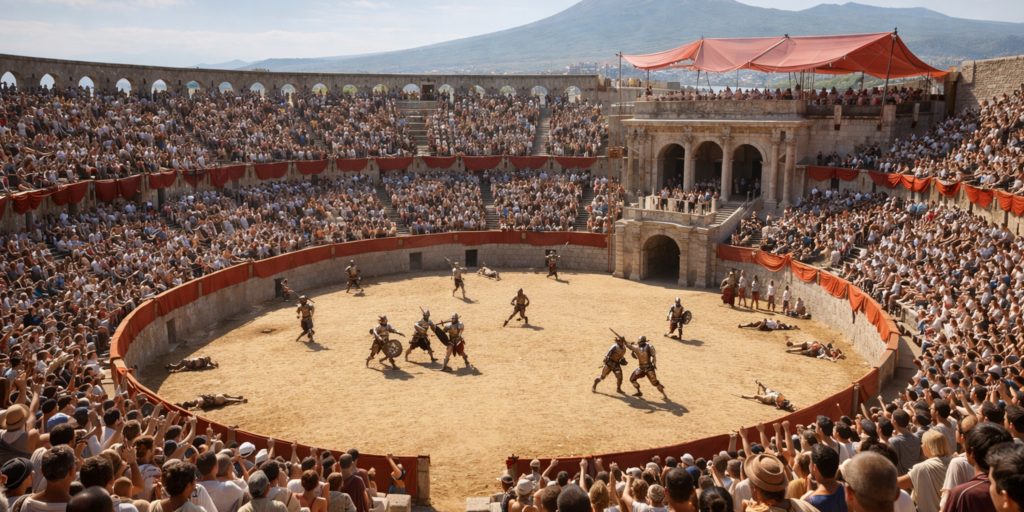
Gladiatorial games were held across the Roman Empire.
Important arenas included:
- The Colosseum in Rome
- The amphitheatre at Capua
- The arena at Pompeii
- Amphitheatres in Nîmes, Arles and Verona
- Roman arenas in Britain, North Africa and the Near East
The Colosseum in Rome remained the greatest and most famous arena of them all. At its height it could hold tens of thousands of spectators.
The Reality Behind the Spectacle
Popular films often present gladiatorial combat as constant slaughter. The truth was slightly different.
Gladiators were expensive to train and maintain. Owners did not want skilled fighters dying unnecessarily. Many matches ended when one gladiator surrendered and the organiser or crowd decided his fate.
Some gladiators survived for years and became celebrities. They earned prize money, admirers and occasionally freedom.
Even so, the arena remained an exceptionally dangerous place. A fighter could lose through exhaustion, injury, bad luck or simply because his opponent had chosen that day to be annoyingly competent.
Seven Swords Takeaway
Roman gladiators were not identical warriors in generic helmets. Each style had its own weapons, tactics and personality.
The murmillo fought with discipline and strength. The Thraex relied on speed and cunning. The retiarius danced around the arena with a net and trident, looking faintly ridiculous until suddenly he did not.
That contrast is what made gladiatorial combat so memorable. Rome turned warfare into theatre, and in doing so created one of the strangest forms of entertainment in history. It was brutal, carefully choreographed and often bizarre. The Romans would probably have called that a successful afternoon.