Few objects have carved themselves into language quite like the sword. Kings waved them, soldiers relied on them, priests blessed them and nervous noblemen used them to point vaguely at maps while discussing catastrophically bad military plans.
For centuries the sword sat at the centre of power, status and survival. It is hardly surprising that it also slipped into everyday speech. Even now, long after most of us stopped carrying a longsword to the shops, we still talk about crossing swords with rivals, falling on our sword, or having a double-edged problem.
Some of these sayings come straight from battlefields. Others emerged from law courts, duels, sermons and old literature. A few have become so familiar that people use them without realising they began life with a sharpened piece of steel in somebody’s hand.
Why Swords Left Such a Mark on Language
For most of recorded history, swords were more than weapons. They were badges of rank, family heirlooms and symbols of justice. In medieval Europe, a sword could mark the difference between a knight and an ordinary infantryman. In ancient Rome, the sword represented military authority. In Japan, the sword was bound tightly to the identity of the samurai.
Because swords carried so much meaning, people naturally used them in proverbs and sayings. A sword could symbolise honour, violence, risk, revenge, courage or stupidity, sometimes all at once.
The language survived because the ideas still make sense. A difficult decision can still be a double-edged sword. Two rivals can still cross swords. Someone forced to accept blame may still fall on their sword, even if the nearest blade is the one in the kitchen drawer.
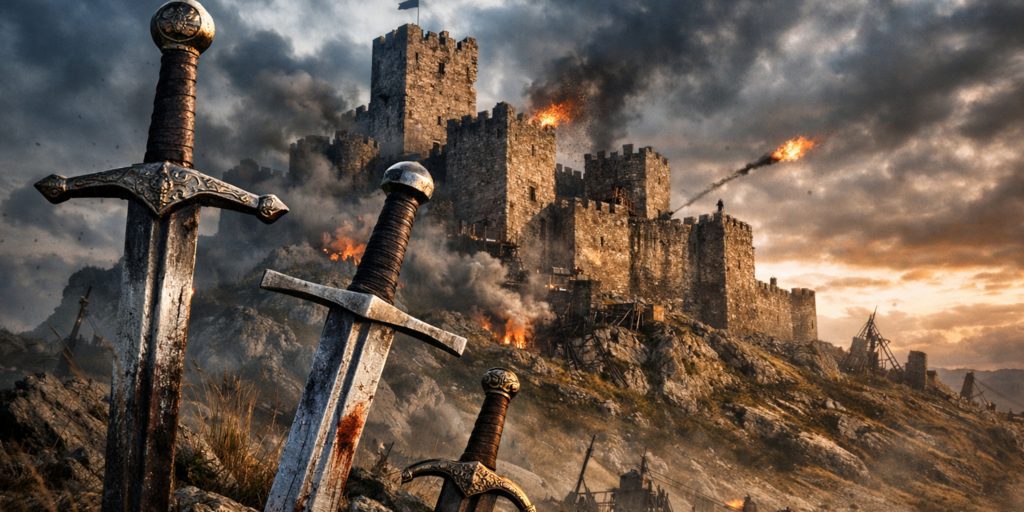
“Live by the Sword, Die by the Sword”
This is perhaps the most famous sword-related saying in English.
The phrase comes from the Bible, specifically the Gospel of Matthew. During the arrest of Jesus, one of his followers draws a sword. Jesus responds:
“All they that take the sword shall perish with the sword.”
The line appears in Matthew 26:52 and became a warning against violence and vengeance. By the medieval period it was quoted regularly by priests and chroniclers.
The meaning is straightforward. Those who rely on violence often meet a violent end themselves.
The phrase was later applied to famous warriors and rulers. Medieval writers used it for figures such as Richard III and the more bloodthirsty crusader princes, usually with the quiet satisfaction of someone who had spent several pages disapproving of them already.
“Cross Swords”
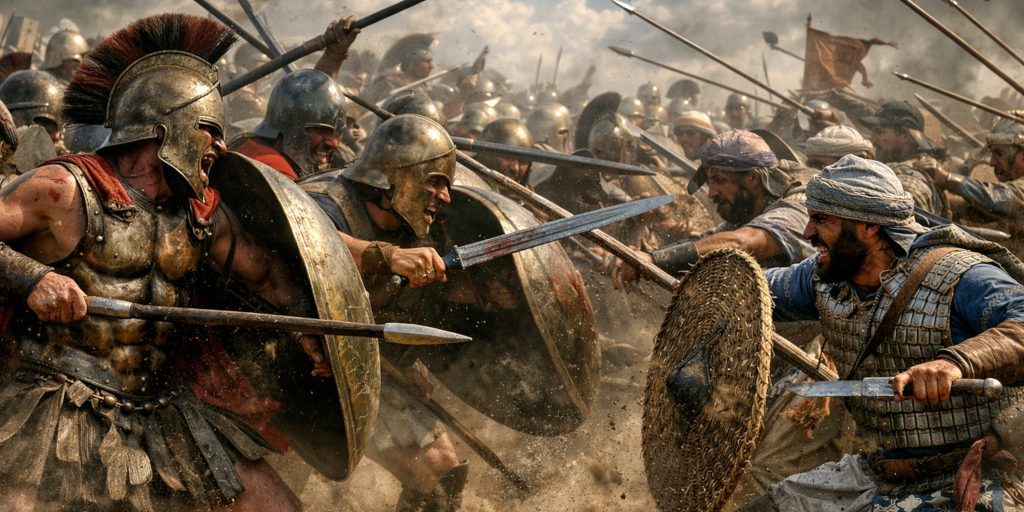
To cross swords with someone means to argue, fight or oppose them.
The phrase comes directly from sword fighting. When two blades met in combat they literally crossed. The expression appears in English from the seventeenth century and quickly gained a wider meaning.
By the eighteenth and nineteenth centuries, writers used it for political arguments and verbal clashes as often as actual duels.
A Victorian newspaper might describe two MPs as crossing swords in Parliament. Mercifully, by then this usually involved shouting and poor temper rather than anyone reaching under the benches for a rapier.
“Double-Edged Sword”
A double-edged sword is something that has both benefits and drawbacks.
The image comes from swords sharpened on both sides of the blade. Such weapons could cut in either direction, making them powerful but also dangerous to the person using them.
The phrase appears in English religious writing as early as the fifteenth century. The Bible also refers to the “two-edged sword” as a symbol of judgement and power.
Today it is used for almost everything.
- Social media is a double-edged sword.
- Fame is a double-edged sword.
- Giving your younger brother a sword in a medieval chronicle is almost certainly a double-edged sword.
“Put to the Sword”
To be put to the sword means to be killed, usually in large numbers.
The phrase comes from warfare in the ancient and medieval world. After a city was captured, particularly after resisting a siege, the defenders and sometimes the civilian population could be massacred.
Chroniclers frequently wrote that a town was “put to the sword” after falling.
The phrase appears throughout accounts of the Crusades, the Mongol invasions and the wars of the ancient Near East.
Sieges and the Origins of Sword Sayings
Many sword sayings were sharpened during sieges.
When medieval or ancient cities resisted too long, the attackers often threatened to put the inhabitants to the sword. It was not merely colourful language. It was policy.
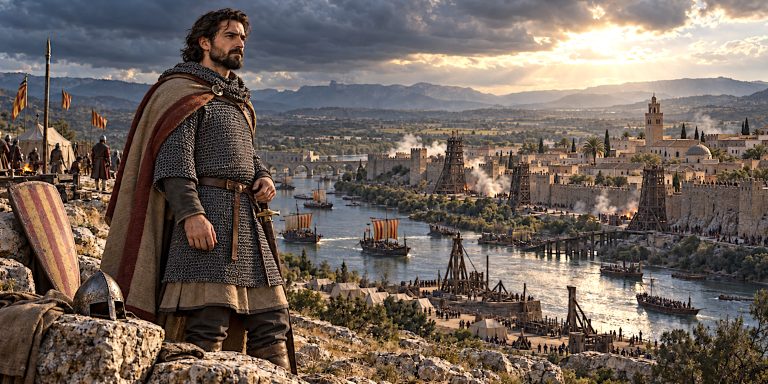
At the siege of Jerusalem in 1099, contemporary chroniclers described the city being taken and large numbers of its defenders and inhabitants put to the sword.
Siege of Jerusalem (1099) became one of the most famous examples because writers across Europe repeated the phrase for centuries.
The same wording appears after the fall of Siege of Béziers (1209) and during the Mongol capture of cities across Eastern Europe and the Middle East.
These sieges left a mark on language because they made sword imagery brutally memorable. When medieval people heard that a city had been put to the sword, they knew precisely what it meant. There was no room for misunderstanding, only for grim imagination.
“Fall on Your Sword”
To fall on your sword means to accept blame or resign honourably.
The phrase comes from the ancient practice of suicide by sword, especially in Roman and Japanese tradition. Roman generals who faced disgrace sometimes killed themselves rather than be captured or publicly humiliated.
The classic example is Marcus Junius Brutus after the Battle of Philippi. Medieval and early modern writers also admired the idea of a defeated nobleman falling on his sword rather than surrendering.
In modern politics, nobody actually expects a minister to perform this literally. One would hope not, anyway. They merely resign with a serious expression and perhaps an unusually heartfelt statement about taking responsibility.
“The Sword of Damocles”
The Sword of Damocles refers to an ever-present danger hanging over someone.
The story comes from ancient Greece. Damocles, a courtier, envied the power of the ruler Dionysius. To teach him a lesson, Dionysius allowed Damocles to sit in his place at a lavish banquet. Above him hung a sword suspended by a single horsehair.
The point was clear. Power and privilege often come with danger.
The phrase became especially popular in the nineteenth and twentieth centuries and still appears in journalism and politics.
Dionysius II may not have expected his little morality tale to survive for more than two thousand years, though one suspects he would have appreciated the drama of it.
“At Sword’s Point”
Something done at sword’s point is done by force or under threat.
The phrase comes from warfare and military occupation. A population might be ruled at sword’s point, meaning it obeyed only because soldiers stood nearby with weapons.
It appears often in accounts of conquest, particularly in Ireland, Scotland and continental Europe during the Middle Ages.
Writers used it to describe lands occupied unwillingly, taxes collected under pressure and treaties accepted with a large quantity of steel nearby.
“Take Up the Sword”
To take up the sword means to begin a struggle or enter a conflict.
The phrase has biblical and military roots. In older texts, to take up the sword often meant joining a rebellion or preparing for war.
The expression later broadened to include political causes and moral campaigns. A reformer might take up the sword against corruption. A writer might take up the sword in defence of tradition.
Thankfully, this usually involves articles and speeches rather than chainmail.
“The Pen Is Mightier Than the Sword”
This saying is technically about the sword rather than from it, but it remains one of the best-known examples.
The phrase comes from the nineteenth-century writer Edward Bulwer-Lytton in his play Richelieu.
“The pen is mightier than the sword.”
Bulwer-Lytton meant that ideas, words and persuasion often have more power than violence.
The saying became enormously popular and remains slightly irritating to sword enthusiasts, who tend to point out that a sword is still more effective than a biro if someone is charging at you across a muddy field.
Timeline of Sword Sayings in History
Ancient World
- “Sword of Damocles” emerges from Greek literature.
- “Fall on your sword” develops from Roman military tradition.
- “Put to the sword” appears in accounts of warfare in the ancient Near East and Rome.
Early Middle Ages
- Biblical phrases such as “live by the sword” spread through Christian Europe.
- Sword imagery becomes common in sermons and chronicles.
High Middle Ages
- Expressions linked to sieges and crusades become widespread.
- “At sword’s point” and “take up the sword” appear regularly in chronicles.
Early Modern Period
- Duelling culture popularises “cross swords”.
- Political writers begin using sword phrases metaphorically.
Victorian Period
- “The pen is mightier than the sword” enters everyday language.
- Newspapers use sword sayings for debates, scandals and politics.
Modern Day
- Sword sayings survive in politics, journalism, films and sport.
- Most people still understand them despite never having held a sword longer than a bread knife.
Archaeology and the Reality Behind the Sayings
Archaeology has helped explain why sword imagery became so powerful.
Excavations across Europe and the Near East have uncovered swords buried with warriors, broken in ritual deposits or placed in graves as symbols of status.
Battle of Visby has produced some of the clearest evidence. Excavations uncovered the remains of soldiers still wearing weapons and armour, including swords and fragments of blades.
Archaeologists at sites such as Illerup Ådal in Denmark and Nydam Bog in Denmark found hundreds of deliberately bent or broken swords. These were offered to the gods after battle.
Such discoveries show that swords were never seen as ordinary tools. They carried emotional, religious and political meaning. That is why they survived so easily in language.
Even damaged blades could become legends. A broken sword in a grave could inspire a story. A famous sword in a royal treasury could become a symbol of authority. Before long, the language followed.
Contemporary Quotes About Swords
“Gird thy sword upon thy thigh, O most mighty.”
From Psalm 45, frequently quoted in the Middle Ages.
“The sword is the soul of the samurai.”
A traditional Japanese saying reflecting the cultural role of the sword.
“We are but warriors for the working day.”
William Shakespeare often linked swords with honour and conflict throughout his plays.
“The weapons are fair where the cause is just.”
From Roman writer Publius Ovidius Naso, better known as Ovid.
Why These Sayings resonate through time
Sword sayings survive because they remain vivid. A sword is simple, dangerous and symbolic. It captures an idea quickly.
If someone says a decision is a double-edged sword, everyone understands. If two politicians cross swords in a debate, the image still works. If a leader falls on their sword, the phrase carries a sense of honour, guilt and perhaps a touch of theatre.
That may be why these expressions endure while other old sayings quietly rust away.
After all, nobody says “he really grasped the agricultural significance of the flail” when they mean an argument became heated.
The sword, for better or worse, still has the sharper vocabulary.