The French Voltigeurs were not supposed to exist for long. When first introduced under Napoleon Bonaparte, they were intended as a practical adjustment to infantry organisation, not a romanticised elite. Yet they quickly became one of the most recognisable elements of the Grande Armée. Small men, or at least men selected for agility, were pulled from line companies and trained to think faster, move lighter, and fight in a way that unsettled more rigid armies.
Their name, derived from “to vault,” hints at their intended use alongside cavalry. The idea of soldiers springing onto horsebacks mid battle sounds ambitious, even optimistic. In practice, Voltigeurs became something far more important, the flexible screen that shaped the opening moments of combat.
Origins and Organisation
The creation of Voltigeur companies in 1804 reflected a shift in how the French army approached battlefield control. Each infantry battalion typically included a Voltigeur company alongside grenadiers and fusiliers.
Their defining characteristics included:
- Selection for speed and initiative rather than height or brute strength
- Training in open order fighting rather than rigid line formations
- Responsibility for screening, scouting, and harassing enemy troops
They often operated ahead of the main line, breaking up enemy cohesion before the heavier formations advanced. If the line infantry were the hammer, Voltigeurs were the irritation that made the hammer strike cleanly.
Battlefield Role and Tactics
Voltigeurs thrived in loose formations. They used terrain with an instinct that line infantry often lacked, slipping behind hedges, trees, and folds in the ground. Their purpose was rarely decisive in isolation, yet they shaped the tempo of battle.
Typical duties included:
- Engaging enemy skirmishers to gain local superiority
- Disrupting artillery crews and officers
- Masking the advance of main formations
- Exploiting gaps once lines began to falter
At battles such as Battle of Austerlitz and Battle of Wagram, Voltigeurs played a quiet but persistent role. They did not win the battle in the dramatic sense, but they ensured that enemy units never felt entirely secure.
Arms and Armour
Voltigeurs were lightly equipped compared to heavy infantry, though “light” is relative when one considers the full burden of Napoleonic kit.
Primary Weapons
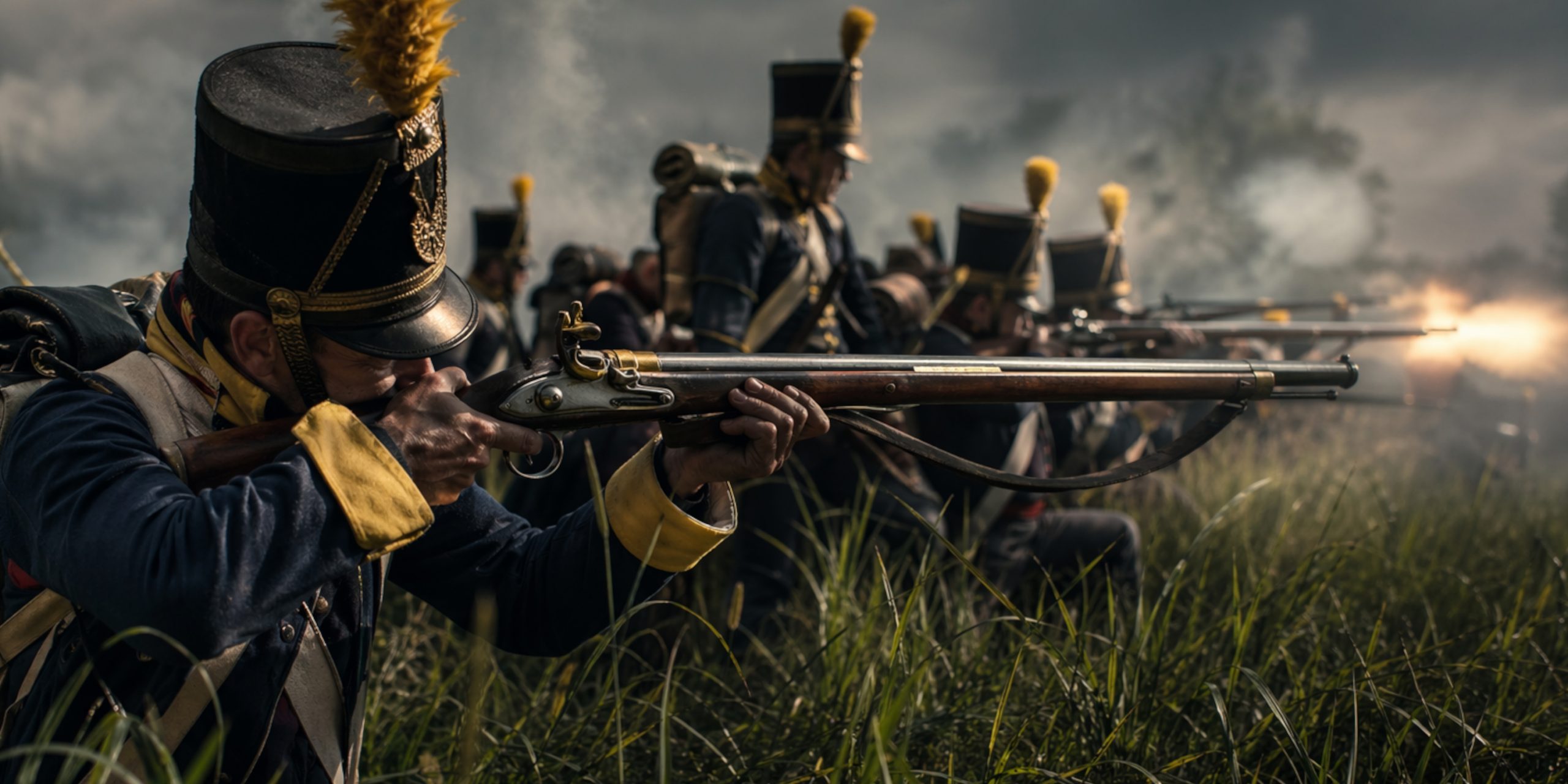
- Charleville Model 1777 musket, the standard French infantry firearm
- Socket bayonet, essential for close combat despite their skirmishing role
Sidearms and Swords
- The briquet sabre, a short, curved infantry sword carried by many soldiers, particularly NCOs
- Some officers carried light sabres with curved blades suited to quick engagement
The briquet is often overlooked, yet it served as a practical tool as much as a weapon. It could clear brush, open crates, or settle matters at close range when firearms became unwieldy.
Uniform and Equipment
- Dark blue coat with distinctive yellow collar and plume
- Shako headgear, often decorated but rarely comfortable
- Cartridge box, haversack, and canteen forming the usual burden
They were not armoured in any meaningful sense. Protection came from movement, cover, and a willingness to avoid standing still when bullets were in the air, which was most of the time.
Training and Discipline
Voltigeurs required a different mindset from line infantry. Independence was encouraged, within reason. A Voltigeur who waited for orders in the middle of a skirmish was missing the point entirely.
Training focused on:
- Marksmanship and rapid firing
- Movement in broken terrain
- Communication through signals and initiative
This flexibility could frustrate officers accustomed to tighter control. Yet when used well, it gave the French army a distinct advantage in the early phases of battle.
Archaeology and Material Evidence
Archaeological work on Napoleonic battlefields has provided a more grounded view of Voltigeur activity. Sites linked to Battle of Waterloo and other engagements reveal patterns that align closely with written accounts.
Finds commonly associated with skirmishers include:
- Scattered musket balls indicating dispersed firing positions
- Uniform buttons and equipment fragments away from main lines
- Evidence of short range engagements near cover such as farms and woods
The distribution of artefacts often shows irregular clusters rather than neat lines, reinforcing the idea of fluid movement rather than static formation. Archaeology, in this case, quietly confirms what the manuals and memoirs describe.
Contemporary Accounts
The voices of the period offer glimpses into how Voltigeurs were perceived by those who fought alongside or against them.
From Jean-Baptiste Antoine Marcellin de Marbot:
“They were everywhere at once, and nowhere long enough to be caught.”
From Baron de Lejeune:
“The Voltigeurs swarmed before the line, a cloud of fire that unsettled the enemy before the storm arrived.”
From Sir Charles Oman:
“The French skirmishers possessed a confidence born of habit, and habit made them formidable.”
There is a consistent theme here. Voltigeurs were less about brute force and more about pressure, the sort that builds quietly until it becomes decisive.
Strengths and Limitations
Voltigeurs were highly effective, though not without their constraints.
Strengths
- Mobility and adaptability
- Ability to disrupt and disorganise
- Strong integration with larger formations
Limitations
- Vulnerable in sustained close combat against formed troops
- Dependent on support from line infantry
- Effectiveness varied with terrain and leadership
They were not a solution to every battlefield problem. Used poorly, they became scattered and ineffective. Used well, they shaped the fight before it properly began.
Legacy
The influence of the Voltigeurs extended beyond the Napoleonic Wars. Their emphasis on skirmishing and flexible tactics foreshadowed later developments in infantry doctrine.
Modern light infantry concepts, with their focus on initiative and dispersed formations, owe something to these early experiments. It is a reminder that military innovation often begins with small adjustments rather than grand reinventions.
Takeaway
The French Voltigeurs occupy an interesting space in military history. They were not elite in the ceremonial sense, nor were they heavily equipped shock troops. Instead, they were practical soldiers shaped by necessity and refined through experience.
Their effectiveness lay in their ability to disrupt, to unsettle, and to create opportunities for others to exploit. It is not the most glamorous role, though it is often the most useful. And as any historian eventually admits, usefulness tends to win wars more reliably than spectacle.