The Battle of Varna sits in that uncomfortable corner of medieval history where bravery and catastrophe become almost impossible to separate. It was supposed to be a triumphant crusade against the expanding Ottoman Empire. Instead, it ended with a dead king, a shattered Christian coalition, and the grim realisation that the Ottomans were not some temporary eastern nuisance that could be brushed aside by noble enthusiasm and a few stirring speeches.
Varna also has one of the great medieval military lessons. If your enemy commander is calm, disciplined, and surrounded by elite bodyguards with long experience of killing heavily armoured knights, perhaps charging directly at him with your royal household cavalry is not the finest idea ever conceived by Christendom.
Yet despite the disaster, the battle remains fascinating. It marked the end of a serious attempt to push the Ottomans out of the Balkans before the fall of Constantinople. Had events gone differently on the Black Sea coast in November 1444, European history might have taken a very different path.
Background to the Battle
By the 1440s, the Ottoman Empire had become the dominant power in the Balkans. Sultan Murad II had defeated and absorbed numerous Christian states while threatening Hungary and the wider Danube frontier.
The Christian coalition opposing him was led by:
- King Władysław III of Poland and Hungary
- The brilliant Hungarian commander John Hunyadi
- Various Hungarian, Polish, Wallachian, Croatian, Bohemian, and Papal contingents
Encouraged by earlier successes during the so-called Long Campaign of 1443, the crusaders believed the Ottomans were vulnerable. Papal diplomats also pushed heavily for renewed war despite an existing peace treaty.
That detail matters. Murad II had actually agreed to peace before the campaign resumed. The crusade therefore carried an awkward air of holy optimism mixed with diplomatic bad faith. Medieval chroniclers naturally framed this differently depending on which side they supported. Funny how that works.
The crusading army marched toward the Black Sea port of Varna, hoping for naval support from Venice and other Christian powers. That support proved inconsistent and inadequate. Murad crossed into Europe regardless.
The trap closed quickly.
Forces at Varna
Crusader Coalition
| Component | Estimated Numbers | Notes |
|---|---|---|
| Hungarian troops | 12,000 to 15,000 | Core heavy cavalry and infantry |
| Polish troops | 4,000 to 6,000 | Included royal household forces |
| Wallachians | 4,000 | Light cavalry under Mircea II |
| Papal and Western volunteers | 1,000 to 2,000 | Knights and mercenaries |
| Total | Roughly 20,000 to 25,000 | Highly mixed coalition |
Ottoman Army
| Component | Estimated Numbers | Notes |
|---|---|---|
| Janissaries | 5,000 to 6,000 | Elite infantry guarding Murad II |
| Sipahi cavalry | 15,000 to 20,000 | Professional feudal cavalry |
| Anatolian troops | 15,000+ | Experienced regional forces |
| Balkan auxiliaries | Several thousand | Vassal contingents |
| Total | Roughly 40,000 to 60,000 | Numerically superior |
Exact numbers remain debated. Medieval chroniclers routinely inflated enemy armies to improve the heroism of survival or the tragedy of defeat. If every medieval source were accurate, Europe would have contained approximately six trillion soldiers by 1450.
Leaders and Commanders
Crusader Command
| Commander | Role | Reputation |
|---|---|---|
| Władysław III | King of Poland and Hungary | Young, courageous, impulsive |
| John Hunyadi | Military commander | One of Europe’s finest generals |
| Cardinal Julian Cesarini | Papal legate | Strong advocate for crusade |
| Mircea II of Wallachia | Cavalry leader | Experienced frontier fighter |
Ottoman Command
| Commander | Role | Reputation |
|---|---|---|
| Murad II | Ottoman Sultan | Calm, disciplined strategist |
| Karaca Pasha | Senior commander | Veteran Ottoman noble |
| Hadım Şehabeddin | Military officer | Experienced field commander |
Arms and Armour
The Battle of Varna showcased the transition between older medieval warfare and increasingly disciplined professional armies.
Crusader Arms and Armour
Weapons
- Longswords
- Arming swords
- Hungarian sabres
- Maces and war hammers
- Poleaxes
- Lances
- Crossbows
- Composite bows
Specific sword types likely included:
- Hungarian-style sabres
- Late medieval knightly longswords
- Arming swords of Central European pattern
Armour
- Full or partial plate armour
- Brigandines
- Mail chausses
- Great helms and bascinets
- Pavise shields for infantry
The Hungarian cavalry in particular had become highly experienced in frontier warfare against Ottoman raiders. Their equipment reflected both western and eastern influences.
Ottoman Arms and Armour
Weapons
- Kilij swords
- Straight double-edged blades
- Composite bows
- Spears and lances
- Maces
- Janissary polearms
The Ottoman composite bow remained one of the deadliest missile weapons in the world at the time. Ottoman cavalry could harass, withdraw, and reform with frightening speed.
Armour
- Lamellar armour
- Mail shirts
- Turbans reinforced with metal caps
- Round shields
- Scale armour for elite troops
Janissaries fought with disciplined cohesion rare in Europe at the time. Their defensive position around Murad II would prove decisive.
The Battlefield at Varna
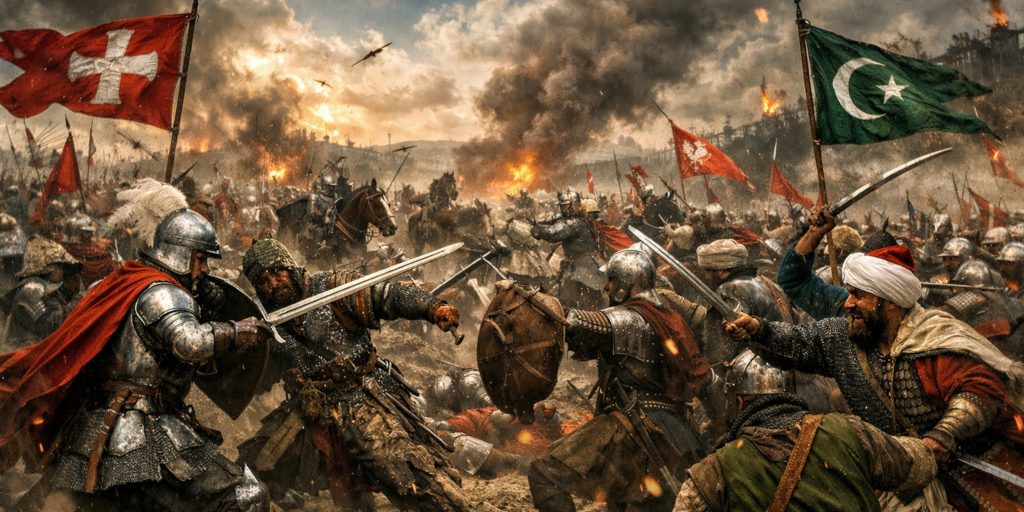
The crusaders found themselves trapped between:
- The Black Sea
- Lake Varna
- Marshy terrain
- Ottoman encirclement
It was not ideal ground for manoeuvre. Hunyadi reportedly recognised the danger immediately.
The crusader army formed a defensive line with wagons and infantry supporting the cavalry wings. The Ottomans deployed in a more traditional crescent formation, with Janissaries entrenched at the centre around the Sultan.
The battlefield itself still carries an eerie atmosphere today. Even modern visitors often remark upon the strange calm of the landscape. Medieval battlefields rarely look dramatic centuries later. They look ordinary. That may be the most unsettling thing about them.
Battle Timeline
Early Morning, 10 November 1444
- Ottoman forces deploy around the crusader position
- Crusader commanders debate strategy
- Hunyadi prepares aggressive cavalry attacks
Mid-Morning
- Crusader right wing launches successful assaults
- Ottoman Anatolian troops suffer heavy pressure
- Wallachian cavalry performs effectively
At this stage, victory genuinely seemed possible.
Midday
- Hunyadi leads attacks against Ottoman flanks
- Several Ottoman units begin falling back
- Murad II remains protected behind Janissary lines
The Ottoman position became unstable in places, but not broken.
Early Afternoon
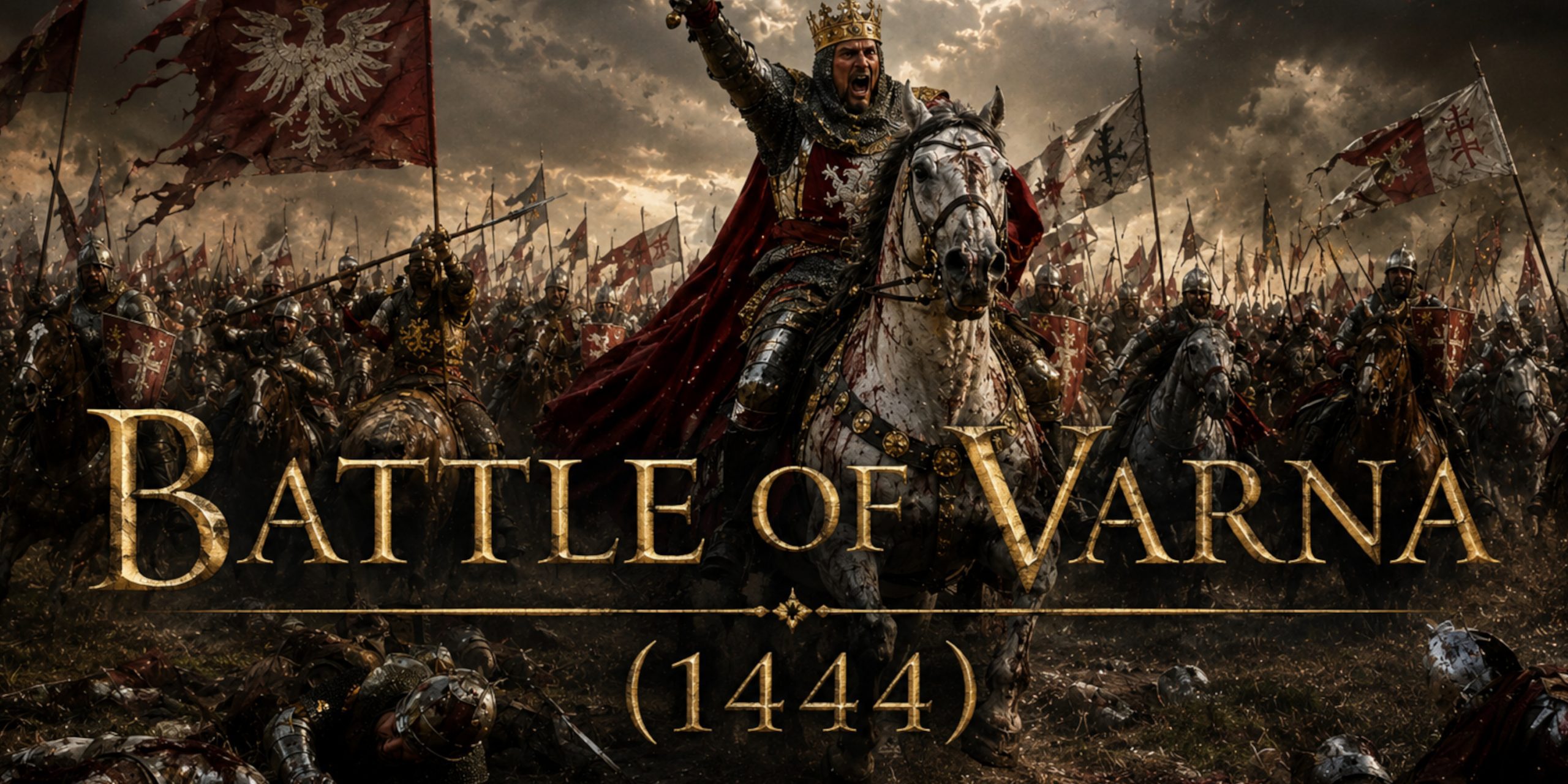
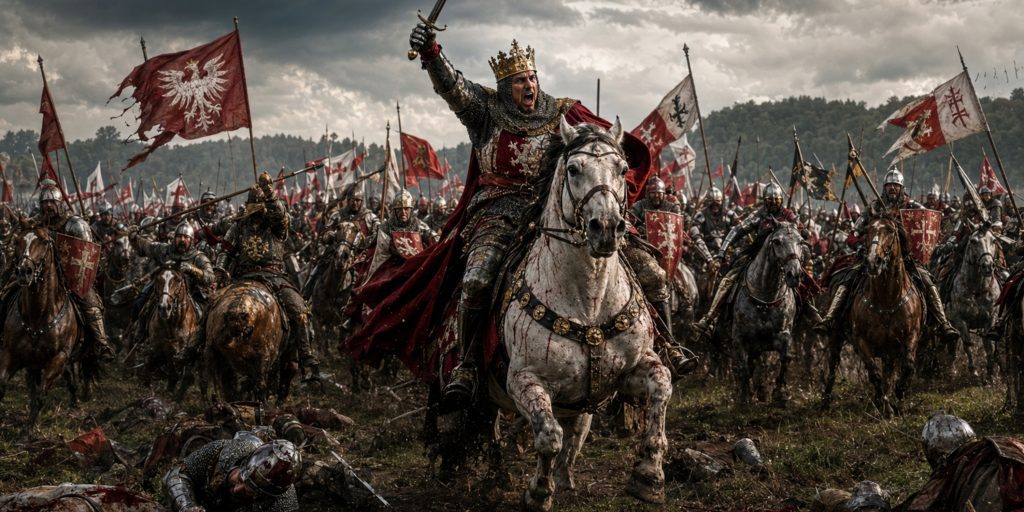
King Władysław III launched a direct cavalry charge toward Murad II.
This became the defining moment of the battle.
Accounts differ slightly, but the general outcome is clear:
- The king charged with roughly 500 elite cavalry
- The Janissaries held formation
- Władysław’s horse was killed or stumbled
- The king was dragged down and killed
His head was reportedly displayed on a spear.
That tends to damage morale.
Late Afternoon
- Crusader cohesion collapsed
- Hunyadi attempted reorganisation
- Ottoman counterattacks overwhelmed surviving forces
- Cardinal Cesarini disappeared during the retreat, likely killed
The crusade ended in complete defeat.
Contemporary Quotes
The Polish chronicler Jan Długosz later wrote:
“The king, driven by youthful ardour, rushed into the midst of the enemy.”
A contemporary Ottoman account praised Murad II’s composure:
“The Sultan stood firm while the unbelievers broke upon his guard.”
Another chronicler described the aftermath bleakly:
“The flower of the Christian host was cut down.”
There is a recurring sadness in accounts of Varna. Even many Christian writers who admired Władysław could not avoid hinting that he had thrown victory away through recklessness.
Archaeology and Modern Research
Archaeological work around Varna has uncovered:
- Arrowheads
- Fragments of armour
- Horse equipment
- Weapon remnants
- Burial evidence
The modern Battle of Varna Memorial Park in Bulgaria preserves parts of the battlefield and includes museum collections connected to the campaign.
Scholars continue debating:
- Exact troop numbers
- Deployment positions
- The precise route of Władysław’s fatal charge
Modern terrain analysis has helped reconstruct likely movement patterns across the marshy battlefield. The confined geography strongly favoured the Ottomans once the crusaders lost cohesion.
Interestingly, no universally accepted grave for Władysław III has ever been identified. Legends emerged for centuries claiming the king survived and wandered Europe in disguise. Medieval Europe adored missing kings almost as much as it adored disastrous crusades.
Why the Ottomans Won
Discipline
The Janissaries held under immense pressure. That discipline changed the course of the battle.
Leadership
Murad II remained composed while the crusader command structure collapsed after Władysław’s death.
Terrain
The crusaders lacked room to manoeuvre effectively once trapped.
Overconfidence
The crusading army underestimated Ottoman resilience and coordination.
The Fatal Charge
The king’s reckless attack transformed a difficult battle into a catastrophe.
Hunyadi reportedly understood this immediately. One can only imagine the language used privately afterward.
Consequences of the Battle
The defeat at Varna had enormous consequences.
Immediate Effects
- Crusader coalition destroyed
- Władysław III killed
- Ottoman dominance in the Balkans reinforced
Long-Term Effects
- Hungary remained under immense pressure
- Christian unity fractured further
- Constantinople became increasingly isolated
Less than a decade later, Constantinople fell to Mehmed II in 1453.
Varna therefore stands as one of the final failed opportunities to halt Ottoman expansion before the Byzantine Empire disappeared entirely.
Legacy of Varna
The Battle of Varna became legendary across both Christian Europe and the Ottoman world.
For Hungarians and Poles, it represented tragic heroism.
For the Ottomans, it confirmed the empire’s growing military superiority.
For historians, it remains a remarkable clash between medieval chivalric warfare and a more disciplined military system built around professional infantry and flexible cavalry tactics.
It also serves as a warning that courage alone does not win battles. Medieval commanders often understood this perfectly well in theory. In practice, however, heavily armoured kings on warhorses occasionally developed ambitious ideas at exactly the wrong moment.
Varna was one of those moments.