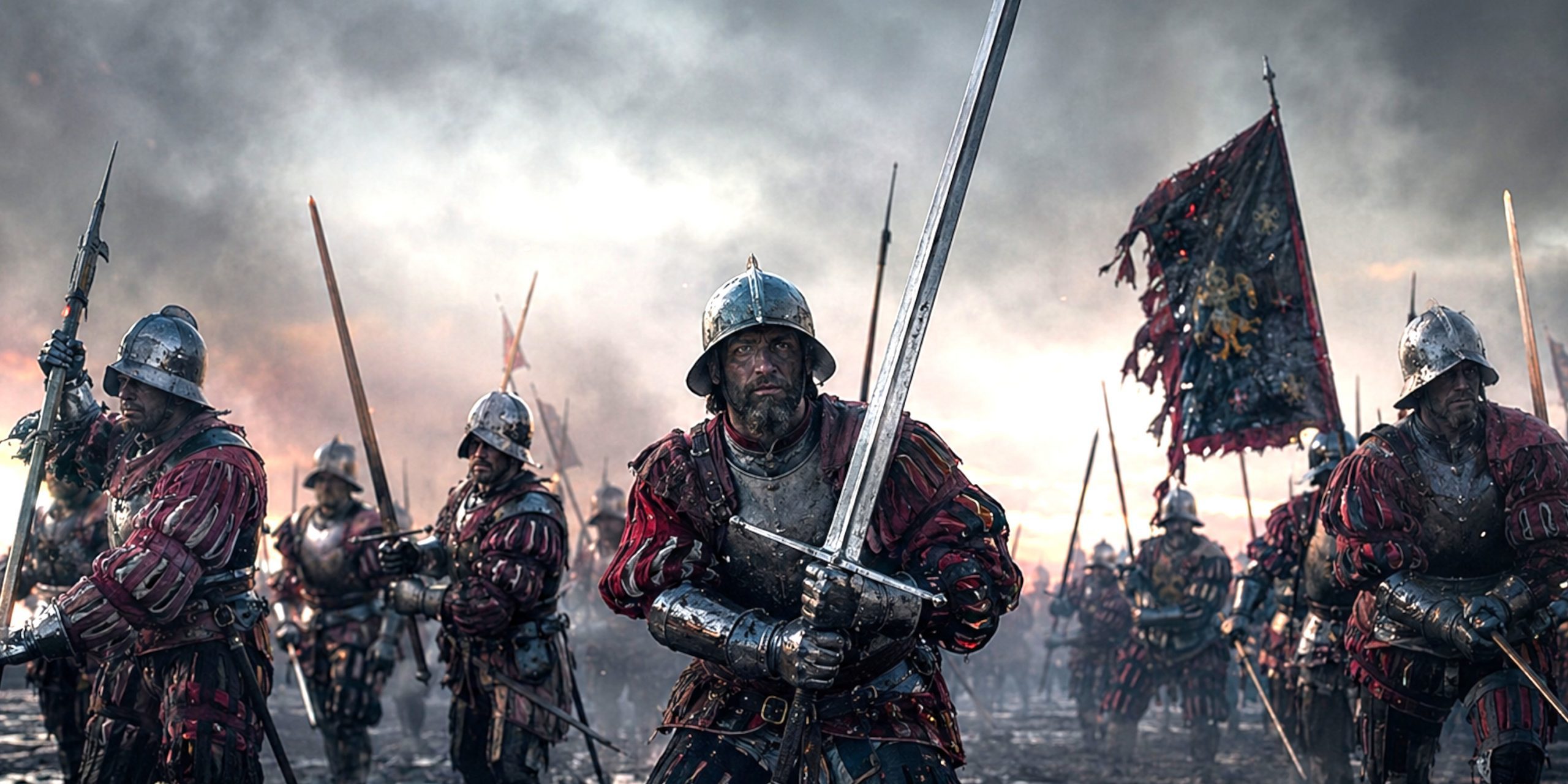
There is something irresistibly dramatic about the Doppelsöldner. Imagine standing in the front rank of an advancing army while carrying a sword nearly as tall as yourself, knowing that your job involved marching directly towards a forest of enemy pikes. It is the sort of profession that would make even the most optimistic career adviser hesitate.
Yet these men were real. They fought in some of Europe’s bloodiest battles during the late fifteenth and sixteenth centuries and became legendary for courage, skill, and, perhaps most importantly, a willingness to take on jobs that few others wanted. Their name literally means “double-pay men”, reflecting the extra wages they received in exchange for exceptional risk.
Although popular culture often exaggerates their role, the Doppelsöldner were genuinely among the most respected soldiers of the Renaissance. They represented the peak of professional infantry warfare during an era when firearms, pikes and enormous swords existed side by side on increasingly lethal battlefields.
What Were the Doppelsöldner?
The Doppelsöldner were elite members of the German Landsknecht mercenary companies.
Rather than forming a separate military unit, they were experienced soldiers within a regiment who received double wages because they accepted particularly dangerous duties. They often occupied the front ranks during battle and were expected to lead assaults, defend standards, storm fortifications and engage enemy pike formations.
Not every veteran automatically became a Doppelsöldner. Contemporary military ordinances suggest that only trusted and capable men earned the designation.
Typical responsibilities included:
- Fighting at the front of advancing formations
- Protecting regimental banners
- Leading assaults against fortified positions
- Breaking enemy pike formations
- Guarding officers
- Carrying especially dangerous weapons
Double pay reflected genuine battlefield value rather than prestige alone.
Origins of the Doppelsöldner
The rise of the Doppelsöldner coincided with dramatic changes in European warfare during the late fifteenth century.
Swiss pikemen had demonstrated that disciplined infantry could defeat heavily armoured knights. German princes responded by creating their own professional infantry force under Emperor Maximilian I.
These soldiers became known as Landsknechts.
Within these formations, certain veterans demonstrated exceptional skill with specialised weapons, particularly enormous two handed swords and halberds. Their willingness to fight in the most exposed positions earned them additional pay.
By the early sixteenth century, the Doppelsöldner had become a recognised part of Landsknecht organisation.
Battlefield Role
The exact tactical role of the Doppelsöldner remains debated among historians.
Older accounts often describe them charging ahead of pike formations, swinging great swords to cut through enemy pikes. It is certainly an exciting image, and artists have embraced it for centuries.
Modern scholarship is more cautious.
Large two handed swords were certainly capable of knocking aside pikes, creating temporary openings and intimidating opponents, but physically chopping through dense ash shafts during combat would have been exceptionally difficult.
Instead, Doppelsöldner probably fulfilled several overlapping roles.
Shock Troops
Veteran soldiers could exploit gaps in enemy formations once opposing pike blocks became disordered.
Bodyguards
Many served near company officers or protected valuable standards.
Assault Specialists
Storming breaches, crossing bridges and attacking fortifications demanded experienced soldiers willing to accept high casualties.
Flexible Infantry
Many also fought with halberds or firearms depending upon battlefield requirements.
The reality was likely far more adaptable than later romantic depictions suggest.
Arms and Armour
The Doppelsöldner used an impressive variety of weapons depending on campaign, employer and battlefield role.
Zweihänder
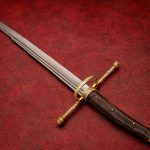
The weapon most closely associated with the Doppelsöldner was the Zweihänder, sometimes called a Bidenhänder.
Specifications:
| Feature | Typical Measurement |
|---|---|
| Overall length | 160 to 180 cm |
| Blade length | 120 to 140 cm |
| Weight | 2.5 to 4 kg |
| Grip | Long enough for two hands |
| Distinctive features | Parrying hooks, long ricasso |
Despite their intimidating size, surviving examples are generally lighter than many people expect.
Katzbalger
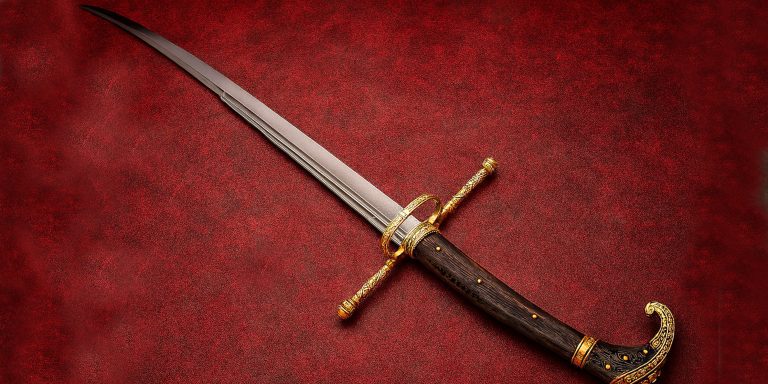
Many Doppelsöldner also carried the famous Katzbalger.
This short sword served as a secondary weapon when close combat became too confined for a great sword.
Characteristics included:
- Broad blade
- Simple construction
- Distinctive S shaped guard
- Excellent cutting ability at close range
Halberd
The halberd remained one of the most practical battlefield weapons.
Its axe blade, spear point and hook made it ideal for fighting armoured opponents and defending standards.
Pike
Although remembered for giant swords, many Doppelsöldner also fought with standard pikes depending upon tactical requirements.
Military organisation valued flexibility over theatrical appearance.
Arquebus
Some elite Landsknechts qualified for double pay because they operated early firearms.
Experienced arquebusiers could receive Doppelsöldner status without ever carrying a great sword.
Armour
Typical equipment included:
- Burgonet or sallet helmet
- Breastplate
- Backplate
- Tassets
- Mail protecting vulnerable joints
- Heavy leather gloves
- Sometimes arm protection
- Occasionally leg armour
Contrary to colourful paintings, many soldiers mixed civilian clothing with military equipment according to wealth and campaign conditions.
Recruitment and Training
No formal academy existed for aspiring Doppelsöldner.
Skill developed through:
- Military experience
- Repeated campaigns
- Weapon practice
- Physical conditioning
- Discipline within Landsknecht companies
Membership often reflected reputation earned under fire.
Many recruits quickly discovered that surviving long enough to collect double wages required considerably more talent than enthusiasm.
Organisation Within the Landsknechts
A Landsknecht regiment usually consisted of several companies under appointed captains.
Within each company:
- Pikemen formed the main body.
- Arquebusiers provided missile support.
- Halberdiers acted as flexible troops.
- Doppelsöldner occupied elite positions.
Their higher wages reflected greater expectations rather than noble birth.
Professional skill mattered more than social class.
Famous Battles
Battle of Bicocca (1522)
Spanish firearms devastated advancing Swiss infantry, illustrating how rapidly battlefield technology was changing.
German Landsknechts fought prominently throughout the engagement.
Battle of Pavia (1525)
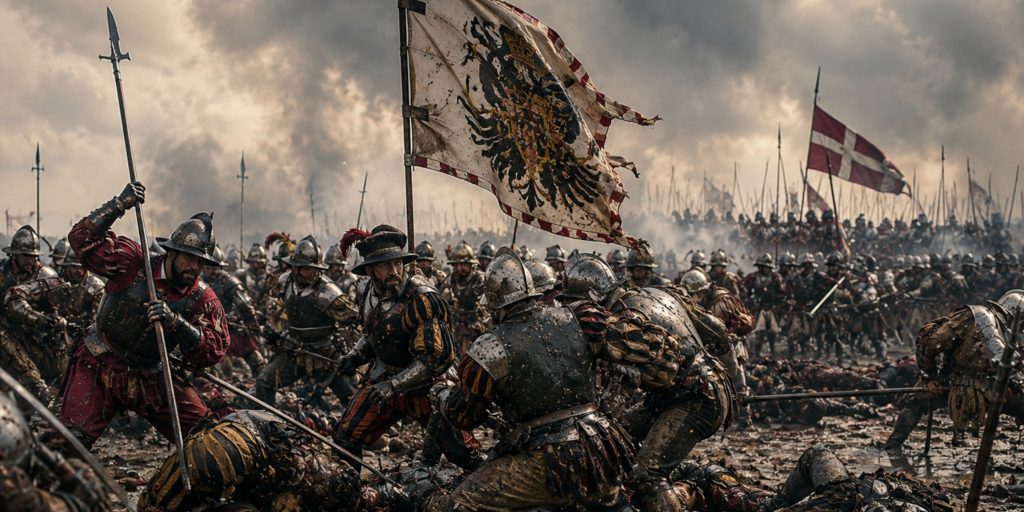
Perhaps the defining battle of Renaissance infantry warfare.
Landsknechts fought on both sides, demonstrating how mercenary service often followed contracts rather than national identity.
The battle confirmed the growing importance of coordinated infantry, firearms and artillery.
Battle of Ceresole (1544)
One of the finest examples of sixteenth century infantry combat.
Landsknechts and Doppelsöldner participated in brutal fighting where pikes, swords and firearms all played significant roles.
Archaeology
Archaeological discoveries continue to improve our understanding of Renaissance mercenary warfare.
Important evidence includes:
- Mass graves from sixteenth century battlefields
- Surviving Zweihänder swords
- Katzbalger examples recovered from river deposits
- Armour fragments
- Pike heads
- Firearms
- Bullet impacts on armour
Battlefield excavations at sites including Pavia and other Renaissance battlefields have revealed large concentrations of lead shot, weapon fragments and skeletal trauma consistent with close infantry combat.
Many surviving Zweihänder swords remain remarkably well preserved in museums across Germany, Austria and Switzerland.
Their balance demonstrates that these weapons were practical fighting tools rather than ceremonial curiosities.
Contemporary Quotes
The Doppelsöldner appear in numerous sixteenth century military writings.
Leonhard Fronsperger, writing in Kriegsbuch (1573), praised disciplined Landsknechts and stressed the value of experienced soldiers capable of maintaining formation under pressure.
Niccolò Machiavelli, although deeply critical of mercenary armies in The Prince, acknowledged the military reputation that German infantry had acquired throughout Europe.
“The infantry of Germany are held to be very formidable.”
Paul Dolnstein, a Landsknecht who produced illustrated accounts of campaigns, left valuable drawings showing soldiers equipped with enormous two handed swords and richly decorated clothing.
These sources reveal admiration for their professionalism while also recognising the dangers and unpredictability of mercenary warfare.
Appearance and Reputation
Few military formations embraced flamboyant fashion quite like the Landsknechts.
Slashed sleeves, brightly coloured clothing, oversized hats and extravagant feathers became part of their identity.
The contrast remains amusing.
These were men carrying weapons capable of splitting helmets while dressed with the confidence of people who had mistaken a battlefield for Renaissance Fashion Week.
Yet their appearance served practical purposes.
Distinctive clothing displayed wealth, confidence and military success while reinforcing company identity.
Decline
By the late sixteenth century, battlefield tactics evolved rapidly.
Firearms became increasingly effective.
Pike formations adapted.
Standing national armies gradually replaced independent mercenary companies.
Large two handed swords remained useful in limited situations but became less important as gunpowder weapons dominated European warfare.
The Doppelsöldner slowly disappeared alongside the military system that had created them.
Legacy
The Doppelsöldner continue to fascinate historians because they represent a unique moment in military history.
They stood at the intersection of medieval and early modern warfare.
Their equipment combined traditional edged weapons with emerging firearms.
Their tactics reflected both discipline and individual courage.
Modern historical European martial arts practitioners continue studying surviving fencing manuals by masters such as Joachim Meyer and Paulus Hector Mair, helping reconstruct techniques for the Zweihänder with increasing accuracy.
While legends sometimes exaggerate their abilities, the historical reality remains impressive enough.
Professional soldiers who willingly accepted the deadliest assignments for double wages hardly require embellishment.
Where to See Doppelsöldner Artefacts
Several museums preserve excellent examples of Doppelsöldner weapons and armour.
| Museum | Country | Highlights |
|---|---|---|
| Germanisches Nationalmuseum | Germany | Landsknecht weapons and armour |
| Kunsthistorisches Museum Vienna | Austria | Renaissance arms and armour |
| Bayerisches Nationalmuseum | Germany | Zweihänder swords and military equipment |
| Royal Armouries, Leeds | United Kingdom | Renaissance European swords and polearms |
| Wallace Collection, London | United Kingdom | Sixteenth century European arms |
Historiography and Modern Debate
Modern historians increasingly challenge older Victorian interpretations that portrayed the Doppelsöldner as solitary sword wielding heroes cutting paths through entire armies.
Researchers such as Sydney Anglo, John Waldman and Keith Roberts argue for a more nuanced understanding based on military manuals, surviving weapons and battlefield evidence.
The consensus today suggests that:
- Two handed swords were specialised battlefield weapons rather than universal issue.
- Doppelsöldner performed multiple tactical roles.
- Discipline mattered more than individual heroics.
- Their reputation reflected genuine military professionalism rather than myth alone.
As so often happens in military history, the truth turns out to be both less theatrical and more interesting.
Takeaway
The Doppelsöldner remain among the most recognisable soldiers of Renaissance Europe because they embodied the changing face of warfare.
They were highly trained professionals who earned greater pay by accepting exceptional danger. Whether wielding a towering Zweihänder, a halberd or an arquebus, they formed an elite within the already formidable Landsknecht armies.
Centuries later, their distinctive clothing, immense swords and reputation for fearless service continue to capture the imagination. Behind the colourful artwork and battlefield legends stood real men whose skill, discipline and willingness to face the worst fighting helped shape the military history of Renaissance Europe.